Amish Custom Kitchen Cabinets vs NYC Craftsmen: Real Differences
Amish custom kitchen cabinets and NYC craftsmen like Green Cabinets NY use the same solid hardwoods and dovetail joinery. The real difference is logistics, lead times, and whether your Brooklyn co-op can handle a delivery truck from Lancaster County.
By Green Cabinets NY Team
Key Takeaways
- Amish cabinets use 100% solid hardwood with dovetail joints and mortise-and-tenon corners but require 10-14 week lead times plus out-of-state coordination.
- NYC makers like Green Cabinets NY match that solid-wood quality while cutting lead times and handling co-op board approvals for tight Brooklyn layouts.
- The US millwork industry hits $37.5 billion in 2025 as urban shops capture share by managing delivery logistics Amish suppliers cannot.
- Specify bamboo for 3-5 year regeneration cycles instead of decades-old hardwoods when sustainability drives your cabinet selection.
Long before Ikea flattened the cabinet industry and big-box stores made stock cabinetry a weekend errand, New York City was supplied by a dense network of immigrant woodworkers. German, Italian, and Eastern European craftsmen who built kitchens by hand in Brooklyn and Queens workshops. That tradition never fully disappeared. Meanwhile, Amish furniture and cabinetry began reaching urban buyers in the 1980s, when antique dealers and design enthusiasts started making the drive to Lancaster County. Today, both traditions compete directly for the same high-end renovation budgets, and the comparison reveals more about values than craftsmanship.
Amish custom kitchen cabinets are built with solid hardwood, hand-joinery, and zero particleboard, but they carry lead times of 10-14 weeks and require out-of-state coordination. NYC custom cabinet makers like Green Cabinets NY match that construction quality while cutting lead times, handling co-op board approvals, and providing in-person consultations for tight Brooklyn layouts. The US millwork industry sits at $37.5 billion in 2025, and a growing share of that budget flows to local shops that can navigate urban delivery logistics that Amish shops simply cannot. Amish cabinets use 100% solid hardwood (oak, maple, hickory, cherry) with dovetail joints and mortise-and-tenon corners, while factory alternatives rely on MDF, particleboard, and staples. Bamboo regenerates in 3-5 years versus decades for hardwoods, making it a genuine sustainability contender for eco-conscious NYC renovations.
The choice between Amish and NYC craftsmen is not really about quality. It is about logistics, accountability, and whether your renovation timeline can absorb a 14-week wait for a truck from Lancaster County.
What Makes Amish Custom Kitchen Cabinets Different
Amish cabinetry has earned its reputation through construction methods that most factory operations abandoned decades ago. The differences start at the material level and extend through every joint in the box.
Amish shops build with solid hardwood throughout. Oak, maple, hickory, and cherry are the standard species. There is no MDF core, no particleboard back panel, no veneer over a composite substrate. The panels are solid wood. The face frames are solid wood. The drawer boxes are solid wood. This is construction designed to last decades, not years.
The joinery tells the real story. Amish builders use dovetail joints for drawer construction and mortise-and-tenon corners for cabinet boxes. These are interlocking mechanical joints that hold tight without relying on adhesives alone. Compare that to factory cabinets, which use staples, brackets, and glue to assemble boxes from particleboard and MDF containing formaldehyde. The Amish approach is slower, more material-intensive, and significantly more durable.
Amish cabinets are frequently described as "designed to outlast your mortgage." That is marketing language, but the underlying construction philosophy supports the claim. A dovetailed drawer joint does not loosen the way a stapled joint does. A mortise-and-tenon corner does not rack the way a bracket-and-screw corner does. The durability gap is real and measurable in years of service life.
The cultural context matters here too. Amish woodworkers operate within communities that prioritize manual craftsmanship over industrial efficiency. This is not a romantic detail. It is a structural reality of how the work gets done. Amish shops typically do not use CNC routers or automated production lines. Cuts are made on table saws and shapers. Joinery is cut by hand or with specialized jigs. This means each cabinet takes more labor hours to produce, which is reflected in both the price and the lead time. The tradeoff is that every cabinet receives individual attention from a single craftsman who is accountable for the final product.
For NYC buyers, the appeal is straightforward. Amish cabinetry represents a quality benchmark. When homeowners research custom kitchen cabinets, the Amish standard is the one they use to evaluate every other option. The question is whether a local NYC shop can meet that same standard while offering the logistical advantages Amish shops cannot.
The research on Amish construction methods confirms what practitioners have observed. According to Valley Kitchen Designs, Amish-built cabinets distinguish themselves through solid wood construction, dovetail joinery, and mortise-and-tenon corners, while factory cabinets rely on MDF, particleboard, staples, and adhesives. Amishwerks echoes this, noting that Amish cabinets are built from solid hardwood and designed for multi-generational longevity. These are not marketing claims. They are descriptions of construction methods that produce measurably different results.
How Do NYC Local Craftsmen Compare?
NYC custom cabinet makers like Green Cabinets NY operate in a fundamentally different environment than Amish shops in Lancaster County. The construction methods can match. The logistics cannot be more different.
The core quality question is whether a Brooklyn-based shop can produce cabinetry built to the same standard as Amish work. The answer is yes, when the shop commits to the same materials and joinery. Green Cabinets NY builds with solid hardwood, uses dovetail joinery for drawers, and constructs cabinet boxes with the same mechanical interlocking joints that define Amish quality. The wood species available include maple, walnut, quartersawn oak, and rustic hickory, matching the species Amish shops use.
Where NYC craftsmen pull ahead is in everything that happens around the cabinetry itself. Amish shops are in rural Pennsylvania, Ohio, and Indiana. They do not visit your Brooklyn brownstone to measure. They do not sit in your kitchen with a tape measure and discuss how the cabinet depth needs to change because your wall is out of plumb by three-quarters of an inch. They do not coordinate with your building's management company or attend a co-op board meeting to explain the installation timeline.
Green Cabinets NY does all of that. The advantage is not in the wood. The advantage is in the service layer that wraps around the wood.
Consider lead times. Amish shops typically run 10-14 weeks from order to delivery, and that assumes no communication delays between the buyer, the dealer, and the shop. A NYC custom cabinet maker can often compress that timeline because the design consultation, measurement, and fabrication happen under one roof with direct client communication. When a measurement needs adjustment, the fabricator hears about it the same day, not through a three-way phone chain.
Then there is the delivery problem. Getting a truck from Lancaster County into Brooklyn means navigating tunnel height restrictions, parking permits, and narrow service elevators. Amish shops ship cabinets on a pallet. NYC shops deliver cabinets piece by piece, carrying them up walk-ups when necessary. This sounds mundane until a delivery arrives and cannot fit through your building's service entrance.
The accountability gap is the factor most buyers underestimate. When an Amish cabinet arrives with a defect or a measurement error, the resolution path is long. The buyer contacts the dealer, the dealer contacts the shop, the shop evaluates whether the issue warrants a remake, and the remake goes back into the production queue. That process can take 4-8 weeks. During that time, your kitchen renovation is stalled. With a NYC shop, the fabricator who built the cabinet is the person standing in your kitchen during installation. If something is wrong, they can cut a replacement part on the spot or fabricate one within days. The difference between a 4-week delay and a 2-day fix is the difference between a renovation that stays on schedule and one that spirals.
There is also the question of design collaboration. Amish shops build cabinets to spec. They do not typically offer design services. The buyer is responsible for the layout, the door style selection, the hardware specification, and the finish choice. This works fine for buyers who have an architect or designer. It does not work for homeowners who need guidance. Green Cabinets NY provides design consultation as part of the process. The team can recommend door styles that complement your home's architecture, suggest wood species that match your flooring, and advise on hardware placement based on how you actually use your kitchen.
Materials, Joinery, and Finish Side by Side
The comparison between Amish and NYC cabinetry comes down to four categories: wood species, joinery method, finish quality, and sustainability credentials. The differences are narrower than most buyers expect.
Wood Species. Both Amish shops and NYC custom makers work with the same hardwoods. Oak, maple, cherry, hickory, and walnut are available from both sources. The US millwork industry, valued at $37.5 billion, sources hardwood from the same regional suppliers. The wood is not different. What differs is the selection process. A NYC shop can show you physical wood samples in your kitchen, under your lighting, next to your countertops. An Amish shop sends samples by mail or relies on a dealer's showroom.
The species selection process deserves more attention than it usually gets. Different hardwoods perform differently in NYC's climate. Maple is dense, takes finish evenly, and resists dents well, making it ideal for high-traffic kitchens. Quartersawn oak is exceptionally stable, meaning it expands and contracts less with humidity changes, which is critical in NYC apartments with steam heat. Walnut offers a rich, dark tone that works in contemporary designs but is softer and shows scratches more easily. Rustic hickory is extremely tough but has dramatic grain variation that not every buyer wants. A local shop can walk you through these tradeoffs with samples in hand. An Amish dealer may understand the characteristics but cannot show you how beech or alder looks next to your specific countertop material under your specific lighting.
Joinery. Amish builders use dovetail joints for drawers and mortise-and-tenon for box construction. NYC custom shops like Green Cabinets NY use the same joinery when clients specify it. The difference is that a NYC shop can show you the joinery in person, explain why dovetail costs more than dowel, and let you make an informed decision. Amish shops offer less flexibility because the construction method is part of their identity.
The mechanics of joinery matter more than most buyers realize. A dovetail joint interlocks mechanically. Even if the glue fails, the joint holds. A dowel joint relies entirely on glue and the friction of the dowel pins. Under repeated stress from drawer opening and closing, a dowel joint can loosen over years. A stapled joint, common in factory cabinets, will fail even sooner. The choice between dovetail and dowel is not aesthetic. It is a decision about how long the drawer will function properly. Amish shops default to dovetail because their tradition demands it. NYC shops offer both and let the client decide based on budget and expected use.
Finish. Amish cabins are typically finished with conversion varnish or catalyzed lacquer, applied in a spray booth. NYC shops use the same finishes. The advantage of a local shop is color matching. If your existing trim has a custom stain, a NYC finisher can match it in person. An Amish shop requires you to mail a sample and hope the match is close.
The finish application process is where environmental conditions play a significant role. Spray booth temperature, humidity, and airflow all affect how the finish cures. A finish applied in a controlled NYC shop environment cures consistently. A finish applied in a rural shop and then transported through varying temperatures and humidity levels during shipping may experience subtle curing variations. These are not dramatic failures. They are the kind of micro-imperfections that show up under close inspection in a sunlit kitchen.
Sustainability. This is where the comparison gets interesting. Amish cabinets use 100% solid hardwood, which is renewable, biodegradable, and recyclable. But solid hardwood takes decades to grow. Bamboo regenerates in 3-5 years, making it a faster-growing alternative. The Forest Stewardship Council certification and KCMA Environmental Stewardship Program certification are the markers to look for, regardless of whether the cabinets come from Lancaster County or Brooklyn.
The sustainability question is more nuanced than "solid wood is good, particleboard is bad." Solid hardwood is renewable and biodegradable, but it takes 40-60 years to grow a mature oak tree. Bamboo regenerates in 3-5 years according to NC State bioresources research, making it a genuinely faster-growing material. However, bamboo cabinetry has its own challenges in NYC. Without proper acclimatization and a robust sealant, bamboo can warp within 12-18 months in a high-humidity bathroom environment. The material is sustainable. The installation must be specified correctly for the climate.
Particleboard and MDF contain formaldehyde, described as a known carcinogen. This is not a minor concern for indoor air quality, especially in small NYC apartments where ventilation is limited. FSC certification ensures that hardwood is harvested from responsibly managed forests. The KCMA Environmental Stewardship Program certifies that cabinet manufacturers meet specific criteria for air quality, resource management, and environmental stewardship. Both Amish shops and NYC custom makers can achieve these certifications, but buyers should ask for documentation rather than assuming.
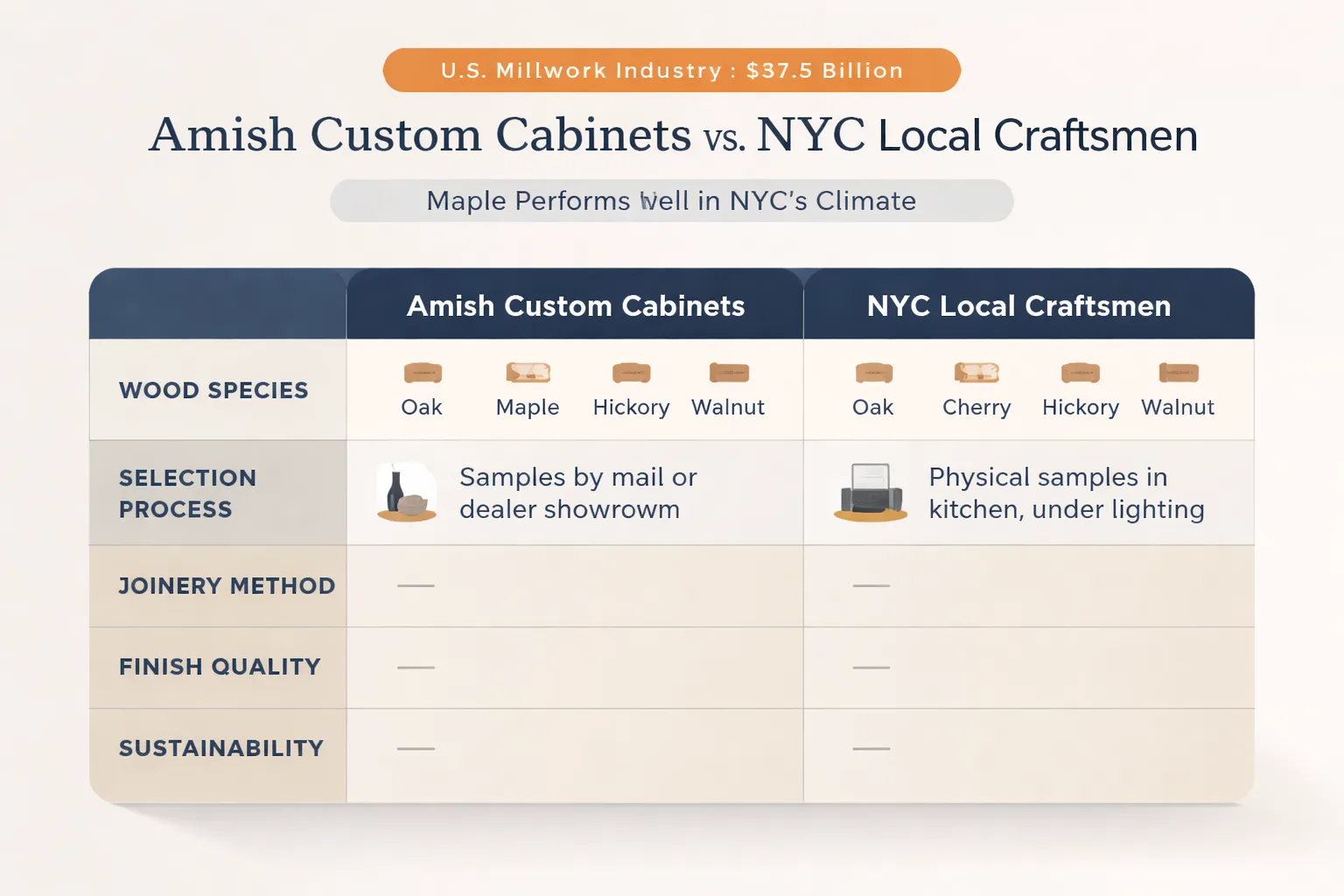
The honest assessment is that Amish shops and quality NYC shops use the same materials and joinery. The differentiator is not the cabinet. It is the process around the cabinet.
Which Option Actually Fits a Brooklyn Kitchen?
Brooklyn kitchens are not average kitchens. The floor plans are irregular. The walls are rarely plumb. The service elevators are small. The co-op boards are demanding. These constraints favor local craftsmen heavily.
Start with the floor plan. A typical Brooklyn galley kitchen might be seven feet wide with a doorway that limits cabinet depth to 24 inches on one side and 18 inches on the other. Stock cabinets cannot handle this. Semi-custom cabinets can get close but leave gaps. Custom cabinets built by a local maker can be sized to the inch, with scribe molding to handle the wall irregularities that every Brooklyn renovation uncovers.
Consider a real scenario. A Brooklyn brownstone kitchen renovation reveals that the back wall is 2 inches out of plumb over 8 feet of run. With stock cabinets, the installer must use filler strips and scribe molding to disguise the taper. The result is visible gaps and a compromised fit. With custom cabinets from a NYC shop, the cabinet boxes are built with a tapered back that matches the wall exactly. The installer slides the cabinet into place and it fits flush. No filler strips. No gaps. This level of customization requires precise on-site measurement and a fabricator who can translate those measurements into a build plan. Amish shops can do this, but only if the measurements they receive are perfect. And measurements taken by a third-party dealer are rarely perfect.
Amish cabinets are custom, but the customization happens remotely. The measurements are taken by a dealer or contractor, sent to the shop, and the cabinets are built to those specs. If the measurements are wrong, or if the wall shifts between measurement and installation, the fix requires shipping the cabinet back to Pennsylvania. A NYC shop measures, builds, and installs. If something is off, the fabricator adjusts on site.
Co-op board approvals are another factor. Many Brooklyn co-ops require detailed renovation plans, contractor insurance certificates, and a project timeline before approving work. Some require a security deposit. Some require that all work be done during specific hours. Some require that the contractor provide a list of references from other buildings in the neighborhood. Green Cabinets NY understands this process because they operate within it every week. Amish dealers may not be familiar with co-op requirements and cannot provide the local references or insurance documentation that boards demand.
The co-op approval process can add 4-8 weeks to a project timeline before any construction begins. During this period, the cabinet design must be finalized so the plans can be submitted. If the board requests changes, the cabinet design may need to be revised. Having a local shop that can quickly revise plans and resubmit is valuable. An Amish dealer operating through a middleman may not be able to respond quickly enough to keep the approval process moving.
Delivery logistics are the hidden killer. A Brooklyn brownstone with a parlor-floor kitchen might require carrying cabinets up two flights of stairs. The stairwell might have a turn that limits cabinet width to 30 inches. Amish shops build standard cabinet widths and ship them fully assembled. If a 36-inch sink base cannot make the turn in your stairwell, you have a problem that requires on-site modification. NYC shops build with the delivery path in mind. They know to build a sink base in two pieces if the stairwell requires it.
The cost for custom kitchen cabinets from a NYC shop is competitive with Amish cabinetry when you factor in the total project cost. Amish cabinets might have a lower unit price, but the added costs of remote measurement errors, shipping, and on-site modifications can erase the savings. Custom kitchen cabinets cost what they cost because of the labor involved. Where that labor happens matters.
For anyone searching "custom kitchen cabinets near me" in Brooklyn or Manhattan, the local advantage is clear. The question is not whether Amish cabinets are good. They are excellent. The question is whether the Amish supply chain can handle your building.
Trying to decide between Amish cabinets and a local NYC custom shop for your kitchen renovation?
How Does Humidity Affect Cabinet Choice?
NYC kitchens and bathrooms operate in a high-humidity environment. Steam radiators, poor ventilation, and the general moisture load of an urban apartment building create conditions that stress cabinetry materials. This is where material selection becomes critical.
Solid hardwood handles humidity well because it can expand and contract naturally. The key is proper acclimatization before installation. Cabinets built in Lancaster County and shipped to Brooklyn arrive in a different humidity zone. They need time to adjust. If installed immediately, the wood can warp or joints can loosen.
Cabinets built locally are acclimatized to NYC conditions during fabrication. The wood is stored and worked in the same humidity zone where it will live. This reduces the risk of post-installation movement.
For bathroom vanities, the humidity challenge is even greater. A steamy NYC bathroom with inadequate ventilation will destroy particleboard and MDF within a few years. Solid hardwood with a proper marine-grade finish will last decades. This is why sustainable bathroom vanities for NYC homes need to be specified with humidity resistance as a primary criterion, not an afterthought.
The finish matters as much as the wood. A catalyzed conversion varnish creates a moisture barrier that standard lacquer does not. NYC shops can specify the finish based on the specific room conditions. Amish shops typically apply a standard finish across all cabinets, regardless of whether they are going into a dry kitchen or a steamy bathroom.
The humidity problem in NYC buildings is not theoretical. Steam radiator heat, common in pre-war buildings, creates dramatic humidity swings. In winter, radiator heat can drop indoor humidity below 20%, causing wood to shrink and joints to gap. In summer, NYC humidity can push indoor moisture levels above 70%, causing wood to swell. This cycle repeats annually and stresses every wood component in the apartment. Cabinets built and acclimatized in the same humidity zone are better prepared to handle these swings. Cabinets shipped from a different climate zone may experience more dramatic movement as they adjust to NYC conditions.
The aggressive cleaning agents common in NYC households add another layer of stress. Many urban homeowners use strong degreasers and disinfectants to combat kitchen grime. These chemicals can strip inadequate sealants and expose the wood beneath to moisture penetration. A high-quality catalyzed conversion varnish resists chemical damage better than standard lacquer or polyurethane. This is a specification that a NYC shop can customize based on the client's cleaning habits. An Amish shop applies a standard finish without knowing how the homeowner maintains the kitchen.
What Does the Custom Cabinet Process Look Like?
Commissioning custom kitchen cabinets in NYC follows a structured process. Understanding the steps helps set expectations and avoids the delays that plague poorly managed renovations.
Step 1: Initial Consultation. Green Cabinets NY meets with the homeowner on site to discuss the project scope, aesthetic preferences, and budget. This is where the conversation about wood species, door style, and finish begins. It is also where a local shop identifies the logistical challenges: stairwell width, elevator dimensions, plumbing locations, and wall conditions.
Step 2: Design and Measurement. Detailed measurements are taken and the cabinet design is finalized. This includes a layout that accounts for appliances, plumbing, and electrical. For NYC renovations, this step also involves coordinating with the contractor and architect to ensure the cabinet design aligns with the overall renovation plan.
Step 3: Material Selection. The client selects wood species, door style, hardware, and finish. Physical samples are reviewed in the actual kitchen space under the actual lighting. This is a step that remote Amish purchasing cannot replicate. Understanding what constitutes a green kitchen unit and how sustainable materials perform in NYC conditions is part of this conversation.
Step 4: Fabrication. Cabinets are built in the shop. Lead times for NYC custom shops typically run 6-10 weeks, depending on project complexity. During fabrication, the shop can provide progress updates and address any questions that arise.
Step 5: Delivery and Installation. Cabinets are delivered and installed by the same team that built them. This is the critical advantage. If a cabinet needs adjustment during installation, the fabricator is right there to make the cut. No shipping delays. No waiting for a replacement from out of state.
The entire process, from consultation to installation, typically takes 8-12 weeks for a NYC custom shop. Amish cabinetry, including dealer coordination and shipping, often takes 14-18 weeks. For a renovation that is already delayed by permit approvals, that difference is significant.
NYC permit approvals deserve their own discussion. The Department of Buildings permitting process can take weeks or months, depending on the scope of work. A kitchen renovation that involves moving plumbing or electrical lines requires filed permits, which means architect or engineer drawings. These drawings must include the cabinet layout. If the cabinet design changes after permit submission, the drawings must be revised and resubmitted. Having a local cabinet maker who can finalize the design quickly and coordinate with the architect keeps the permit process on track. An Amish dealer operating remotely cannot participate in this coordination effectively.
The installation phase is where the local advantage becomes most visible. A typical NYC kitchen installation takes 3-5 days with a local crew that knows the building. The installer arrives with the cabinets, the hardware, and the tools. If a cabinet needs to be shimmed, it gets shimmed. If a filler piece needs to be cut, it gets cut. The installer can call the shop for a replacement part and have it delivered the next day. With Amish cabinets, the installer is often a separate contractor who did not build the cabinets. If something does not fit, the installer can modify it, but the modification may void any warranty. And replacement parts require another trip through the 10-14 week production queue.
How Do Custom Cabinet Prices Compare?
The cost question is unavoidable. Custom kitchen cabinets prices vary widely based on materials, construction methods, and project complexity. Understanding the cost structure helps buyers make informed decisions rather than reacting to sticker shock.
Amish cabinets are often priced lower per linear foot than NYC custom cabinets. This is because Amish shops have lower overhead costs. Land in Lancaster County is cheaper than industrial space in Brooklyn. Labor costs are lower. The shops are smaller and operate with less infrastructure. These savings get passed to the buyer in the form of lower unit prices.
However, the unit price is not the total project cost. When comparing the cost of custom kitchen cabinets from Amish versus NYC sources, buyers need to account for several additional expenses. Shipping from Lancaster County to NYC adds cost. If the delivery requires a lift gate, a helper, or a parking permit, those costs add up. If the cabinets arrive damaged and need to be remade, the delay costs money in extended contractor time and lost use of the kitchen. If measurements taken by a dealer are slightly off and the cabinets need on-site modification, the installer charges for the extra labor.
A NYC shop like Green Cabinets NY bundles many of these costs into the project price. Delivery is local. Installation is done by the shop's own crew. Measurement errors are the shop's responsibility, not the buyer's. When a measurement is wrong, the shop eats the cost of the remake, not the homeowner.
The price of custom kitchen cabinets should be evaluated as a total project cost, not a per-unit cost. A lower unit price that requires a 14-week wait, a complex delivery, and a separate installation contract may end up costing more than a higher unit price that includes everything under one roof.
For semi-custom kitchen cabinets, the calculus changes. Semi-custom cabinets are partially built to spec but use standard sizes and limited material options. They cost less than full custom but offer less flexibility. For a straightforward kitchen with standard dimensions, semi-custom may be sufficient. For a Brooklyn kitchen with irregular walls, tight clearances, and specific design requirements, full custom is the better investment.
When This Approach Fails
Local fabrication is not always the right answer. There are specific scenarios where the Amish route genuinely wins, and pretending otherwise would be dishonest.
First, if your project is in a standalone house with easy ground-floor access, wide doorways, and no co-op board involvement, the delivery advantage of a NYC shop disappears. In that case, the lower unit price of Amish cabinetry becomes the deciding factor. A homeowner in a Staten Island detached house with a ground-floor kitchen and a driveway can receive an Amish delivery without any of the urban logistics problems that make local fabrication valuable.
Second, if you want a specific wood species or construction detail that Amish shops are known for and local shops do not offer, the quality argument flips. Some Amish shops specialize in quartersawn white oak or rift-cut cherry in ways that require specific equipment and experience. If that exact look matters to you, go to the source.
Third, if your timeline is flexible and you are renovating a country house or a property outside the five boroughs, the lead time advantage of a NYC shop is irrelevant. The Amish supply chain works fine when there is no co-op board breathing down your neck and no tenant waiting to move in.
The local advantage is real but specific. It applies to urban renovations with tight timelines, difficult logistics, and buildings that require local accountability.
What This Won't Fix
Custom cabinets, whether Amish or NYC-built, will not fix a poorly designed kitchen layout. If the sink, stove, and refrigerator are arranged in a way that creates traffic conflicts, new cabinets in the same layout will produce the same frustrations. The cabinet is a container. The layout is the system. Fix the layout before investing in custom containers.
Custom cabinets also will not compensate for inadequate lighting, poor ventilation, or insufficient electrical circuits. These are infrastructure problems that need to be addressed during the renovation, not after the cabinets are installed. A beautiful walnut cabinet in a dimly lit kitchen with no exhaust fan will still feel like a dimly lit kitchen with no exhaust fan.
Finally, custom cabinets will not make a trendy style last longer. If you commit to an aesthetic that falls out of favor, the quality of the construction will not make it feel current again. This is why Green Cabinets NY advises clients to choose classic door styles and wood species that have enduring appeal, then incorporate trends through hardware, paint, or accessories that can be changed without replacing the cabinets.
How to Start Your Custom Cabinet Project
Starting a custom cabinet project with Green Cabinets NY is straightforward. The first step is scheduling a consultation. This can be done through the website or by calling the shop directly.
Before the consultation, gather a few things. Know your budget range. The price of custom kitchen cabinets varies widely based on wood species, door style, and finish complexity. Having a realistic budget helps the design team recommend options that fit. Collect inspiration images. Whether it is a walnut kitchen you saw online or a friend's maple cabinets you admired, visual references speed up the design conversation. If you have existing plans from an architect or contractor, have them ready.
During the consultation, the Green Cabinets NY team will assess the space, discuss your needs, and provide initial recommendations. They will explain the construction methods, show you wood samples, and walk through the finish options. They will also identify any logistical challenges specific to your building.
The goal is not to sell you cabinets. The goal is to help you decide whether custom cabinetry is the right investment for your renovation. Sometimes it is not. Sometimes semi-custom or even well-selected stock cabinets styled thoughtfully will serve your needs at a lower cost. An honest cabinet maker will tell you that.
For NYC homeowners and developers weighing Amish custom kitchen cabinets against local craftsmen, the decision comes down to three questions. Can your building handle remote delivery? Can your timeline absorb 14 weeks of lead time? Do you need on-site problem-solving during installation? If the answer to any of these is no, a NYC custom shop is the better choice. Green Cabinets NY offers the construction quality of Amish cabinetry with the logistical advantages of a local fabricator. That combination is what makes the difference in a Brooklyn renovation.
FAQ
Are Amish cabinets actually better quality than NYC custom cabinets?
Not necessarily. Both can use solid hardwood, dovetail joinery, and mortise-and-tenon construction. The quality depends on the specific shop, not the geography. Amish shops have a reputation for hand-craftsmanship, but NYC shops like Green Cabinets NY build to the same standard. The difference is that NYC shops offer in-person consultations, faster lead times, and local installation support.
How much do custom kitchen cabinets cost in NYC?
Custom kitchen cabinets cost varies based on wood species, door style, finish, and project complexity. Generally, custom cabinetry runs higher than semi-custom or stock options. The cost of custom kitchen cabinets from a NYC shop is competitive with Amish cabinetry when total project costs are considered, including delivery, installation, and potential modifications.
Can Amish cabinets be delivered to a Brooklyn co-op?
Technically yes, but practically it is difficult. Co-op buildings often have strict delivery rules, limited service elevator hours, and insurance requirements. Amish dealers may not be set up to handle these logistics. NYC custom shops like Green Cabinets NY navigate co-op requirements daily and can coordinate with building management.
What wood species are best for NYC kitchens?
Hardwoods like maple, oak, cherry, and walnut perform well in NYC kitchens. Maple is durable and takes finish evenly. Oak is classic and tough. Cherry develops a rich patina. Walnut offers a premium look. The best choice depends on your aesthetic preferences, budget, and the specific humidity conditions in your kitchen.
How long does a custom cabinet project take with Green Cabinets NY?
The typical timeline is 8-12 weeks from consultation to installation. This includes design, measurement, fabrication, and installation. Complex projects or those requiring co-op board approval may take longer. Amish cabinetry typically takes 14-18 weeks when including dealer coordination and shipping.
Do NYC custom cabinets meet sustainability standards?
Quality NYC shops can provide FSC-certified wood and KCMA Environmental Stewardship Program certified cabinets. Solid hardwood construction is inherently sustainable because it is renewable and biodegradable. The key is asking for certifications and understanding the finish system used.
Schedule a consultation with Green Cabinets NY to see wood samples, discuss your layout, and get a realistic timeline for your Brooklyn or NYC kitchen project.