Cheap Custom Kitchen Cabinets: What NYC Buyers Actually Get
Cheap custom kitchen cabinets in NYC range from $500 to $1,200+ per linear foot, but the quality gap between vendors is enormous. Here's how to spot what buyers actually get.
By Green Cabinets NY Team
Key Takeaways
- Stock cabinets cost $75 to $250 per linear foot while true custom ranges from $500 to $1,200+ per linear foot, creating a $15,000+ gap for most NYC kitchens.
- Custom cabinets represent 30 to 40% of a total kitchen remodel budget according to the RealCostIQ calculator.
- No primary source tracks material quality or defect rates for budget-tier custom cabinets delivered to Brooklyn buyers.
- Stock cabinets arrive in 3-inch width increments with 10-20 finishes, forcing filler strips and fit compromises in non-standard pre-war layouts.
For most of the twentieth century, New York City kitchens weren't designed. They were assigned. Pre-war tenements and mid-century co-ops came with whatever cabinetry a landlord or developer had spec'd out in bulk, and personalizing that space simply wasn't part of the conversation. The custom cabinet industry as homeowners know it today didn't meaningfully reach outer-borough buyers until the renovation boom of the early 2000s. Now, two decades later, the demand for cheap custom kitchen cabinets has created an entirely new tier of suppliers making promises that the original craftsmen who built this industry would barely recognize.
Stock cabinets run $75 to $250 per linear foot, while true custom ranges from $500 to $1,200+ per linear foot, according to Marfa Cabinets' pricing analysis. That gap, often $15,000 or more for a full kitchen, is where the 'cheap custom' market lives. The RealCostIQ kitchen calculator confirms custom cabinets represent 30 to 40% of a total remodel budget. The problem: no primary source tracks actual material quality or defect rates for budget-tier custom cabinets delivered to Brooklyn buyers. Pricing data is abundant. Quality data is not.
What 'Cheap Custom Kitchen Cabinets' Really Means
The phrase 'cheap custom kitchen cabinets' sounds contradictory. Custom implies bespoke. Cheap implies sacrifice. In practice, the market splits into three tiers that most NYC buyers conflate.
Stock cabinets come in 3-inch width increments (12", 15", 18") with 10 to 20 finish options. They are mass-produced, warehouse-stored, and deliver speed. What they sacrifice is fit. A Brooklyn galley kitchen with a weird bulkhead or an angled wall gets filler strips and compromises. The standard widths mean a 17-inch gap gets a 15-inch cabinet and 2 inches of filler. That filler is visible. It collects grease. It signals 'not custom' to anyone who looks.
Semi-custom kitchen cabinets occupy the middle ground. Manufacturers offer modular boxes with some dimensional flexibility, a broader finish palette, and optional modifications like extended stiles or glass inserts. The Houzz discussion on custom vs. semi-custom documents a real homeowner quote where semi-custom came in $10,000 cheaper than a custom bid with identical hinge specs, plywood thickness, and drawer slide quality. One commenter, Linda Gomez, chose semi-custom after finding equivalent construction specs at a lower cost. The semi-custom category has grown to 6,600 monthly searches, reflecting its position as the most-researched cabinet category for NYC buyers.
True custom cabinets are built to spec. Every box is cut for the actual wall dimensions. Wood species, joinery, finish, and hardware are specified per project. The custom kitchen cabinets cost reflects labor, material, and one-off engineering. Lead times run 6 to 12 weeks. No inventory. No warehouse. Each project starts when the deposit clears and the measurements are confirmed.
'Cheap custom' usually means one of two things: semi-custom marketed as custom, or true custom from a shop with low overhead. The first is a labeling problem. The second is legitimate, and it is where Green Cabinets NY operates.
The confusion between these tiers is not accidental. Vendors benefit from the ambiguity. A homeowner who cannot distinguish semi-custom from custom will not challenge a price that sits between the two. The cost for custom kitchen cabinets becomes whatever the market will bear, not what the build actually warrants. Understanding the three-tier spectrum is the first defense against overpaying for relabeled product.
Where Corners Get Cut on Budget Cabinets
When a vendor offers custom cabinets at a price that seems too good, something is giving. The question is what.
Thinner box materials are the most common cut. A spec sheet might say 'plywood' without listing thickness or ply count. Budget shops use 1/2-inch or even 3/8-inch plywood where premium builds use 5/8-inch or 3/4-inch. The difference shows up the first time a heavy pot hits a shelf edge. A 3/8-inch shelf deflects under 30 pounds of cast iron. A 3/4-inch shelf does not move. That is not a subtle difference. It is the difference between a shelf that holds dishes for 20 years and one that sags by year three.
Wood species selection narrows dramatically at lower price points. A shop quoting custom at near-stock prices is not offering walnut, rift-cut white oak, or cherry. They are offering paint-grade poplar, birch, or MDF with a wood-look veneer. These are not bad materials, but they are not what the showroom samples implied. A client who selected a walnut display and receives birch with a dark stain will notice. The grain pattern is wrong. The color depth is wrong. The repair characteristics are wrong. Birch does not accept stain the way walnut does, and no amount of toner fixes that.
Finish options shrink. Stock cabinets typically offer 10 to 20 colors. Budget custom might offer 'any color' but apply it with a single conversion varnish pass instead of a multi-step seal-and-sand process. The Axalta case study on two top-5 cabinet manufacturers documents how even major producers struggle with finishing costs when painted cabinet demand rises. If the big manufacturers are sweating finish economics, a budget shop cutting corners is not hypothetical. It is the default. The Axalta case study specifically identifies operational efficiency improvements in the finishing process as the cost reduction mechanism, not material substitution. That means the legitimate path to lower finishing costs exists, but it requires process investment that budget shops have not made.
Hardware gets downgraded. Soft-close slides become standard roller slides. Hinges lose their brand name. Adjustable hinge plates get replaced with fixed-mount versions that cannot be dialed in after settling. A Blum soft-close slide costs $15 to $35 per drawer. A generic roller slide costs $4 to $8. On a kitchen with 15 drawers, that is $165 to $525 in savings for the vendor and 15 drawers that slam shut for the next decade.
Joinery simplifies. Dovetail drawer boxes become dadoed or stapled boxes. Mortise-and-tenon doors become cope-and-stick with pocket screws. These are not visible in a showroom sample. They show up when a drawer bottom drops after three years of daily use, or when a door stile separates from the rail at the joint.
Lead times stretch. A shop quoting low prices often does so because it operates with a thin bench and a backlog. The 6 to 12 week custom lead time becomes 14, 16, 20 weeks. Some Brooklyn renovations have stalled because a budget vendor could not deliver. The contractor moves to the next job. The homeowner lives without a kitchen for two extra months. The cost of that delay, in takeout meals and lost time, rarely appears in the initial quote comparison.
**Main Line Kitchen Design's cabinet review framework](https://www.mainlinekitchendesign.com/general/cabinet-reviews-ratings-for-the-top-100-cabinet-brands/) rates frameless European-style cabinets with a maximum quality grade of B, versus A for framed cabinetry, specifically because of durability trade-offs. Frameless looks sleeker. It does not last as long. That trade-off is real and rarely discussed in a sales pitch. The same framework rates cabinet price points on a 1 to 6 scale, where 1 is the least expensive stock option and 6 is the most expensive custom build. A budget custom shop quoting at price point 2 or 3 is not delivering price point 5 quality, regardless of what the label says.
How Does Green Cabinets NY Deliver Without the Markup?
The question is not whether custom cabinets are expensive. They are. The question is where the money goes.
Showroom-heavy competitors carry real estate costs that homeowners pay for. A 3,000-square-foot showroom in Manhattan or North Jersey with designers on staff, sample displays, and lighting demos has overhead that exceeds what most Brooklyn workshops spend on materials. That overhead is baked into every linear foot quoted. A showroom pays rent, utilities, insurance, and sales staff salaries whether a client walks in or not. The client who does walk in pays for the showroom's fixed costs.
Green Cabinets NY operates differently. The Brooklyn-based, direct-to-homeowner model eliminates the showroom middleman. The process of designing and installing custom cabinets in NYC happens between the client and the shop, not through a chain of representatives, designers, and installers who each take a margin. A typical showroom chain involves the manufacturer, the regional distributor, the showroom retailer, the in-house designer, and the subcontracted installer. Each layer adds 15 to 25% margin. Five layers means the final price reflects 75 to 125% in stacked margins before the cabinet reaches the kitchen.
That model does not mean cutting material quality. It means cutting cost layers. The same plywood box, the same dovetailed drawers, the same soft-close hardware, and the same species-specific finishing process cost less because fewer people are standing between the shop floor and the kitchen.
The sustainable bathroom vanity options for NYC homes follow the same logic. Local fabrication, direct delivery, no showroom premium. A vanity built in Brooklyn and installed in Brooklyn does not cross a bridge, sit in a warehouse, or pass through a distributor's hands. The savings are not theoretical. They are the eliminated costs of logistics, storage, and multi-layer sales.
The direct model also means accountability. When the shop that builds the cabinets also measures, delivers, and installs them, there is no finger-pointing. If a box arrives damaged, the shop replaces it. If a door is misaligned, the installer who works for the shop fixes it. There is no manufacturer blaming the distributor, the distributor blaming the installer, and the installer blaming the manufacturer. One entity owns the outcome.
5 Questions to Ask Any 'Cheap Custom Cabinet' Vendor in NYC
A vendor quoting custom cabinets at a price that hovers near semi-custom territory needs to answer five questions before a contract is signed. The answers separate legitimate low-overhead shops from corner-cutters.
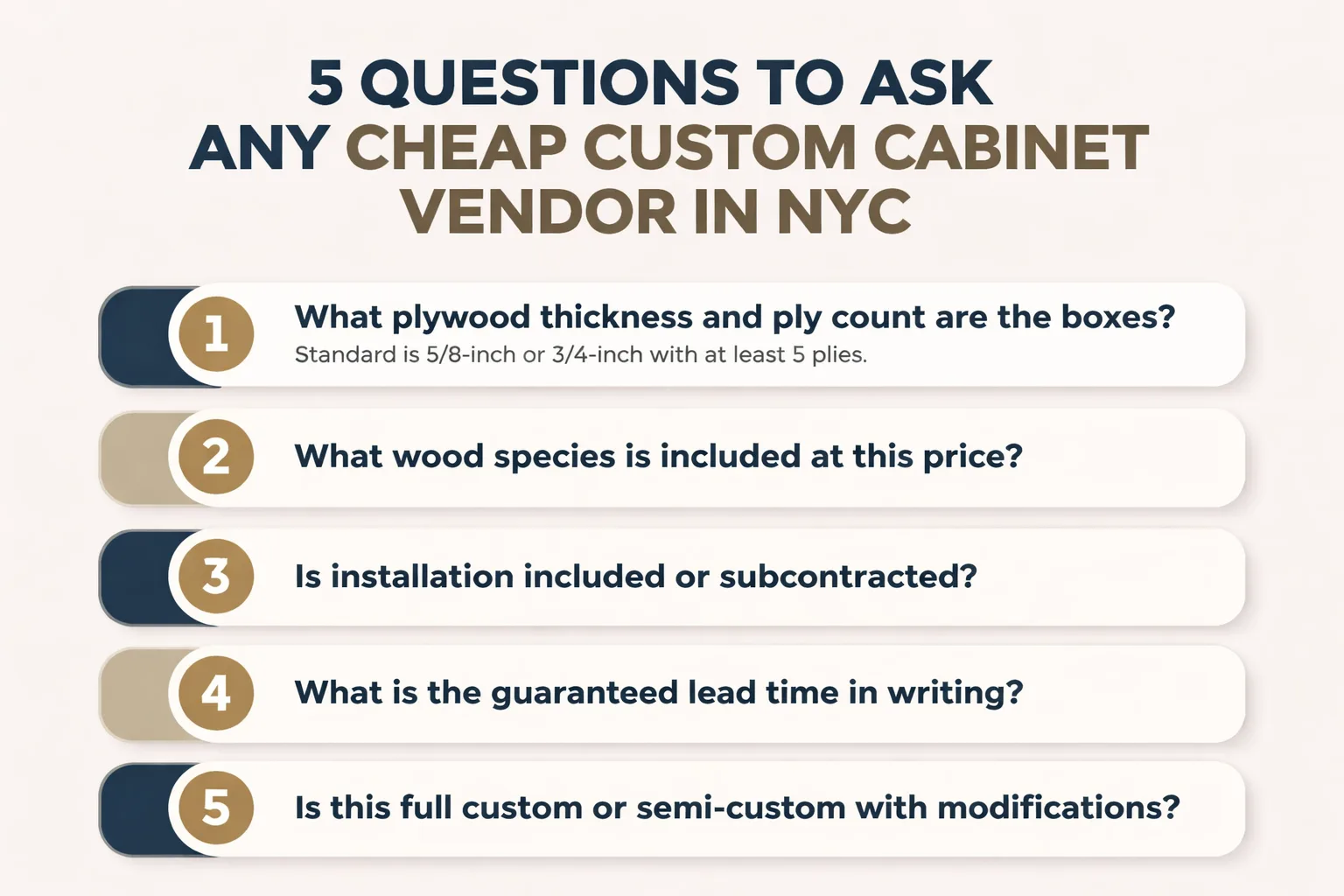
1. What plywood thickness and ply count are the box panels? If the answer is 'half-inch' or vague, the spec is below standard for a custom build. Look for 5/8-inch or 3/4-inch with at least 5 plies. A 3/4-inch, 7-ply plywood box panel costs roughly $45 to $65 per sheet more than a 1/2-inch, 3-ply alternative. On a kitchen with 20 cabinet boxes, that is $900 to $1,300 in material cost difference. A vendor quoting custom at a price that assumes 1/2-inch plywood is passing off semi-custom construction at custom pricing.
2. What wood species is included at the quoted price? Paint-grade maple, birch, or MDF is fine for painted finishes. But if the sample showed walnut and the quote delivers poplar, the discrepancy is the vendor's profit margin hiding in material substitution. Walnut costs $8 to $15 per board foot. Poplar costs $3 to $5. A kitchen with 40 cabinet doors uses roughly 60 to 80 board feet of face frame and door material. The species swap saves the vendor $300 to $720. The client pays for walnut and receives poplar. The stain looks different. The grain reads different. The longevity differs.
3. Is installation included, or is it subcontracted separately? Installation quality matters as much as cabinet quality. A Houzz forum thread documenting cabinet installation failures details a homeowner's experience with an installer who over-torqued screws into the cabinet frame, bent water pipes during installation, and left base cabinets misaligned. The cabinets were fine. The install destroyed them. YouTube creators and homeowner forums document these as recurring, recognized problems. Another installation video catalogs the same pattern: screw placement through the frame instead of into it, glue where mechanical fasteners should be, and base cabinet misalignment that compounds across a run. If installation is subcontracted, ask who is responsible when a pipe gets bent. The answer should be in the contract, not assumed.
4. What is the guaranteed lead time, in writing? A verbal '8 to 10 weeks' without a contract penalty clause is not a guarantee. Budget shops overpromise on timeline because they need the deposit. A legitimate shop puts the lead time in the contract and offers a remedy if the deadline is missed. The remedy can be a per-day penalty, a deposit refund option, or a written commitment to expedite at the shop's cost. Without a remedy clause, the lead time is a suggestion.
5. Is this full custom or semi-custom with modifications? Semi-custom with modifications is a legitimate product. It is not custom. If the vendor calls it custom, the quote is mislabeled. That mislabeling is a signal about how the rest of the relationship will go. The test: ask whether the vendor can build a cabinet to a specific fractional dimension, such as 17 and 3/8 inches wide, without a filler strip. If the answer requires rounding to the nearest 3-inch increment, the product is semi-custom.
What This Won't Fix
A well-chosen custom cabinet from a Brooklyn shop solves fit, material, and finish problems. It does not solve every problem.
It will not fix a bad layout. If the sink, range, and refrigerator form a triangle that forces a user to cross the entire kitchen to drain a pot, custom cabinets will make that bad layout more beautiful. They will not make it functional. Layout problems require a designer or architect, not a cabinetmaker. A cabinetmaker can build a perfect box for a terrible workflow. The result is a beautiful kitchen that is miserable to cook in.
It will not fix uneven walls or settled floors without a site visit. A shop that quotes without measuring the actual space is quoting blind. NYC pre-war buildings have walls that are not plumb by an inch or more. Floors slope. Ceilings vary in height across a single room by half an inch. Custom cabinets scribed to those walls fit. Custom cabinets built to nominal dimensions do not. The difference between a scribed fit and a nominal fit is the difference between a cabinet that looks built-in and one that looks dropped-in.
It also will not fix a plumbing or electrical problem that should have been addressed before the cabinets arrived. If the rough plumbing is in the wrong location, the cabinet has to be cut to accommodate it, or the plumbing has to be moved. Moving plumbing costs $500 to $2,000 per fixture. Cutting a cabinet to fit bad plumbing compromises the cabinet. Neither option is free, and neither was in the cabinet quote.
Are you comparing custom cabinet quotes and unsure which one is actually custom?
Is the Cost of Custom Kitchen Cabinets Worth It?
The cost of custom kitchen cabinets, when evaluated over a 10-year horizon, tells a different story than the initial quote.
A stock cabinet kitchen at $100 to $400 per linear foot, installed in a typical Brooklyn kitchen of 15 to 20 linear feet, costs $1,500 to $8,000. A true custom kitchen at $500 to $1,200+ per linear foot costs $7,500 to $24,000+. The price of custom kitchen cabinets reflects the labor of building each box to spec. The Columbus Kitchen Cost reference page provides additional sourcing context for these ranges, though it does not normalize for NYC-specific labor rates.
The math changes when you factor in replacement. Stock cabinets in a NYC apartment, subjected to humidity swings, steam from dishwashers, and daily use, show wear within 5 to 7 years. Hinges loosen. Finishes chip. Shelf pins strip. Replacement means another full kitchen renovation, with demolition, disposal, and reinstallation costs that add $3,000 to $8,000 on top of the new cabinet price.
Custom cabinets, built with proper joinery, sealed with multi-step finishes, and installed correctly, last 15 to 25 years in the same conditions. The cost per year of ownership drops below stock when the timeline extends past a decade.
The custom kitchen cabinets price includes the value of fit. A custom cabinet in a Brooklyn galley kitchen uses every inch. A stock cabinet with filler strips wastes 3 to 6 inches per wall. In a kitchen with 12 feet of wall, that is a full cabinet's worth of lost storage. In a small NYC kitchen where every inch matters, that lost storage is the difference between a functional kitchen and one that forces the user to store pantry items in another room.
Over a 10-year period, a $15,000 custom kitchen costs $1,500 per year. A $5,000 stock kitchen replaced once in the same period costs $1,000 per year but loses storage, requires two renovations, and never fits the space properly. The custom option is not cheaper. It is better value.
The calculation shifts further when factoring in the disruption cost of a second renovation. A kitchen renovation takes 4 to 8 weeks of construction noise, dust, takeout meals, and lost use of the space. For a family, that disruption has real cost. Two renovations in 10 years means 8 to 16 weeks of total disruption. One custom renovation means 4 to 8 weeks. The avoided second disruption is worth something, even if it does not appear on a spreadsheet.
When Cheap Custom Fails
Three scenarios break the model.
Scenario 1: The flip. An investor renovating a property for sale within 6 months does not need 20-year cabinetry. Custom is overbuilt for the use case. Stock or semi-custom delivers faster, costs less, and the buyer will likely renovate anyway. The return on custom cabinetry in a flip is zero. The buyer does not care about dovetail joinery. They care about the kitchen looking clean and new in the listing photos. Stock achieves that at a fraction of the cost.
Scenario 2: The rental unit. Cabinets in a rental face tenant wear that no finish can withstand. A landlord spending $1,200 per linear foot on custom walnut in a rental unit is making an emotional decision, not a financial one. Tenants do not treat cabinetry with the care an owner does. Scratches, water damage, and heavy use are the norm, not the exception. Semi-custom or stock with a durable finish is the rational choice for a rental. Save the custom budget for the owner-occupied unit.
Scenario 3: The temporary home. A homeowner planning to sell within 3 years gets minimal return on custom cabinetry. Appraisers do not credit custom cabinets at full cost. Buyers see 'nice kitchen' and offer accordingly, but the premium over a semi-custom renovation is rarely recovered in a short hold. The math works when the homeowner stays 10+ years. Under 3 years, the custom premium is a gift to the next owner.
What Material Choices Mean for Long-Term Performance
Material selection drives performance more than any other variable. The difference between a cabinet that lasts 5 years and one that lasts 25 is not the label. It is the wood.
For dark finishes, walnut has become the recommendation for specific reasons. Its inherent resistance to warping and consistent grain minimize the staining issues that plague other species. Projects attempting deep, consistent dark stains on less forgiving woods have led to delays and rework. Walnut performs predictably. It costs more upfront. It saves time and prevents client dissatisfaction. The walnut species page details the specific properties that make it suited for textured, dark applications. The walnut cabinet worth analysis breaks down the cost-benefit math for NYC buyers specifically.
For light finishes, hard maple presents a known challenge. The blotching issue when stained is documented across the industry. NYC apartments with humidity fluctuations exacerbate finishing problems. Achieving a light wood aesthetic on maple can become a larger undertaking than initially quoted. The white oak cabinet guide offers an alternative for light-tone projects without maple's finishing volatility. White oak accepts stain evenly, resists moisture, and provides a predictable grain pattern that does not blotch under finish application.
For painted finishes, the substrate matters more than the paint. MDF panels resist warping in painted applications where solid wood panels would move. A budget shop using solid wood panels for painted doors is not delivering a premium product. It is delivering a future warranty claim. Solid wood moves with humidity. In a NYC kitchen with a dishwasher venting steam and a radiator cycling temperatures, solid wood painted panels will expand and contract. The paint cracks at the joints. MDF does not move. The paint stays intact. This is why premium painted cabinetry uses MDF center panels with solid wood frames.
The finishing process itself is a quality indicator. A proper painted finish involves sanding, sealing, sanding again, applying a primer coat, sanding again, applying two topcoats, and sanding between each coat. That is six to eight sanding steps. A budget shop applies primer and one topcoat with a single sanding pass. The difference is visible under raking light. The budget finish shows orange peel. The proper finish is smooth and flat. The proper finish also costs more in labor time, which is why budget shops skip steps.
What Smart Storage Really Costs in Small NYC Kitchens
Brooklyn kitchens average smaller than national norms. The small kitchen renovation guide addresses the specific challenge of maximizing storage in compact footprints.
The handleless, minimalist styles that Brooklyn's top providers showcase look clean. They also reduce usable edge space for towel bars and hooks. Smart storage means pull-out pantries, toe-kick drawers, and blind-corner solutions. These features cost more per linear foot but recover storage volume that standard configurations waste.
A pull-out pantry in a 12-inch wide cavity adds 8 to 10 cubic feet of storage that a standard shelf configuration would waste. A toe-kick drawer across a 10-foot run of base cabinets adds 4 to 6 cubic feet of storage for items like baking sheets and cutting boards. A blind-corner pull-out in a 36-inch corner cabinet recovers 6 to 8 cubic feet that would otherwise require the user to crawl into the cabinet to reach the back.
The trade-off no one discusses: integrated smart features like motorized drawers and charging stations carry reliability concerns over a 15 to 20-year product lifecycle. The technology will obsolete before the cabinet does. Traditional mechanical storage solutions outlast electronic ones. A buyer paying a premium for smart features should understand they are buying a replacement cycle for the tech, not the cabinetry. A motorized drawer mechanism that fails in year 8 requires either a proprietary replacement part that may no longer be manufactured or a full drawer retrofit. A mechanical soft-close slide that fails in year 8 requires a $15 replacement from a standard hardware supplier.
The competitive landscape in Brooklyn reveals a gap here. Leading custom cabinet makers advertise tailored solutions and material longevity, but they are largely ignoring the market for integrated smart features. Motorized drawers, integrated charging, and smart lighting are virtually non-existent in their offerings. This tells us they are either deliberately avoiding the smart home trend due to perceived obsolescence and repair challenges, or they have not yet seen enough client demand to justify the investment. For now, the smart storage conversation should focus on mechanical solutions that maximize space without introducing electronic failure points.
The Honest Cost Comparison
| Factor | Stock Cabinets | Semi-Custom | True Custom (Green Cabinets NY) |
| Price per linear foot | $75-$250 | $150-$700 | $500-$1,200+ |
| Width increments | 3-inch fixed | Some flexibility | Exact to measurement |
| Plywood thickness | 1/2-inch typical | 1/2 to 5/8-inch | 5/8 to 3/4-inch |
| Wood species | 5-10 options | 15-30 options | Unlimited, spec'd per project |
| Finish options | 10-20 colors | 20-50 colors | Custom match, multi-step |
| Lead time | 1-4 weeks | 4-8 weeks | 6-12 weeks |
| Fit in irregular NYC walls | Filler strips | Some scribing | Scribed to wall |
| Expected lifespan | 5-10 years | 10-15 years | 15-25 years |
| Installation | Separate | Often separate | Included or shop-directed |
| Drawer joinery | Stapled or dadoed | Dadoed or dovetail | Dovetailed |
| Hinge adjustability | Fixed or limited | Adjustable | Adjustable, soft-close standard |
| Shelf material | 1/2-inch PB | 1/2 to 5/8-inch plywood | 3/4-inch plywood |
The table is not an argument that custom is always better. It is an argument that the three tiers serve different needs. Stock serves speed and budget. Semi-custom serves the middle. Custom serves fit, longevity, and material control.
Building Custom Kitchen Cabinets: What the Process Actually Involves
The process of building custom kitchen cabinets is not a single event. It is a sequence of phases, each with its own failure points and cost drivers. Understanding the sequence helps a buyer evaluate whether a vendor's quote reflects the full process or a shortcut version.
Phase 1: Measurement and site assessment. A shop representative visits the site, measures wall dimensions, checks for plumb and level, identifies obstructions (pipes, radiators, structural quirks), and confirms appliance cutouts. This step takes 1 to 2 hours on site. A vendor that skips this step and works from builder's plans is quoting blind. Builder's plans reflect intended dimensions, not actual dimensions. In NYC pre-war buildings, the difference between intended and actual can be an inch or more per wall.
Phase 2: Design and material specification. The shop produces shop drawings showing every box, door, drawer, and fixed panel with dimensions, species, finish, and hardware called out. The client reviews and approves. Changes after approval incur costs. A budget shop may skip shop drawings entirely, going straight from measurements to production. That eliminates the client's opportunity to catch errors before wood is cut.
Phase 3: Material procurement. The shop orders plywood, solid stock, hardware, and finishing materials. Lead times on specific species can add 2 to 4 weeks. Walnut, rift-cut white oak, and cherry are not always in stock at local lumber yards. A shop that quotes 6 weeks total but needs 3 weeks for material procurement has 3 weeks for production. That is tight for a custom build.
Phase 4: Production. Boxes are cut, assembled, and sanded. Doors are built, sanded, and finished. Drawers are dovetailed, assembled, and sanded. This phase takes 3 to 6 weeks depending on kitchen size and shop capacity. A shop with two craftsmen and a 10-kitchen backlog is producing at a rate that does not match a 6-week quote.
Phase 5: Finishing. Sanded cabinets enter the finish room. Stain or paint is applied in multiple coats with sanding between each. Finishing takes 5 to 10 days for proper cure time between coats. A budget shop that rushes finishing delivers a finish that looks acceptable on delivery and fails within 2 to 3 years.
Phase 6: Delivery and installation. Cabinets are delivered to the site, checked against the shop drawings, and installed. Installation takes 2 to 5 days for a typical kitchen. The shop that built the cabinets should install them. A subcontracted installer does not know the specific quirks of the build.
The full process takes 8 to 14 weeks from contract to completion. A quote promising 4 to 6 weeks for true custom is either optimistic or skipping steps.
What This Actually Means for NYC Buyers
The cheap custom kitchen cabinets market exists because NYC buyers want custom fit without paying showroom markups. That desire is legitimate. The execution varies wildly.
A homeowner who understands the difference between semi-custom marketed as custom and true custom from a low-overhead shop can find value. A homeowner who buys on price alone gets what they paid for.
The five questions in this article are the filter. The cost-per-year math is the decision framework. The material guidance is the quality control.
Green Cabinets NY exists in the space between showroom premium and budget compromise. The sustainable cabinetry approach and the walnut cabinet analysis provide deeper material guidance for buyers ready to move past price comparison into specification.
The bottom line: cheap custom kitchen cabinets are not a myth. They are a category with a wide quality range. The buyer's job is to identify where on that range a vendor actually operates before the deposit clears. The vendor's job is to answer the five questions honestly. The buyer's job is to listen to the answers and verify them against the spec sheet, not the sales pitch.
FAQ
What is the average custom kitchen cabinets cost for a Brooklyn kitchen?
A typical Brooklyn kitchen of 15 to 20 linear feet, built true custom, costs $7,500 to $24,000+ depending on wood species, finish complexity, and hardware. Semi-custom ranges from $2,250 to $14,000 for the same footprint. Stock runs $1,500 to $8,000. The custom kitchen cabinets price reflects the labor of building each box to spec, not the cost of materials alone. Labor typically represents 50 to 60% of the total custom cabinet cost.
How long do custom cabinets take to build and install?
True custom lead times run 6 to 12 weeks from contract to delivery. Installation adds 2 to 5 days depending on kitchen size and complexity. Shops quoting under 4 weeks for custom are either building semi-custom or carrying inventory. The full process includes measurement, design, material procurement, production, finishing, and installation. Each phase has a minimum duration that cannot be compressed without compromising quality.
Are semi-custom kitchen cabinets a good compromise?
For many NYC kitchens, yes. Semi-custom offers dimensional flexibility and broader finish options than stock at a lower cost than true custom. The trade-off is fit precision and species selection. A kitchen with standard wall dimensions and no unusual angles is a strong candidate for semi-custom. The 6,600 monthly searches for semi-custom kitchen cabinets reflect its position as the most-researched compromise option. A kitchen with angled walls, bulkheads, or non-standard dimensions is not a good semi-custom candidate.
Can I get custom cabinets on a budget in NYC?
Yes, by working with a direct-to-homeowner shop like Green Cabinets NY that eliminates showroom overhead. The key is verifying that the quote includes true custom construction (5/8-inch or thicker plywood, species-specific material, multi-step finish) rather than semi-custom labeled as custom. The savings from a direct model are real, but they should come from eliminated overhead, not from downgraded materials.
What wood species is most cost-effective for custom cabinets?
Paint-grade maple or birch offers the lowest cost for painted finishes. For natural or stained finishes, oak provides good durability at a mid-range price. Walnut costs more upfront but delivers predictable finishing performance for dark tones, reducing rework risk. For light-tone stained finishes, white oak avoids the blotching issues that hard maple presents. MDF center panels with solid wood frames are the correct substrate for painted doors in NYC kitchens with humidity fluctuations.
What are the most common installation mistakes with custom cabinets?
Over-torqued fasteners causing frame damage, water pipe damage during installation, and base cabinet misalignment are the most documented failures. Screw placement through the frame instead of into it compromises the box structure. Gluing where mechanical fasteners should be used prevents future adjustment. Base cabinet misalignment compounds across a run, meaning each cabinet offset from the previous one makes the next harder to align. These are recognized, recurring problems documented across homeowner forums and installation videos.
Get a true custom cabinet quote from a Brooklyn shop that builds to your walls, not to a catalog.