Custom-Built Kitchen Cabinets vs. Big-Box: The Real Difference
Stock cabinets cost $75 to $300 per linear foot. Custom-built runs $500 to $1,200+. But the real difference shows up in 3 to 5 years, when edge banding lifts, drawer bottoms sag, and filler strips waste 15 percent of your storage. Here is what the big-box quote does not include.
By Green Cabinets NY Team
Key Takeaways
- Custom-built kitchen cabinets cost $500 to $1,200+ per linear foot versus $75 to $300 for big-box stock, buying dimensional precision and humidity-resistant finishes that survive decades.
- The kitchen cabinet market will grow from $91.07 billion in 2025 to $124.42 billion by 2031 at a 5.36% CAGR, driven by premium custom segments.
- Stock cabinet installs frequently cause damage such as over-torqued fasteners, bent pipes, and cracked frames, turning the lower upfront price into double the total cost.
- In NYC apartments with non-standard walls, radiators, and ceiling heights, custom cabinets are the true budget choice because stock units require expensive rework.
Picture the showroom floor of any major home improvement chain on a Saturday morning in Brooklyn. Rows of identical cabinet boxes stacked to the ceiling, laminated doors on display hinges, a printed spec sheet taped to each unit. A sales associate pulls up a software tool and starts dropping rectangles into a floor plan. Within twenty minutes, you have a "design" and a quote. It feels efficient. It feels decided. What it rarely feels like. And what it rarely is. Is a kitchen built around how you actually cook, store, and live.
Custom-built kitchen cabinets cost $500 to $1,200+ per linear foot, while stock cabinets from big-box retailers run $75 to $300 per linear foot, according to Marfa Cabinets. The $15,000+ gap buys more than materials. It buys dimensional precision, joinery that survives decades, and finishes that do not delaminate in NYC humidity. The kitchen cabinet market is projected to grow from $91.07 billion in 2025 to $124.42 billion by 2031 at a 5.36% CAGR, per Mordor Intelligence, with custom segments driving premium growth. Yet most Brooklyn homeowners still default to big-box options because the price comparison feels insurmountable. A documented Houzz case study shows a stock cabinet install where fasteners were over-torqued, water pipes were bent, and the frame was damaged during installation. That is the real cost difference.
Here is the contrarian position: for NYC apartments with non-standard walls, radiators, and ceiling heights, stock cabinets are not the budget option. They are the expensive option you pay for twice.
What 'Custom-Built' Actually Means (and What It Doesn't)
The cabinet industry uses four terms that sound similar but describe fundamentally different products. Stock cabinets are mass-produced in fixed 3-inch width increments, come in 10 to 20 finish options, and ship from a warehouse. Semi-custom kitchen cabinets start with the same factory boxes but allow limited modifications: you can adjust depth slightly, choose from a broader finish menu, and swap door styles. Custom-built kitchen cabinets are built from scratch to the exact dimensions of your space, with joinery, materials, interiors, and finishes specified for your project.
The misconception that derails NYC buyers is this: semi-custom is not custom. A big-box retailer offering "custom" options is almost always selling semi-custom product. The cabinets are still manufactured in a factory, still constrained by standard width increments, and still assembled from modular components. The "customization" is a menu of pre-approved modifications, not a built-to-spec process.
True custom-built means a craftsman or workshop cuts every panel, builds every face frame, and finishes every surface for your kitchen. No filler strips. No compromise dimensions. No "that is the closest standard size we carry." The difference shows up in the details that big-box showrooms never display: dovetailed drawer joints instead of stapled bottoms, mortise-and-tenon door frames instead of routed MDF, solid wood end panels instead of vinyl-wrapped particleboard.
A buyer comparing custom and semi-custom with identical specs (same hinges, same plywood thickness, same drawer count, same slides) found a roughly $10,000 difference, per a Houzz discussion. That premium is real. But the comparison is misleading because the specs are never truly identical. The semi-custom box uses factory-standard joinery and factory-applied finishes. The custom build uses site-specific construction and hand-applied finishes. You are not comparing the same product at different price points. You are comparing different products.
The terminology problem extends to how these products are marketed. A big-box retailer will list a cabinet line as "semi-custom" and use language that implies tailoring: "designed to fit your space," "configured for your kitchen," "built for your lifestyle." None of that means built-to-spec. It means configured from existing modular components. The cabinet box is still manufactured in a standard size. The modifications happen within a predefined range. You can choose a 24-inch drawer base instead of a 24-inch door base, but you cannot choose a 26-inch drawer base because your wall opening is 26 inches. That constraint is invisible in the showroom. It becomes visible when the installer arrives and fills the gap with a filler strip.
There is also a distinction between custom-built and custom-assembled. Some companies market themselves as custom cabinet makers when they are actually assembling pre-cut components from a supplier. The panels arrive pre-finished. The builder assembles them on-site. This is better than stock, but it is not the same as a workshop that cuts, routes, assembles, and finishes every component for a specific kitchen. The difference matters because pre-cut components are still constrained by standard dimensions. A true custom builder cuts to your measurements, not to a supplier's catalog.
For NYC buyers, the confusion is compounded by the fact that many design firms use the word "custom" loosely. A firm that designs your kitchen and orders cabinets from a semi-custom manufacturer is not a custom cabinet builder. They are a design firm that sells semi-custom product. The distinction is not semantic. It determines whether your cabinets fit your space or whether your space is forced to fit your cabinets.
How Custom-Built Cabinets Solve NYC's Toughest Space Problems
Brooklyn brownstones, pre-war apartments, and NYC condos share a trait that big-box catalogs do not account for: nothing is square, nothing is standard, and everything is in the way. Radiators sit where a cabinet should. Ceilings slope. Walls bow. Gas lines emerge from floors at angles that make no sense. Steam pipes run through the corner where a pantry would go.
Stock cabinets cannot solve these problems. They come in fixed widths (typically 9, 12, 15, 18, 21, 24, 27, 30, 33, 36 inches). When your wall is 34.5 inches wide, you get a 30-inch cabinet and a 4.5-inch filler strip. That filler strip is wasted space. Multiply that across a full kitchen and you lose 10 to 15 percent of your storage capacity to gaps that exist only because the cabinet could not be cut to fit.
Custom-built kitchen cabinets eliminate every filler strip. Every inch becomes usable storage. A cabinet that needs to be 34.5 inches wide is built at 34.5 inches. A cabinet that needs to clear a radiator pipe is notched around it. A ceiling that slopes six inches over ten feet gets crown molding cut to match. This is not a luxury. In a 60-square-foot Brooklyn galley kitchen, recovering 10 to 15 percent of storage is the difference between a functional kitchen and a daily frustration.
The workflow argument matters too. Stock cabinets force your kitchen layout to conform to available sizes. Custom cabinets conform to your workflow. A homeowner who cooks daily needs drawer banks where pots go, not where standard cabinet widths happen to fit. A family that buys in bulk needs a pantry that fits the awkward alcove next to the refrigerator, not a 12-inch cabinet that wastes the space above it. The process of designing custom cabinets in NYC starts with how you use the space, not what sizes are in a catalog.
For small kitchens specifically, the storage recovery from custom construction is the single biggest argument against big-box. When every cabinet is built to the exact opening, you gain usable depth, usable width, and usable height that stock cabinets sacrifice to standardization. Learn more about maximizing small space kitchens with custom solutions in our dedicated guide.
Consider the specific geometry of a typical Brooklyn brownstone kitchen. The room is often a narrow galley, maybe 7 feet wide and 12 feet long. One wall has a window. The opposite wall has a radiator under it. The ceiling is 9 feet 2 inches on the left side and 8 feet 11 inches on the right because the floor slopes. The back wall has a gas pipe emerging 4 inches from the corner at a 45-degree angle. A steam pipe runs horizontally across the top of the back wall, 7 feet off the floor.
Now try to fit stock cabinets into that space. The radiator wall needs cabinets that are shallow enough to clear the radiator depth (typically 9 to 10 inches from the wall) or tall enough to sit above it with a toe kick that clears the radiator height (typically 28 to 30 inches). Standard base cabinets are 24 inches deep and 34.5 inches tall. They will not clear the radiator without being modified, and modifying stock cabinets voids the warranty. The sloping ceiling means your upper cabinets will not sit flush at the top. The gas pipe and steam pipe mean you cannot place a cabinet in the back corner without cutting around them, and cutting stock cabinets weakens the structural integrity of the box.
A custom builder solves every one of these problems. The radiator wall gets cabinets built at 12 inches deep with a toe kick height that clears the radiator. The upper cabinets are built with a scribed top that follows the ceiling slope. The back corner cabinet is notched around both pipes without compromising the box structure because the notches are designed into the build, not cut on-site. Every inch of storage is recovered. Every pipe is cleared. Every wall irregularity is accommodated.
This is not a hypothetical. This is a typical Brooklyn brownstone kitchen. The choice is not between custom and stock at different price points. The choice is between cabinets that fit your space and cabinets that do not.
The same logic applies to NYC condo kitchens, which present a different set of constraints. Condos often have structural columns that interrupt cabinet runs. They have bulkheads that reduce clearance above the counter. They have appliance garages that need to be integrated into the cabinet design rather than sitting on the counter. Stock cabinets handle none of these conditions well. Custom cabinets handle all of them by design.
Materials, Joinery, and Finish: Where the Quality Gap Shows
Walk into a big-box showroom and look at the edge banding on a display cabinet. That thin strip of vinyl or PVC covering the raw edge of particleboard is the first thing that peels. It peels from humidity. It peels from cleaning products. It peels from a bumped hip. Once the edge banding lifts, the particleboard underneath absorbs moisture, swells, and the cabinet is done. Not refinishable. Not repairable. Done.
Custom-built kitchen cabinets use solid wood, plywood, or high-grade MDF for core construction. Solid wood face frames. Plywood box sides. Dovetailed drawer joints. Mortise-and-tenon door frames. These are not aesthetic choices. They are structural choices that determine whether your cabinets last 5 years or 30.
The joinery difference is the one most buyers never see until it fails. A stapled drawer bottom holds until it does not. A dovetailed joint interlocks mechanically, meaning the joint gets stronger under load, not weaker. The cost difference between a stapled drawer and a dovetailed drawer is minimal in materials. The difference is labor, and that is what you pay for with custom construction.
Finish quality separates custom from stock as decisively as joinery. Big-box cabinets receive factory-sprayed conversion varnish or lacquer, applied in a controlled environment. The finish is consistent but thin. Custom builders apply finish by hand, often in multiple coats with sanding between each, allowing for deeper penetration and a more durable surface. In NYC apartments where cooking grease, humidity, and daily wear accelerate finish degradation, the difference between a factory spray and a hand-rubbed finish is visible within 3 to 5 years.
Green Cabinets NY approaches material selection with a focus on sustainability and durability. The walnut species page outlines how solid walnut performs in NYC kitchens, and the white oak design guide breaks down why white oak has become a dominant choice for 2026 renovations. Both species offer natural resistance to wear that particleboard cannot match.
For homeowners evaluating sustainable options, the sustainable bathroom vanities guide covers material certifications and durability expectations. The same principles apply to kitchen cabinetry: CARB2 compliance limits formaldehyde emissions, and FSC certification verifies responsible sourcing. Bamboo regenerates in 3 to 5 years versus decades for hardwoods, per research from NC State. But as RONBROW notes, "most cabinetry brands talk about sustainability and durability without showing the numbers you need." Third-party certifications are the proxy. Demand them.
The material conversation needs to go deeper than "solid wood versus particleboard" because the specifics determine performance. Particleboard, the dominant material in stock cabinets, is engineered from wood particles bonded with resin. Its density is inconsistent. It holds screws poorly, which means hinges loosen over time as the screw holes strip. It absorbs moisture from the air, expanding permanently. Once it swells, it does not return to its original dimension. The structural integrity is compromised.
Plywood, the standard for custom cabinet boxes, is engineered from thin layers of wood veneer glued with the grain alternating at 90-degree angles. This cross-grain construction gives plywood dimensional stability that particleboard cannot match. It resists moisture. It holds screws because the dense layers grip the threads. It does not swell permanently when exposed to humidity. A plywood box built properly will outlast the house it sits in.
Solid wood is the premium for face frames, door panels, and drawer fronts. It is not used for box sides because solid wood expands and contracts with humidity changes, which can warp a full box. Instead, custom builders use solid wood where it shows and where structural integrity benefits from its density: face frames, door frames, drawer fronts. The box is plywood. The drawers are solid wood. The face frames are solid wood. This combination delivers both dimensional stability and visible quality.
The finish conversation is equally specific. Factory-applied conversion varnish is a catalyzed finish that cures through a chemical reaction. It is hard, thin, and consistent. It is also brittle. In a NYC kitchen where temperature swings from 60 degrees in winter (radiator heat) to 85 degrees in summer (no central air), the finish expands and contracts at a different rate than the wood underneath. Over 3 to 5 years, the finish cracks along grain lines, allowing moisture to penetrate the wood. Once moisture penetrates, the finish fails.
Hand-applied finishes, the standard for custom construction, penetrate the wood rather than sitting on top of it. Oil-based finishes soak into the grain, providing protection from within. Multiple coats with sanding between each build a surface that is thinner but more flexible. It moves with the wood. It does not crack along grain lines. It can be repaired: a scratched hand-rubbed finish can be sanded and recoated. A cracked conversion varnish cannot.
The ICC-ES Safe and Sustainable Cabinetry (SASC) program measures formaldehyde emission compliance, greenhouse gas emissions, water consumption, and waste recycling, per the ICC-ES program documentation. These metrics matter for indoor air quality in NYC apartments where ventilation is often poor. But the program does not provide comparative benchmarks between custom and stock products. A homeowner seeking specific VOC emission levels in parts per million will not find them. The certifications are binary: compliant or non-compliant. They do not rank quality.
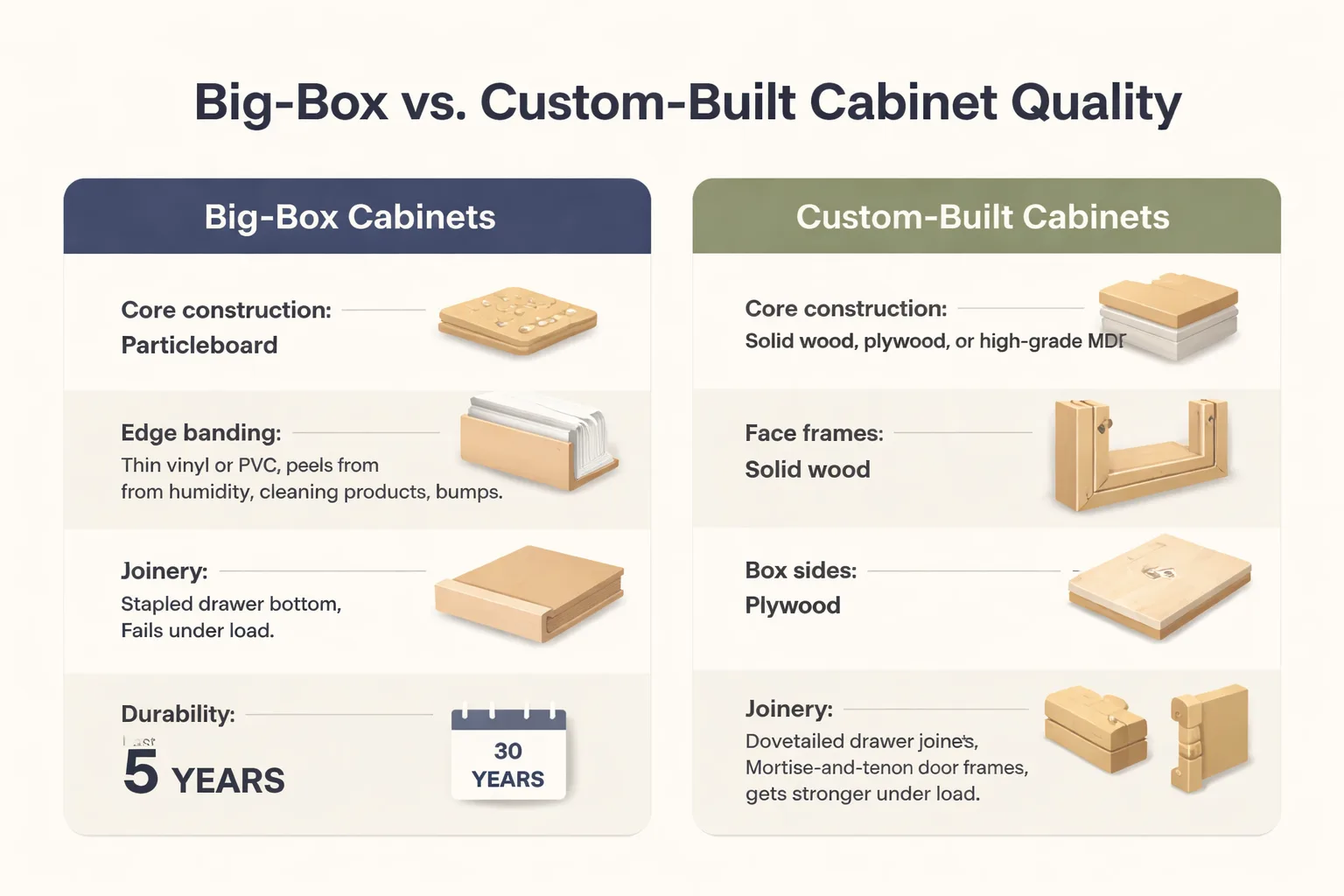
Custom vs. stock construction quality comparison
Total Cost Over Time: Is Custom-Built Worth It in NYC?
The cost for custom kitchen cabinets is the number that stops buyers cold. Stock cabinets run $75 to $300 per linear foot. Custom runs $500 to $1,200+ per linear foot. For a 10-foot kitchen run, that is $750 to $3,000 for stock versus $5,000 to $12,000 for custom. The premium is real, and pretending otherwise does not serve anyone.
But the upfront price is not the total cost. Here is what the big-box quote does not include.
Contractor fitting fees. When stock cabinets do not fit the space, the installer charges to cut, shim, and fill. In NYC, where walls are rarely plumb and floors are rarely level, fitting fees add $1,500 to $3,000 to a stock cabinet installation. Custom cabinets are built to the measured space, so fitting is minimal.
Replacement cycles. Stock particleboard cabinets in a humid NYC kitchen show visible wear within 3 to 5 years. Edge banding lifts. Drawer bottoms sag. Hinges pull out of stripped holes. The replacement cycle for stock is 7 to 12 years. Custom cabinets last 25 to 30 years with proper care. Over 25 years, you replace stock cabinets two to three times. You replace custom once.
Resale value. NYC buyers in 2026 are educated. They open cabinet doors. They look at joinery. They recognize solid wood versus particleboard. A kitchen with custom-built cabinets signals quality construction throughout the apartment. Real estate agents in Brooklyn consistently position custom millwork as a selling feature, not a neutral detail.
The honest financial comparison is not $3,000 versus $12,000. It is $3,000 plus fitting fees plus one or two replacement cycles versus $12,000 once. Over 25 years, the math narrows considerably. And that calculation does not account for the daily cost of living with cabinets that do not fit your space, do not store what you need, and show wear within years of installation.
The custom kitchen cabinets price also varies by material choice. Painted maple costs less than walnut. Plywood construction costs less than solid wood. A good custom builder helps you allocate budget where it matters most: solid construction in high-use areas, strategic material upgrades where they show. The custom kitchen cabinets guide for NYC buyers breaks down what you actually get for the investment.
Let us run the actual arithmetic on a realistic Brooklyn kitchen. Take a 12-foot run of base cabinets and 12-foot run of uppers in a typical brownstone galley. That is 24 linear feet total.
Stock cabinet scenario: At $150 per linear foot (mid-range stock), the cabinets cost $3,600. Installation in a non-standard space requires 3 days of fitting work at $850 per day, totaling $2,550. Delivery and waste disposal add $400. Total upfront: $6,550. At year 8, the edge banding is lifting on two cabinets, one drawer bottom has sagged, and two hinge holes have stripped. You refinish and repair at a cost of $1,200. At year 14, the cabinets are visibly worn and you replace them with another stock set: $6,550 again. By year 25, you have spent $14,300 on cabinets that still do not fit your space properly.
Custom cabinet scenario: At $700 per linear foot (mid-range custom), the cabinets cost $16,800. Installation is 2 days because the cabinets are built to the measured space: $1,700. Delivery adds $300. Total upfront: $18,800. At year 12, you refinish the surfaces at a cost of $800. At year 25, the cabinets are still in place and functioning. Total spent over 25 years: $19,600.
The gap is $5,300 over 25 years. That is $212 per year. For $212 per year, you get cabinets that fit every inch of your space, use solid wood and plywood instead of particleboard, and do not require replacement within the lifespan of your ownership. And this calculation assumes you only replace stock once. If you replace twice, the custom option is cheaper in absolute dollars.
The calculation also excludes the storage recovery. In the same 24-linear-foot kitchen, stock cabinets with filler strips waste approximately 2.5 linear feet of base storage. That is 2.5 feet of pots, pans, and pantry goods that have nowhere to go. In a 60-square-foot kitchen, that lost storage forces items onto countertops, into hallways, and into other rooms. The functional cost of that lost storage is not measurable in dollars, but it is measurable in daily frustration.
The price of custom kitchen cabinets also includes something the stock quote never mentions: design integration. Custom cabinets are designed as part of your kitchen, not placed into it. The cabinet heights match your ceiling. The cabinet depths match your counter overhang. The drawer configurations match your cooking workflow. The finish matches your flooring and your trim. This integration is not a line item on a quote. It is the difference between a kitchen that feels designed and a kitchen that feels assembled.
Wondering if your kitchen needs custom-built cabinets or if stock will do? The answer depends on your walls, your budget, and your timeline.
How to Choose the Right Builder for Custom-Built Cabinets in Brooklyn
Vetting a custom cabinet maker in NYC is harder than it should be. The market includes everyone from one-person workshops to design-build firms to national companies that outsource fabrication. Here is what to evaluate.
Portfolio depth. Ask for photos of completed kitchens, not just renderings. Look for projects in buildings similar to yours: pre-war apartments, brownstones, new-construction condos. Each building type presents different challenges. A builder who has never worked in a Brooklyn brownstone may not anticipate the wall irregularities, pipe locations, and floor slope that define the installation.
Material sourcing transparency. Where does the wood come from? Is it FSC-certified? Is the plywood CARB2-compliant? A builder who cannot answer these questions is buying from suppliers who cannot answer them either. Green Cabinets NY sources materials with sustainability certifications and provides material documentation on request. The ash wood species page is an example of the transparency you should expect: specific species, specific properties, specific applications.
Lead times. Custom-built kitchen cabinets take 8 to 14 weeks from design approval to installation. Big-box stock is available immediately. If your timeline cannot accommodate custom lead times, you need to know that before committing. A good builder gives you a realistic schedule and sticks to it. The Brooklyn custom cabinet comparison provides context on what to expect from local providers.
Local knowledge. NYC buildings have specific challenges: co-op board approval requirements, loading dock restrictions, elevator size limitations, parking for delivery vehicles. A builder who works in Brooklyn regularly knows these logistics. A builder who does not will learn them on your project, on your dime.
Design-to-installation continuity. The most common failure in NYC cabinet projects is the disconnect between the design firm and the installer. Cabinets arrive that do not fit the measured space. Layouts designed in software do not account for field conditions. The result is a kitchen that looks right in renderings and wrong in reality. Green Cabinets NY controls the full process from design through installation, eliminating the communication gap that causes these failures.
For practical integration features, consider whether your builder can incorporate solutions like a built-in trash bin cabinet or integrated garbage bin cabinet. These details separate a kitchen designed for your life from one designed for a catalog.
The vetting process should also include references. Ask for contact information for past clients in buildings similar to yours. Call them. Ask specifically about the installation: did the cabinets fit the space as designed? Were there change orders during installation? Did the installer communicate field conditions to the builder? The answers reveal whether the builder maintains continuity from design through installation, which is the single biggest predictor of a successful project.
Ask about the workshop. Where are the cabinets built? A builder who fabricates in-house controls quality at every stage. A builder who outsources fabrication to a third party depends on that party's quality standards and timeline. Both can produce good work, but the in-house builder can adjust, repair, and modify during fabrication without waiting for a supplier. In NYC, where timeline pressure is constant, the ability to make changes during fabrication is a significant advantage.
Ask about hardware. What hinges, slides, and pulls does the builder use? Blum and Salice are industry standards for custom construction. If the builder uses generic or unbranded hardware, that is a cost-cutting signal. Hinges and slides are the moving parts of your kitchen. They are the components that fail first. A builder who invests in premium hardware is building for longevity. A builder who does not is building for margin.
Ask about the finish process. How many coats? What sanding grit between coats? What is the curing time? A builder who can answer these questions has a controlled finish process. A builder who cannot is applying finish inconsistently. The finish is what you see and what protects the wood. It is worth understanding before you commit.
What Does Semi-Custom Actually Get You?
Semi-custom kitchen cabinets occupy the middle ground between stock and custom, and they deserve honest evaluation. At 6,600 monthly searches, the term "semi-custom kitchen cabinets" generates more search volume than "custom kitchen cabinets cost" at 1,600 monthly searches. That tells us buyers are actively looking for the middle option. The question is whether the middle option delivers enough value to justify its position.
Semi-custom cabinets start with stock box dimensions and allow modifications within a defined range. You can typically choose from 30 to 50 door styles versus 10 to 20 for stock. You can adjust depth in 1-inch increments. You can select from a broader finish palette. Some semi-custom lines offer plywood upgrade options for box sides, replacing particleboard with plywood at a premium of $50 to $100 per cabinet.
The appeal is obvious. Semi-custom delivers more personalization than stock at a lower price than custom. CabStone positions semi-custom as the "balance of personalization and value" without installation-time data. The positioning is accurate for kitchens with standard dimensions. If your walls are plumb, your ceiling is flat, and your runs match standard widths, semi-custom gives you better materials and more style options than stock without the custom premium.
The limitation is the same as stock: fixed width increments. Semi-custom cabinets still come in 3-inch width multiples. You still get filler strips when your wall does not match a standard width. You still cannot build a cabinet that is 34.5 inches wide. You still cannot notch around a radiator pipe without voiding the warranty. The modifications happen within the factory system, not in response to your specific space.
For NYC buyers, the honest assessment is this: semi-custom is the right choice when your space is standard and your budget cannot accommodate custom. It is the wrong choice when your space is non-standard and you are paying a premium for modifications that still do not solve your dimensional problems. A semi-custom cabinet that costs $300 per linear foot but still requires $2,500 in fitting fees is not saving you money over a custom cabinet that costs $500 per linear foot and requires minimal fitting.
The decision framework is straightforward. If your kitchen walls are within 1 inch of standard widths, semi-custom is a rational choice. If your walls deviate by more than 1 inch, require notching around pipes, or need to clear radiators, the semi-custom premium buys you better materials but does not buy you fit. In that case, custom is the only option that solves the actual problem.
When This Fails: Where Custom-Built Does Not Make Sense
Custom-built kitchen cabinets are not always the right answer, and pretending otherwise undermines credibility. Three scenarios where custom is the wrong call.
You are renovating to sell within 12 months. Custom cabinets add resale value, but the premium takes years to amortize. If you are flipping a property or selling within a year, semi-custom kitchen cabinets deliver 80 percent of the visual impact at 40 percent of the cost. The buyer will not inspect your dovetail joints.
Your kitchen has standard dimensions. If your walls are plumb, your ceilings are flat, and your available runs match standard cabinet widths, the dimensional advantage of custom disappears. Stock cabinets with professional installation will look and function well. The custom premium buys you nothing measurable.
Your budget cannot absorb the lead time cost. Custom takes 8 to 14 weeks. If you are living through a renovation with a temporary kitchen, that timeline has a real cost in quality of life and meal expenses. Stock cabinets installed in a week may be the rational choice despite the quality trade-off.
The Brooklyn-based ECKSTRØM studio used Shinnoki pre-finished millwork in a brownstone renovation at 437 Sackett Street, demonstrating that design-build firms can achieve material performance and cost discipline with semi-custom approaches. Shinnoki finishes from Robin Reigi offer a middle ground: pre-finished panels with custom fabrication. Not every project needs full custom. The right answer depends on your space, your timeline, and your budget.
What This Actually Means for Your Renovation
The choice between custom-built kitchen cabinets and big-box stock is not a choice between expensive and affordable. It is a choice between two different products with different lifespans, different fit tolerances, and different long-term costs. The big-box price wins on day one. The custom-built price wins over the years you actually live with the cabinets.
For NYC homeowners in non-standard spaces, the calculation is straightforward. Stock cabinets waste 10 to 15 percent of your storage to filler strips. They show wear in 3 to 5 years. They require replacement within 7 to 12 years. They arrive in fixed widths that force your layout to conform to a catalog. Custom-built cabinets fit every inch, last 25 to 30 years, and conform to how you cook, store, and live.
The question is not whether custom-built kitchen cabinets are worth the premium. The question is whether your space, your timeline, and your budget can afford the alternative.
Green Cabinets NY builds custom cabinetry for Brooklyn and NYC homeowners who need kitchens designed for their actual spaces, not for a warehouse. From sustainable material sourcing to site-specific construction, every cabinet is built to the millimeter. Because in NYC apartments, every millimeter matters.
FAQ
How much more do custom-built kitchen cabinets cost than big-box stock options?
Custom cabinets typically run $500 to $1,200+ per linear foot, while stock cabinets from major retailers cost $75 to $300 per linear foot. This creates a gap of $15,000 or more on a typical project, though the higher price covers precision fit, durable joinery, and finishes suited to humid environments like NYC.Why might stock cabinets prove more expensive for non-standard Brooklyn apartments?
Stock cabinets often require modifications or multiple installations to fit irregular walls, radiators, and ceiling heights, leading to damage and rework as shown in documented Houzz case studies. In these spaces, the initial savings disappear because the cabinets fail to adapt without costly adjustments or replacements over time.What quality differences separate custom cabinets from big-box stock models?
Custom cabinets deliver dimensional precision, long-lasting joinery, and finishes that resist delamination in local humidity, unlike the laminated, mass-produced units that frequently show installation flaws such as over-torqued fasteners or bent pipes. These differences matter most in older NYC buildings where standard sizes rarely align perfectly.What does "custom-built" actually mean for kitchen cabinets?
It refers to cabinets designed and constructed around a homeowner’s specific cooking, storage, and living needs rather than dropped into a generic floor plan via software. This approach avoids the identical, ceiling-stacked boxes common in big-box showrooms and prioritizes exact measurements over quick quotes.Get a custom cabinet consultation with Green Cabinets NY and find out exactly what your kitchen needs, down to the millimeter.