Custom Kitchen Cabinets Chicago vs. Brooklyn: What NYC Buyers Learn
NYC buyers comparing custom kitchen cabinets Chicago shops to Brooklyn fabricators find 25-40% price gaps. Here's what those comparisons actually reveal about value, logistics, and total cost of ownership.
By Green Cabinets NY Team
Key Takeaways
- NYC buyers discover 25-40% price gaps, with Chicago fabricators quoting $50,000-$60,000 for kitchens that Brooklyn shops price at $75,000-$90,000.
- A typical 180-square-foot Brooklyn kitchen receives an $85,000 quote while a comparable Chicago build comes in at $52,000 installed.
- Chicago cabinets require navigating 29-inch doorways, fourth-floor walk-ups, and pre-1962 plumbing that add unpriced installation costs in NYC co-ops.
- Factor DOE permitting, freight-elevator limits, and local code compliance into any out-of-state cabinet quote before accepting the lower number.
The mood board is pinned to the wall: cerused oak doors, integrated pulls, a deep navy island with unlacquered brass hardware. The Brooklyn designer and her clients sit around a reclaimed-wood table in a Gowanus studio, debating lead times and lumber costs. The quote on the table is eye-watering. Nearly $85,000 for a 180-square-foot kitchen. Someone slides a laptop across the table showing a comparable Chicago fabricator's portfolio. The room goes quiet. The cabinets are stunning. The estimate is $52,000 installed. The question hanging in the air: why didn't anyone mention Chicago sooner?
NYC buyers who research custom kitchen cabinets Chicago shops discover price gaps of 25-40% on comparable projects, with Chicago fabricators quoting $50,000-$60,000 for kitchens that Brooklyn shops price at $75,000-$90,000. The difference is real. But the comparison reveals less about Brooklyn overcharging and more about what each market optimizes for. Chicago fabricators benefit from lower warehouse rents, cheaper labor rates, and easier logistics. Brooklyn shops build for a radically different environment: pre-war co-op buildings with freight-elevator restrictions, DOE permitting, and plumbing configurations that haven't been touched since 1962.
The homeowners who run this comparison almost always arrive at the same conclusion. The Chicago price is tempting. The Chicago portfolio is beautiful. The logistics of getting those cabinets into a fourth-floor Williamsburg walk-up, through a 29-inch doorway, and installed to NYC code are a nightmare nobody priced into that $52,000 estimate.
This is where the conversation gets interesting.
Why Homeowners Search Chicago Cabinet Makers
The search behavior follows a predictable arc. A Brooklyn homeowner receives a quote for custom kitchen cabinets, experiences sticker shock, and types variations of "custom kitchen cabinets Chicago" or "custom kitchen cabinets near me" into Google. Chicago appears because the city has a deep furniture-making tradition, a high concentration of skilled fabricators, and significantly lower operating costs than NYC. The results are impressive. Portfolios show clean modernist kitchens, shaker inset doors, fluted oak islands. The work is genuinely good.
According to Kitchen Search's 2026 cost analysis, custom kitchen cabinets typically range from $500 to $1,200 per linear foot, with total project costs between $12,000 and $30,000 for standard kitchens. Those numbers reflect national averages and tend to track closer to Chicago pricing than NYC pricing. Brooklyn quotes run higher because the inputs cost more. A shop in Greenpoint paying $42 per square foot for workshop space cannot match the pricing of a shop in Pilsen paying $18 per square foot. That differential flows through every quote.
The cost of custom kitchen cabinets depends on factors that vary sharply by geography. Lumber costs are roughly comparable nationally (hardwood wholesalers ship from the same Southeastern and Mid-Atlantic mills). But labor, real estate, insurance, and transportation create a pricing gap that no amount of efficiency can fully close. Brooklyn fabricators know this. Chicago fabricators know this. The homeowner sitting at that reclaimed-wood table is the last person to find out.
What Chicago comparisons reveal is not that Brooklyn is overpriced. The comparison reveals that NYC fabrication carries structural cost premiums tied to geography, and that those premiums buy something specific: a shop that can send a craftsman to your apartment on a Tuesday afternoon to remeasure because the wall shifted 3 millimeters during demolition. That service has a price. It happens to be the difference between $52,000 and $85,000.
The psychology of the search matters too. Homeowners don't search Chicago because they want to buy from Chicago. They search Chicago because they want to know if the Brooklyn quote is fair. The Chicago number serves as a benchmark. A sanity check. The problem is that the benchmark is measuring a different market with different cost structures and different deliverables. It's like comparing the price of a restaurant meal in Manhattan to the same meal in Omaha. The ingredients might be identical. The overhead is not.
Some homeowners take the search further. They look at Houston, Austin, even Amish custom kitchen cabinets from Pennsylvania and Ohio. The pattern repeats. Lower quotes, beautiful portfolios, and a logistics gap that widens with every mile between the fabricator and the installation site. The further the shop, the more the homeowner becomes the project manager, the freight coordinator, and the warranty administrator.
How Chicago and Brooklyn Cabinet Markets Differ
The two markets diverge in four areas that matter to anyone actually building a kitchen in NYC.
Lead times. Chicago shops typically quote 10-14 weeks for custom work. Brooklyn shops quote 12-16 weeks. The gap is narrower than most homeowners expect. Brooklyn shops build longer lead times because they account for site visits, measurement verification, and the reality that NYC renovations encounter delays at permitting, plumbing, and electrical stages. Chicago shops build for a market where the job site is a suburban home with a driveway, a basement, and no co-op board approval process.
Material sourcing. Both markets draw from similar hardwood suppliers. Walnut, white oak, and ash come from the same regional mills. The difference is in finishing. Brooklyn shops like Urban Homecraft emphasize in-house finishing as a core differentiator, which matters because NYC air-quality regulations restrict certain finish types. A shop that finishes in-house can control VOC compliance, color consistency, and repair workflows. A shop that finishes off-site or subcontracts finishing loses that control.
Labor costs. This is the big one. Cabinetmakers in NYC command higher wages than their Chicago counterparts, reflecting the cost of living and the premium placed on tradespeople who can navigate NYC building logistics. A Brooklyn shop employing five finish carpenters at NYC rates carries a payroll that is 30-40% higher than a comparable Chicago shop. That cost appears in the quote.
Design aesthetics. Chicago's cabinet market skews toward Prairie School influences, wide plank profiles, and a midwestern modernist sensibility. Brooklyn's market is darker, more textured, more European-influenced. Fluted panels, cerused finishes, and integrated hardware dominate Brooklyn portfolios. The aesthetic gap is narrowing as social media homogenizes design trends, but regional preferences persist.
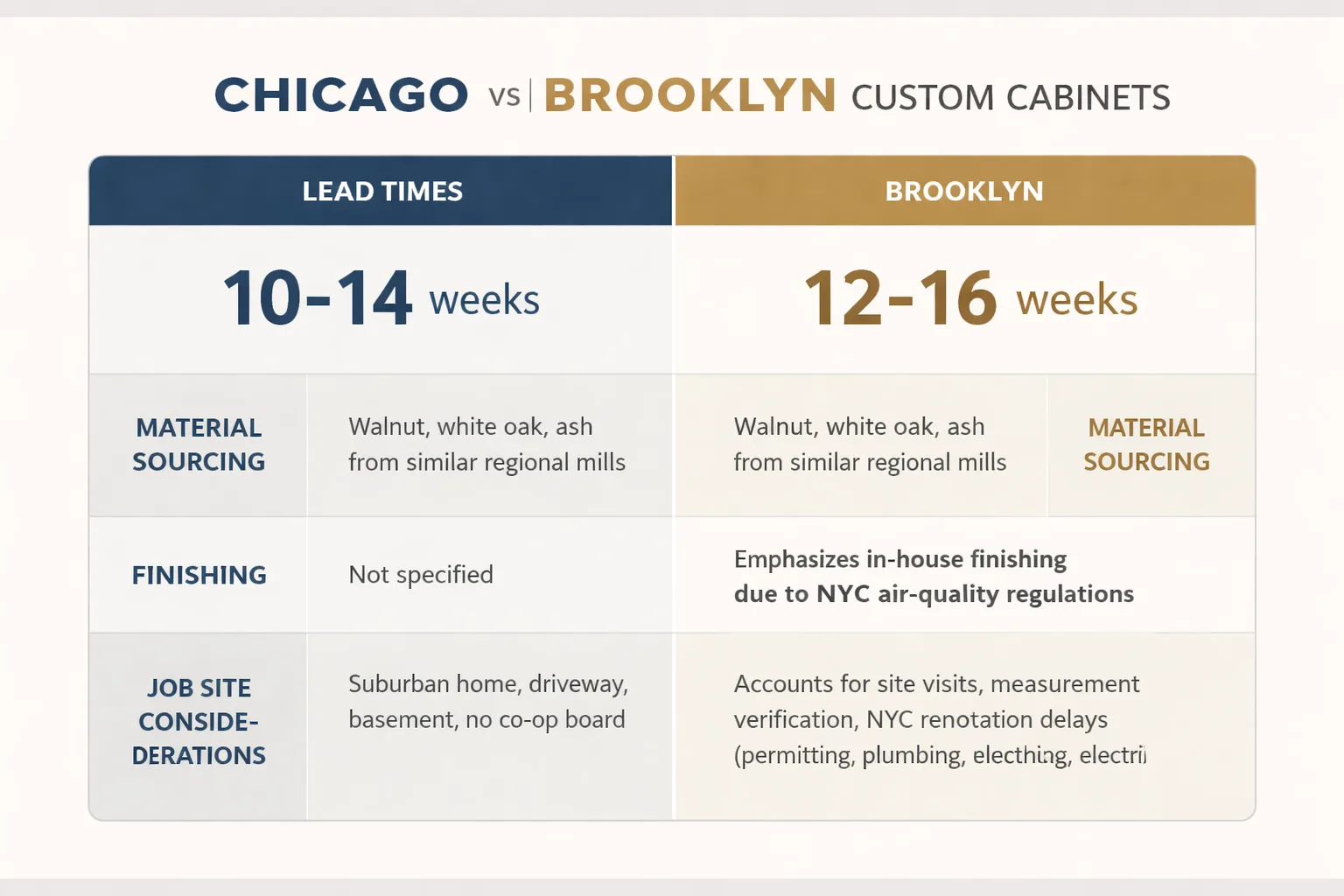
The pattern is clear. Chicago wins on price. Brooklyn wins on fit.
For NYC homeowners, fit is not a luxury. It is a structural necessity.
The material sourcing conversation deserves deeper attention. When a Brooklyn shop sources walnut from a Mid-Atlantic hardwood supplier, the lumber arrives at the shop within 2-3 days. The fabricator can inspect each board, reject pieces with excessive sapwood or grain deviation, and hand-select for color matching across an entire kitchen run. A Chicago shop sourcing from the same supplier has the same access. But a Chicago shop shipping finished cabinets to NYC cannot offer the homeowner a visit to the shop to see the wood selection in person. That experience, walking through a Brooklyn workshop and pointing to the exact walnut slabs that will become the kitchen island, is something no remote fabricator can provide. It changes the homeowner's relationship to the finished product fundamentally.
What Green Cabinets NY Offers That Out-of-Market Shops Cannot
The moment a homeowner chooses an out-of-market fabricator, they assume a set of risks that local shops absorb by default. Green Cabinets NY operates within the NYC metropolitan area, and that proximity creates specific advantages that no Chicago shop can replicate regardless of quality or price.
On-site measurement and verification. NYC apartments have walls that are not plumb, floors that are not level, and corners that are not square. A Brooklyn brownstone kitchen might have a 2-inch variance between the left and right walls. Green Cabinets NY sends a craftsman to measure the space, remeasure after demolition, and verify dimensions before fabrication begins. An out-of-market shop relies on contractor-provided measurements, which introduces a failure point that becomes the homeowner's problem when the cabinets arrive and don't fit.
NYC building code familiarity. Every co-op board, condo association, and landmarked building in NYC has its own renovation requirements. The NYC kitchen cabinet installation process involves DOB filings, insurance certificates, and building-specific rules about work hours, elevator reservations, and waste removal. A Brooklyn shop navigates this daily. A Chicago shop has never heard of an Alteration Agreement Type 2.
Post-installation support. Cabinets settle. Hardware loosens. A door might need a hinge adjustment six weeks after installation. Green Cabinets NY can dispatch someone to make that adjustment in 48 hours. A Chicago shop would need to ship a replacement part, coordinate with a local installer, or fly someone out. The cost of that service is baked into the Brooklyn quote. It is absent from the Chicago quote.
Material expertise for NYC conditions. NYC apartments experience humidity swings from forced-air heating in winter to open-window summers. Green Cabinets NY recommends wood species and construction techniques that account for these swings. For clients seeking dark, textured finishes, walnut has become the go-to species because its dimensional stability and consistent grain minimize the warping and staining issues that plague less forgiving woods in NYC's climate. This is the kind of knowledge that comes from fabricating for NYC spaces specifically, not from building beautiful cabinets in a Chicago workshop and hoping they perform in a Brooklyn brownstone.
The custom millwork process for a Brooklyn renovation involves considerations that out-of-market shops simply don't encounter. Freight elevator dimensions. Stairwell clearances. Loading dock schedules. These aren't exotic problems. They are Tuesday.
Consider the measurement process in detail. A typical Brooklyn brownstone kitchen renovation follows this sequence: initial consultation and design (weeks 1-3), demolition (week 4-5), rough plumbing and electrical (weeks 5-7), and then the critical moment. The walls are open. The old cabinets are gone. The space is finally visible in its raw state. This is when Green Cabinets NY returns to the site with digital calipers, laser levels, and a measuring tape to capture the as-built dimensions. Not the planned dimensions from the architect's drawings. The actual dimensions, which in a 1925 brownstone can deviate from the plans by 1-3 inches per wall. Those measurements go back to the shop, where the CNC machine cuts the cabinet boxes to the real numbers, not the theoretical ones. A Chicago shop doesn't have this moment. They have the architect's drawings and the contractor's measurements, taken with a tape measure and a prayer.
The post-installation support difference deserves its own examination. In the first six months after installation, a typical NYC kitchen experiences settling. Hinges need micro-adjustments. Drawer slides might catch. A panel might develop a hairline gap as the building breathes through its first seasonal humidity cycle. Green Cabinets NY schedules a follow-up visit at the 90-day mark to address these issues. It's standard practice. A Chicago fabricator's warranty covers defects in materials and workmanship, but the practical reality of honoring that warranty from 800 miles away means shipping parts, scheduling a local handyman, and hoping the handyman understands custom cabinetry hardware. The homeowner becomes the middleman in a warranty claim that should be between the fabricator and the product.
How to Evaluate Any Custom Cabinet Maker
Whether the shop is in Brooklyn, Chicago, or anywhere else, the evaluation framework is the same. The difference is that local shops can be held accountable in ways that remote shops cannot.
Portfolio review. Look for projects in buildings similar to yours. A shop that has done three kitchens in pre-war Brooklyn co-ops understands the quirks of those spaces. A shop whose portfolio is all suburban new construction does not. Ask to see installed projects, not just shop photos. Installed photos show fit, finish, and how the cabinets interact with the actual space.
Material transparency. The shop should specify exact wood species, plywood vs. MDF box construction, hinge and slide brands, and finish systems. According to MasterBrand Cabinets, the primary difference between stock and custom cabinetry is the degree of customization and availability. But the deeper difference is material quality. A custom shop using furniture-grade plywood with dovetail drawers and soft-close Blum hardware is building something fundamentally different from a shop using particleboard boxes with stapled drawers, even if both call themselves "custom."
Warranty terms. Read the warranty. Does it cover installation, or just materials? Does it require the shop's own installation team, or does it apply to any installer? What is the response time for warranty claims? A one-year warranty with a 48-hour response time from a local shop is worth more than a ten-year warranty from a shop 800 miles away.
Installation process. Who installs the cabinets? Is installation handled in-house or subcontracted? Does the shop coordinate with the general contractor, plumber, and electrician? In NYC, cabinet installation is never isolated. It connects to plumbing rough-ins, electrical chase locations, and appliance specifications. A shop that treats installation as someone else's problem is a shop that creates problems.
The process of choosing materials for kitchen cabinets should involve a conversation about how those materials perform over time, not just how they look on the day of installation. That conversation is easier to have with a local shop that will be around in five years.
The evaluation process should include a shop visit. Not a website visit. A physical visit to the workshop where the cabinets will be fabricated. A real custom cabinet shop has sawdust on the floor, CNC machines humming, and finish booths with drying racks full of doors in various stages of completion. If the shop is in Chicago, that visit requires a plane ticket. If the shop is in Brooklyn, it requires a 20-minute subway ride. The homeowner who visits the Green Cabinets NY workshop sees the walnut slabs selected for their kitchen, feels the weight of a dovetail drawer joint, and watches the finisher apply the first coat of conversion varnish. That experience builds trust in a way that no portfolio photo can.
Ask specific technical questions during evaluation. What is the thickness of the plywood used for cabinet boxes? (Furniture-grade is typically 3/4-inch, 7-ply birch or maple veneer core.) What brand of hinges and slides are specified? (Blum and Salice are industry standards. Unbranded or generic hardware is a red flag.) What finish system is used? (Conversion varnish is more durable than lacquer. Water-based finishes have lower VOCs but may require more coats for equivalent durability.) How are drawer boxes constructed? (Dovetail joints, particularly half-blind dovetails, indicate a higher level of construction than stapled or doweled joints.) A shop that answers these questions transparently is a shop that takes construction seriously. A shop that deflects or gives vague answers is a shop that cuts corners.
The Total Cost Question Nobody Asks
Here is the contrarian take. The custom kitchen cabinets price comparison between Chicago and Brooklyn is the wrong comparison entirely. Homeowners compare the installation quote. They should be comparing the total cost of ownership over 10 years.
A Chicago-installed kitchen in a Brooklyn apartment carries hidden costs that don't appear in the initial quote. The contractor who has to manage a remote fabricator's delivery schedule. The installer who has to adapt cabinets built to specifications that don't quite match the as-built conditions. The replacement parts that need to be shipped. The adjustments that require a local carpenter because the fabricator is 800 miles away.
Research from Kitchen Search indicates that custom kitchen cabinets cost between $500 and $1,200 per linear foot, but total cost of ownership includes maintenance, repairs, and adjustments that can add 10-20% over a decade. A Brooklyn shop that handles its own installation, provides post-installation service, and can remeasure on-site is pricing those future costs into the initial quote. A Chicago shop is not.
This is the conversation that needs to happen at every Brooklyn design studio. Not "Chicago is cheaper." Not "Brooklyn is better." The conversation is: what are you actually paying for, and what are you giving up when you choose price over proximity?
For NYC developers managing multiple units, the calculus shifts further. The benefits of custom millwork for developers include consistent quality across units, a single point of accountability, and a fabrication partner who can adapt to different building conditions without starting from scratch each time. Those benefits disappear when the fabricator is remote.
Let's break down the hidden costs with a concrete example. A homeowner chooses the Chicago shop at $52,000. The cabinets are ready. Now the logistics begin. Crating and freight from Chicago to Brooklyn: $1,200-$2,000 depending on volume and speed. A liftgate truck for delivery to a building without a loading dock: $350-$500. Co-op building fees for freight elevator reservation and building protection: $500-$1,000 in Manhattan, $200-$500 in Brooklyn. A local installer experienced with remote-fabricated cabinetry (who can handle scribe fitting, filler panels, and on-site adjustments): $4,000-$8,000 for a typical kitchen, compared to $0 additional when a Brooklyn shop includes installation in its quote. Then the adjustments. A filler panel that needs recutting because the wall is 1/2 inch wider than the contractor measured: $200-$400 in local carpenter time plus the delay of ordering a replacement from Chicago. A hinge adjustment six months later: $150-$300 for a local handyman who may not understand the specific hardware system. Add these costs up. The $52,000 Chicago kitchen becomes a $58,000-$63,000 kitchen, and the homeowner has spent 20-30 hours coordinating logistics that a Brooklyn shop would have handled internally.
Wondering whether a Brooklyn or out-of-market fabricator is right for your kitchen renovation?
When Does Chicago Actually Make Sense?
Chicago fabrication makes sense in specific scenarios that are worth naming honestly.
Suburban and standalone homes. If the kitchen is going into a house with a driveway, a basement, and no building board, the logistics simplify dramatically. A Chicago shop can crate and ship cabinets, and a local installer can handle the installation. The price advantage holds.
Large-volume developer orders. A developer building 20 identical units can justify the logistics of remote fabrication because the per-unit cost savings multiply. The specification is locked. The variation is minimal. The installer does the same thing 20 times.
Highly standardized designs. If the kitchen design uses standard dimensions, no unusual angles, and off-the-shelf appliance specifications, a remote shop can fabricate to plan without needing to see the space.
None of these scenarios describe a typical Brooklyn brownstone kitchen renovation.
The typical Brooklyn renovation involves a 90-year-old building with settled floors, a plumbing stack that occupies the corner where the pantry should go, and a co-op board that requires a $5,000 security deposit and a three-week window for the freight elevator. That is the environment Brooklyn shops build for. That is what the price premium buys.
There's a scenario that sits between these extremes. A Brooklyn homeowner with a straightforward kitchen layout in a newer construction condo. The walls are relatively plumb. The building has a loading dock and a freight elevator. The design doesn't require unusual angles or custom integrated features. In this case, a Chicago shop can fabricate to the architect's drawings with reasonable confidence that the cabinets will fit. The homeowner saves $15,000-$25,000 and accepts a slightly higher risk of fit issues. This is the scenario where the Chicago comparison genuinely makes sense. It's also the scenario that describes perhaps 15% of Brooklyn kitchen renovations. The other 85% involve at least one complicating factor that makes remote fabrication a risk.
Sustainable Cabinetry and the Local Advantage
The sustainability conversation connects directly to the local-vs-remote debate. A kitchen fabricated in Chicago and shipped to NYC travels roughly 790 miles by truck. That transportation carries a carbon cost that nobody in the pricing comparison mentions. Local fabrication eliminates that cost entirely.
Green Cabinets NY focuses on sustainable cabinetry practices that include FSC-certified lumber, low-VOC finishes, and waste-reduction workflows in the shop. These practices matter. But the biggest sustainability advantage of local fabrication is the one nobody markets: no cross-country trucking.
For homeowners exploring eco-friendly cabinetry for modern living, the question isn't just what materials go into the cabinets. It's how far those cabinets travel to reach the kitchen. A locally fabricated kitchen using FSC-certified walnut and low-VOC finishes has a fundamentally smaller carbon footprint than a Chicago-fabricated kitchen using the same materials shipped 790 miles.
The sustainable bathroom vanity options available from local NYC fabricators follow the same logic. Local means accountable. Local means adjustable. Local means the person who built the vanity can come back and fix the drawer slide that sticks.
The sustainability math extends beyond transportation. A local shop generates wood waste that stays within the NYC recycling and waste management ecosystem. Green Cabinets NY partners with local wood reclamation programs that redirect cutoffs and surplus lumber to community workshops and school programs. A Chicago shop's waste enters the Chicago waste stream. It never reaches NYC. The local economic multiplier of a Brooklyn fabrication shop, employing Brooklyn residents and paying Brooklyn commercial rent, keeps dollars circulating within the community. These are not abstract sustainability benefits. They are measurable economic and environmental impacts that don't appear in any quote comparison.
Maximizing Small-Space Kitchens with Local Fabrication
NYC kitchens average 70-120 square feet. Chicago suburban kitchens average 200-300 square feet. The design challenges are fundamentally different.
A Brooklyn shop fabricating for a 70-square-foot kitchen has to solve problems that a Chicago shop fabricating for a 250-square-foot kitchen never encounters. Every inch matters. A 2-inch filler panel isn't a detail. It's the difference between a cabinet that fits and a cabinet that doesn't. Custom solutions for maximizing small space kitchens require a fabricator who can work to tolerances that mass production doesn't accommodate.
Integrated storage, pull-out pantries, and appliance garages all require precise fitting to the actual space. Not the planned space. The actual space, which in NYC is always different from the planned space because the building has shifted, settled, and been modified by 90 years of renovations.
This is where the Chicago comparison breaks down completely. The $52,000 Chicago quote assumes a level of dimensional consistency that NYC apartments simply don't provide. When the cabinets arrive and the wall is 1.5 inches out of plumb, the Chicago shop isn't there to recut the filler panel. The Brooklyn shop is.
Consider a specific example. A Park Slope brownstone kitchen measuring 8 feet by 10 feet. The architect's drawings show a straight wall where the refrigerator goes. Demolition reveals that the wall bows inward by 1.5 inches at the center. A Brooklyn fabricator who has measured the as-built space knows this and fabricates the refrigerator housing with a custom scribe panel that accounts for the bow. The installation takes 4 hours. A Chicago fabricator building to the architect's drawings delivers a refrigerator housing built for a straight wall. The installer discovers the bow on installation day. The refrigerator housing doesn't fit. The installer calls the homeowner. The homeowner calls the Chicago shop. The Chicago shop says they built to spec. The architect's spec was wrong. Now the homeowner needs a local carpenter to cut a custom filler, the finish doesn't match because the local carpenter doesn't have the same conversion varnish, and the installation that should have taken one day stretches into three. The $33,000 savings just became $28,000 in savings, and the homeowner has spent two days managing a problem that a Brooklyn shop would have prevented before fabrication began.
Stock vs. Custom Cabinets: Where the Lines Blur
The Chicago vs. Brooklyn comparison often leads homeowners to question whether they need custom cabinets at all. The market offers a spectrum: stock, semi-custom, and fully custom. Understanding where the lines blur helps clarify what the price premiums actually buy.
Stock cabinetry offers limited sizes, typically in 3-inch increments, with a fixed selection of finishes and door styles. According to MasterBrand Cabinets, stock cabinets are mass-produced and readily available, which keeps costs down. A stock kitchen for a 10x10 space might cost $4,000-$8,000. Semi-custom kitchen cabinets bridge the gap. They offer some modification flexibility within standard sizes, with more finish and door style options. Semi-custom projects typically run $10,000-$20,000 for the same 10x10 space. Fully custom kitchen cabinets, built to the exact dimensions and specifications of the space, start around $20,000 and can exceed $80,000 for premium materials and complex configurations.
The blur happens in marketing. Some Chicago shops advertise "custom" cabinetry that is actually semi-custom with limited dimensional flexibility. The homeowner pays a custom price for a product that doesn't offer true custom benefits. A genuine custom shop fabricates every box, door, and drawer to the specific dimensions of the installation space. No filler panels to disguise standard sizes. No compromising on drawer depth to accommodate a stock cabinet's fixed dimensions. No accepting a 12-inch cabinet where an 11-inch cabinet would fit perfectly because the stock line doesn't make an 11-inch cabinet.
For NYC apartments, where every inch matters and walls are rarely straight, the difference between semi-custom and fully custom is the difference between a kitchen that looks good and a kitchen that fits. A 2-inch gap filled with a scribe molding is acceptable in a suburban kitchen with 30 linear feet of cabinetry. In a 70-square-foot Brooklyn kitchen with 12 linear feet, that same 2-inch gap is a design failure.
The Real Decision Framework
The decision between a Chicago fabricator and a Brooklyn fabricator comes down to three questions.
First: what is the total cost of ownership, including installation management, adjustments, and warranty service over 10 years? If the answer is "I don't know," the Chicago quote is incomplete.
Second: who is responsible when something doesn't fit? If the answer is "the contractor," the homeowner is paying for a level of risk management that should be the fabricator's job.
Third: can the fabricator see the space before building? If the answer is no, the fabricator is building to a drawing, not to reality. In NYC, reality and drawings diverge by an average of 1-3 inches per wall.
The data shows that custom kitchen cabinets Chicago quotes run 25-40% below Brooklyn quotes for comparable specifications, but NYC installation of remote-fabricated cabinets adds 15-25% in contractor management, shipping, and adjustment costs that erase most of the savings.
That math doesn't appear in any quote. It appears in the experience.
A more detailed decision framework considers the specific characteristics of the project. What type of building is the kitchen going into? A pre-war co-op with landmark status, an Alteration Agreement, and a freight elevator that runs 9 AM to 3 PM on weekdays only. A new-construction condo with a loading dock and 24/7 freight access. A brownstone with a street-level entrance and no elevator. Each scenario changes the logistics calculus. The pre-war co-op is the hardest environment for remote fabrication. The new-construction condo is the easiest. The brownstone falls in between.
What is the kitchen layout? A galley kitchen with two straight runs of cabinets is more forgiving of measurement errors than an L-shaped kitchen with an island and a custom hood enclosure. Straight runs accommodate filler panels gracefully. Angled installations and integrated features do not.
What level of customization does the design require? Fluted wood panels, integrated appliance housings, custom range hood surrounds, and curved cabinetry all demand precise fabrication to as-built dimensions. Flat-panel doors in a straight run with standard appliance specifications can tolerate more dimensional variance.
The homeowner who answers these questions honestly will find that most Brooklyn renovations fall on the demanding end of the spectrum. That's not a coincidence. NYC spaces are demanding. The fabrication market that serves them has evolved to meet that demand. The price premium reflects the cost of meeting it.
What This Actually Means
The Brooklyn homeowner sitting in that Gowanus studio, staring at a $52,000 Chicago quote next to an $85,000 Brooklyn quote, faces a genuine decision. The price gap is real. The quality gap is not. Both shops can build beautiful cabinets.
The decision is about what happens after the cabinets leave the shop. Who measures the space. Who handles the delivery. Who installs. Who adjusts. Who fixes the hinge that sticks six months later. Who is accountable.
Green Cabinets NY builds custom kitchen cabinets for NYC spaces because NYC spaces demand a fabricator who shows up. The price reflects that commitment. The alternative is a beautiful kitchen built 790 miles away, shipped in a crate, and installed by someone who didn't build it. Sometimes that works. In NYC, it usually doesn't.
The homeowners who run the Chicago comparison almost always come back to the local shop. Not because Brooklyn is cheaper. Because Brooklyn is accountable. And in a city where buildings shift, walls settle, and co-op boards change their minds, accountability is the feature that no price gap can replace.
For those exploring custom walnut kitchen cabinets or other premium material options, the local advantage compounds. Material selection, finish sampling, and construction decisions all benefit from in-person collaboration. A screen can't convey how cerused oak catches afternoon light in a south-facing Brooklyn kitchen. A sample in your hand can.
The Chicago comparison is worth running. It validates that the Brooklyn quote is in the right ballpark for a major metro custom fabrication market. It surfaces the specific cost premiums that NYC fabrication carries. And it clarifies, through contrast, exactly what a Brooklyn shop provides that a remote shop cannot: presence, accountability, and a craftsman who can be at your apartment on Tuesday afternoon.
That is what $85,000 buys. The $52,000 alternative buys cabinets. The difference is everything that happens next.
FAQ
Can I buy cabinets from a Chicago shop and install them in my NYC apartment?
Technically yes. Practically, it requires hiring a contractor experienced with remote-fabricated cabinetry, arranging freight delivery to a building with loading dock and freight elevator access, and accepting that any fit issues become the homeowner's responsibility. The cost savings often shrink once installation management and adjustment costs are included. A $52,000 Chicago quote can become $58,000-$63,000 by the time the kitchen is installed and adjusted in a Brooklyn apartment.
What is the average cost of custom kitchen cabinets in Brooklyn?
Brooklyn custom kitchen cabinet projects typically range from $30,000 to $90,000 depending on kitchen size, material selection, and complexity. A 180-square-foot kitchen with premium materials and integrated hardware commonly quotes between $70,000 and $90,000. Chicago quotes for comparable specifications run 25-40% lower, but the total cost of ownership narrows the gap significantly over the first two years.
How do I know if a cabinet maker is truly custom?
A true custom shop builds to the specific dimensions of the space, offers unlimited sizing and configuration options, fabricates boxes and doors in-house, and provides on-site measurement. According to MasterBrand Cabinets, stock cabinetry offers limited sizes and finishes while custom cabinetry is built to order with extensive personalization. Ask the shop to describe their fabrication process and material specifications in detail. If they can't specify plywood thickness, hinge brands, and finish systems, they're not a true custom shop.
What should I look for in a cabinet warranty?
Look for a warranty that covers both materials and installation, specifies a response time for claims, and comes from a shop that can physically honor it. A lifetime warranty from a shop 800 miles away is less valuable than a five-year warranty from a Brooklyn shop that can dispatch a craftsman in 48 hours. Ask whether the warranty covers labor for adjustments and repairs, or only replacement parts. Parts-only warranties from remote shops leave the homeowner paying for a local carpenter's time.
Are semi-custom kitchen cabinets a good middle ground?
Semi-custom cabinets offer some modification flexibility within standard sizes and can work well for straightforward kitchens. They cost less than full custom but limit dimensional flexibility, which matters in NYC apartments with non-standard walls and tight spaces. For kitchens with unusual angles, integrated features, or tight clearances, full custom fabrication is usually worth the premium. A semi-custom kitchen in a 70-square-foot NYC apartment will almost certainly require filler panels that a custom shop would eliminate entirely.
How far in advance should I order custom cabinets for an NYC renovation?
Order 14-18 weeks before the target installation date. NYC renovations frequently encounter delays at demolition, plumbing, and electrical stages. Building buffer time into the cabinet order allows the fabricator to verify final dimensions after demolition rather than building to pre-demo measurements that may change. A Brooklyn shop that measures post-demolition can adjust the fabrication schedule. A remote shop building to pre-demo drawings cannot.
What wood species performs best in NYC apartment conditions?
Walnut, white oak, and maple are the most stable species for NYC apartments due to their dimensional stability and resistance to humidity-related warping. Walnut is particularly recommended for dark, textured finishes because its consistent grain minimizes staining issues. Softer woods like pine or woods with high movement coefficients like hickory may perform poorly in apartments with significant seasonal humidity swings from forced-air heating and open-window ventilation.
Get a quote from Green Cabinets NY and see exactly what local fabrication, on-site measurement, and post-installation support are worth for your NYC kitchen.