Custom Kitchen Cabinets Houston: What NYC Buyers Can Learn
Custom kitchen cabinets in Houston cost $500 to $1,200+ per linear foot, the same materials as NYC but with lower overhead. Here's what NYC buyers can learn from the comparison and where the premium actually comes from.
Custom Kitchen Cabinets Houston: What NYC Buyers Can Learn
By Green Cabinets NY Team
Key Takeaways
- Custom kitchen cabinets Houston pricing runs $500 to $1,200+ per linear foot, matching Brooklyn quotes but stripping out Manhattan labor overhead, permits, and access costs.
- Houston shops deliver plywood boxes with solid wood fronts at $500 per linear foot, closer to true material and labor costs than NYC rates inflated by building logistics.
- The global kitchen cabinets market will reach $91.07 billion in 2026 and $124.42 billion by 2031 at 5.36% CAGR, while eco-friendly cabinetry grows at 7.19% CAGR to $1.64 billion by 2032.
- NYC buyers should benchmark against Houston's lower labor rates and faster permit cycles to identify exactly where local premiums add cost without changing the cabinet box itself.
Houston is quietly building the kitchens New York City wishes it could afford.
Custom kitchen cabinets Houston pricing runs $500 to $1,200+ per linear foot, and that range holds steady whether the shop is in Texas or Brooklyn. The difference isn't the cabinet box. It's everything around it: labor overhead, permit timelines, building access logistics, and material acclimatization for regional climate. NYC buyers researching custom kitchen cabinets Houston Texas benchmarks are doing something smart. They're using a lower-overhead market to understand what they're actually paying for when they buy locally. Green Cabinets NY builds custom cabinetry in Brooklyn for homeowners and developers across NYC, and the comparison to Houston reveals exactly where NYC premium costs come from and where they don't.
The global kitchen cabinets market sits at $91.07 billion in 2026, growing to $124.42 billion by 2031 at a 5.36% CAGR. Meanwhile, the eco-friendly furniture market is projected to grow from $878 million to $1.64 billion by 2032 at a 7.19% CAGR. Those numbers tell a story: demand for custom, sustainable cabinetry is rising faster than the overall market. NYC buyers who understand the cost structure can make informed decisions instead of overpaying for opacity.
Why Compare Houston and NYC Cabinet Markets?
NYC buyers research Houston pricing for one reason. They want a benchmark that strips out Manhattan overhead to see what cabinetry actually costs.
It's a smart instinct. Houston has lower labor rates, easier building access, and faster permit cycles. When a custom cabinet shop in Houston quotes $500 per linear foot for a plywood box with solid wood fronts, that number is closer to the true material and labor cost. When a Brooklyn shop quotes $1,200 per linear foot for the same spec, the premium covers things that have nothing to do with wood quality: freight elevators, parking permits, co-op approval timelines, and workshop rent per square foot.
The comparison isn't about choosing Houston over NYC. It's about understanding the cost anatomy. A buyer who knows that $400 of the $1,200 per linear foot goes to logistics and overhead can ask better questions. They can push back on inflated quotes. They can prioritize where to spend: solid wood fronts, dovetailed drawers, soft-close hardware. And where to save: box construction, finish complexity, decorative panels that don't need to be premium species.
Green Cabinets NY operates in this premium market. The Brooklyn workshop delivers custom cabinetry built for NYC apartments, co-ops, and developer projects. The team understands that NYC buyers deserve transparency about what drives cost. That's the value of the Houston comparison. It gives buyers a reference point that the local market often obscures.
How Custom Kitchen Cabinet Costs Differ Between Houston and NYC
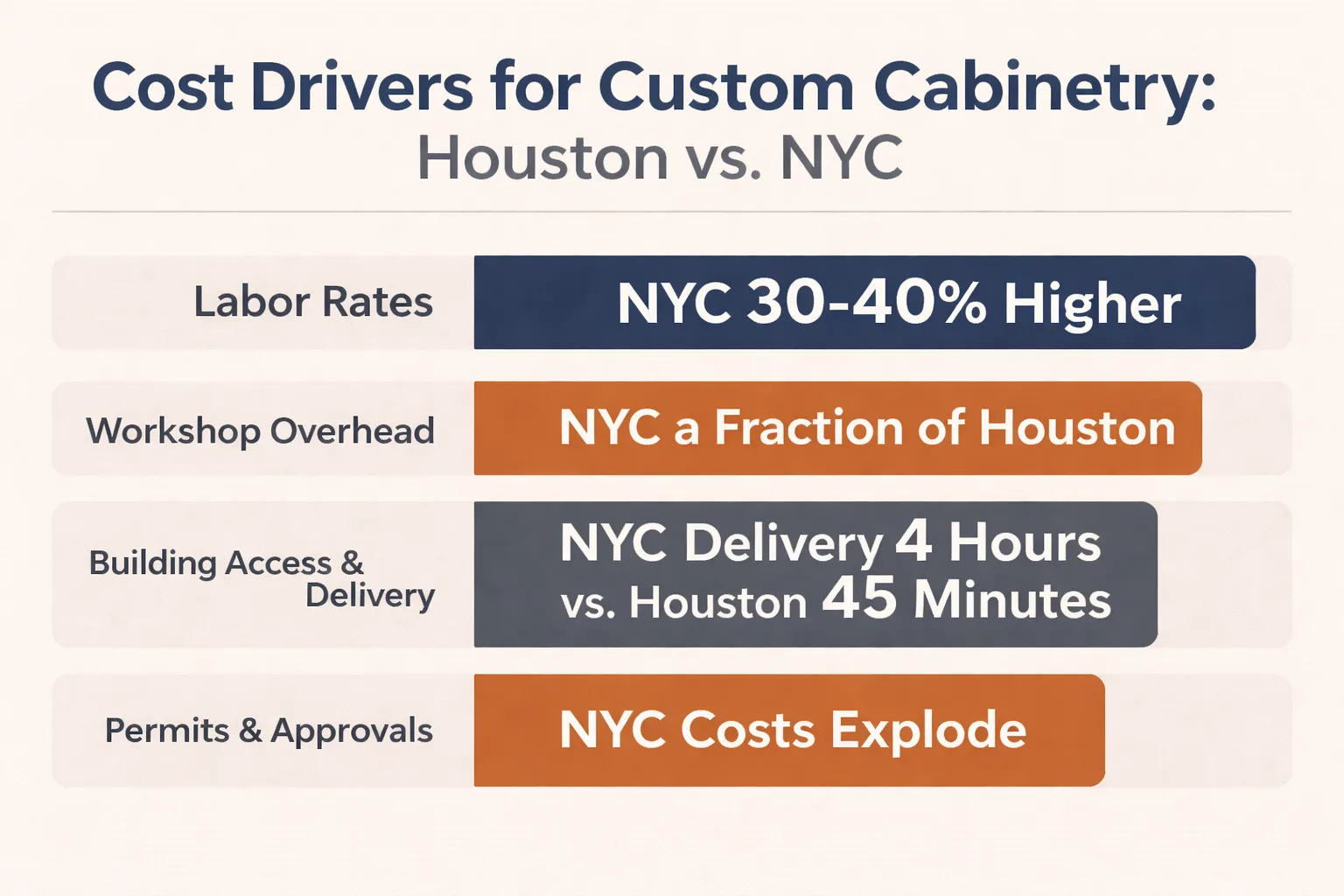
The price gap between Houston and NYC custom cabinetry comes from four cost drivers. None of them involve wood quality.
Labor rates. Texas cabinetmakers earn less than their NYC counterparts. The Bureau of Labor Statistics tracks regional wage differences for woodworkers, and NYC rates run 30 to 40% higher than Houston. That gap flows directly into per-linear-foot pricing.
Workshop overhead. A 3,000-square-foot workshop in Houston costs a fraction of what the same space costs in Brooklyn. NYC shops build that rent into every cabinet. Houston shops don't.
Building access and delivery. This is where NYC costs explode. A Houston delivery truck backs up to a driveway. Two workers carry cabinets through a front door. In NYC, a delivery needs a parking permit, a freight elevator reservation, and sometimes a building superintendent's sign-off. A single cabinet delivery in Manhattan can take four hours. In Houston, it takes 45 minutes. That labor gets billed.
Permit and approval timelines. Houston permit approvals for interior renovations typically take weeks. NYC co-op board approvals can take 3 to 6 months. That timeline risk gets priced into every quote because the shop has to hold capacity and manage scheduling uncertainty.
Stock cabinets run $75 to $250 per linear foot. Custom cabinets run $500 to $1,200+ per linear foot. That gap of $15,000+ for a full kitchen holds across both markets, according to Marfa Cabinets. The difference is that in Houston, the $500 end of custom is achievable. In NYC, $500 per linear foot is nearly impossible because overhead alone consumes $200 to $300 of that number.
This is why some NYC buyers explore options like home depot custom kitchen cabinets or lowes custom kitchen cabinets. Big-box custom lines offer predictable pricing and standardized processes. They rarely match the quality of a dedicated custom shop, but they fill a gap for buyers who need a baseline. The same logic applies to ikea kitchen custom cabinets, which dominate the budget-conscious NYC renovation market. None of these options deliver the material quality, joinery, or finish durability of custom-built kitchen cabinets from a dedicated workshop. But they exist because the custom market in NYC is expensive, and buyers need alternatives.
What Building Custom Kitchen Cabinets Involves in Both Markets
Building custom kitchen cabinets follows the same process whether the workshop is in Houston or Brooklyn. The steps don't change. The execution does.
Design consultation. This is where the project takes shape. A designer measures the space, discusses storage needs, and selects materials. In Houston, this happens in a suburban showroom with plenty of space. In NYC, it happens in a Brooklyn apartment or a compact showroom. The constraints of NYC spaces force more precise planning. Every inch matters when the kitchen is 8 feet wide.
Green Cabinets NY starts every project with a design consultation that accounts for NYC's unique spatial constraints. The team measures, discusses material options like walnut or quartersawn oak, and plans the installation logistics that NYC buildings demand.
Material sourcing. Both markets source from similar suppliers. Plywood, solid wood, hardware, and finishes come from national distributors. The difference is freight. Houston shops receive deliveries by truck with minimal logistics. NYC shops navigate tunnel restrictions, bridge clearances, and parking constraints. Material costs are comparable. Freight costs are not.
Box construction. The cabinet box is the structural foundation. Quality shops use plywood, not particleboard. Plywood resists moisture, holds screws, and survives the humidity fluctuations that NYC apartments experience. Particleboard swells, delaminates, and fails. This is a universal quality marker. A Houston shop cutting corners on box construction produces the same failure as a NYC shop doing the same thing.
Finishing. The finish determines durability. Conversion varnish outperforms lacquer and polyurethane for moisture resistance and longevity. Both markets have access to the same finishing materials. The difference is environmental: Houston's heat and humidity require different curing conditions than NYC's seasonal swings. A good shop in either market accounts for this.
Installation. This is where NYC and Houston diverge sharply. Houston installation is straightforward. Drive to the site, carry cabinets in, level and secure. NYC installation involves building access coordination, freight elevators, potential street closures for delivery, and tight working spaces. A Houston installer might complete a kitchen in two days. The same kitchen in a Brooklyn co-op might take four days because of access constraints alone.
The process of designing and installing custom cabinets in NYC demands a partner who understands these logistics. Green Cabinets NY builds, finishes, and installs from its Brooklyn workshop, which means the team controls every step and can navigate NYC building requirements without relying on third parties who don't understand co-op rules or freight elevator scheduling.
Want to see what custom cabinets should actually cost for your NYC kitchen?
How to Build Custom Kitchen Cabinets: The Fabrication Process
The question of how to build custom kitchen cabinets gets asked frequently, and the answer reveals why custom cabinetry costs what it does. The process involves precise, sequential steps that require specialized equipment and skilled labor.
It starts with the cut list. Every cabinet panel, side, shelf, and face frame gets dimensioned from shop drawings. A CNC machine handles the repetitive cuts with precision. A skilled woodworker handles the joinery: dovetails for drawers, mortise and tenon for face frames, dadoes for shelf attachment.
The assembly stage brings the components together. Drawer boxes get glued and clamped. Face frames get assembled square. Cabinet boxes get assembled with screws, dowels, and sometimes pocket screws for face frames. Every joint needs to be square, flush, and tight.
Finishing comes next. The wood gets sanded through progressive grits, stained or sealed as specified, and topcoated with a durable finish. Conversion varnish is the industry standard for kitchen cabinetry because it resists moisture, heat, and cleaning chemicals. Lacquer looks good but doesn't hold up in a kitchen environment.
Finally, hardware installation. Hinges, drawer slides, knobs, and pulls get attached. Soft-close mechanisms get tested. Doors get aligned. Drawers get adjusted for smooth operation.
This process applies whether someone is building custom kitchen cabinets in Houston or Brooklyn. The skills and equipment are the same. What changes is the cost of the labor, the overhead of the workshop, and the logistics of getting the finished product into the building.
For NYC buyers, understanding this process matters because it helps them evaluate quotes. A shop quoting $500 per linear foot should be cutting corners somewhere: particleboard boxes, vinyl finishes, staple construction. A shop quoting $1,000+ per linear foot should be delivering plywood boxes, solid wood fronts, dovetailed drawers, and conversion varnish finishes. The Houston comparison helps buyers see where the money goes and where it shouldn't.
What NYC Homeowners Should Prioritize That Houston Buyers Skip
Houston buyers and NYC buyers face different priorities. What works in a Houston suburban kitchen doesn't always work in a Brooklyn walk-up.
Plywood over particleboard. This is non-negotiable in NYC. Houston's climate-controlled homes can tolerate particleboard in dry areas. NYC apartments experience humidity fluctuations from steam heat, bathroom proximity, and older building envelopes. Particleboard swells when exposed to moisture. Plywood doesn't. The cost difference is $50 to $100 per cabinet. The lifespan difference is decades versus years.
Green Cabinets NY builds with plywood boxes as a standard. The team also offers solid wood options for buyers who want maximum durability. Species like maple and beech offer excellent hardness and stability for NYC kitchen environments.
Building access planning. Houston buyers rarely think about this. NYC buyers must. Will the cabinets fit in the elevator? Will they fit through the door? Can the delivery truck park legally? These questions determine whether installation takes two days or two weeks. A good NYC cabinet maker designs cabinets in sections that navigate building constraints. A Houston shop might build a 10-foot island as one piece. A NYC shop builds it in two sections that fit in a freight elevator.
Co-op approval timelines. This is the hidden cost of NYC cabinetry. A co-op board can take 3 to 6 months to approve a renovation. During that time, the cabinet shop has to hold production slots, manage material ordering, and coordinate scheduling. That holding cost gets built into the quote. Houston buyers don't face this. NYC buyers can't avoid it.
Custom solutions for small spaces. NYC kitchens are small. The average Brooklyn galley kitchen is 50 to 70 square feet. Stock cabinets don't fit well in these spaces because they come in 3-inch increments and assume plumb walls. NYC apartments have settling walls, out-of-square corners, and uneven floors. Custom cabinets fit the actual space, not the theoretical space. This is where custom cabinets for kitchen spaces in NYC deliver value that stock cabinets from home depot custom kitchen cabinets or lowes custom kitchen cabinets can't match.
Material acclimatization. Wood moves. It expands in humidity and contracts in dry conditions. NYC's seasonal swings from humid summers to dry radiator heat in winter are extreme. Custom cabinets need to acclimate to the apartment before installation. A shop that builds cabinets in a climate-controlled workshop and installs them immediately in a dry NYC apartment risks joint failure. The wood needs 48 to 72 hours in the space to equilibrate. Houston's climate is more consistent, so acclimatization matters less. In NYC, it's essential.
This is also why sustainable bathroom vanities in NYC need special attention. Bamboo and reclaimed wood vanities look beautiful and serve eco-conscious buyers. But without proper acclimatization and sealant, they can warp within 12 to 18 months in a humid NYC bathroom. The aggressive cleaning agents many NYC homeowners use can strip inadequate sealants and expose these materials to moisture damage. A green choice becomes a premature replacement. Green Cabinets NY addresses this with proper finishing protocols and material selection, as detailed in their guide to sustainable bathroom vanities for NYC homes.
Are Trend-Driven Cabinet Choices Worth the Premium?
The Houzz Kitchen Trends Study shows white cabinets declined from 40% to 28% between 2023 and 2026, while wood cabinets rose from 24% to 29%. That shift matters for buyers deciding where to invest.
Trends are expensive. An all-white kitchen installed in 2023 is now considered dated by 2026 trend forecasts. The homeowner who spent $40,000 on white shaker cabinets now faces refinishing or replacement to stay current. The homeowner who chose natural wood fronts can update hardware, change wall color, and refresh the space without touching the cabinets.
This is where the Houston comparison gets interesting. Houston buyers tend to follow national trends closely. The shift from white to wood is visible in both markets. But NYC buyers have an additional consideration: durability in a high-use urban kitchen. Natural wood tones age better than white paint in a kitchen that sees daily use, aggressive cleaning, and tenant turnover in rental properties.
Solid wood cabinets need refinishing every 10 to 15 years. Painted cabinets need touch-ups every 3 to 5 years because paint chips at high-traffic areas: around handles, near the sink, on drawer fronts that get bumped. In a NYC kitchen used three times a day, painted surfaces show wear fast.
The strategy is to incorporate trends subtly. Fluted details on an island front. A wood species with warm tones. A finish that can be updated without replacing the cabinet. Green Cabinets NY helps clients choose designs that incorporate 2026 trends without locking them into a style that ages poorly. The team's approach to sustainable cabinetry means materials that last decades, not seasons.
Custom walnut kitchen cabinets represent a strong choice for longevity. Walnut develops a rich patina over time, hides wear better than painted surfaces, and works across design styles from modern to transitional. It costs more upfront. It saves money over 15 years because it doesn't need repainting or replacing.
Can You Buy Custom Kitchen Cabinets Online?
The online custom kitchen cabinets market has grown significantly. Buyers in Houston, Phoenix, San Antonio, and other markets with less dense custom cabinetry infrastructure often turn to online options. The appeal is obvious: lower prices, broader selection, and convenience.
But online custom cabinetry has real limitations. The buyer can't see the wood in person. Finish colors look different on screen than in hand. Measurements need to be perfect because there's no installer coming to verify. And when something goes wrong, the buyer is dealing with a remote shop that may not have local service capacity.
For NYC buyers, online custom cabinetry is rarely the right choice. The spatial constraints, building access issues, and installation logistics demand a local partner. A shop that can't send someone to measure the space, check the elevator dimensions, and coordinate with the building is a liability.
Houston buyers can make online cabinets work more easily because their spaces are larger, access is simpler, and installation is less complex. A buyer in a Houston suburb can order custom kitchen cabinets online, accept delivery in a driveway, and hire a local installer. A buyer in a Brooklyn co-op can't do that.
The same logic applies to big-box custom options. Custom kitchen cabinets home depot and custom kitchen cabinets lowes offer convenience and pricing transparency. They work for straightforward spaces. They struggle with the irregular layouts, non-standard dimensions, and building constraints that define NYC kitchens.
What About Custom Kitchen Pantry Cabinets?
Custom kitchen pantry cabinets deserve specific attention because they represent one of the highest-value applications of custom cabinetry. A well-designed pantry cabinet can add 30 to 50% more functional storage to a kitchen without expanding the footprint.
In Houston homes, pantry cabinets are often large walk-in spaces. The cabinetry is straightforward: shelving, maybe a countertop, and storage for bulk items. In NYC apartments, a pantry cabinet might be 12 inches deep by 24 inches wide by 84 inches tall. Every inch matters. Custom construction allows pull-out shelves, spice racks, and specialized storage that stock cabinets can't provide in that footprint.
The cost of a custom pantry cabinet runs $800 to $2,500 depending on configuration, materials, and hardware. That sounds expensive until you compare it to the cost of adding square footage in NYC. A custom pantry cabinet that adds 20 cubic feet of storage in a Brooklyn kitchen costs $1,500. Adding 20 cubic feet to the apartment footprint would cost $50,000+ in construction alone.
This is where custom cabinets for kitchen spaces in NYC deliver their strongest value proposition. They maximize utility in minimal space. Stock cabinets can't do this because they come in standard sizes that don't fit NYC's irregular layouts.
What Does Custom Cabinet Lifespan Actually Look Like?
The lifespan question is where the Houston vs. NYC comparison gets complicated. No primary source provides regional lifespan data for custom cabinetry. What's known comes from material science and construction methods.
Plywood cabinet boxes with solid wood fronts, dovetailed drawers, and conversion varnish finishes can last 30 to 50 years. The wood itself lasts indefinitely with proper care. What fails first is the finish, the hardware, and the adhesives.
Houston's climate is hot and humid but consistent. Wood acclimates to that environment and stays relatively stable. NYC's climate swings from humid summers to dry winters with radiator heat. That swing stresses joints, finishes, and materials. A cabinet built for Houston's climate might perform differently in NYC.
This is why material selection matters more than market comparison. A buyer who chooses solid wood fronts, plywood boxes, and quality hardware gets longevity regardless of where the cabinets are built. A buyer who chooses particleboard boxes, vinyl finishes, and cheap hardware gets premature failure regardless of market.
Green Cabinets NY builds for NYC conditions. The team selects materials that handle humidity swings, uses finishes that resist cleaning chemicals, and constructs joints that survive thermal cycling. Species like alder, birch, and rustic hickory offer different aesthetic and performance profiles for NYC buyers to consider.
Should NYC Buyers Consider Houston Cabinet Shops?
The contrarian take: some NYC buyers should consider Houston cabinet shops. Not for the cabinetry itself, but for specific components.
Custom kitchen cabinets doors are one area where remote fabrication can work. A Houston shop can build cabinet doors to exact specifications and ship them to NYC. The doors don't require building access coordination. They ship via freight in manageable sizes. The buyer saves on labor costs for door construction while keeping the box construction local.
This hybrid approach works for buyers who want premium wood species without the NYC premium. Custom walnut kitchen cabinets doors built in Houston and shipped to Brooklyn can save 20 to 30% on the door component. The box construction stays with a local shop like Green Cabinets NY that understands NYC building requirements.
The risk is finish matching. A door finished in Houston might not exactly match a box finished in Brooklyn. Different spray environments, different humidity during curing, and different finish applicators can produce subtle color differences. For some buyers, that's acceptable. For others, it's not.
This approach also works for buyers in other markets who are researching custom kitchen cabinets phoenix arizona, custom kitchen cabinets phoenix az, or custom kitchen cabinets san antonio. The same logic applies: remote fabrication for specific components, local fabrication for boxes and installation.
Why Discount Custom Kitchen Cabinets Usually Cost More
The search for affordable custom kitchen cabinets leads many buyers to discount options. The results are predictable.
Discount custom kitchen cabinets, cheap custom kitchen cabinets, and inexpensive custom kitchen cabinets all share a common approach: they reduce costs by reducing quality. Particleboard instead of plywood. Vinyl wrap instead of conversion varnish. Stapled joints instead of dovetails. Imported hardware instead of domestic soft-close systems.
The initial savings are real. A discount custom cabinet might cost $300 per linear foot instead of $800. On a 20-foot kitchen, that's $10,000 saved. But the lifespan difference is dramatic. A quality custom cabinet lasts 30+ years. A discount cabinet might need replacement in 8 to 10 years. Over 30 years, the discount cabinet gets replaced three times. The total cost is higher.
This is the calculation NYC buyers need to make. The Houston comparison helps because Houston has more shops operating in the $400 to $600 per linear foot range. NYC shops operate more commonly in the $800 to $1,200 range. The gap is real. But the quality difference between a $400 Houston cabinet and a $400 NYC cabinet is zero. The NYC cabinet costs more because of overhead, not because of better materials.
The right question isn't "how can I get custom cabinets for less?" It's "what am I getting for the money?" A buyer who understands the cost breakdown can make that assessment. A buyer who doesn't understand it either overpays for opacity or underpays for quality and lives with the consequences.
Green Cabinets NY provides transparent pricing that accounts for NYC's real costs. The Brooklyn workshop builds cabinets designed for NYC spaces, NYC buildings, and NYC conditions. The premium isn't arbitrary. It reflects real logistics, real labor, and real overhead. Understanding the Houston comparison helps buyers see that distinction clearly.
FAQ
What is the average cost of custom kitchen cabinets in Houston vs. NYC?
Custom kitchen cabinets in Houston typically cost $500 to $1,000 per linear foot. In NYC, the range runs $800 to $1,200+ per linear foot. The difference comes from labor rates, workshop overhead, building access logistics, and permit timelines. The materials and construction methods are comparable across both markets.
How long do custom kitchen cabinets last?
Well-built custom cabinets with plywood boxes, solid wood fronts, dovetailed joinery, and conversion varnish finishes last 30 to 50 years. Painted cabinets need refinishing every 10 to 15 years. The finish and hardware are the first components to need attention. The wood structure itself lasts indefinitely with proper care.
Can I order custom kitchen cabinets online for an NYC apartment?
Online custom cabinetry works for simple, rectangular spaces with easy access. NYC apartments rarely qualify. The irregular layouts, building access constraints, and installation logistics demand a local partner who can measure in person, coordinate with buildings, and handle installation. Online cabinets are better suited for Houston, Phoenix, or San Antonio where spaces are larger and access is simpler.
What materials should NYC buyers prioritize for custom cabinets?
NYC buyers should prioritize plywood box construction over particleboard, solid wood fronts over veneered MDF, and conversion varnish finishes over lacquer or polyurethane. These choices address NYC's humidity fluctuations, aggressive cleaning, and high-use patterns. Wood species selection matters less than construction quality: a well-built maple cabinet outlasts a poorly built walnut one.
Are big-box custom cabinets from Home Depot or Lowe's worth considering?
Big-box custom lines offer pricing transparency and standardized processes. They work for straightforward spaces with standard dimensions. They struggle with NYC's irregular layouts, non-standard sizes, and building access requirements. For a Brooklyn galley kitchen with out-of-square walls, a dedicated custom shop delivers better fit, better materials, and better longevity.
How does the co-op approval process affect custom cabinet timelines in NYC?
Co-op board approvals can take 3 to 6 months in NYC. During that time, the cabinet shop must hold production capacity, manage material ordering, and coordinate scheduling. This holding cost gets built into the quote. Houston buyers face no equivalent timeline. NYC buyers should factor this into their renovation planning and start the approval process early.
Get a transparent quote from Green Cabinets NY and understand exactly where every dollar goes in your custom kitchen cabinet project.