Custom Walnut Kitchen Cabinets: Are They Worth It in NYC?
Custom walnut kitchen cabinets are surging in Brooklyn and Manhattan for 2026. This guide breaks down cost, durability, maintenance, and whether walnut is actually worth the premium in a NYC kitchen.
By Green Cabinets NY Team
Key Takeaways
- Roughly 9.8 million tons of old cabinets reach U.S. landfills annually, pushing 61% of homeowners to rank sustainability among their top three renovation priorities.
- The sustainable cabinet market is projected to hit $16.5 billion by 2030, with walnut as the durable hardwood that accepts low-VOC finishes and refuses to look dated.
- NYC clients selecting custom walnut cabinets reject the 3-to-5-year replacement cycle that defines cheaper factory-made cabinetry.
- Lighter, clear-finished walnut now dominates Brooklyn and Manhattan renovations for its tight grain, resistance to warping, and pairing with white oak floors and brass hardware.
Walnut has been the prestige wood of American cabinetmakers since at least the mid-1800s, when Victorian craftsmen prized its tight grain and natural resistance to warping in the damp, unpredictable climates of northeastern cities. Early New York brownstones were fitted with walnut millwork as a deliberate signal of permanence and taste. A tradition that never fully disappeared, even as factory-made cabinetry swept the postwar market. Today, custom walnut kitchen cabinets are experiencing a documented resurgence in Brooklyn and Manhattan, not as nostalgia, but as a calculated response to a renovation market that increasingly rewards quality, sustainability, and longevity over speed.
The data backs the shift. Roughly 9.8 million tons of old cabinets reach U.S. landfills annually, and 61% of homeowners now rank sustainability among their top three renovation priorities, per NAHB survey data. The sustainable cabinet market is projected to hit $16.5 billion by 2030. Walnut sits at the intersection of these forces: a durable hardwood that ages gracefully, accepts low-VOC finishes, and refuses to look dated. Green Cabinets NY has built walnut projects across Brooklyn and Manhattan, and the pattern is consistent. Clients who choose walnut are not chasing a trend. They are rejecting the 3-to-5-year replacement cycle that defines cheaper cabinetry.
Why Walnut Is Having a Moment in NYC Kitchens
Walk through a Brooklyn brownstone renovation in 2026 and walnut is the wood you keep seeing. Not the dark, glossy, almost black walnut of the 1990s. The current look is lighter, warmer, often finished with a natural or clear coat that lets the wood's chocolate-to-honey grain do the talking. It pairs with white oak floors, brass hardware, and the transitional aesthetic that dominates NYC interior design right now.
The resurgence is not purely aesthetic. Walnut offers genuine functional advantages for New York apartments. The wood has a tight, fine grain that resists warping in the humidity swings typical of older buildings. It is dimensionally stable. It does not move the way maple or oak can when the radiator kicks on in October and the apartment goes from 40% to 20% relative humidity in a week. That stability matters in pre-war buildings where walls are rarely plumb and a cabinet that shifts even an eighth of an inch can throw off an entire run.
Green Cabinets NY has worked with walnut across a range of Brooklyn projects, from Park Slope galley kitchens to Williamsburg loft islands. The consistent feedback is that walnut delivers a warmth that painted MDF and white oak simply cannot replicate. The grain has depth. The color has natural variation that reads as character, not inconsistency. In a city where so many apartments suffer from poor natural light, that warmth is a functional asset, not just a style preference.
The market signals align. When comparing top custom kitchen cabinet providers and 2026 design trends, walnut consistently appears in the premium tier of material offerings. It is not the cheapest option. It is the one that holds value longest.
The aesthetic versatility of walnut also explains its current dominance. In a Brooklyn Heights pre-war conversion, walnut flat-panel doors with integrated pulls read as modern and clean. In a Bed-Stuy brownstone restoration, walnut shaker doors with antique brass knobs read as classic and grounded. The same wood, finished the same way, serves entirely different design visions. Few materials offer that range. Painted MDF locks you into a specific color story. Oak locks you into a grain pattern that reads as traditional. Walnut adapts. That adaptability matters in a market where resale value depends on broad aesthetic appeal. A buyer who might reject a green-painted kitchen will almost never reject walnut.
There is also a tactile dimension that photographs do not capture. Walnut has a density that feels substantial when you close a drawer. The sound is different from the hollow report of a thermofoil door. In a luxury renovation where every detail is scrutinized, that tactile quality reinforces the perception of value. Clients who have lived with builder-grade cabinetry notice the difference immediately. The door closes with a muted, solid contact rather than a plastic click. That sounds trivial. It is not. The daily sensory experience of interacting with cabinetry is what determines whether a client feels the renovation was worth the investment six months after completion.
What Makes Walnut Different From Other Cabinet Woods
Understanding walnut means understanding the alternatives. The most common comparison points are maple, oak, and painted MDF. Each has distinct properties that affect how cabinets perform in a NYC kitchen over a 10-to-20-year horizon.
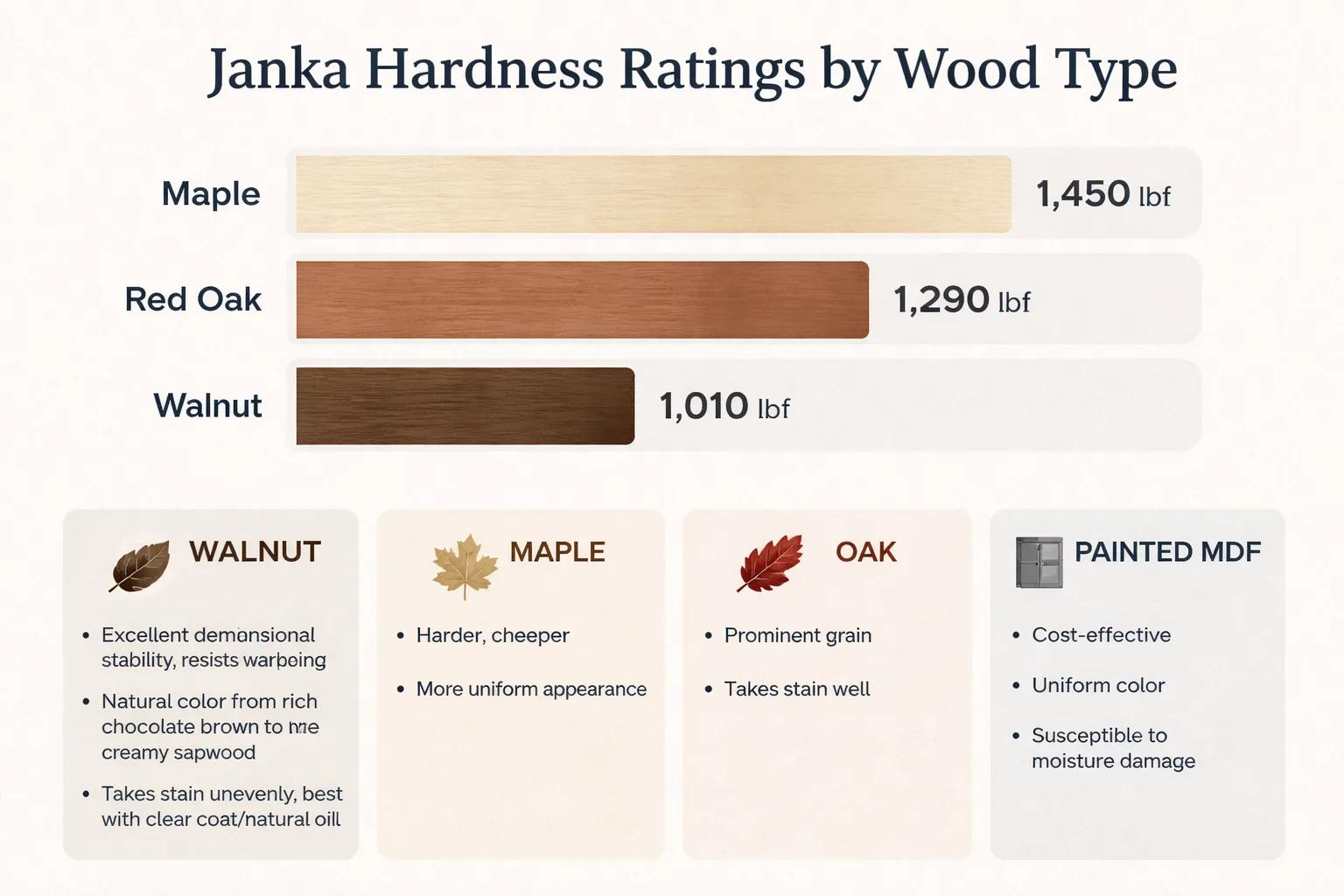
Walnut is a hardwood with a Janka hardness rating around 1,010 lbf. That places it below maple (1,450 lbf) and red oak (1,290 lbf) on raw dent resistance, but walnut's tight grain structure gives it excellent dimensional stability. It resists warping and movement better than harder species. The natural color ranges from a rich chocolate brown heartwood to a lighter, sometimes creamy sapwood. This variation is a feature, not a defect, though buyers who want uniformity sometimes find it challenging. Walnut takes stain unevenly because the wood's pore structure absorbs pigment at different rates, which is why most premium walnut cabinets are finished with a clear coat or natural oil rather than heavy stain.
Maple is harder, cheaper, and more uniform. It accepts paint and stain beautifully. But maple has a tendency to develop a yellowish tint over time when exposed to UV light, which can shift the color of a white-painted maple cabinet noticeably within five years. In south-facing Brooklyn apartments, this is a real problem.
Oak has an open, pronounced grain that reads as traditional. It is durable and affordable but harder to make look contemporary. Rift-sawn white oak has become the modern alternative, but that is a different species with different pricing.
Painted MDF is the budget choice. It offers a perfectly smooth painted finish with no grain telegraphing. But MDF does not age. It does not develop character. If it chips or absorbs moisture at an edge, it swells irreversibly. The Savona Design comparison guide frames the decision as dependent on style, lifestyle, and budget, and notes that whether a cabinet finish holds up in a busy household or starts looking rough after three years is a key decision factor. The guide provides qualitative framing but no head-to-head numerical benchmarks. The absence of hard comparative data is itself a finding. The industry talks about durability in generalities because no standard testing protocol exists for comparing cabinet wood species in residential conditions.
For a deeper look at how another premium hardwood compares, the white oak cabinet design guide covers rift-sawn white oak as the primary alternative to walnut in modern NYC kitchens.
The staining behavior of walnut deserves special attention because it trips up homeowners who come to the material with expectations formed by working with oak or maple. Walnut's pore structure is what woodworkers call "filled but variable." The pores are small enough to create a smooth surface, but they absorb pigment at different rates depending on the density of each growth ring. This means that a dark stain applied to walnut will look blotchy. The heartwood areas absorb more pigment and go nearly black. The sapwood areas absorb less and remain light. The result is a high-contrast, muddy appearance that obscures the natural grain. This is why experienced cabinetmakers almost always recommend a clear coat or a light natural oil finish for walnut. The wood does not need enhancement. It needs protection.
Aging behavior is the other differentiator that matters in NYC specifically. Over a 10-year period, walnut darkens and deepens. The initial chocolate brown shifts toward a richer, almost purplish brown. The grain becomes more pronounced as the wood oxidizes. This is a desirable patina. Maple, by contrast, yellows. White paint on maple develops a warm, then yellow, then distinctly amber cast over 5-8 years. Oak remains relatively color-stable but its open grain collects grease and dirt in a way that walnut's tight grain does not. Painted MDF does not change color, but the paint itself can crack at joints where the substrate expands and contracts. Each aging profile has maintenance implications. Walnut's aging is purely aesthetic and generally welcomed. Maple's aging often requires repainting. MDF's aging often requires replacement.
How Much Do Custom Walnut Kitchen Cabinets Cost in NYC?
The custom kitchen cabinets cost question is the one Brooklyn homeowners ask first, and the honest answer is that walnut sits at the top of the pricing spectrum. The cost of custom kitchen cabinets varies based on wood grade, finish, construction method, and hardware, but walnut commands a premium because the raw material itself is expensive and because working with it requires experience.
Several factors drive the price of custom kitchen cabinets when walnut is the species. Solid walnut construction, where door panels and face frames are built from solid lumber, is the most expensive option. Walnut veneer over a stable substrate (MDF or plywood) reduces material cost while delivering the same visual appearance. The difference matters for durability. Solid walnut can be refinished, sanded, and repaired. Veneer cannot. For a kitchen that will see heavy use, solid construction is the better long-term investment despite the higher upfront cost.
Finish type affects both cost and performance. A catalyzed conversion varnish is the most durable factory finish. It resists moisture, heat, and chemicals. It is also the most expensive. Natural oil finishes are cheaper and look stunning on walnut, but they require periodic reapplication and offer less protection against water rings and grease splatter. Hardware selection can add 15 to 30 percent to the total project cost. Soft-close hinges and drawer slides are standard in custom work. Integrated pulls, handleless profiles, and specialized storage accessories add to the bottom line quickly.
Green Cabinets NY approaches walnut projects with a transparent pricing model. The team provides detailed quotes that break down material, labor, finish, and hardware costs separately so clients understand exactly what they are paying for. The custom kitchen cabinets buying guide covers what NYC buyers should expect in terms of deliverables, timelines, and contract specifics.
For comparison, semi custom kitchen cabinets from national brands typically run 40 to 60 percent less than fully custom walnut cabinetry. The trade-off is that semi-custom options use standard sizes, limited finish choices, and no ability to tailor the design to awkward NYC kitchen layouts. In a Brooklyn pre-war kitchen with non-standard dimensions, that limitation often means filler panels and wasted space.
The cost for custom kitchen cabinets also depends on the scope of the project. A small galley kitchen with 12 linear feet of cabinetry will have a different price profile than an L-shaped kitchen with 25 linear feet plus an island. The per-linear-foot cost of walnut cabinetry is higher than other species, but the total project cost is also influenced by the number of cabinets, the complexity of the installation, and the level of customization required. Corner cabinets, pull-out pantries, and integrated appliance panels all add to the cost. A simple run of flat-panel walnut cabinets will be significantly less expensive than a kitchen with curved corners, custom hoods, and integrated refrigeration panels, even if the wood species is identical.
The wood grade also affects the custom kitchen cabinets price. Walnut is graded by the National Hardwood Lumber Association, and the grade determines how much usable, clear material can be extracted from a board. FAS (First and Seconds) is the highest grade, yielding the longest clear cuts with minimal sapwood. FAS walnut is what premium cabinetmakers use. Lower grades like #1 Common contain more knots, sapwood, and color variation. Some manufacturers use lower-grade walnut and call it "rustic" or "character grade" to justify the appearance while charging a premium. Buyers should ask specifically what grade of walnut is being used. The price difference between FAS and #1 Common can be 30-40 percent on the raw material, which translates to a meaningful difference in the total project cost.
Another cost factor specific to NYC is logistics. Delivering cabinetry to a fourth-floor walkup in Carroll Gardens requires more labor than a ground-level delivery in a suburban home. NYC parking restrictions, elevator reservations, and building COI (Certificate of Insurance) requirements all add time and cost to the installation process. These are not optional line items. They are the reality of working in the city. Green Cabinets NY factors these costs into the initial quote so there are no surprises on installation day.
Thinking about walnut for your kitchen? See how it compares to other premium hardwoods.
Is Walnut the Right Choice for Your Brooklyn Kitchen?
This is where the decision gets real. Walnut is not the right answer for every kitchen, and pretending otherwise does a disservice to homeowners evaluating a significant investment.
Walnut shines in these scenarios. Kitchens with limited natural light benefit from walnut's inherent warmth. The wood adds visual depth without darkening the space the way a painted dark cabinet would. Transitional and contemporary designs pair naturally with walnut because the grain provides texture without requiring decorative detailing. Kitchens where the cabinetry is the design statement (rather than tile, stone, or lighting) benefit from a wood that rewards close inspection. Walnut is also the right choice for homeowners who plan to stay in their space for 10-plus years and want a material that ages into character rather than into obsolescence.
Walnut may not be the right choice when the budget is constrained. If the total kitchen budget cannot accommodate premium cabinetry without sacrificing on appliances, plumbing, or electrical work, choosing walnut creates an imbalance. A well-equipped kitchen with maple or oak cabinets will serve a family better than a walnut kitchen with an underpowered range and inadequate ventilation. Walnut is also a stretch for households where the kitchen sees heavy, messy daily use from young children. The natural finish that makes walnut beautiful shows water spots and fingerprints more readily than a painted surface. A dark painted MDF cabinet (navy, forest green, charcoal) may be more practical for a family of five that cooks three meals a day.
The decision framework should account for kitchen size, lighting, lifestyle, and design style. For small NYC kitchens where storage optimization is the primary concern, the small kitchen renovation guide covers how to maximize space regardless of wood species. For gut renovations where the entire layout is being reimagined, the NYC gut renovation planning guide walks through the full process from demolition through installation.
The contrarian take: most Brooklyn kitchens do not need walnut. They need better design. A well-configured kitchen in ash or maple with smart storage will outperform a poorly planned walnut kitchen every single time. The wood species is the last decision, not the first. Clients who lead with material selection before resolving layout, workflow, and storage needs end up with beautiful cabinets in a kitchen that does not function. Green Cabinets NY has seen this play out repeatedly. The first conversation should be about how the family cooks, where the trash goes, what gets stored where. The wood choice follows from that, not the other way around.
Consider a concrete example. A family in a Clinton Hill co-op had their heart set on walnut cabinetry. They had a budget that could accommodate it, but only if they cut corners on the layout. The original kitchen had a dysfunctional triangle with the refrigerator blocking a walkway. Moving the refrigerator required relocating a plumbing line, which ate into the budget. The choice was walnut cabinetry in the dysfunctional layout, or ash cabinetry in a reconfigured layout that fixed the workflow. They chose ash. Two years later, they cook every day in a kitchen that works. The ash has aged well. They do not regret the decision. The wood species was secondary to the function.
Another example: a couple in a DUMBO loft with floor-to-ceiling windows and abundant natural light chose walnut for a kitchen island only, paired with white oak perimeter cabinets. The walnut island serves as the visual anchor of the space. The white oak keeps the perimeter light and bright. This hybrid approach delivered the walnut aesthetic where it would have the most impact, while managing cost by using a less expensive species for the bulk of the cabinetry. This is the kind of strategic material allocation that a good custom cabinet maker will suggest. It is not about using the most expensive wood everywhere. It is about using it where it matters.
How to Care for Walnut Cabinets in a NYC Home
Walnut is a low-maintenance wood, but low does not mean zero. The specific care requirements differ from painted or lacquered cabinets, and understanding them before purchase prevents frustration three years in.
UV exposure is the biggest concern. Walnut darkens naturally over time when exposed to light. This is a desirable aging process for most owners, but it can create uneven coloration if only parts of the cabinet are exposed to sunlight. A south-facing Brooklyn kitchen with large windows will see the cabinet doors on the sun-facing wall darken faster than the cabinet doors on the interior wall. The solution is not to block the light. It is to rotate items on open shelving periodically and, for closed cabinets, to accept that the wood will deepen. Using UV-filtering window film reduces the rate of change without eliminating it.
Cleaning should be simple. A damp microfiber cloth with mild soap is sufficient for daily cleaning. Avoid abrasive sponges, spray cleaners with ammonia, and anything labeled as a degreaser. Walnut's finish (whether conversion varnish or oil) is designed to repel normal kitchen soil. Harsh cleaners strip the protective layer and accelerate wear. For oil-finished walnut, a light reapplication of food-safe mineral oil or a dedicated wood oil every 6 to 12 months keeps the wood hydrated and prevents the dry, chalky appearance that develops in low-humidity NYC apartments during winter.
Scratches and dings are repairable. This is one of walnut's genuine advantages over painted MDF. A scratched painted cabinet requires color-matching paint and careful blending. A scratched walnut cabinet can often be repaired with a wax fill stick in a matching tone, or for deeper damage, sanded and re-oiled locally. The repair blends into the surrounding grain because the wood's natural variation hides the transition. Green Cabinets NY provides clients with a small repair kit matched to their specific finish on every walnut project.
Humidity management matters more than cleaning. NYC apartments experience extreme humidity swings. Radiator heat in winter can drop interior humidity below 20 percent. Summer humidity can push it above 70 percent. These swings cause wood to expand and contract. Walnut is dimensionally stable for a hardwood, but it still moves. A whole-apartment humidifier set to 35-45 percent relative humidity protects not just cabinets but hardwood floors, musical instruments, and even skin. The investment pays for itself across multiple materials.
The seasonal care calendar for walnut in NYC is straightforward. In fall, before radiator season begins, inspect cabinet joints for any gaps that appeared during the summer humidity. These are normal and will close when the air dries out, but monitoring prevents panic. In winter, run a humidifier. The dry air is the single most damaging factor for wood cabinetry in NYC apartments. Cracking, checking, and joint separation are almost always caused by low winter humidity, not by anything the homeowner did wrong. In spring, wipe down all cabinet exteriors with a damp cloth to remove any accumulated winter dust. In summer, check that the range hood is functioning properly. Cooking generates significant moisture, and if the ventilation is inadequate, that moisture settles on cabinet surfaces and can dull the finish over time.
For oil-finished walnut specifically, the re-oiling process is simple but requires attention. Use a clean cotton rag to apply a thin coat of food-safe mineral oil or a dedicated walnut oil. Let it sit for 15-20 minutes, then wipe off all excess with a clean cloth. Never leave pooled oil on the surface. It will become sticky and attract dust. The wood should absorb what it needs in that time. If the oil beads up on the surface, the wood does not need re-oiling yet. Check again in three months. The frequency depends on the apartment's humidity levels. A dry apartment may need oiling every 4 months. A moderately humid apartment may only need it once a year.
What’s the difference in custom walnut vs semi-custom?
The comparison between custom build kitchen cabinets and semi-custom options is not just about price. It is about what the homeowner gets for the difference, and whether that difference matters in a NYC kitchen.
Semi-custom kitchen cabinets are manufactured in standard widths, typically in 3-inch increments (12, 15, 18, 21 inches, and so on). The manufacturer offers a range of door styles, finishes, and hardware options. The homeowner selects from a catalog. The cabinets are built to order but within fixed parameters. The advantage is cost. Semi-custom cabinetry from national brands can be 40-60 percent less expensive than fully custom walnut cabinetry. The disadvantage is fit. In a Brooklyn pre-war kitchen where walls are not square, floors are not level, and dimensions do not align to 3-inch increments, semi-custom cabinets require filler strips. Filler strips are the telltale sign of a kitchen that was designed to fit the cabinets rather than cabinets that were designed to fit the kitchen.
Fully custom walnut cabinetry from Green Cabinets NY is built to the specific dimensions of the space. Every cabinet is sized to fit. There are no filler strips. There are no compromises. The cabinet maker visits the site, measures the space (often multiple times, because NYC walls can shift between the measuring visit and the installation date), and builds the cabinetry to those exact dimensions. This is particularly important in galley kitchens, where even an inch of wasted space on each side of a run adds up to a meaningful loss of storage. It is also important in corner installations, where a custom cabinet can access space that a standard corner cabinet cannot.
The construction quality also differs. Custom walnut cabinets from a reputable maker use solid wood face frames, dovetailed drawer joints, and full-extension soft-close drawer slides. The drawers are often built with solid walnut sides, not just walnut fronts. The interior of the cabinet can be specified. Some clients want a matching walnut interior for glass-front display cabinets. Others prefer a lighter maple or poplar interior to reduce cost without affecting the exterior appearance. Semi-custom cabinets typically use MDF or plywood interiors with a wood-grain vinyl coating. The difference is not visible from the outside, but it affects the cabinet's longevity and the homeowner's daily experience of using it.
The finish quality is another differentiator. Custom walnut cabinets are typically finished with a catalyzed conversion varnish that is sprayed in a controlled environment. This produces a uniform, durable coating that resists moisture, heat, and household chemicals. Semi-custom cabinets are often finished with a lacquer or urethane that is adequate but not in the same durability class. The difference shows up after 3-5 years of use. The custom finish will look essentially new. The semi-custom finish may show wear around high-touch areas like handles and the edge of the sink cabinet.
For homeowners searching for "custom kitchen cabinets near me," the local advantage matters. A NYC-based custom cabinet maker understands the building requirements, the logistics of delivering and installing in a walkup building, and the aesthetic preferences of the local market. Green Cabinets NY handles the entire process from design through installation, which eliminates the communication gaps that plague projects where the designer, builder, and installer are different companies.
What This Won't Fix
Walnut cabinetry will not solve a poorly designed kitchen layout. It will not create storage where none was planned. It will not compensate for inadequate task lighting, insufficient counter space, or a workflow that forces the cook to walk six steps between the sink and the stove. Beautiful material in a dysfunctional kitchen produces a beautiful dysfunctional kitchen. The number of Brooklyn renovations where premium materials mask fundamental design problems is higher than most people think. Homeowners see the walnut grain in the design rendering and stop asking hard questions about where the cutting boards will live or whether the dishwasher door will block the walkway when open. These are the questions that determine whether a kitchen works. The wood species is secondary.
Walnut also will not eliminate the gap between design rendering and final installed product. That gap is a communication problem between the design firm and the installer. It happens when measurements are taken once and not verified. It happens when the installer is not the same person who did the site visit. The disconnect between initial design renderings and final installed product is the most common unadvertised pain point in NYC custom cabinet projects. Cabinets that do not sit flush to the ceiling. Layouts that do not fit the measured space. These issues trace back to process failures, not material failures. Green Cabinets NY addresses this by having the same team handle measurement, design, fabrication, and installation. No handoff means no translation loss.
Sustainability Claims Need Honest Context
The sustainability conversation around walnut cabinetry deserves a more nuanced treatment than most manufacturers provide. The data gap is real. No primary research exists comparing eco-friendly walnut custom cabinets to standard options on VOC emissions or longevity specifically in NYC homes. General industry data shows that 9.8 million tons of cabinets reach U.S. landfills yearly and that 61% of homeowners rank sustainability among their top three renovation priorities, per NAHB sustainability survey data. But no walnut-specific or NYC-specific comparative data exists.
Manufacturers like Ronbow offer near-zero VOC cabinetry with Greenguard Gold certification and EN 71-3 toy safety standard compliance. These certifications are meaningful. They indicate that the finish meets strict chemical emissions standards. But they do not provide head-to-head VOC comparisons between walnut and standard laminate options, and they do not test for longevity in NYC climate conditions.
Bamboo is often cited as the sustainable alternative because it regenerates in 3-5 years versus decades for hardwoods, per NC State University bioresources research. That regeneration rate is genuinely impressive. But bamboo's durability characteristics in high-humidity NYC bathrooms and kitchens lack long-term failure data. The absence of what-does-not-work information means buyers are relying on general durability claims without NYC-specific caveats.
For walnut, the sustainability argument is really about longevity. A walnut cabinet that lasts 25 years is more sustainable than a cheaper cabinet replaced every 7 years, regardless of the wood's regeneration rate. The math is simple. Nine and a half million tons of cabinet waste does not come from premium hardwoods that were refinished and kept. It comes from mass-produced cabinetry that was designed to be replaced. The most sustainable cabinet is the one you do not have to replace.
For homeowners exploring eco-friendly vanity options for other rooms, the sustainable bathroom vanities guide covers what NYC homes actually need from sustainable materials in high-moisture environments.
The FSC (Forest Stewardship Council) certification is another factor to consider. FSC-certified walnut comes from forests managed to specific environmental and social standards. Not all walnut is FSC-certified. The certification adds cost to the raw material, typically 10-15 percent. Some clients prioritize this. Others do not. Green Cabinets NY can source FSC-certified walnut upon request and provides documentation of the chain of custody from forest to fabrication. The decision to use FSC-certified wood is personal, but it should be an informed decision. Too often, homeowners assume that premium pricing implies sustainable sourcing. It does not. The only way to verify sustainable sourcing is through certification, and the only certification with meaningful standards is FSC.
CARB 2 compliance is another certification that matters for indoor air quality. California's Air Resources Board Phase 2 standards limit formaldehyde emissions from composite wood products (plywood, MDF, particleboard). All cabinetry sold in the United States must meet CARB 2 standards as of 2023. But meeting the minimum standard and exceeding it are different things. Low-formaldehyde and no-added-formaldehyde (NAF) substrates are available at a premium. For walnut veneer cabinets that use a plywood substrate, the substrate's formaldehyde emissions affect indoor air quality more than the walnut itself. Buyers should ask what substrate is used and whether it is NAF or ultra-low-emitting formaldehyde (ULEF).
The Walnut Specifier's Checklist
Before committing to walnut, buyers should have clear answers to six questions. These are the items that determine whether the investment will deliver or disappoint.
1. Is the kitchen layout resolved? The workflow from refrigerator to sink to stove should be logical before any wood species is selected. If the layout is still being debated, walnut is premature. 2. Has the budget been allocated proportionally? Cabinets should represent roughly 30-40 percent of a total kitchen renovation budget. If walnut pushes that ratio above 50 percent, other critical elements are being underfunded. 3. What is the lighting situation? South-facing kitchens will see faster UV darkening. North-facing kitchens will benefit most from walnut's warmth. Both are fine, but the buyer should know which they are getting. 4. What is the household's cooking intensity? Daily heavy cooking with grease splatter requires a durable conversion varnish finish. Occasional cooking allows for a natural oil finish that showcases the grain. 5. Is the installation team the same as the design team? The most common failure point in NYC custom cabinet projects is the handoff between design and installation. One team handling both eliminates this risk. 6. What is the long-term plan for the apartment? Walnut rewards longevity. If the plan is to sell in two years, the ROI on premium cabinetry may not materialize. If the plan is to stay for ten-plus years, walnut pays for itself in durability and aesthetic satisfaction.
The walnut wood species page provides additional technical specifications and examples of completed walnut projects from Green Cabinets NY.
Designing and Installing Custom Cabinets in NYC
The process of designing and installing custom walnut kitchen cabinets in NYC follows a specific sequence. Understanding this process helps homeowners set realistic expectations and avoid the timeline surprises that derail renovations.
The process begins with a site visit. A designer or cabinet maker visits the apartment, measures the space, and assesses the existing conditions. In NYC, this visit also involves checking for plumb walls, level floors, square corners, and the location of plumbing, gas, and electrical lines. Pre-war buildings frequently have walls that are out of plumb by an inch or more over a 10-foot run. This is not a defect. It is the reality of 100-year-old construction. The cabinetry must be built to accommodate these conditions, which is why custom work is so valuable in this market.
Following the site visit, the design phase begins. Green Cabinets NY produces detailed drawings that show the cabinet layout, door styles, hardware placement, and finish specifications. This is the stage where material selection is finalized. For walnut projects, the client reviews wood samples, finish options, and grain characteristics. The drawings are revised until the client approves every detail. This approval is critical. Once fabrication begins, changes are expensive and sometimes impossible.
Fabrication typically takes 6 to 10 weeks for custom walnut cabinetry. The wood must be milled, assembled, finished, and cured. Walnut's density means that finish application requires longer curing times between coats. A catalyzed conversion varnish needs 24-48 hours between coats in a controlled spray environment, and the final cure takes 7-14 days before the cabinets can be safely handled and installed. Rushing this process produces a finish that will fail prematurely.
Installation in NYC presents unique challenges. Building managers require certificates of insurance from all contractors. Elevator reservations must be booked in advance, often with time restrictions. Parking for delivery trucks requires permits or double-parking arrangements. In walkup buildings, every cabinet must be carried up stairs, which limits the size of individual components and increases installation time. A typical NYC kitchen installation takes 3-5 days for custom cabinetry, compared to 1-2 days in a suburban setting with ground-level access and a freight elevator.
The final step is punch-list resolution. After installation, the client walks through the kitchen with the installer and identifies any items that need adjustment. A drawer that does not close perfectly flush. A door that rubs slightly. A finish touch-up where the installer's tool left a mark. These items are normal and expected. What matters is that they are resolved before the final payment is released. Green Cabinets NY handles punch-list items within 7 days of installation completion.
Comparing Stock vs. Custom Cabinets for Your Renovation
The stock vs. custom decision is the first fork in the road for any kitchen renovation, and it determines everything downstream. Stock cabinets are mass-produced in fixed sizes, sold off the shelf, and delivered within days. They are the cheapest option. They are also the least flexible. A stock cabinet comes in widths like 12, 18, 24, and 30 inches. If the kitchen wall is 34 inches wide, the homeowner gets a 30-inch cabinet and a 4-inch filler strip. That filler strip is wasted space.
Custom cabinets eliminate filler strips because every cabinet is built to the exact dimension of the space. In a NYC kitchen where every inch matters, this is the difference between a cabinet that fits and a cabinet that looks like it was borrowed from a different house. The cost difference is real. Custom walnut cabinetry can cost 2-3 times what stock cabinetry costs. But the value difference is also real. A custom kitchen designed for the space functions better, looks better, and lasts longer.
The middle ground is semi-custom. Semi-custom cabinets offer more size options, door styles, and finishes than stock cabinets, but they are still built within manufacturer constraints. They are a reasonable choice for homeowners who want some customization without the full cost of custom work. The limitation is that semi-custom cabinets are still designed around standard dimensions. In a NYC kitchen with non-standard dimensions, they still require filler strips and compromises.
For a walnut kitchen specifically, stock and semi-custom options are limited. Few national brands offer walnut as a standard species. Those that do typically offer it as a stain-grade option on a maple or poplar substrate, which is not the same thing as solid walnut. The homeowner who wants real walnut cabinetry is almost always in the custom cabinet market. This is not a marketing claim. It is a structural reality of how the cabinetry industry works.
Maximizing Small Space Kitchens with Walnut
The perception that walnut is too dark for small kitchens is one of the most persistent myths in NYC kitchen design. The concern is understandable. Dark cabinets in a small space can make the room feel smaller. But walnut is not inherently dark. The color of walnut depends entirely on the finish. A natural clear coat on walnut produces a medium brown with golden undertones. It is warmer than white oak but not darker than a medium gray paint. In a small kitchen with white countertops and a white backsplash, natural walnut cabinets provide warmth and contrast without closing the space in.
The key to using walnut in a small kitchen is lighting. Under-cabinet LED lighting is essential. It illuminates the countertop and prevents the area beneath the upper cabinets from becoming a shadow zone. In a small galley kitchen, the upper cabinets are close to the opposite wall, so light from the ceiling fixture does not reach the counter. Under-cabinet lighting solves this. With proper lighting, walnut cabinets in a small kitchen look rich and intentional rather than heavy and oppressive.
Storage optimization matters more than wood species in a small NYC kitchen. The guide to renovating a small kitchen without losing storage covers the specific strategies that work in NYC apartments. Pull-out pantries, corner carousels, and vertical drawer dividers can double the functional storage in a small kitchen. These features are available in custom walnut cabinetry without compromising the aesthetic. The integration of trash bin cabinets and built-in garbage bin solutions into the cabinet design keeps the kitchen clean and functional, which matters more in a small space where there is no room for a freestanding trash can.
Walnut can also be used selectively in a small kitchen to create visual interest without overwhelming the space. A walnut island or peninsula in an otherwise white or light-gray kitchen creates a focal point. The walnut draws the eye and defines the cooking zone. This approach also manages cost, since the walnut is used only where it has the most visual impact. The perimeter cabinets can be painted or constructed from a less expensive wood species.
FAQ
How long do walnut kitchen cabinets last?
Properly constructed and maintained walnut cabinets can last 20 to 30 years or more. The wood's dimensional stability resists the warping and movement that shorter-lived species experience in NYC's humidity swings. Solid walnut construction outlasts veneer because it can be refinished multiple times. The finish type matters as much as the wood. A catalyzed conversion varnish will protect the wood for 10-15 years before refinishing is needed. Oil finishes require more frequent attention but are easier to touch up.
Does walnut darken over time?
Yes. Walnut undergoes a natural photo-oxidation process when exposed to light. The wood deepens in color over the first 6-12 months after installation, then continues to darken at a slower rate for several years. This is considered a desirable patina by most owners. Uneven darkening can occur if only part of the cabinet receives sunlight. UV-filtering window film helps manage the rate of change.
Can walnut cabinets be painted?
Technically yes, but it defeats the purpose. Walnut's grain and natural color are the reasons to choose it. Painting walnut is like buying a painting and hanging it face to the wall. If painted cabinets are the goal, maple or MDF are better substrate choices at lower cost. Walnut should be finished with a clear coat or natural oil that showcases the grain.
Is walnut better than white oak for kitchen cabinets?
Neither is universally better. Walnut offers warmer tones, finer grain, and a more traditional American cabinetry aesthetic. Rift-sawn white oak offers a more contemporary look, tighter grain lines, and slightly better dent resistance. The choice depends on design style and personal preference. Both are premium hardwoods that perform well in NYC kitchens. Green Cabinets NY works with both species and can show samples side by side.
How do you clean walnut kitchen cabinets?
Use a damp microfiber cloth with mild dish soap for daily cleaning. Wipe dry immediately. Avoid ammonia-based cleaners, abrasive sponges, and degreasers. For oil-finished walnut, apply food-safe mineral oil or a dedicated wood oil every 6 to 12 months. Never use steam cleaners or excessive water on any wood cabinet, regardless of species or finish.
What is the Janka hardness of walnut?
Black walnut has a Janka hardness rating of approximately 1,010 lbf. This is lower than maple (1,450 lbf) and red oak (1,290 lbf) but sufficient for cabinet use. Walnut's advantage is dimensional stability rather than raw hardness. It resists warping and movement better than harder species, which matters more in NYC's climate swings than surface dent resistance.
Can walnut cabinets be used in bathrooms?
Yes, but with caveats. Bathrooms have higher humidity than kitchens, and walnut's dimensional stability helps. However, the finish must be rated for high-moisture environments. A catalyzed conversion varnish is recommended over oil finishes for bathroom vanities. Proper ventilation (a working exhaust fan) is essential regardless of the wood species.
How does walnut compare to ash for kitchen cabinets?
Ash is lighter in color, has a more pronounced grain, and is less expensive than walnut. Ash accepts stain well and can be finished to mimic walnut's color, though the grain pattern will be different. Ash is slightly harder (1,320 lbf on the Janka scale) but less dimensionally stable. For a contemporary look on a budget, ash is a strong choice. For warmth and natural beauty, walnut is superior. The ash wood species page provides more detail on ash as an alternative.
Get a custom walnut cabinetry quote tailored to your Brooklyn or NYC kitchen layout, with transparent material, finish, and hardware pricing broken out line by line.