Home Depot Custom Kitchen Cabinets vs. Brooklyn Custom Builders
Home Depot's 'custom' cabinet program is semi-custom modular, not built-to-measure. Here's how it compares to a Brooklyn custom builder on cost, quality, and fit for NYC kitchens.
By Green Cabinets NY Team
Key Takeaways
- Home Depot's "custom" program sells modular units from KraftMaid, Hampton Bay, and Thomasville that software fits to standard catalog sizes, not built-from-scratch cabinetry.
- 9.8 million tons of old cabinets reach U.S. landfills each year, so choosing durable local construction over disposable modular lines directly cuts long-term waste.
- Brooklyn homeowners with 9-by-11 galley kitchens should verify whether quoted "custom" cabinets allow only 3-inch size increments or true bespoke dimensions before signing.
- The choice between Home Depot's retail channel and a Brooklyn custom shop locks in kitchen performance for the next twenty years, so measure twice and confirm construction method first.
The showroom on Atlantic Avenue is quiet on a Tuesday morning. A designer lays out cabinet door samples across a long table. Painted inset, shaker, slab, white oak veneer. While a couple from Carroll Gardens tries to reconcile their Pinterest board with the reality of a 9-by-11 galley kitchen in a 1920s brownstone. Forty minutes later, they'll pull up the Home Depot website on a phone and start comparing prices. This exact scene plays out dozens of times a week across Brooklyn, and the decision these homeowners make next will define their kitchen for the next twenty years.
Home Depot custom kitchen cabinets dominate the search conversation when NYC homeowners start researching renovations, and the appeal is obvious: perceived convenience, a recognizable brand, and pricing that feels transparent on a screen. But the label "custom" at a big-box retailer means something fundamentally different than what a Brooklyn shop means by the same word. According to MasterBrand Cabinets' breakdown of stock vs. custom cabinetry, the industry uses "custom" loosely, often describing semi-custom modular lines that offer size increments and finish choices rather than built-from-scratch cabinetry. The data shows that 9.8 million tons of old cabinets reach U.S. landfills each year, and the choice between disposable modular units and built-to-last cabinetry is the real decision on that table in Carroll Gardens.
What Home Depot's Custom Cabinet Program Actually Offers
Home Depot's cabinet program is not a cabinet shop. It is a retail distribution channel for modular lines from manufacturers like KraftMaid, Hampton Bay, and Thomasville. The process works like this: a store associate or third-party kitchen designer measures the space, enters dimensions into a design software program, and the software selects standard modular units from a catalog to fit the layout. The customer picks door styles, wood species, and finishes from a preset matrix. The order goes to a manufacturer, ships flat-packed or semi-assembled, and a third-party installer contracted through Home Depot puts it together on site.
That is semi-custom, not custom. The distinction matters because the constraints are structural. Cabinet widths come in 3-inch increments. If a wall is 34 inches wide, the customer gets a 30-inch cabinet and a filler strip, not a 34-inch cabinet. Depth and height are fixed per line. A homeowner looking for custom kitchen cabinets doors with an unusual profile, or a non-standard overlay, is limited to what the manufacturer's catalog offers. The same applies to interior configurations: pull-out shelves, spice racks, and custom kitchen pantry cabinets are available as add-on accessories, but only in predetermined sizes that map to the modular system.
Lead times for Home Depot orders typically run 4 to 8 weeks depending on the line selected, with premium lines pushing toward the longer end. The installation is subcontracted, which means Home Depot coordinates scheduling but the actual labor quality depends on which installer the system assigns. In NYC, where old-plaster walls, uneven floors, and non-square corners are the norm, the skill of the installer matters more than the quality of the modular unit. A poorly installed semi-custom cabinet in a Brooklyn brownstone will look worse than a cheaper cabinet installed by someone who knows how to scribe a filler to a wavy wall.
The material tiers at Home Depot range from MDF with thermofoil wraps (entry level) to solid hardwood fronts with plywood boxes (premium lines). The pricing reflects this: a basic 10x10 kitchen in entry-level thermofoil can run $2,000 to $4,000, while premium solid wood lines can reach $8,000 to $12,000 or more for the same footprint. The issue is that even premium modular lines use standardized construction methods: dowel joints, cam locks, and staples rather than the mortise-and-tenon or dovetailed joinery that defines custom-built kitchen cabinets. For a homeowner who wants affordable custom kitchen cabinets, the big-box premium tier can look attractive until the joinery and finish quality are compared side by side with a custom shop's work.
The big-box experience also has a structural limitation in how design changes are handled. If a homeowner decides mid-project to shift the sink location by 4 inches or change the depth of a blind corner cabinet to accommodate a new appliance, the modular system requires a new order. The original cabinet goes back (if it has not been installed) or becomes a $400 paperweight in the garage. A custom shop, by contrast, builds to order and can adjust dimensions during construction because the cabinet does not exist until the shop builds it. This flexibility is not a luxury in NYC renovations, where demo frequently reveals conditions that were not visible in the original design phase: a plumbing stack behind a wall, a floor joist that limits undercabinet depth, or a gas line that cannot be moved without a DOB permit.
How a Brooklyn Custom Cabinet Builder Works Differently
A Brooklyn custom builder like Green Cabinets NY operates on a fundamentally different model. There is no catalog of modular sizes. Every cabinet is built to the specific dimensions of the space, which means a 34-inch wall gets a 34-inch cabinet. The process starts with an in-person site visit where a craftsman measures the space, notes the wall conditions, checks for out-of-plumb corners, and accounts for things modular software cannot: a radiator pipe that exits the floor 3 inches from the corner, a window sill that sits lower than standard counter height, or a structural beam that dictates an asymmetric layout.
Material selection happens at the shop, not through a catalog. A homeowner can walk into the Green Cabinets NY showroom and put their hands on walnut, maple, quartersawn oak, or rustic hickory. They can see the actual grain pattern of the wood that will become their cabinets, not a thumbnail photo on a website. For clients exploring custom walnut kitchen cabinets, the difference between a book-matched grain pattern and a random match is visible and tactile. That level of material engagement is impossible in a big-box model where wood selection is a dropdown menu.
The construction methods are where the gap becomes stark. Custom shops use solid wood face frames, dovetailed drawer boxes, mortise-and-tenon or cope-and-stick door construction, and hand-applied finishes. The plywood used for cabinet boxes is typically furniture-grade, with veneer cores that resist the humidity fluctuations of NYC's older buildings. This matters because Brooklyn brownstones and pre-war apartments experience seasonal humidity swings that can range from 25% relative humidity in winter to 70% or higher in summer. MDF and thermofoil, the backbone of entry-level modular cabinets, absorb moisture and swell or delaminate under those conditions. Solid wood and plywood, properly sealed and finished, move with the humidity without failing.
Green Cabinets NY also controls the finishing process in-house. The finish on a cabinet is not just about color. It is the protective barrier that determines how long the wood underneath stays sound. A shop that mixes its own stains and applies multiple coats with sanding between each layer produces a finish that can be repaired in place if damaged. A factory-sprayed thermofoil or lacquer finish from a modular line cannot be touched up without replacing the entire door or drawer front.
For homeowners who want kitchen cabinets custom made to fit a specific aesthetic, the custom shop model also allows for design flexibility that no modular system can match. A client who wants an inset door with a 1/4-inch reveal, a specific bead detail on the face frame, or a custom stain that matches existing millwork in a 1920s brownstone is not going to find that in a Home Depot catalog. The custom shop builds to the design, not the catalog.
The local builder model also solves a problem that the big-box system creates by design: accountability. When a custom shop measures, builds, finishes, and installs the cabinetry, there is a single point of responsibility. If a drawer sticks six months after installation, the homeowner calls the shop and the shop fixes it. In the Home Depot model, the measurement is done by one entity, the manufacturing by another, and the installation by a third. When a problem arises, the homeowner enters a claims process where each party can point to another as the source of the issue. The manufacturer says the installation was wrong. The installer says the measurement was wrong. The designer says the product was defective. This is not a hypothetical scenario. It is the structural reality of a distributed supply chain applied to a custom product.
Side-by-Side: Cost, Timeline, and Quality Compared
The honest comparison starts with cost, because that is where most homeowners make their decision. Here is what the numbers actually look like for a typical NYC kitchen renovation.
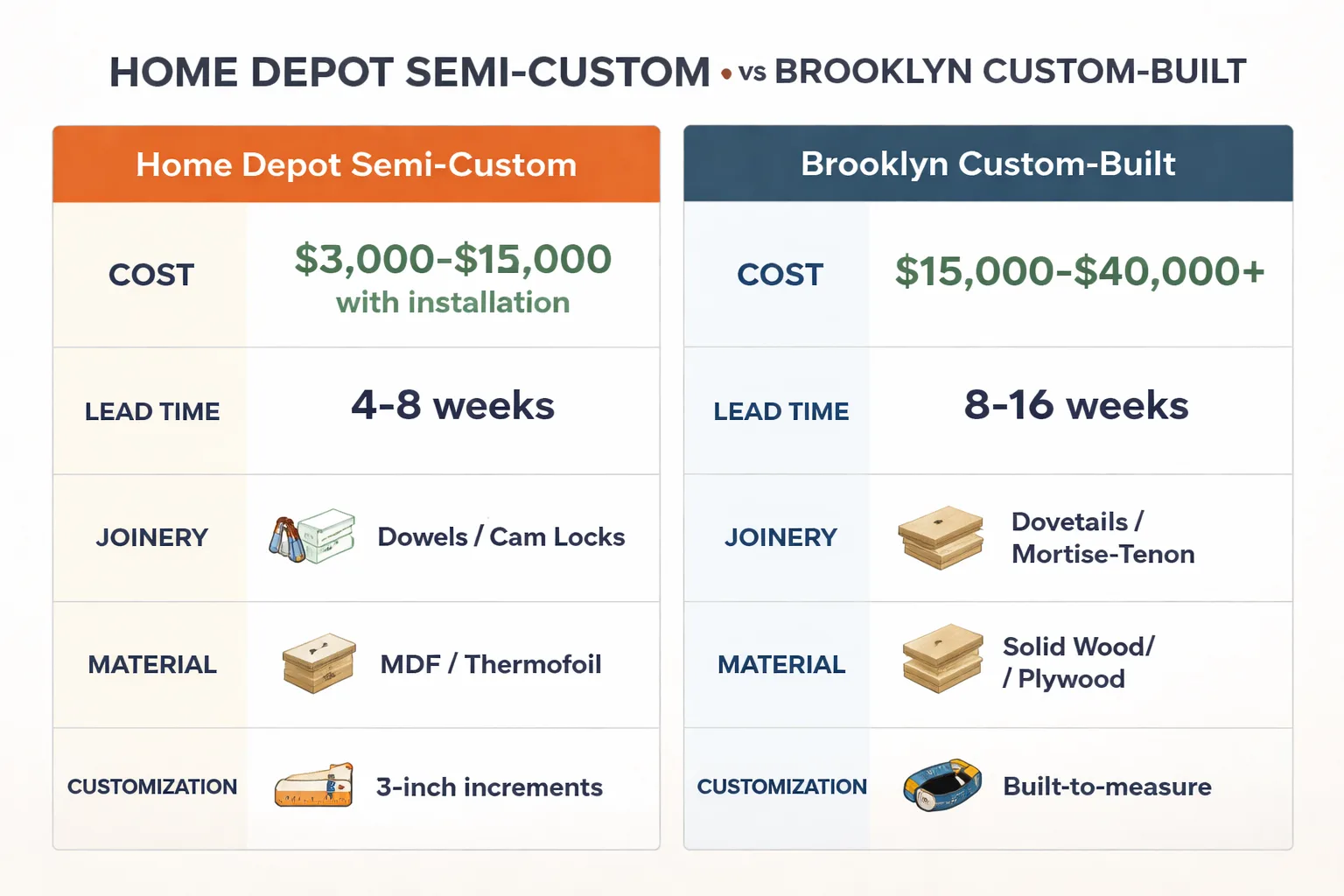
A Home Depot semi-custom kitchen in a standard 10x10 galley layout runs $2,000 to $12,000 depending on the material tier selected. Installation through Home Depot's network adds $1,500 to $3,000. Total: $3,500 to $15,000, with a 4 to 8 week lead time and a 1 to 3 day installation. The warranty covers manufacturer defects on the cabinets and, in some cases, the installation workmanship, but the terms vary by line and installer.
A custom build from a Brooklyn shop like Green Cabinets NY for the same 10x10 space typically runs $15,000 to $40,000 or more, depending on wood species, finish complexity, and interior accessories. Lead time is 8 to 16 weeks from design finalization to installation. Installation is done by the shop's own crew or a trusted partner, usually over 2 to 4 days. The warranty is typically more personal: the shop stands behind the work because their name is on it, and repairs or adjustments are handled directly.
The quality difference is not just about materials. It is about how the cabinet interacts with the space over time. A modular cabinet in a non-square Brooklyn kitchen will have gaps, filler strips, and scribe moldings that collect dust and look like afterthoughts. A custom cabinet is scribed to the wall during installation, with fills and transitions that look intentional. The difference becomes more visible after 5 years, when the modular unit's cam-lock joints start loosening from seasonal movement and the thermofoil on the sink base starts peeling from moisture exposure.
The sustainability question also favors the custom build. Research on bamboo as an emerging resource and broader industry metrics from USA Cabinet Express show that material waste varies significantly by door style: slab doors generate 5 to 10% waste, while shaker doors generate 15 to 25%. A custom shop can optimize material yield and select sustainably sourced wood. A modular manufacturer optimizes for production speed, not material efficiency. With 61% of homeowners ranking sustainability among their top 3 renovation priorities, and 9.8 million tons of old cabinets hitting landfills annually, the lifecycle cost of disposable cabinetry is a real factor that the sticker price does not capture.
Not sure if your kitchen needs custom or semi-custom cabinets?
Which NYC Kitchens Benefit Most from Custom Build?
Not every kitchen needs a custom build. A homeowner in a new-construction condo with square walls, standard ceiling heights, and a straightforward layout can get good results from a premium modular line through Home Depot or another retailer. The space was designed around modular dimensions, and the cabinets will fit without compromise. For that homeowner, the big-box route saves money and time without sacrificing much in quality.
The picture changes fast in Brooklyn's older housing stock. A 1920s brownstone with plaster walls, a sloped floor, and a non-standard ceiling height of 9 feet 4 inches is not a modular space. A pre-war apartment with a structural column in the middle of the kitchen wall, or a radiator under the window that limits base cabinet depth, needs cabinetry designed around those constraints. In those spaces, modular cabinets look like modular cabinets: filler strips, awkward gaps, and compromises that telegraph the fact that the cabinets were not made for the room.
For developers, the calculation is different. A developer renovating a multi-unit building for resale may prioritize speed and cost over longevity, and a modular line makes sense. But a developer building a high-end single-family renovation or a luxury condo where the kitchen is the selling point needs the finish quality and design flexibility that only a custom shop provides. The benefits of custom millwork for developers extend beyond the kitchen itself: a shop that builds kitchen cabinets can also produce matching bathroom vanities, built-ins, and millwork that create a cohesive design language throughout the unit.
The long-term value question is where custom wins decisively. A custom kitchen built with solid wood and plywood, properly maintained, lasts 20 to 30 years before needing refinishing. A modular kitchen in MDF and thermofoil has a realistic lifespan of 10 to 15 years in a high-use NYC household, and often less in a humid bathroom or near a dishwasher. The cost per year of useful life is closer than the initial price gap suggests, and the custom kitchen adds resale value that a modular kitchen does not.
When Big-Box Semi-Custom Makes Sense
There are scenarios where the Home Depot route is the right call, and pretending otherwise undermines the credibility of the comparison. A homeowner with a $5,000 budget who needs to replace water-damaged cabinets in a rental unit is not well served by a $25,000 custom build. The modular line will function, look acceptable, and last long enough to serve the purpose. A homeowner who plans to sell within 3 years and just needs a kitchen that photographs well for a listing is also a reasonable candidate for semi-custom. The buyer is not paying for 30-year longevity; they are paying for 3-year marketability.
The big-box program also wins on speed. If a kitchen flood requires replacement cabinets in 2 weeks, the modular line with in-stock inventory is the only option. A custom shop cannot produce built-to-order cabinetry in that timeframe, and no amount of craftsmanship changes that constraint. For homeowners who need cheap custom kitchen cabinets in a time-sensitive situation, the big-box semi-custom tier is a legitimate solution.
What Home Depot's Program Cannot Do
The limitations of the big-box model are most visible in the details that matter most to design-conscious homeowners. Home Depot's cabinet lines do not offer inset construction, where the door sits flush inside the face frame rather than overlaying it. Inset construction is the hallmark of high-end cabinetry and is standard in custom shops. The modular lines do not offer custom stain matching to existing woodwork, which is essential in a Brooklyn brownstone where the kitchen needs to coexist with original oak floors and millwork. They do not offer non-standard depths, which matters in a galley kitchen where every inch of counter depth affects workflow.
The installation model also has a structural limitation in NYC. Home Depot's installers are third-party contractors, and the quality depends on who the system assigns. In a city where skilled trades are in high demand, the best installers are booked through custom shops and high-end contractors, not through a retail installation network. A homeowner who gets a good installer through Home Depot is lucky. A homeowner who gets a bad one is stuck with a warranty claim process that involves the retailer, the installer, and the manufacturer, each pointing at the other.
For homeowners who want sustainable bathroom vanities that match their kitchen design, the big-box model cannot produce coordinating millwork across rooms. A custom shop builds the kitchen, the vanity, the built-in pantry, and the bookshelves from the same wood, with the same finish, in the same style. That coherence is a quality that no modular system, however flexible, can replicate.
How Does Material Selection Differ Between the Two Options?
Material selection is the single most visible difference between a big-box semi-custom program and a Brooklyn custom builder, and it affects everything from durability to resale value. Home Depot's modular lines offer a fixed set of wood species: typically oak, maple, cherry, and hickory on the premium end, with paint-grade MDF and thermofoil on the entry end. The homeowner selects from a chart, and the finish is applied in a factory under controlled conditions. That sounds like an advantage, but it means the homeowner has no control over grain selection, board matching, or the specific cut of lumber used in their cabinets.
A custom shop flips that model. The homeowner visits the shop and selects lumber from the actual stock on hand. If a client wants a specific grain pattern in quartersawn oak, the shop can book-match the grain across adjacent cabinet doors so the pattern flows visually. If a client wants the warm, tight grain of beech for a painted inset door, the shop sources it specifically. If a client wants the reddish-brown tones of alder for a specific aesthetic, the shop builds with that wood. The homeowner gets the actual material they chose, not a factory's interpretation of a species name.
The finish application also differs in ways that affect longevity. A factory finish is typically a single coat of conversion varnish or lacquer sprayed in a booth. It looks good out of the box but is thin and difficult to repair. A custom shop applies multiple coats of finish with hand sanding between each layer, building a thicker, more durable barrier against moisture and wear. That difference becomes visible after 5 years of use, when the factory finish on a sink base cabinet starts showing water damage at the edges and the custom finish still looks intact.
Can Online Custom Cabinet Retailers Compete with Local Brooklyn Builders?
The rise of online custom kitchen cabinet retailers has added a third option to the decision. Companies selling custom kitchen cabinets online promise the customization of a local shop with the convenience and pricing of a big-box retailer. The appeal is understandable: a homeowner uploads measurements, selects wood and finish options through a website, and receives flat-packed cabinets ready for assembly. The pricing often sits between Home Depot's premium tier and a Brooklyn custom shop, making it attractive to homeowners who want something better than modular without the full custom price tag.
The reality is more complicated. Online custom cabinet retailers still operate on a modular framework. They offer a wider range of sizes and finishes than Home Depot, but the cabinets are still built in standard increments and shipped flat-packed. The joinery is still machine-cut dowels and cam locks, not hand-cut dovetails. The finish is still factory-applied, not hand-sanded between coats. And critically, the measurement and installation are still the homeowner's responsibility or the responsibility of a third-party contractor the retailer recommends. In a Brooklyn brownstone with non-square walls and structural quirks, the gap between an online retailer's "custom" and a local shop's custom becomes obvious during installation, when the cabinets do not fit the space the way the website promised they would.
A local Brooklyn builder provides something no online retailer can: a person on site who measures the space, accounts for its quirks, and takes responsibility for the fit. When the cabinets arrive and a wall is out of plumb by 3/4 of an inch, the local shop's installer scribes the filler and adjusts the installation. The online retailer ships a filler strip and expects the installer to figure it out. That difference is the difference between a kitchen that looks built for the space and a kitchen that looks installed in the space.
Questions to Ask Before You Commit to Either Path
What Does "Custom" Actually Mean Here?
Ask the retailer or builder to define "custom" in writing. If the answer involves a catalog of sizes, it is semi-custom. If the answer involves building to the specific dimensions of the space, it is custom. This distinction determines whether the cabinets fit the room or the room is forced to fit the cabinets.
Who Handles the Installation?
In the Home Depot model, installation is subcontracted. Ask who the installer is, how many NYC jobs they have completed, and whether they are familiar with pre-war construction. In the custom shop model, ask whether the shop's own crew handles installation or whether it is outsourced. The installer is the person who determines whether the cabinets look right in the space, regardless of how well they were built.
What Is the Real Lead Time?
Home Depot's stated lead times do not always include design consultation, measurement, and order processing. Ask for the total timeline from first meeting to installation completion. Custom shops should provide a similar end-to-end timeline. Comparing the two requires looking at the full process, not just the manufacturing window.
What Happens If Something Is Wrong?
The warranty question is about process, not just coverage. Ask who handles a problem: the retailer, the installer, or the manufacturer. Ask how long a repair typically takes. In a custom shop, the answer is simple: the shop fixes it. In a big-box model, the answer involves a claims process that can take weeks and may result in the homeowner living with a non-functional cabinet while parties negotiate responsibility.
Can the Cabinets Handle NYC Humidity?
Ask about the material specifications: solid wood vs. MDF, plywood vs. particleboard, and the type of finish applied. NYC's humidity swings are real and damaging to materials that are not designed for them. A green kitchen unit built with solid wood and a multi-coat finish will handle seasonal movement. A thermofoil-wrapped MDF panel will not.
What About Sustainability?
Ask about wood sourcing, VOC emissions, and material waste. Look for third-party certifications like CARB Phase 2 compliance and FSC-certified wood. According to Ronbow's analysis, the hard proof of sustainability is in the documentation, not the marketing. A custom shop that sources from specific mills and can name the origin of the wood is more accountable than a manufacturer that produces 10,000 cabinets a month.
What If the Layout Changes?
Ask whether the cabinets can be modified or relocated in the future. Custom cabinets built as individual units can be moved, reconfigured, or repurposed. Modular cabinets connected with cam locks and designed for a specific layout are harder to reconfigure without replacing components. For a homeowner who might renovate again or move the kitchen layout, this flexibility matters.
When This Comparison Breaks Down
This framework assumes the homeowner is choosing between two functional options. In reality, there is a third path that muddies the decision: IKEA's Sektion line with custom fronts from third-party companies like Semihandmade. That hybrid approach sits between big-box semi-custom and full custom in both price and quality, and it is a legitimate option for homeowners who want more design flexibility than Home Depot offers without paying for a full custom build. The IKEA ecosystem also has a massive accessories market that can rival custom interior configurations for less money. The tradeoff is that the boxes are still modular MDF, the installation still depends on whoever the homeowner hires, and the finish quality of third-party fronts varies significantly by manufacturer. It is not a replacement for custom, but it is a real alternative that this comparison does not fully capture.
Making the Decision in a Brooklyn Kitchen
The choice between Home Depot custom kitchen cabinets and a Brooklyn custom builder comes down to three questions. What is the space? A standard, square, new-construction kitchen can work with modular. A pre-war, non-square, architecturally specific space needs custom. What is the budget? A $5,000 budget points toward modular. A $20,000 budget opens the custom door. What is the timeline? A 2-week emergency points toward modular. A 12-week planned renovation allows for custom.
The homeowners at that table on Atlantic Avenue, the ones with the Pinterest board and the 9-by-11 galley kitchen, are not choosing between two versions of the same product. They are choosing between two different relationships with their kitchen. The modular line is a transaction: buy, install, use, replace. The custom build is a collaboration: design, build, install, live with. The first is faster and cheaper. The second is better and lasts longer. Neither is wrong. The wrong choice is making the decision without understanding which one is being made.
For homeowners and developers in Brooklyn and across NYC who want cabinetry built to their space, their materials, and their design, Green Cabinets NY provides the custom path. The shop's work in quartersawn oak, beech, and alder represents the quality and specificity that no modular catalog can replicate. The decision is not about price. It is about whether the cabinets are made for the kitchen or the kitchen is made to fit the cabinets.
FAQ
Are Home Depot custom kitchen cabinets actually custom?
No. Home Depot's cabinet program offers semi-custom modular lines from manufacturers like KraftMaid and Thomasville. Cabinets come in standard 3-inch width increments with preset door styles and finishes. True custom cabinetry is built to the specific dimensions of the space, with non-standard sizes, custom joinery, and in-house finishing. Home Depot's program is a configurable catalog, not a custom build.
How much do Brooklyn custom kitchen cabinets cost compared to Home Depot?
A Home Depot semi-custom kitchen for a standard 10x10 layout runs $3,500 to $15,000 including installation. A custom build from a Brooklyn shop for the same space typically runs $15,000 to $40,000 or more. The custom build uses solid wood, plywood, and dovetailed joinery, while the modular line uses MDF, particleboard, and cam-lock construction.
How long do custom kitchen cabinets last in NYC?
Custom cabinets built with solid wood and plywood, properly maintained, last 20 to 30 years before refinishing. Modular cabinets in MDF and thermofoil have a realistic lifespan of 10 to 15 years in a high-use NYC household. NYC's humidity swings, ranging from 25% to 70% relative humidity seasonally, accelerate wear on non-solid-wood materials.
Can Home Depot match custom stain colors?
No. Home Depot's cabinet lines offer a fixed palette of factory-applied finishes. Custom shops mix stains in-house and can match existing woodwork, floors, or millwork. In a Brooklyn brownstone with original oak details, this matching capability is essential for a cohesive design.
Who installs the cabinets when you buy from Home Depot?
Home Depot uses third-party subcontractors for installation. The quality depends on which installer the system assigns. Custom shops typically use their own crews or trusted partners who are familiar with the shop's construction methods and the specific challenges of NYC installations.
What is the difference between custom and semi-custom cabinets?
Semi-custom cabinets are modular units produced in standard size increments (typically 3-inch widths) with a range of door styles and finishes selected from a catalog. The manufacturer builds the cabinet to the selected configuration, but the dimensions are fixed. Custom cabinets are built from scratch to the specific dimensions of the space, with no size increments, no catalog limitations, and full control over joinery, material, and finish. The difference is whether the cabinet adapts to the space or the space adapts to the cabinet.
Book a free design consultation at our Brooklyn showroom and see the difference custom cabinetry makes in person.