How to Build Custom Kitchen Cabinets That Fit a Phoenix Home
Stock cabinets fail in Phoenix homes because desert heat warps standardized boxes and filler strips waste space. This guide walks through building custom kitchen cabinets matched to dry climates, from material selection to installation.
By Green Cabinets NY Team
Key Takeaways
- Custom cabinets for Phoenix homes prove more economical than stock over five to ten years once hidden costs of filler strips, summer warping replacements, and lost resale value are totaled.
- 9.8 million tons of cabinets enter U.S. landfills yearly, so choose resilient custom builds that 61% of homeowners now rank among their top three renovation priorities.
- Stock cabinets in 3-inch increments leave dust-collecting gaps in Phoenix's taller-ceiling, open-plan kitchens, while custom units fit exact dimensions and indoor-outdoor flow.
- Specify custom cabinetry to match structural columns, uneven walls, and chosen appliances instead of bolting on standardized boxes that disrupt desert-home layouts.
Stock cabinets aren't cheaper. They just look that way on the invoice. When Phoenix homeowners tally the cost of filler strips, modification cuts, a second purchase to replace warped boxes after a brutal Arizona summer, and the resale value lost on a kitchen that looks assembled rather than designed, the savings evaporate fast. Custom kitchen cabinets built for Phoenix homes cost more upfront, but they are almost always the more economical decision over a five- to ten-year horizon. The math changes completely once you factor in the desert climate.
The case for custom kitchen cabinets phoenix az comes down to three measurable factors: material resilience in extreme dry heat, spatial precision for open-plan desert layouts, and long-term ROI. Research indicates that 9.8 million tons of old cabinets reach U.S. landfills yearly, and 61% of homeowners rank sustainability in their top 3 renovation priorities. Green Cabinets NY approaches every build with cross-market expertise, applying Brooklyn-grade craftsmanship to the specific demands of Phoenix architecture.
Why Phoenix Kitchen Layouts Demand a Custom Approach
Phoenix homes are not Brooklyn apartments. The square footage is bigger, the ceilings are taller, and the relationship between indoor and outdoor space is fundamental to the design. Stock cabinets, built in standardized 3-inch increments, fail spectacularly in these environments. They leave awkward gaps filled with filler strips that collect dust and break the visual line of the room.
The challenge is that Phoenix kitchens often serve as the hub for indoor-outdoor living. A kitchen that opens onto a patio or a desert vista needs cabinetry that integrates with that flow, not boxes that look bolted to the wall as an afterthought. Custom cabinets for kitchen spaces like these are designed to fit the exact dimensions of the home, accounting for structural columns, uneven walls, and the specific appliances the homeowner has chosen.
Green Cabinets NY has built custom cabinetry for NYC developers who demand precision in tight spaces. That same precision, applied to the expansive layouts of Phoenix, means every inch is accounted for. A custom kitchen pantry cabinet can be built to fit a specific wall niche, reaching floor to ceiling without the wasted space that stock options leave behind. The result is a kitchen that looks designed rather than assembled, and that holds its value over time.
The desert climate adds another layer. Low humidity and extreme temperature swings affect wood movement in ways that stock manufacturers do not account for. Boxes built for generic national averages will warp, crack, or separate at the joints when subjected to Phoenix conditions. Custom builders select materials and construction techniques matched to the local environment, which is the difference between cabinets that last a decade and cabinets that last a lifetime.
Consider the typical Phoenix great room. A 15-foot wall of cabinetry that needs to house a built-in refrigerator, a double oven, and a floor-to-ceiling pantry cannot be achieved with stock components without visible filler strips breaking the vertical lines. A custom builder designs the entire run as a single integrated system. The refrigerator cabinet is built to the exact width of the appliance plus a quarter-inch for ventilation. The pantry is sized to the ceiling height, eliminating the dust-collecting soffit that stock cabinets leave exposed. Every measurement is exact because every measurement is made for that specific wall.
How to Build Custom Kitchen Cabinets Step by Step
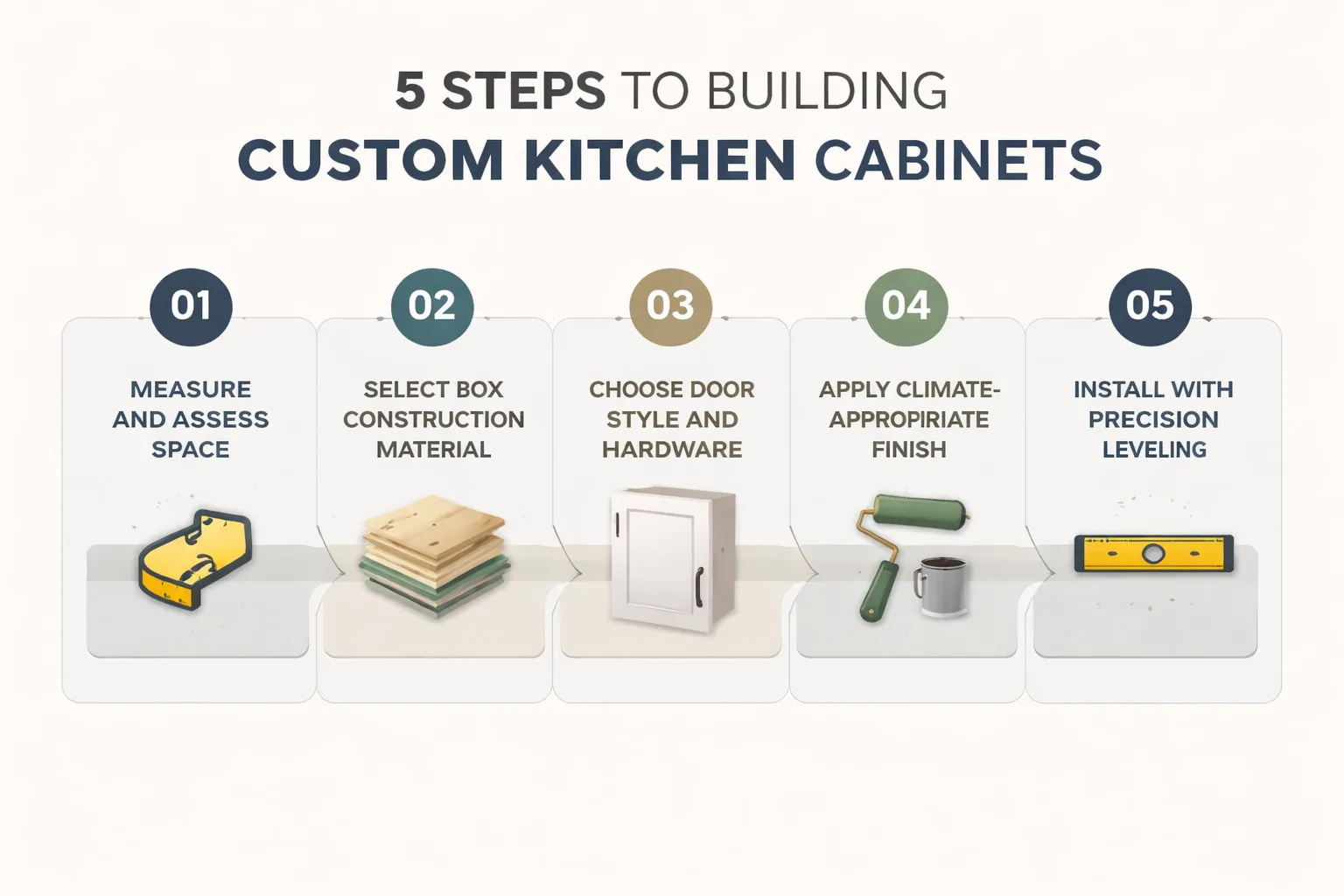
Building custom kitchen cabinets is a phased process. Each phase builds on the last, and skipping steps creates problems that compound downstream. Here is the process that Green Cabinets NY follows, applicable whether the build is in Phoenix or Brooklyn.
Phase 1: Measure and Assess the Space
Before any material is selected, the space must be measured with precision. This is not a rough estimate. Every wall is measured at multiple heights because walls are rarely plumb. Ceiling height is checked at multiple points. The locations of plumbing, electrical, and gas lines are mapped. Appliance dimensions are confirmed against manufacturer specs.
In Phoenix homes, this phase also includes assessing the thermal envelope. Cabinets placed on exterior walls that face the afternoon sun will experience higher surface temperatures. This affects material choice and finish selection. A cabinet built against a west-facing wall in July needs to withstand conditions that a cabinet on an interior wall never will.
Phase 2: Select Box Construction
The cabinet box is the structural foundation. The two primary options are plywood and MDF (medium-density fiberboard). Plywood is the standard for quality construction. It holds screws well, resists moisture, and maintains structural integrity over time. MDF is smoother, less expensive, and takes paint well, but it does not hold screws as reliably and can swell if exposed to moisture.
For Phoenix homes, plywood is the better choice for box construction. The low humidity is less of a concern for MDF swelling, but the temperature swings cause expansion and contraction that stress joints over time. Plywood handles this stress better. Green Cabinets NY uses plywood for its custom built kitchen cabinets because the structural integrity matters more than the marginal cost savings of MDF.
Phase 3: Choose Door Style, Hardware, and Finish
Door style is where aesthetics meet practicality. Shaker doors remain the most popular choice because they are timeless and versatile. Slab doors offer a modern look and generate less waste in production (5-10% waste versus 15-25% for Shaker, according to USA Cabinet Express). Hardware selection affects daily use. Soft-close hinges and full-extension drawer slides are not upgrades; they are baseline requirements for a quality build.
Finish selection is climate-dependent. In Phoenix, the dry heat can cause certain finishes to become brittle over time. UV-resistant finishes are essential for cabinets near windows or glass doors. Green Cabinets NY specifies finishes based on the specific conditions of the installation environment, drawing on experience from how to style black kitchen cabinets in a NYC home where light exposure and finish durability are equally critical.
Phase 4: Climate-Appropriate Sealing and Assembly
This is the step most builders skip. The sealant and assembly method must match the climate. In Phoenix, the extreme dryness pulls moisture from wood faster than in humid environments. This means wood must be properly acclimated before assembly, and joints must be constructed to allow for movement without failing.
Dovetail joints are the standard for quality drawer construction. They interlock mechanically, which means they hold even if the adhesive fails. For face frames, mortise-and-tenon joints provide the same mechanical advantage. These construction methods take longer but produce cabinets that survive decades of use.
Phase 5: Installation
Installation is where precision meets reality. Even perfectly built cabinets fail if installed poorly. Floors must be leveled. Walls must be shimmed. Cabinets must be secured to studs, not just drywall. In Phoenix, the concrete slab common in many homes requires specific anchoring methods.
Green Cabinets NY handles installation as part of the build process. This eliminates the finger-pointing that happens when one party builds the cabinets and another installs them. The builder who measured the space, selected the materials, and assembled the boxes is the same party placing them in the home.
Materials That Hold Up in Dry vs. Humid Climates
The material conversation changes depending on where the cabinets will live. Phoenix and NYC sit at opposite ends of the humidity spectrum. Phoenix averages 20-30% relative humidity for much of the year. NYC regularly exceeds 60% during summer months. This difference affects every aspect of cabinet performance.
Wood is hygroscopic. It absorbs and releases moisture based on the surrounding environment. In high humidity, wood expands. In low humidity, it contracts. This movement is natural, but it stresses joints, finishes, and hardware if not accounted for during construction.
In Phoenix, the primary risk is excessive contraction. Wood that dries too quickly can crack, warp, or split. The solution is to select species that are dimensionally stable in dry conditions. Alder is an excellent choice for Phoenix kitchens. It is relatively stable, takes finish well, and is less prone to the dramatic movement that affects harder species. Rustic hickory is another option that handles dry conditions well, though its dramatic grain pattern is not for every aesthetic.
In NYC, the primary risk is excessive expansion. Wood that absorbs too much moisture can swell, causing doors to stick and joints to fail. Quartersawn oak is the gold standard for humid environments because the quartersawn cut produces grain that is inherently more stable. Beech is another dense, stable option that performs well in high humidity.
The finish matters as much as the wood. In Phoenix, finishes need to be flexible enough to move with the wood as it contracts. Rigid finishes will crack as the wood shrinks beneath them. In NYC, finishes need to be moisture-resistant to prevent humidity from penetrating the wood. The sealant strategy is different for each environment, and using the wrong one will shorten the cabinet's lifespan regardless of the wood species selected.
Bamboo regenerates in 3-5 years versus decades for hardwoods, according to research from NC State's Bioresources journal. This makes it an attractive sustainable option, and IKEA's FRÖJERED line uses bamboo with recycled paper cores and plant-based glue, as noted on IKEA's sustainability page. However, bamboo vanities installed without proper acclimatization or a robust sealant can show warping within 12-18 months in high-humidity environments. The material is sustainable, but the installation method must match the climate.
The KCMA (Kitchen Cabinet Manufacturers Association) recommends looking beyond marketing labels to verify sustainability claims. Their buyer's guide emphasizes CARB Phase 2 compliance, VOC certifications, and material sourcing verification. RONBOW makes the same point in their sustainability analysis: the cabinetry industry needs to prove sustainability beyond labels. The sustainable cabinet market is projected to reach $16.5 billion by 2030, but that growth means nothing if the cabinets fail prematurely because the materials were not matched to the environment.
What Wood Species Work Best in Dry Climates?
Wood species selection for Phoenix kitchens comes down to dimensional stability, hardness, and aesthetic versatility. The desert's low humidity favors species that resist excessive contraction and maintain their structural integrity through temperature swings.
Alder is the top recommendation for Phoenix builds. It is a softer hardwood, which means it dents more easily than maple or oak, but it is remarkably stable in dry conditions. It takes stain evenly, allowing for a range of finish options from natural to dark espresso. For homeowners who want a harder surface, maple is a viable alternative. Maple is dense, durable, and resists the kind of surface damage that softer woods show. It is less dimensionally stable than alder in extreme dryness, but the difference is manageable with proper acclimatization and construction techniques.
For homeowners seeking a premium aesthetic, walnut offers a rich, dark grain that does not require stain. Walnut is dimensionally stable and performs well in dry climates. It is more expensive than alder or maple, but the aesthetic payoff is significant. Custom walnut kitchen cabinets are a statement piece that elevates the entire kitchen.
Birch is a budget-conscious option that performs adequately in dry climates. Birch is smooth, takes paint well, and is dimensionally stable enough for Phoenix use. It is not as hard as maple or as stable as alder, but it offers a good balance of cost and performance for homeowners who want custom quality without premium pricing.
The species to avoid in Phoenix are those with high movement coefficients. Certain species of pine and cedar, while attractive, move dramatically with humidity changes. In a climate where humidity can swing from 15% to 40% in a single day during monsoon season, these species will crack, warp, or twist. The cost savings of a softer, less stable wood are erased the first time a door splits along the grain.
Planning custom cabinets for a Phoenix kitchen? Let's talk materials and climate strategy.
What to Ask Any Custom Cabinet Maker Before You Sign
The custom cabinet market is crowded. Some builders are craftsmen. Others are assemblers who buy components and install them. The difference matters. Here is what to ask before signing any contract.
What is the lead time, and what happens if it slips? Lead times for custom cabinets typically run 8-12 weeks. If a builder promises 4 weeks, they are either not building custom or they are cutting corners. Ask what happens if the timeline slips. Who absorbs the cost of delayed countertops, appliances, or flooring? Green Cabinets NY provides written timelines and communicates delays immediately, because the alternative is a homeowner discovering at week 10 that their cabinets have not started production.
What does the warranty cover, and for how long? A warranty should cover materials and workmanship for a minimum of 5 years. Ask specifically whether the warranty covers finish failure, joint separation, and hardware replacement. Some warranties exclude finish issues, which is the most common failure point. Get the warranty terms in writing before signing.
Who handles installation? If the builder does not install, find out who does and whether they are licensed and insured. Installation is where most cabinet projects fail. A poorly installed cabinet will not function correctly regardless of how well it was built. Green Cabinets NY handles installation in-house to eliminate this risk.
Can you verify material sourcing and compliance? Ask for CARB Phase 2 compliance documentation. Ask where the plywood comes from. Ask about VOC emissions from finishes. If the builder cannot answer these questions, they are not sourcing quality materials. The KCMA buyer's guide provides a framework for evaluating these claims.
Can I see examples of your work in similar climates? A builder who has only worked in humid environments may not understand the specific challenges of Phoenix dryness. Ask for references from homeowners in similar climates. Green Cabinets NY has cross-market experience, having built cabinets for the demanding NYC market and applied those standards to builds in other regions.
When This Fails: Where Custom Cabinetry Breaks Down
Custom cabinets are not a universal solution. There are specific scenarios where the investment does not pay off, and pretending otherwise is dishonest.
The first failure scenario is the short-term ownership situation. If a homeowner plans to sell within two years, custom cabinets will not deliver enough ROI to justify the cost. The resale premium for custom cabinetry exists, but it requires time to amortize the upfront investment. Stock or semi-custom options are the rational choice for a flip or a short-term hold.
The second failure scenario is the unprepared homeowner. Custom cabinets require decisions: wood species, door style, finish color, hardware type, drawer configuration, organizational accessories. Homeowners who are not prepared to make these decisions, or who defer to the builder for every choice, often end up with cabinets that do not match their needs. The process requires engagement. A homeowner who cannot commit time to the design phase will not get the full value of custom cabinetry.
The third failure scenario involves structural issues that cabinetry cannot solve. If a kitchen has fundamental layout problems, inadequate electrical service, or plumbing that does not meet code, custom cabinets will not fix those issues. They will simply dress up a broken kitchen. The structural and mechanical systems must be sound before the cabinetry phase begins.
How Does Remote Custom Cabinet Ordering Work?
Remote ordering of custom cabinets is increasingly common. Homeowners in Phoenix can work with builders based outside Arizona, including Green Cabinets NY, through a structured remote process. The key is that the remote process does not skip any of the steps outlined above.
The process begins with the homeowner providing measurements and photos of the space. Green Cabinets NY reviews the information and conducts a virtual consultation to understand the homeowner's needs, aesthetic preferences, and budget. Detailed measurements are then taken, either by the homeowner using a provided guide or by a local contractor hired for the measurement phase.
Designs are produced and reviewed remotely. 3D renderings allow the homeowner to see exactly how the cabinets will look in their space before production begins. Material samples are shipped to the homeowner so they can see and feel the wood species and finish options in their own lighting. This is not the same as seeing samples in a showroom, but it is close enough for most homeowners to make confident decisions.
Online custom kitchen cabinets are not a lesser option. They are a different process that requires more communication and more trust. The advantage is access to builders whose craftsmanship exceeds what is available locally. The disadvantage is that the homeowner cannot walk into a showroom and point at a display. For homeowners who know what they want, or who are willing to work through the design process remotely, the quality difference is worth the tradeoff.
What Is the Average Cost in Phoenix vs. NYC?
Pricing for custom kitchen cabinets varies based on materials, complexity, and finish level. According to Kitchen Search, the cost differences between markets are driven by labor rates, material availability, and local demand.
In Phoenix, custom kitchen cabinets typically range from $400 to $800 per linear foot for quality construction with standard finishes. Premium materials and complex designs can push the price to $1,000 or more per linear foot. A typical 10x10 kitchen with 20 linear feet of cabinetry runs $8,000 to $16,000 for standard custom work.
In NYC, the same quality level runs $600 to $1,200 per linear foot, driven by higher labor costs and the premium associated with NYC-based craftsmanship. The same 10x10 kitchen costs $12,000 to $24,000. The materials are the same. The construction methods are the same. The difference is labor and overhead.
This is why remote ordering from a builder like Green Cabinets NY can make sense for Phoenix homeowners. The craftsmanship standards of NYC, applied to a Phoenix build, can deliver quality at a price point that local Phoenix builders may struggle to match. The key is that the remote process must be managed carefully to ensure that the quality does not suffer from the distance.
Homeowners looking for affordable custom kitchen cabinets should focus on the value equation rather than the absolute price. The cheapest option is rarely the most affordable over a ten-year horizon. Cabinets that need replacement in five years cost more than cabinets that last twenty. The sustainability conversation ties directly into this: 9.8 million tons of cabinets reach U.S. landfills yearly. Cabinets built to last reduce that waste and save money over time.
For homeowners exploring options at big-box retailers, it is worth noting that Home Depot custom kitchen cabinets and Lowes custom kitchen cabinets are semi-custom, not fully custom. They offer modification of standard sizes but do not provide the made-to-measure construction that a custom builder delivers. The price is lower, but the fit, material quality, and longevity are not comparable. Green Cabinets NY explains these differences in detail during consultations, and homeowners can learn more about sustainable options in their guide to green kitchen units and their analysis of sustainable bathroom vanities for NYC homes.
Stock vs. Custom: The Real Cost Breakdown
The price comparison between stock and custom cabinets is misleading when it only looks at the invoice. Stock cabinets from big-box retailers appear cheaper because the base unit cost is lower. Home Depot custom kitchen cabinets and Lowes custom kitchen cabinets offer a middle ground, but they are semi-custom at best. The real cost of stock and semi-custom options includes hidden expenses that do not appear on the initial quote.
Filler strips are the first hidden cost. When stock cabinets do not fit the exact dimensions of the wall, filler strips are used to close the gaps. These strips are made from matching material and require additional labor to install and finish. A typical kitchen with 15 linear feet of cabinetry might require 3 to 5 filler strips, adding $200 to $500 in material and labor costs.
Modification cuts are the second hidden cost. When a stock cabinet needs to be cut to accommodate plumbing, gas lines, or non-standard appliance dimensions, the structural integrity of the box is compromised. Cutting a stock cabinet weakens the joints and exposes raw edges that must be sealed. This labor adds cost and reduces the lifespan of the cabinet.
The third hidden cost is replacement. Stock cabinets built with particleboard or low-grade MDF will not survive Phoenix's climate indefinitely. Warped doors, swollen boxes, and failed finishes require replacement within 5 to 7 years. The cost of replacing cabinets includes not only the new cabinets but also the labor to remove the old ones, repair any damage to walls or floors, and reinstall the new units. This is how a $5,000 stock kitchen becomes a $15,000 expense over ten years.
Custom cabinets eliminate these hidden costs. The cabinets are built to fit the space exactly, so there are no filler strips. The boxes are constructed from quality materials that withstand the climate, so there is no premature replacement. The finishes are specified for the environment, so there is no premature failure. The upfront cost is higher, but the total cost of ownership over ten years is lower.
How to Choose Cabinet Doors and Hardware
Cabinet doors and hardware define the kitchen's aesthetic and functional experience. The door style sets the visual tone. The hardware determines how the cabinets feel and function every day. Both decisions deserve careful consideration.
Door Styles and Their Practical Implications
Shaker doors are the most popular choice for custom kitchen cabinets doors because they are timeless and versatile. The recessed panel design works in both traditional and contemporary kitchens. The clean lines complement the open-plan layouts common in Phoenix homes. Shaker doors do have a higher waste factor in production (15-25% versus 5-10% for slab doors, according to USA Cabinet Express), which is reflected in the price.
Slab doors offer a modern, minimalist look that suits contemporary Phoenix architecture. They are flat panels without frames or recesses, which makes them easier to clean and maintain. The lower waste factor makes them a more sustainable choice. Slab doors show imperfections more readily than framed doors, so the material quality and finish application must be flawless.
Flat-panel doors with applied moldings offer a middle ground. They provide the visual interest of a framed door with the clean lines of a slab. The applied moldings can be changed or removed if the homeowner wants to update the look without replacing the entire door. This flexibility is valuable for homeowners who want to refresh their kitchen's appearance in the future without a full cabinet replacement.
Hardware Selection
Hardware is the component that homeowners interact with most frequently. Every door opening, every drawer pull, every hinge movement is a tactile experience. Cheap hardware degrades that experience and fails prematurely. Quality hardware enhances it and lasts for decades.
Hinges should be soft-close and adjustable. Soft-close mechanisms prevent doors from slamming, which protects the finish and reduces noise. Adjustable hinges allow for fine-tuning after installation, which is essential because doors shift over time as the cabinets settle. Six-way adjustable hinges are the standard for quality custom cabinets.
Drawer slides should be full-extension and soft-close. Full-extension slides allow the drawer to open completely, providing access to the entire drawer cavity. Soft-close slides prevent the drawer from slamming shut. Undermount slides are preferred for their clean appearance and smooth operation. They are more expensive than side-mount slides, but the difference is noticeable every time the drawer is opened.
Pulls and knobs are the most visible hardware elements. The choice is primarily aesthetic, but ergonomics matter. Pulls are easier to grip than knobs, especially for drawers. The finish should match or complement the cabinet finish. Oil-rubbed bronze and brushed nickel are durable finishes that resist corrosion and wear. Avoid plated finishes, which can chip and expose the base metal.
Maximizing Small Space Kitchens with Custom Solutions
While Phoenix homes are often spacious, many homeowners in older neighborhoods or smaller properties face the same space constraints as NYC residents. Custom solutions maximize every inch of available space, turning awkward corners and tight layouts into functional storage.
Corner cabinets are a common challenge. Stock corner cabinets are typically lazy Susan configurations that waste significant space. Custom corner cabinets can be designed with pull-out shelving, tiered drawers, or specialized storage systems that make the entire corner accessible. A custom builder can design a corner cabinet that fits the exact dimensions of the space and the specific storage needs of the homeowner.
Vertical storage is another area where custom cabinets excel. A custom kitchen pantry cabinet can be built to reach the ceiling, providing storage that stock cabinets cannot match. Pull-down shelving mechanisms make upper shelves accessible without a step stool. This is particularly valuable in Phoenix homes with 10-foot or higher ceilings, where the vertical space above standard cabinets is often wasted.
Drawer configuration is where custom cabinets truly outperform stock options. Instead of standard drawer sizes, a custom builder can design drawers specifically for the items they will hold. A drawer sized for pots and pans. A drawer sized for baking sheets. A drawer with integrated dividers for utensils. These configurations make the kitchen more functional and reduce the time spent searching for items.
FAQ: Custom Kitchen Cabinets in Phoenix and Beyond
How long does it take to build custom kitchen cabinets?
The typical timeline runs 10-14 weeks from contract signing to installation. This includes 2-3 weeks for design and material selection, 6-8 weeks for production, and 1-2 weeks for delivery and installation. Complex designs or premium materials with long lead times can extend this to 16 weeks. Builders who promise faster timelines are likely using semi-custom or stock components rather than building from scratch.
Can I order custom cabinets remotely if I live in Phoenix?
Yes. Green Cabinets NY offers a remote process that includes virtual consultations, 3D renderings, and shipped material samples. The homeowner or a local contractor handles on-site measurements using a provided guide. Production and shipping follow the same quality standards as local builds. The remote process works well for homeowners who know their aesthetic preferences and are comfortable making decisions from renderings and samples.
What is the difference between custom and semi-custom cabinets?
Custom cabinets are built to the exact dimensions of the space. Every box, door, and drawer is made to measure. Semi-custom cabinets start with standard sizes and allow modifications such as width adjustments, depth changes, and finish options. Stock cabinets come in fixed sizes with no modifications. The fit and finish quality increases with each level, as does the price. Custom is the only option that eliminates filler strips and maximizes every inch of available space.
Are eco-friendly cabinets as durable as traditional options?
Eco-friendly cabinets can be as durable as traditional options, but only if the materials are matched to the environment. Bamboo is sustainable (regenerating in 3-5 years) but can warp in high humidity without proper acclimatization and sealing. Reclaimed wood offers character and sustainability but may have structural inconsistencies that require careful selection. The key is verifying sustainability claims with documentation like CARB Phase 2 compliance and VOC certifications, rather than relying on marketing labels alone.
What hardware should I choose for custom cabinets?
Soft-close hinges and full-extension drawer slides are baseline requirements, not upgrades. For door pulls, the choice is aesthetic and ergonomic. Knobs are traditional and easy to grip. Pulls are modern and spread the force across the door, reducing stress on the hinge. The finish should match or complement the cabinet hardware. Avoid budget hardware, as it is the most common point of failure in otherwise quality cabinets.
Do custom cabinets increase home value?
Custom cabinets increase home value by improving the kitchen's functionality and aesthetic appeal. Kitchens are the primary selling point for most homes. A kitchen with cabinets that fit the space perfectly, use quality materials, and show craftsmanship signals a well-maintained home to potential buyers. The resale premium varies by market, but quality cabinetry is consistently cited as one of the highest-ROI kitchen investments.
The decision to build custom kitchen cabinets phoenix az is not about spending more. It is about spending wisely. The right materials, matched to the right climate, built by craftsmen who understand the difference, produce cabinets that outlast and outperform every alternative. Green Cabinets NY brings NYC standards to every build, whether the kitchen is in Brooklyn or the Sonoran Desert.
Get a consultation with Green Cabinets NY and build cabinets that survive the desert and look stunning doing it.