How to Choose Custom Kitchen Cabinet Doors That Last in NYC
NYC kitchens destroy standard cabinetry. Here is how to select custom kitchen cabinet doors that handle humidity, steam, and daily wear for 20+ years, with material, style, and hardware guidance from Green Cabinets NY.
By Green Cabinets NY Team
Key Takeaways
- The kitchen cabinets market will grow from USD 95.95 billion in 2026 to USD 124.42 billion by 2031, driving demand for humidity-resistant custom doors.
- Allocate the median $55,000 major kitchen remodel budget toward semi-custom framed cabinets that deliver the best durability-to-value ratio.
- Choose engineered hardwoods or thermofoil doors engineered for NYC brownstones to prevent warping within 18 months from steam and humidity swings.
- Skip thin veneers over cheap cores, which fail quickly in dense urban kitchens unlike standard suburban advice assumes.
In the postwar building boom of the late 1940s, New York City developers began installing mass-produced cabinet doors across thousands of new apartments. Thin veneers over cheap cores, built for speed, not longevity. Seventy years later, renovation crews are still ripping them out. The irony is that today's market offers a dizzying array of truly durable options for custom kitchen cabinets doors, from humidity-resistant engineered hardwoods to thermofoil alternatives built specifically for high-moisture urban environments. Yet without knowing what to look for, modern buyers are still making the same mistakes their grandparents' landlords did.
The kitchen cabinets market is projected to grow from USD 95.95 billion in 2026 to USD 124.42 billion by 2031, according to Mordor Intelligence's industry report. The median major kitchen remodel spend sits at $55,000, based on 2026 Houzz Kitchen Trends data. Semi-custom framed cabinets are identified as offering the best durability-to-value combination in the current market. Green Cabinets NY builds custom kitchen cabinets doors specifically engineered for Brooklyn brownstones and NYC condos, where humidity, compact layouts, and high-use conditions demand more than standard construction delivers.
Why Cabinet Door Choice Matters More in NYC Homes
NYC kitchens punish cabinetry. The combination of year-round humidity fluctuations, steam from small kitchens without proper ventilation, and daily wear from dense households creates a brutal environment for any door panel. A door that performs fine in a dry suburban kitchen can warp, crack, or delaminate inside a Brooklyn brownstone within 18 months.
The core problem is that most cabinet guidance online assumes a suburban context: large kitchens, controlled humidity, and moderate daily use. NYC kitchens invert all three assumptions. A 60-square-foot galley kitchen in a pre-war building sees more daily traffic than a 300-square-foot suburban kitchen ever will. Steam from a stovetop two feet from the nearest upper cabinet has nowhere to go. Radiant heat from old steam pipes creates temperature swings that stress joinery and finishes.
This is why material selection, door construction, and finish type matter disproportionately in this market. A door built with a plywood core and proper veneer will handle these conditions for decades. A particleboard door with a thin thermofoil wrap will not. The difference between stock and custom cabinetry comes down to exactly these construction choices, and in NYC, those choices have real consequences.
The failure pattern is predictable. Particleboard cores absorb ambient moisture through unsealed edges, particularly where the thermofoil wrap meets the door's back panel. Once the core swells, the thermofoil lifts at the seams. Within 36 months, the door looks delaminated. This is not a defect in the material. It is the material performing exactly as designed in an environment it was never built for.
Green Cabinets NY approaches every project with these conditions in mind. The focus is on materials and construction methods that handle humidity, resist grease penetration, and maintain structural integrity through tenant turnover. For a deeper look at what NYC buyers actually receive when they invest in custom work, the custom kitchen cabinets breakdown covers the specifics.
The market data supports this focus. The global kitchen cabinets market is on a trajectory from USD 95.95 billion in 2026 toward USD 124.42 billion by 2031, growing at a 5.36% CAGR per Mordor Intelligence. That growth is driven by renovation activity, and in NYC, renovation activity is driven by the need to replace cabinetry that failed prematurely. The 2026 Houzz Kitchen Trends Study pegs the median major kitchen remodel at $55,000. When a kitchen at that price point needs cabinet replacement in 5 years instead of 25, the financial calculation changes dramatically.
How to match door style to kitchen layout?
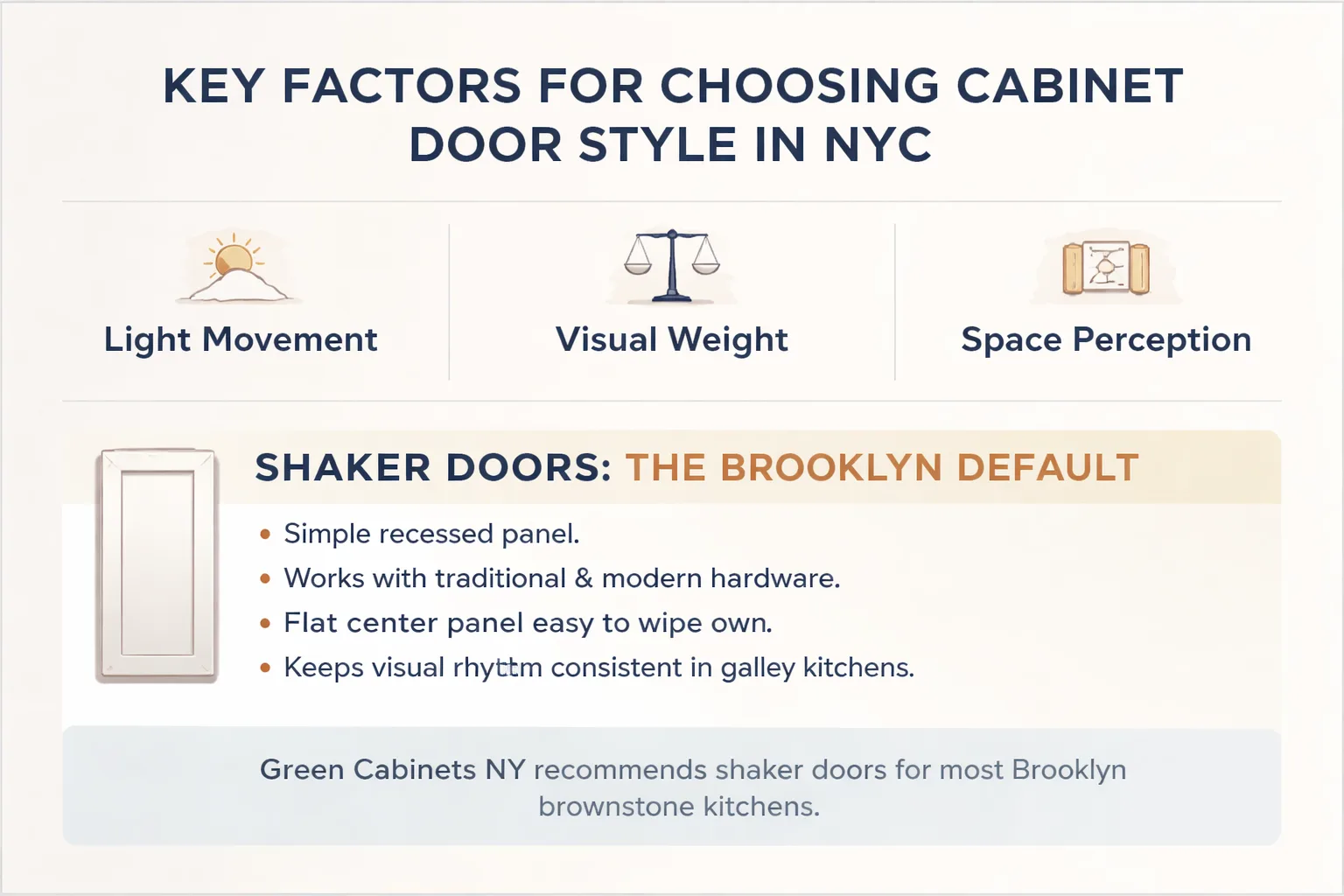
Door style is not purely an aesthetic decision. The profile you select affects how light moves through the kitchen, how much visual weight the upper cabinets carry, and whether a tight space feels open or claustrophobic.
Shaker Doors: The Brooklyn Default
Shaker doors are the dominant choice in NYC custom cabinetry, and for good reason. The simple recessed panel reads clean from any angle, works with both traditional and modern hardware, and the flat center panel is easy to wipe down. In a galley kitchen where cabinets line both walls, shaker doors keep the visual rhythm consistent without overwhelming the space.
The recessed panel does collect some dust in the inner edge, but a well-finished shaker door with a proper radius on the inside corner is manageable. Green Cabinets NY recommends shaker doors for most Brooklyn brownstone kitchens because they bridge traditional architecture and modern function.
A shaker door built with a solid wood frame and an MDF center panel gives you the best of both worlds: the dimensional stability of engineered material in the wide center panel, and the durability and repairability of solid wood at the edges where most impact damage occurs. This hybrid construction is what separates well-built custom kitchen cabinets doors from the semi-custom alternatives that use MDF throughout or particleboard with a wood-print veneer.
Slab Doors: Maximum Light, Minimum Fuss
Slab (or flat-panel) doors are the best choice for small NYC kitchens where maximizing perceived space is the priority. A flat slab door with a matte finish reflects less light directly but creates fewer visual interruptions across a run of cabinets. In an L-shaped kitchen with limited natural light, slab doors in a light color can make the space feel larger than it is.
The trade-off is that slab doors show every imperfection in the wall and installation. If the cabinet box is out of level by even an eighth of an inch, a run of slab doors will telegraph that misalignment. Shaker doors are more forgiving because the shadow line of the frame breaks up the visual plane.
Slab doors also demand a flawless finish. Any texture inconsistency in the substrate, any sanding mark in the primer coat, will be visible on a flat slab door under kitchen lighting. This is why high-quality slab doors are often more expensive to produce than shaker doors despite having a simpler profile. The labor goes into surface preparation, not joinery.
Inset Doors: Precision and Patience
Inset doors sit flush with the cabinet face frame rather than overlaying it. This is the most demanding construction style because the tolerances are tight. In a humid NYC kitchen, a solid wood inset door that is not properly acclimated will stick in summer and show gaps in winter. Engineered materials with stable cores are the safer choice for inset construction in this climate.
Inset doors look exceptional in pre-war apartments where the architecture already has a refined, built-in quality. The cost is higher because the construction requires more time and more precise joinery. For homeowners considering this style, the NYC gut renovation planning guide walks through how inset doors fit into a full renovation timeline.
The gap tolerance on inset doors is typically 3/32 of an inch on each side. In a Brooklyn brownstone where humidity swings from 30% relative humidity in winter (dry steam heat) to 75% in summer (no central air), a solid maple inset door can expand by 1/8 inch across a 15-inch width. That expansion closes the gap entirely, causing the door to bind against the frame. An MDF center panel in an inset door will move less than 1/32 inch under the same conditions. The material choice is not academic. It determines whether the door opens in August.
How to pick material for durability and finish?
Material choice is where most NYC renovations go wrong. The market is flooded with options that look identical on day one but perform completely differently by year three. The 2026 Houzz Kitchen Trends Study confirms that homeowners are investing heavily in kitchen renovations, which makes material failures even more costly.
Solid Wood: Beautiful but Demanding
Solid wood doors (maple, oak, cherry, walnut) offer the most natural beauty and can be refinished multiple times. The problem is movement. Wood expands and contracts with humidity changes, and NYC's seasonal swing from dry winter heat to humid summer air stresses solid wood doors constantly.
For Brooklyn brownstones with steam heat and older windows, solid wood doors require proper sealing on all sides (not just the visible faces) and acclimatization before installation. A solid wood door installed without acclimatization in a humid NYC kitchen can show warping signs within 12-18 months. This is not a material defect. It is a installation protocol failure that looks like a material failure.
Green Cabinets NY uses solid wood selectively, often for walnut feature pieces or painted maple doors where the client wants the grain texture visible through the finish. For custom walnut kitchen cabinets, the richness of the material is worth the maintenance commitment if the homeowner understands what they are signing up for.
The specific protocol for solid wood in NYC involves acclimatizing the material in the installation environment for 5-7 days before hanging the doors. This allows the wood to reach equilibrium moisture content with the kitchen's ambient conditions. The finish must be applied to all five sides of the door (front, back, top, bottom, and all edges) to seal the material completely. A door finished only on the front and visible edges will absorb moisture through the back panel and warp toward the finished side because only one face is sealed.
MDF: The Stable Workhorse
Medium-density fiberboard is the most dimensionally stable material for painted cabinet doors in NYC. It does not expand and contract with humidity the way solid wood does, which means painted MDF doors will not develop hairline cracks at the joints. This is why most painted shaker doors in high-end NYC kitchens use an MDF center panel with a solid wood frame.
The limitation of MDF is water exposure. If the finish is compromised and moisture reaches the core, MDF will swell and never recover. This makes MDF a poor choice for doors directly adjacent to a sink or dishwasher without a robust sealant. For bathroom applications, the sustainable bathroom vanity guide covers how MDF performs in even higher-moisture environments.
The density of MDF matters. A 44-pound MDF (referring to density per cubic foot) is the minimum acceptable grade for painted cabinet doors. Lower-density MDF (36-38 pound) is cheaper but will telegraph screw holes, accept paint unevenly, and is more susceptible to moisture infiltration at edge details. Green Cabinets NY specifies 44-pound or higher MDF for all painted door panels to ensure the finish adheres properly and the panel maintains its shape over time.
Plywood Core: The NYC Sweet Spot
Plywood core doors with a real wood veneer offer the best balance of stability, durability, and repairability for NYC kitchens. Plywood handles humidity better than particleboard, does not swell like MDF if the edge is exposed, and the veneer can be sanded and refinished if needed.
Discussions across r/kitchenremodel, r/cabinetry, and r/HomeImprovement (late 2024 through mid-2025) consistently identify plywood box construction as a marker of quality in the semi-custom tier. According to a synthesis of Reddit cabinet brand discussions, KraftMaid Vantage leads the semi-custom tier specifically because of its plywood boxes and deep customization options. The same source notes that Fabuwood polarizes the market: trade professionals defend its construction and value, while homeowners report finish issues with painted cabinets.
Green Cabinets NY recommends plywood core construction for most NYC kitchens. For Brooklyn brownstones, a plywood core with a maple or oak veneer handles the humidity swings and can be refinished after tenant turnover. For modern condos with controlled climate systems, the same construction works but allows for more material flexibility since the environment is less aggressive.
For those exploring ash wood options, ash veneer over plywood core offers excellent durability with a distinctive grain pattern that works well in both stained and painted finishes.
The veneer grade on plywood core doors is a specification most homeowners never ask about but should. A2 grade veneer (the standard for visible cabinet work) allows for small, tight knots and consistent color. A4 grade, which is sometimes substituted to cut costs, allows for larger knots, mineral streaks, and color variation that becomes visible under a clear or light stain. The difference is not visible in a showroom under fluorescent lights. It becomes visible in a Brooklyn kitchen under LED recessed lighting with a natural stain.
Step 3. Select Hardware That Complements the Door and Survives Daily Use
Hardware is the component most homeowners underthink. A door panel can be perfectly constructed and beautifully finished, but if the hinges sag after six months or the finish on the pulls rubs off, the entire kitchen looks worn.
Hinges: Concealed, Soft-Close, Adjustable
Concealed hinges with soft-close mechanisms are the standard for custom cabinetry in 2026. The key specification to verify is adjustability. A quality concealed hinge allows six-way adjustment (left-right, up-down, in-out) so the installer can align every door perfectly after installation. Cheaper hinges offer limited adjustment, which means a door that is slightly off will stay slightly off.
Soft-close is not a luxury in NYC. In a small kitchen where the stove is inches from the nearest cabinet, the soft-close mechanism prevents the door from slamming when someone reaches for a pot while cooking. This protects the finish and extends the life of the hinge.
The hinge rating matters in a high-use kitchen. A hinge rated for 80,000 open-close cycles will last approximately 11 years in a kitchen where that door is opened 20 times per day. A hinge rated for 200,000 cycles will last 27 years under the same usage. The cost difference between these two hinges is typically $4-6 per hinge. On a kitchen with 30 doors, that is $120-180 in hardware that separates a kitchen that lasts a decade from one that lasts a generation.
Pulls and Knobs: Finish Durability Matters More Than Style
The finish on cabinet hardware determines how long it looks new. PVD (physical vapor deposition) finishes are the most durable option and resist the salt, grease, and cleaning chemicals that NYC kitchens generate. Brushed nickel and stainless steel finishes are practical choices that hide fingerprints and water spots.
Avoid unlacquered brass and oil-rubbed bronze in kitchens with heavy use unless the homeowner wants a living finish that changes over time. These finishes oxidize and patina, which can look beautiful but is unpredictable in a kitchen environment.
The clearance between the pull and the door face is another specification that affects longevity. A pull mounted with a 3/4-inch projection will catch on apron strings, dish towels, and clothing in a tight NYC galley. A pull with a 1-1/4 inch projection gives knuckle clearance but may interfere with adjacent door swings in tight layouts. The hardware selection needs to account for the actual workflow in the kitchen, not just the aesthetic.
Hardware and Door Style Coordination
The hardware should complement the door profile, not fight it. Shaker doors work with almost any pull style because the frame is visually neutral. Slab doors are more demanding: a chunky bar pull on a flat slab door can look industrial, while a slim integrated pull maintains the clean line. Inset doors require specific hardware that accommodates the flush-mount construction, and the knob or pull must clear the face frame.
For small kitchens where storage optimization is the primary concern, the small kitchen renovation guide covers how hardware placement affects usable space inside the cabinet.
Not sure which door material fits your NYC kitchen? Let's talk through your space.
What to Ask Your Cabinet Maker Before Ordering
The questions below are the difference between a kitchen that lasts 25 years and one that needs refacing in 5. Every NYC homeowner should confirm these details before signing a contract with any cabinet builder, including Green Cabinets NY.
Lead Times and Project Sequencing
NYC permit approvals can take up to 6 months in some jurisdictions, and those delays cascade through procurement and construction. Ask the cabinet maker for a realistic lead time that accounts for their production schedule and the permitting timeline. If the answer is vague, the project will likely run long.
A specific question: "What is your production lead time from approved shop drawings to delivery, and how does that interact with my contractor's installation window?" The answer should include a specific number of weeks and a clear explanation of what triggers the production clock.
The sequencing issue is particularly acute in NYC because cabinet delivery must be scheduled around the general contractor's demolition and rough work timeline. If the cabinets arrive before the space is ready, they sit in a truck or storage facility and risk damage. If they arrive after the contractor has moved on to another project, the installation waits and the kitchen sits unfinished. A cabinet maker who understands NYC project sequencing will build the production schedule around the GC's milestones, not their own convenience.
Finish Samples and Material Specifications
Request physical finish samples, not digital renders. A finish that looks perfect on a screen can look completely different under the LED lighting in a Brooklyn kitchen. Ask for a sample of the actual door material with the actual finish applied, and take it home to see it in the kitchen's lighting.
Ask specifically: "What material is the door panel made of, what is the core, and what finish system is applied?" The answer should be specific: solid maple with a conversion varnish, or MDF center panel with solid maple frame and a lacquer finish, or plywood core with oak veneer and a polyurethane finish. Vague answers like "painted wood" or "hardwood doors" are red flags.
The finish system determines how the door ages. Conversion varnish (also called catalyzed lacquer) is a post-catalyzed finish that cures through a chemical reaction, creating a harder and more moisture-resistant film than standard lacquer. It is the standard for high-end custom cabinetry. Standard nitrocellulose lacquer is easier to repair but softer and more vulnerable to water rings and grease penetration. Polyurethane is durable but can amber over time, which matters on white or light-colored painted doors. The cabinet maker should be able to specify which system they use and why.
Warranty and Failure Protocols
Ask what happens when something goes wrong. A cabinet door warps. A finish chips. A hinge fails. The warranty should cover materials and workmanship for a specific period, and the cabinet maker should have a clear protocol for addressing issues.
Ask: "What is your warranty period, what does it cover, and what is your typical response time for a warranty claim?" A reputable custom builder will stand behind their work and have a process, not just a promise.
The warranty should specifically address the failure modes most common in NYC kitchens: finish degradation from grease exposure, door panel warping from humidity, and hinge failure from daily use. A warranty that excludes "environmental damage" is effectively useless in NYC, where the environment is the primary cause of cabinet failure. Look for a warranty that covers material and workmanship defects for a minimum of 5 years, with a clear process for inspection and remediation.
Installation Process and Site Conditions
Custom cabinets require installation by someone who understands the tolerances the builder designed for. Ask whether the cabinet maker handles installation or works with specific installers, and ask about site conditions. In NYC, this includes elevator access, stairwell width, and whether the building has any renovation restrictions.
For kitchens that need specific functional additions like a trash bin cabinet integration, the installation plan should account for how that feature fits into the overall layout.
Stock vs Custom Cabinets for NYC Renovations
The decision between stock and custom cabinetry is not just about budget. It is about whether the cabinetry can be adapted to the specific conditions of an NYC kitchen. Stock cabinets are built to standard dimensions, which means they assume standard wall heights, standard corner conditions, and standard appliance clearances. NYC kitchens rarely offer any of these.
A standard stock wall cabinet is 12 inches deep and 30 inches tall. In a Brooklyn brownstone with 9-foot ceilings and a soffit that is not perfectly level, that standard dimension leaves a gap, requires a filler strip, or forces the installer to cut the cabinet down (which destroys the structural integrity of the box). Custom cabinetry is built to the actual dimensions of the space, which means the soffit gap is eliminated, the corner condition is handled with a custom lazy susan or blind corner pullout, and the appliance clearance is exact.
The MasterBrand guide to stock vs custom cabinetry outlines the functional differences: stock cabinets offer limited finish options, standard sizes, and faster delivery, while custom cabinets offer unlimited finish options, exact-fit dimensions, and longer lead times. In NYC, the tradeoff is not just about options. It is about whether the cabinets fit the space at all.
For homeowners weighing options like ikea kitchen custom cabinets against fully custom work, the comparison comes down to long-term durability. IKEA Sektion cabinets have loyal owners a decade in, according to the Reddit cabinet brand synthesis, but the particleboard construction is a known trade-off. In a dry suburban kitchen, that trade-off is acceptable. In a humid Brooklyn brownstone, it is a calculated risk.
The same calculus applies to big-box options. The search volume for terms like "custom kitchen cabinets home depot" and "lowes custom kitchen cabinets" reflects real homeowner interest in semi-custom solutions from national retailers. These options can work for budget-conscious renovations in controlled-climate condos. They are less suited for pre-war buildings where the humidity and space constraints demand materials and construction methods that stock lines do not offer.
When This Process Fails
This step-by-step approach breaks down in three specific scenarios that NYC homeowners should recognize.
Scenario 1: Landlord-grade renovations in rental buildings. If the renovation is for a rental unit where the owner will not maintain the kitchen, investing in custom construction is irrational. The tenant will not treat the cabinets with care, and the landlord will not pay for maintenance. Stock cabinets from a big-box retailer are the correct choice here. Not every kitchen deserves custom work.
Scenario 2: Historic landmark buildings with non-standard openings. In Brooklyn Heights and Park Slope landmark districts, the building department may require specific approvals that constrain cabinet dimensions and materials. A design that works perfectly in a standard condo may be rejected by the landmarks commission. This process can add months and may force material substitutions that change the durability calculus.
Scenario 3: Extremely tight budgets under $15,000. Custom cabinetry starts at a price point that reflects the labor and materials involved. If the total kitchen budget is under $15,000, the money is better spent on a quality semi-custom installation than on custom doors built with compromised materials to hit a price target. A well-installed semi-custom kitchen will outperform a custom kitchen built with cut-rate materials.
The Bottom Line on NYC Cabinet Door Selection
Choosing custom kitchen cabinets doors for an NYC home is a decision that compounds over time. The right material, construction method, and hardware will deliver 20+ years of service in conditions that destroy standard cabinetry. The wrong choice will look worn within 3-5 years and require refacing or replacement long before the investment has paid off.
The data is consistent. The market is growing because homeowners are investing more in kitchens that last. The median spend of $55,000 on a major kitchen remodel means the stakes are real. Material selection, door style, hardware, and builder expertise are the four variables that determine whether that investment holds up.
Green Cabinets NY builds for the specific conditions of Brooklyn and NYC: the humidity, the compact layouts, the steam, the grease, and the daily wear. The guidance in this article reflects what works in this market, not what looks good in a showroom. For homeowners ready to move forward, the questions in the checklist above will separate a builder who can deliver from one who will promise and underperform.
FAQ
What is the most durable cabinet door material for NYC kitchens?
Plywood core doors with a real wood veneer offer the best balance of durability and stability for NYC kitchens. The plywood core handles humidity fluctuations without warping, and the veneer can be refinished if needed. Solid wood is beautiful but requires acclimatization and maintenance. MDF is stable for painted doors but vulnerable to water exposure at edges.
How long do custom kitchen cabinets doors last in a Brooklyn brownstone?
Properly constructed custom doors with plywood or solid wood cores and quality finishes should last 20-30 years in a Brooklyn brownstone. The key variables are material selection, finish quality, and proper installation. Doors that fail within 3-5 years typically have construction issues (particleboard cores, inadequate finish, no acclimatization) rather than material problems.
Are shaker doors still in style for 2026 NYC kitchens?
Shaker doors remain the dominant choice in NYC custom cabinetry for 2026. The clean profile works across architectural styles, from pre-war brownstones to modern condos. The style has staying power because it is functional, not trendy. Slab doors are gaining popularity in modern condos, but shaker remains the versatile default.
What hardware finish holds up best in a high-use NYC kitchen?
PVD (physical vapor deposition) finishes are the most durable option for kitchen hardware. Brushed nickel and stainless steel are practical choices that resist fingerprints, water spots, and cleaning chemicals. Avoid unlacquered brass in high-use kitchens unless a living patina is the desired aesthetic.
How much should I budget for custom kitchen cabinets doors in NYC?
Custom cabinetry pricing depends on material, door style, finish, and hardware selections. The median major kitchen remodel spend is $55,000 according to 2026 Houzz data, and custom cabinetry typically represents a significant portion of that budget. Request itemized quotes from builders rather than square-footage estimates, and compare material specifications across quotes.
Is it worth ordering custom kitchen cabinets online for an NYC renovation?
Ordering custom kitchen cabinets online carries specific risks for NYC kitchens. The primary concern is that online manufacturers cannot verify site conditions, which in NYC include non-standard wall dimensions, uneven floors, and humidity levels that affect material performance. A local custom builder like Green Cabinets NY can measure, acclimatize materials, and adjust during installation. Online orders typically cannot accommodate these requirements.
What is the difference between custom built kitchen cabinets and semi-custom?
Custom-built kitchen cabinets are constructed from raw materials to the exact specifications of the kitchen, including non-standard dimensions, custom finishes, and specialized storage features. Semi-custom cabinets start with a standard box size and offer modifications like door style, finish, and hardware. The construction difference matters most in NYC, where non-standard wall dimensions and humidity conditions make the fully custom approach more durable and better fitting.
Get a custom cabinet consultation with Green Cabinets NY and build doors that survive NYC kitchens.