How to Pick Affordable Custom Kitchen Cabinets Without Cutting Corners
Custom cabinetry in NYC runs $15,000 to $50,000+, but the price gap between custom and stock comes down to four controllable levers: material, finish, hardware, and box construction. Here's how to manage each one.
By Green Cabinets NY Team
Key Takeaways
- NYC custom cabinets run $15,000–$50,000+ while IKEA alternatives cost $5,000–$15,000 installed, creating a 3x–10x gap that shrinks only when buyers control material, finish, hardware, and box construction.
- Green Cabinets NY keeps custom pricing accessible by treating the four variables—material selection, finish complexity, hardware tier, and box method—as independent levers rather than defaults.
- Skip premium wood on the box, matching interior-exterior finishes, and full top-tier hardware to avoid $40,000 quotes without resorting to particleboard.
- The US millwork market’s projected $36.1 billion size in 2026 and 2.6% CAGR decline show margins are already tight, rewarding buyers who make informed trade-offs instead of showroom defaults.
Custom kitchen cabinets don't have to cost a fortune. They just have to be planned right.
The data on NYC kitchen renovations is blunt: custom cabinets run $15,000 to $50,000+ while IKEA alternatives cost $5,000 to $15,000 installed, according to Crafthaus Remodeling's cost analysis. That 3x to 10x gap terrifies homeowners. But the gap exists because most buyers never separate what drives cost from what drives value. The US millwork industry is projected to reach $36.1 billion in 2026, per IBISWorld's industry analysis, yet revenue actually declined at a 2.6% CAGR over the past five years. That means the market is squeezing margins, not inflating them. Green Cabinets NY builds affordable custom kitchen cabinets by controlling the four variables that actually determine price: material selection, finish complexity, hardware tier, and box construction method. Skip one of those levers and the quote balloons. Control all four and custom cabinetry becomes accessible without the particleboard compromise that comes with IKEA's medium-density fiberboard construction.
Why 'Affordable' and 'Custom' Are Not Opposites
The assumption that custom means expensive comes from a specific source: homeowners who walk into a showroom, pick premium materials across every category, then act shocked when the quote hits $40,000. That is not the cost of custom. That is the cost of not making trade-offs.
Affordable custom kitchen cabinets exist when the buyer makes deliberate, informed choices about where to spend and where to save. The cabinet box does not need the same wood species as the door fronts. The interior does not need the same finish as the exterior. The hardware does not need to be top-tier European brand across every drawer. These are not corners being cut. They are decisions being made.
Green Cabinets NY structures its process around this principle from the first consultation. The team breaks the project into four cost categories: box material, door style and species, finish level, and hardware. Each category has a range from value-tier to premium. A kitchen that uses plywood boxes with solid maple door fronts, a factory-applied conversion varnish finish, and mid-range Blum hardware delivers genuine custom quality at a fraction of what an all-walnut, hand-finished, premium-hardware kitchen would cost. The difference is not craftsmanship. The difference is specification.
The market supports this approach. When the US millwork industry is projected to hit $36.1 billion in 2026 after five years of revenue decline, the signal is clear: manufacturers and custom shops are competing on efficiency and process, not on premium pricing. A2Z Millwork's estimation guide confirms that material selection plays a significant role in overall millwork cost, with wood species and sheet goods requiring distinct cost and labor calculations. The shop that can produce custom work efficiently, with transparent material options, delivers value that semi-custom resellers cannot match.
Semi-custom and stock alternatives win on speed but lose on fit. In NYC kitchens, where walls are rarely square, ceilings are often uneven, and floor plans are constrained by building design, the fit problem is not cosmetic. It is structural. A cabinet that does not fit the space creates gaps, alignment issues, and premature wear. That is the real cost difference: custom cabinets fit the space they are built for, while stock cabinets force the space to accommodate the cabinet.
What must-haves should you define before quotes?
Before requesting a single quote, the buyer needs a prioritized specification sheet. This is the single most effective cost-control tool available, and it takes less than an hour to complete. The exercise forces decisions about what matters and what does not, which prevents the scope creep that inflates custom quotes by 20 to 40 percent.
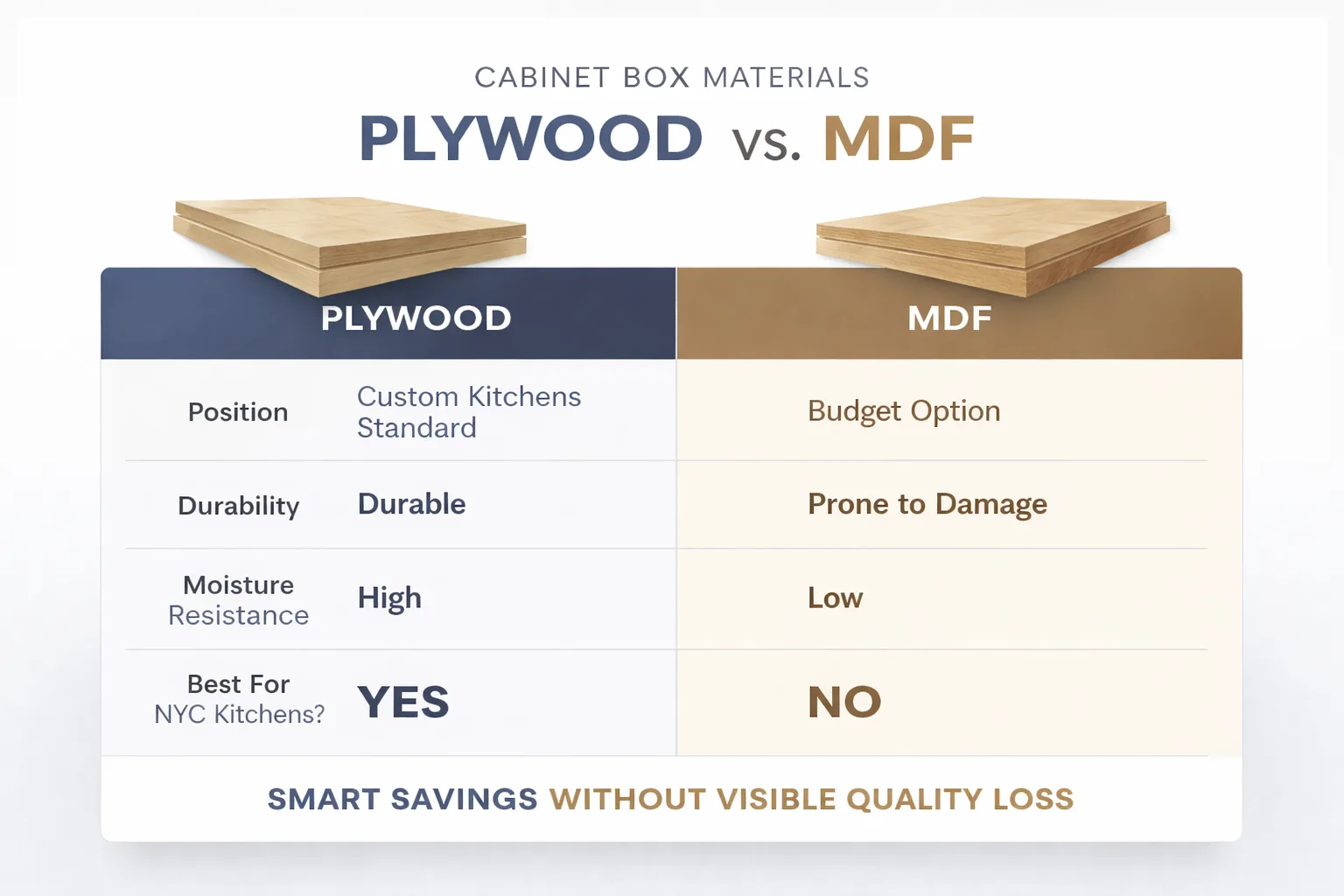
Cabinet box material is the first decision. Plywood is the standard for custom work, offering durability and moisture resistance appropriate for NYC kitchens. MDF (medium-density fiberboard) is cheaper but less resistant to humidity and water damage. For homeowners considering sustainable bathroom vanity options, the same material logic applies: high-humidity environments demand materials that will not swell or delaminate. The box material is where significant savings are available without visible quality loss, because nobody sees the box once the doors are closed.
Door style is the second decision, and it is where most homeowners overspend. Shaker doors are the most popular style in Brooklyn and across NYC for good reason: they are timeless, versatile, and cost-effective to produce. Raised panel doors, custom arch profiles, and intricate milled designs add labor cost that can increase the door package by 30 to 50 percent. The door style should complement the kitchen's architecture, not fight it.
Wood species is the third decision and the one with the widest cost range. Paint-grade maple or poplar is significantly less expensive than custom walnut kitchen cabinets or cherry. For painted finishes, the wood species matters less because the grain is covered. For clear or stain finishes, the species defines the look. A kitchen that will be painted can use a more affordable species without any visual compromise.
Interior fittings are the fourth decision. Pull-out shelves, spice racks, and integrated trash bin cabinets add functionality but also add cost. The approach here is to prioritize based on workflow: the area around the range and sink gets the most use, so fittings there deliver the most value. A trash bin cabinet integrated into the layout near the sink is a high-value addition. A pull-out pantry in a corner that is rarely accessed is a lower priority.
Finish level is the fifth decision. A factory-applied conversion varnish is durable, consistent, and cost-effective. A hand-rubbed stain with a multi-coat clear topcoat is beautiful but adds significant labor. For most NYC kitchens, the factory finish delivers better durability (it is more resistant to the aggressive cleaning products many homeowners use) at a lower cost.
The must-have versus nice-to-have exercise is simple. List the five categories above. For each, write down what is essential and what would be nice. The essential items define the base quote. The nice-to-haves become optional upgrades that can be added or removed to hit a budget target.
Step 2. Understand What Drives Cost
Four levers control the price of custom cabinetry. Understanding each one transforms the quote review process from sticker shock to informed negotiation.
Wood species is the most visible cost driver. Walnut, cherry, and rift-sawn white oak carry premium prices because the raw material is expensive and the milling process is more demanding. Paint-grade maple, poplar, and birch are significantly less expensive because the material is abundant and the finish covers imperfections. The cost difference between a paint-grade maple kitchen and a walnut kitchen can be 40 to 60 percent of the total material cost, even though the construction quality is identical.
For homeowners exploring white oak cabinet options, the species offers a middle ground: it is more affordable than walnut but carries a premium over paint-grade maple. The decision should be driven by the desired aesthetic, not by a assumption that more expensive means better.
Finish type is the second cost driver. A sprayed conversion varnish finish, applied in a controlled shop environment, is the most durable and cost-effective option. It cures to a hard, chemical-resistant surface that withstands daily cleaning. A hand-applied stain with multiple coats of polyurethane or lacquer adds labor hours that increase the finish cost by 25 to 40 percent. The visual difference is subtle, but the cost difference is significant.
In NYC's older buildings, where dust accumulation and humidity fluctuations are constant challenges, the finish durability matters more than the finish complexity. A finish that looks beautiful for two years then shows wear is not a value at any price. A finish that maintains its appearance for a decade is a value even at a premium.
Hardware is the third cost driver. Blum and Salice are the standard hardware brands used in quality custom cabinetry, and they offer multiple product tiers. Entry-level soft-close hinges and drawer slides are functionally excellent. Premium lines add features like tip-on opening (push to open, no handle needed) and servo-driven electric opening, but these features add cost that may not deliver proportional value. The hardware tier should match how the kitchen is actually used. A kitchen with young children benefits from soft-close everywhere. A kitchen used primarily for entertaining benefits from premium hardware on the most-visible, most-touched cabinets.
IKEA cabinets use Blum hardware and come with a 25-year warranty, which explains part of their appeal. But the hardware is only as good as the box it is attached to. Medium-density fiberboard and particleboard construction, which is what IKEA uses, does not hold screws and hinges as securely as plywood over the long term. The hardware may be the same brand, but the performance differs because the substrate differs.
Box construction is the fourth cost driver and the one that most buyers overlook. Full plywood box construction with dado joints and glued assembly is the gold standard. It costs more than MDF or particleboard but delivers structural integrity that lasts decades. The construction method affects not just durability but also the quality of hardware installation. Installation failures in small NYC kitchens commonly stem from inadequate support and hardware installation errors, which are often a function of the box material and construction method.
Step 3. Ask the Right Questions When Comparing Providers
The questions a buyer asks reveal more about the provider than the answers do. A genuine custom builder welcomes specific, technical questions. A semi-custom reseller deflects them.
Where is your shop located? This is the first question. A local shop in Brooklyn or the NYC area means the team that builds the cabinets is involved in the installation, can respond to site-specific issues, and is accountable for the final product. A reseller who orders from an out-of-state manufacturer has no control over quality, lead times, or installation. Green Cabinets NY operates locally, which means the design team, the production team, and the installation team are part of the same operation.
What is included in the quote? This is the second question, and it separates transparent providers from those who quote low and add fees later. The quote should include materials, construction, finish, hardware, delivery, and installation. If installation is not included, the quote is incomplete. If the finish is listed as 'optional,' the provider is hiding the real cost. A genuine custom builder provides an itemized quote that shows the cost of each component.
What is the lead time, and what causes delays? This is the third question. In NYC, permit approvals can take up to six months in some jurisdictions, and those delays cascade through procurement and construction sequencing. A provider who cannot explain the lead time in detail is not managing the project. A provider who blames 'supply chain issues' without specifics is not being honest. The lead time for custom cabinetry should be broken down into design phase, production phase, finishing phase, and installation phase, with realistic timelines for each.
What warranty do you offer, and what does it cover? This is the fourth question. A warranty that covers materials and workmanship for a defined period (typically five to ten years for custom work) is standard. A 'lifetime warranty' that is vague about what is covered is a marketing tool, not a guarantee. The warranty should specify what is covered (hinge failure, finish degradation, structural issues) and what is not (normal wear, improper cleaning, water damage from plumbing leaks).
Can I see examples of your work in NYC kitchens? This is the fifth question. A portfolio of completed projects in Brooklyn and NYC demonstrates that the provider understands the specific challenges of NYC kitchens: small spaces, older building construction, and tight access for installation. A provider whose portfolio is all suburban kitchens with generous square footage may not have the experience to handle a Brooklyn brownstone kitchen with uneven floors and limited delivery access.
Green Cabinets NY differentiates on transparency. The team provides itemized quotes, explains every cost lever, and welcomes technical questions. The process of designing and installing custom cabinets in NYC is documented and shared with the client at every stage. This transparency is not just good service. It is the mechanism that makes affordable custom kitchen cabinets possible. When the buyer understands what they are paying for, they can make informed trade-offs that control cost without sacrificing quality.
For homeowners comparing providers, the Brooklyn custom kitchen cabinet comparison provides a framework for evaluating local options. The comparison should focus on the four factors above: shop location, quote transparency, lead time clarity, and warranty specificity.
Want to see what affordable custom kitchen cabinets look like for your NYC kitchen?
How Does Material Selection Affect Longevity?
Material selection is the single most important factor in how long custom kitchen cabinets last, and the data on this is more specific than most buyers realize. The conversation about durability in NYC kitchens is not abstract. It is about humidity, cleaning practices, and tenant turnover.
Solid wood and plywood remain the standard for durability in NYC's climate. The humidity fluctuations in older buildings, combined with the steam and moisture from cooking, create conditions that test cabinet materials constantly. MDF and particleboard, which are the materials used in IKEA and most stock cabinetry, are more susceptible to swelling and delamination when exposed to moisture. A plywood box with solid wood face frames is the construction method that handles these conditions best.
The finish is the second line of defense. A conversion varnish finish, which is catalyzed and cured in a controlled environment, creates a harder and more chemical-resistant surface than field-applied lacquer or paint. This matters because NYC homeowners tend to use aggressive cleaning products that can strip inadequate sealants. A finish that fails in 18 months is not a savings at any price point.
The hardware is the third factor. Soft-close hinges and drawer slides from reputable brands (Blum, Salice, Hafele) are rated for tens of thousands of cycles. Generic hardware may look similar but fails sooner, especially in kitchens where drawers are loaded with heavy pots and pans. The cost difference between premium and generic hardware is small relative to the total project cost, but the longevity difference is significant.
For sustainable material choices, bamboo is often promoted as an eco-friendly option. Bamboo regenerates in 3 to 5 years compared to decades for hardwoods, making it a highly renewable resource. However, the sustainability conversation needs to include performance. Bamboo vanities installed without proper acclimatization or a robust sealant have been observed to show warping within 12 to 18 months in high-humidity NYC bathrooms. The green choice becomes a premature replacement when the material is not matched to the environment.
The same principle applies to kitchen cabinets. An eco-friendly material that cannot handle the conditions of an NYC kitchen is not a sustainable choice. Sustainability includes longevity. A cabinet that lasts 20 years is more sustainable than one that needs replacement in 5 years, regardless of the material's renewable credentials.
When Does Custom Stop Making Sense?
There is a point where custom cabinetry is not the right answer, and pretending otherwise does not serve the buyer. Three scenarios exist where the custom premium cannot be justified.
The kitchen is a rental unit. If the property is a rental with high tenant turnover, the wear and tear on cabinets is accelerated and the incentive to invest in longevity is reduced. In this case, semi-custom or quality stock cabinets with durable finishes are a more rational investment. The cabinets will be replaced or refaced in 5 to 7 years regardless of their construction quality, so paying for 20-year durability does not make economic sense.
The layout is standard and simple. If the kitchen is a straightforward galley or U-shape with standard dimensions, no soffits, no angled walls, and no structural anomalies, the fit advantage of custom cabinets is minimal. A semi-custom line with the right modifications can achieve a near-custom fit at a lower cost. The custom premium is justified by fit problems that stock and semi-custom cannot solve. If those problems do not exist, the premium is not justified.
The budget cannot absorb $15,000 minimum. Custom cabinetry in NYC starts around $15,000 for a modest kitchen, and that floor is real. If the total renovation budget cannot accommodate that number without compromising on other critical elements (plumbing, electrical, flooring), then custom is not the right choice for this project. A quality semi-custom installation at $8,000 to $12,000, done well, is better than a custom installation that forced compromises on infrastructure.
The honest framing is this: affordable custom kitchen cabinets are accessible, but they are not free. The affordability comes from informed specification, not from cutting quality. When the project parameters do not support even the most efficiently specified custom build, the honest answer is to wait, save, or choose the best semi-custom alternative available.
What About Stock Cabinets and Big-Box Options?
The comparison between custom and stock cabinets is not binary. It is a spectrum, and understanding where each option falls on that spectrum helps buyers make informed decisions.
Stock cabinets from big-box retailers like Home Depot and Lowe's serve a specific market segment. They are mass-produced in standard sizes, which means they fit standard openings but cannot accommodate non-standard dimensions without fillers and modifications. The construction is typically MDF or particleboard with veneer or thermofoil finishes. The hardware is functional but not premium. The warranty varies by manufacturer.
IKEA kitchen cabinets occupy a unique position in this market. At $5,000 to $15,000 installed, with Blum hardware and a 25-year warranty, they are 3 to 10 times less expensive than custom. The trade-off is material quality: IKEA uses medium-density fiberboard and particleboard, which are less durable than plywood and solid wood. The Emily Henderson four-year review is a personal anecdote, not a formal case study, but it reflects the experience many IKEA kitchen owners report: the cabinets function well initially but show wear patterns that custom cabinets would not.
The decision between stock, semi-custom, and custom should be driven by three factors: the kitchen's physical constraints, the homeowner's longevity plan, and the budget reality. A kitchen with standard dimensions, a homeowner planning to sell in five years, and a tight budget is well-served by quality stock or semi-custom. A kitchen with non-standard dimensions, a homeowner planning to stay, and a budget that can accommodate custom is best served by custom.
The key insight is that 'custom' is not synonymous with 'expensive' and 'stock' is not synonymous with 'cheap.' Custom can be affordable when specified efficiently. Stock can be expensive when modifications and fillers are needed to force fit. The buyer's job is to match the solution to the problem, not to default to a category.
For NYC homeowners, the custom kitchen cabinets comparison provides a detailed breakdown of what custom actually delivers versus stock and semi-custom alternatives. The value of custom is not just in the materials or the construction. It is in the fit, the workflow optimization, and the ability to solve problems that stock and semi-custom cannot address.
Common Mistakes That Inflate Cabinet Quotes
Three mistakes consistently inflate custom cabinet quotes, and all three are preventable.
Specifying premium materials across every component. The most common mistake is choosing walnut door fronts, then specifying walnut for the box interior, the crown molding, and the toe kick. The door fronts are visible. The box interior is not. The toe kick is not. Specifying premium materials for components that are never seen adds 20 to 30 percent to the material cost with zero visible benefit. The fix is to specify paint-grade or utility-grade materials for non-visible components and premium materials only where they are seen.
Changing the specification after the quote. The second mistake is requesting a quote based on one set of specifications, then changing the door style, wood species, or finish after the quote is delivered. Custom builders price based on the specifications provided. Changes trigger re-estimation, which often results in higher costs because the original quote assumed efficiencies that no longer apply. The fix is to finalize the specification before requesting the quote and to treat changes after the quote as a new project with a new price.
Not accounting for installation complexity. The third mistake is underestimating the installation challenges of an NYC kitchen. Older buildings have uneven walls, out-of-square corners, and floors that are not level. Installation in these conditions takes more time and may require on-site modifications that add labor cost. A quote that does not account for installation complexity is incomplete. The fix is to have the provider assess the site before finalizing the quote and to ensure the installation cost reflects the actual conditions.
These mistakes are not failures of the custom process. They are failures of process management. The buyer who approaches the project with a finalized specification, a realistic assessment of site conditions, and a clear understanding of where to spend and where to save will get a custom kitchen at an accessible price point. Green Cabinets NY guides clients through this process to ensure the quote reflects the actual project, not inflated specifications or unanticipated installation costs.
FAQ
What is the minimum budget for affordable custom kitchen cabinets in NYC?
Custom cabinetry in NYC typically starts around $15,000 for a modest kitchen with efficient specifications. That floor includes plywood box construction, paint-grade maple or poplar door fronts, a factory-applied conversion varnish finish, and standard soft-close hardware. Projects below that floor generally require semi-custom or stock alternatives. The $15,000 entry point reflects the cost of genuine custom construction, not a premium for luxury materials.
How long does custom cabinet production take in NYC?
Production time for custom cabinetry typically runs 6 to 10 weeks from design approval to installation, but the total project timeline is longer. Design phase takes 2 to 4 weeks, production takes 4 to 8 weeks, and installation takes 1 to 2 weeks. Permit approvals in some NYC jurisdictions can add 3 to 6 months to the front end, so the total timeline from contract to completion can be 4 to 9 months. Providers who quote 2 to 3 weeks are selling semi-custom, not custom.
Can I get custom cabinets for less than IKEA prices?
No. IKEA kitchen cabinets cost $5,000 to $15,000 installed, and genuine custom cabinetry cannot match those prices because the construction methods and materials are fundamentally different. IKEA uses medium-density fiberboard and particleboard, which are mass-produced and inexpensive. Custom uses plywood and solid wood, which are built to specification. The price gap reflects a material and construction difference, not a markup. Custom cabinets at IKEA prices would require cutting corners on materials or construction quality.
What wood species is most cost-effective for custom cabinets?
Paint-grade maple and poplar are the most cost-effective species for custom cabinets that will be painted. The grain is tight, the surface takes paint well, and the material is abundant. For clear or stain finishes, ash and birch offer good value. Walnut, cherry, and rift-sawn white oak carry premium prices. The species choice should be driven by the desired finish: if painting, choose a paint-grade species. If staining, choose a species with grain that matches the aesthetic.
What should be included in a custom cabinet quote?
A complete custom cabinet quote should include materials, construction labor, finish application, hardware, delivery, and installation. The quote should be itemized so the buyer can see the cost of each component. If installation is not included, the quote is incomplete. If the finish is listed as optional or separate, the provider is not being transparent. A genuine custom builder provides an itemized, all-inclusive quote that accounts for site conditions and installation complexity.
How do I maintain custom cabinets to maximize lifespan?
Clean cabinets with a soft cloth and mild soap, avoiding abrasive cleaners and aggressive chemicals that can strip the finish. Check hinge and slide operation annually, tightening screws if needed. Address plumbing leaks immediately, as water damage is the most common cause of premature cabinet failure. In NYC's humidity, ensure kitchen ventilation is adequate to prevent moisture buildup. With proper maintenance, custom cabinets with plywood construction and a quality finish can last 20 to 30 years.
Affordable custom kitchen cabinets are not a contradiction. They are the result of informed specification, transparent pricing, and a provider who understands how to control cost without compromising construction quality. Green Cabinets NY delivers this by breaking the project into cost-controllable components, guiding the buyer through trade-offs, and building locally in NYC. The buyer who approaches the project with a clear specification and realistic budget will find that custom quality is accessible, and the alternative of stock or semi-custom is not the only option.
Get an itemized quote from Green Cabinets NY that breaks down every cost lever, so you control the price without sacrificing construction quality.