How to Pick Custom Kitchen Cabinets That Beat Lowe's Options
Lowe's stock cabinets cost $100-$650 per linear foot versus $500-$1,200 for custom, but the real comparison includes installation, modifications, and lifespan. Here's how Brooklyn homeowners can build an honest apples-to-apples comparison.
By Green Cabinets NY Team
Key Takeaways
- Lowe's stock and semi-custom cabinets cost $100-$650 per linear foot, while true custom runs $500-$1,200 per linear foot according to Angi data.
- Cabinets consume 26% of total kitchen remodel budgets, making them the single largest material decision per NKBA reports.
- The global kitchen cabinets market will grow from $95.95 billion in 2026 to $124.42 billion by 2031 at 5.36% CAGR, with the custom segment expanding fastest.
- Big-box cabinets are built for standard 36-inch suburban runs, so NYC homeowners with non-standard walls and tin ceilings should measure against local custom millwork instead.
Maria had been staring at the same cabinet door for three weeks. It was the wrong shade of white. Not the warm, creamy off-white she'd chosen from the swatch, but a cold, sterile white that clashed with her Brooklyn brownstone's original tin ceiling. The cabinets had arrived from Lowe's on schedule, been installed on schedule, and were wrong on schedule. Returning them meant tearing out the whole kitchen and starting over. That's when her neighbor handed her a business card for a local custom millwork shop, and Maria finally understood what she'd been missing.
Lowe's stock and semi-custom cabinets cost $100-$650 per linear foot, while true custom kitchen cabinets run $500-$1,200 per linear foot, according to Angi's cost data. The price gap is real. But so is the quality gap, the fit gap, and the longevity gap. The National Kitchen & Bath Association reports cabinets consume roughly 26% of total kitchen remodel budgets, making this the single largest material decision in a renovation. The global kitchen cabinets market is projected to grow from $95.95 billion in 2026 to $124.42 billion by 2031 at a 5.36% CAGR, per Mordor Intelligence, and the custom segment is expanding fastest as homeowners reject one-size-fits-all solutions. For Brooklyn and NYC homeowners dealing with non-standard walls, original tin ceilings, and pre-war layouts, the question isn't whether to choose lowes custom kitchen cabinets versus local custom builders. It's how to evaluate both options honestly and pick the one that fits the actual kitchen, not the catalog.
The recurring pattern in NYC renovations is that big-box cabinets are designed for suburban homes with standard 36-inch base cabinet runs, 8-foot ceilings, and plumb walls. Brooklyn brownstones have none of those things. When a homeowner orders semi custom kitchen cabinets from a big-box retailer and the installer arrives to find walls that are 2 inches out of square across a 10-foot run, the solution is usually a scribe molding and caulk. That's not a kitchen. That's a patch job.
What Lowe's Actually Offers. And Where It Falls Short
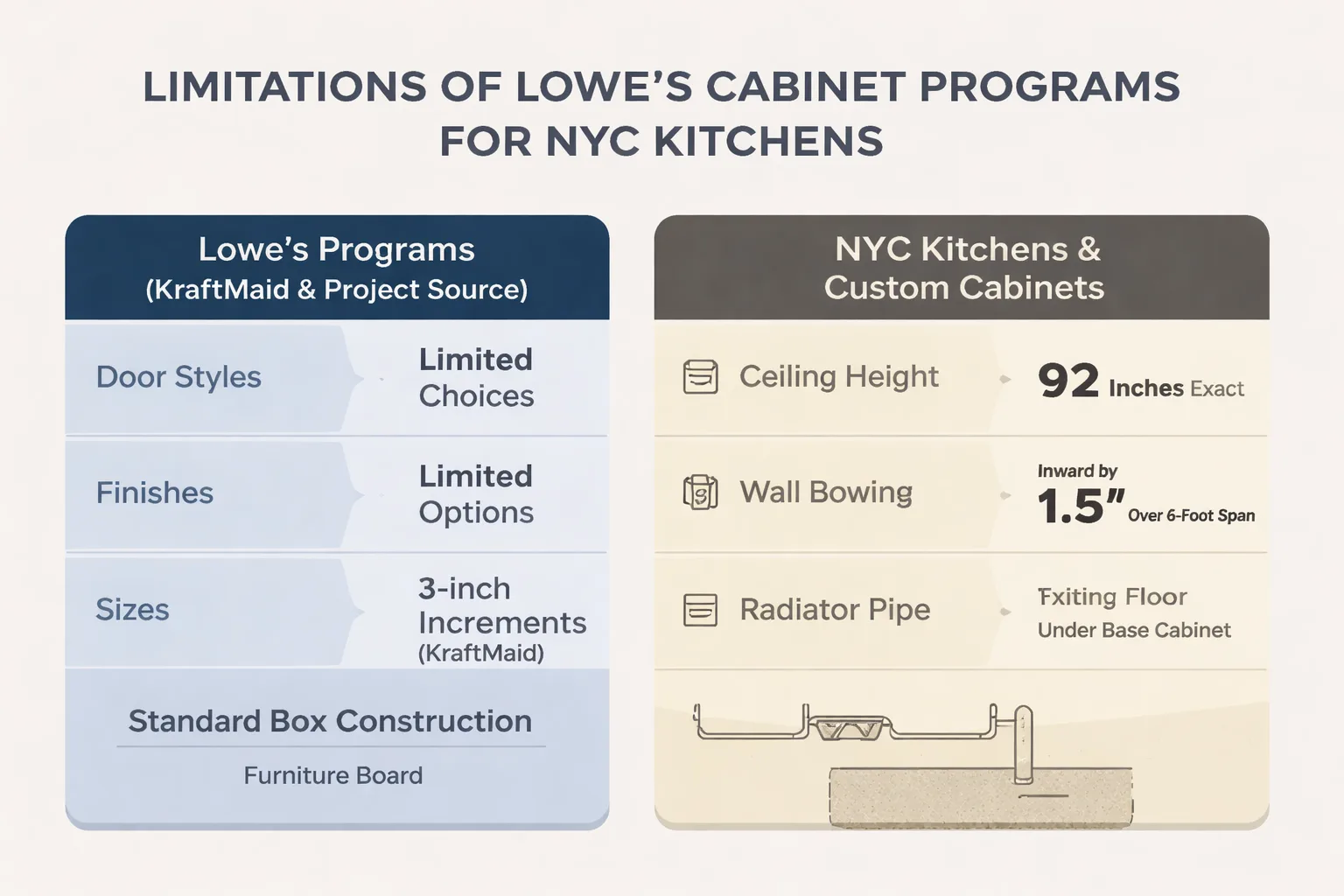
Lowe's carries two primary cabinet programs: KraftMaid (semi-custom) and their in-house Project Source line (stock). The semi-custom program allows buyers to select from a fixed catalog of door styles, finishes, and sizes in 3-inch increments. The stock line offers even fewer choices. Both programs share a fundamental limitation: they are built to standard dimensions that assume a standard kitchen.
NYC kitchens are not standard. A typical Brooklyn brownstone kitchen might have a 92-inch ceiling height (not the 96 or 108 inches the catalog assumes), a wall that bows inward by 1.5 inches over a 6-foot span, or a radiator pipe that exits the floor in the exact spot where a base cabinet should go. Lowe's semi-custom programs cannot accommodate these conditions without field modifications. Those modifications are where the installation budget balloons and the finish quality drops.
The material grades tell their own story. KraftMaid's standard box construction uses furniture board (particleboard) with a wood veneer exterior. Dovetail joinery is available on drawer construction, but only on upgraded lines. The standard offering uses a cam-lock assembly system that relies on hardware connections rather than wood-to-wood joinery. Soft-close hinges and drawer slides are included on most lines, but the hardware is proprietary to the manufacturer, meaning replacements require ordering through Lowe's, not buying at a local hardware store.
Lead times are another friction point. Lowe's semi-custom cabinet orders typically run 4-8 weeks from order to delivery, and that assumes no supply chain disruptions. Stock cabinets are available same-day from the store, but the size and finish options are so limited that most NYC kitchens cannot be completed from stock alone. The result is a hybrid order: stock cabinets for some runs, semi-custom for others, and the homeowner hoping the finishes match.
The finish matching problem is the one that catches people off guard. A white from the stock line and a white from the semi-custom line are rarely the same white. Maria's story at the top of this article is not unique. It is the predictable outcome of mixing cabinet lines from different production runs and hoping the color matches. A Houzz forum discussion on custom cabinets vs. IKEA vs. Semihandmade highlights the same frustration homeowners face when mixing product lines: the finishes don't align, and the workaround is usually a compromise nobody wanted.
Step 1. Define the Gaps Lowe's Can't Fill
Before comparing prices or browsing door styles, map the kitchen. Not metaphorically. Get a tape measure, graph paper, and measure every wall, corner, ceiling height, and obstruction. This is the step that reveals whether Lowe's can serve the project or whether a custom builder like Green Cabinets NY is the only viable path.
Start with the walls. In a pre-war Brooklyn building, walls are rarely plumb. Measure the distance between walls at the floor, at counter height, and at the ceiling. If those three measurements differ by more than half an inch across a 6-foot span, stock cabinets will require scribe filler strips that eat into usable storage. Semi-custom programs offer filler strips in fixed widths (typically 3 inches). Custom builders cut filler strips to the exact dimension needed, which means a 1.75-inch filler instead of a 3-inch filler that wastes 1.25 inches of cabinet space. In a 72-inch kitchen run, that wasted inch and a quarter is real storage.
Next, check the ceiling height. Standard upper cabinets are 30, 36, or 42 inches tall, designed to sit below a standard ceiling with a soffit or leave space for crown molding. A 92-inch ceiling (common in Brooklyn brownstones) doesn't fit any of those options cleanly. The gap between the cabinet top and ceiling becomes a dust-collecting ledge or requires a custom soffit build-out. A custom millwork shop builds the upper cabinet to the exact height that reaches the ceiling, eliminating the gap and adding usable storage volume.
Then catalog the obstructions. Radiator pipes, gas lines, structural columns, window casings, and exposed brick all eat into the cabinet footprint. Stock and semi-custom programs handle obstructions by cutting the cabinet on-site during installation. Cutting a particleboard box on-site with a circular saw is not precision work. The cut edges are exposed, the structural integrity of the box is compromised, and the finish is never as clean as a factory or shop cut. Custom builders template around obstructions in the shop, where the cuts are made on a CNC machine and the edges are finished to match the cabinet exterior.
This is where Green Cabinets NY's process begins: with a blank slate. The design team visits the site, measures to the millimeter, and builds the cabinet layout around the kitchen's actual conditions, not around a catalog's assumed conditions. For Brooklyn homeowners exploring how to pick affordable custom kitchen cabinets without cutting corners, this site-visit-first approach is what separates a custom build from a semi-custom order with a custom price tag.
The gap definition exercise should produce a list. That list is the decision document. If the list contains three or more non-standard conditions (out-of-plumb walls, non-standard ceiling height, obstructions, or finish requirements that don't exist in the catalog), Lowe's programs cannot deliver a clean installation. The question shifts from price to fit.
How Does Box Construction Actually Differ?
The cabinet box is the structural foundation. Everything visible (the door, the drawer face, the finish) is cosmetic. The box is what holds the weight, resists racking, and determines whether the cabinet survives 5 years or 25 years. This is where the quality gap between Lowe's offerings and custom millwork is widest.
Stock and semi-custom cabinets from big-box retailers typically use particleboard (also called furniture board) for the box sides, back, and floor. Particleboard is engineered wood particles bonded with resin under heat and pressure. It is flat, stable, and inexpensive. It is also heavy, brittle at fastener points, and vulnerable to moisture. A plumbing leak behind a particleboard cabinet box will cause the material to swell, delaminate, and lose structural integrity within 24-48 hours of exposure. The cabinet cannot be repaired; it must be replaced.
Custom builders like Green Cabinets NY use plywood for box construction. Plywood is layered wood veneers bonded with adhesive, with the grain direction alternating between layers for strength. Plywood is lighter than particleboard, holds fasteners better (the layers give screws something to bite into), and tolerates moisture exposure far better. A plywood box that gets wet can be dried, sealed, and returned to service. The structural integrity is maintained because the layered construction resists swelling.
The joinery is the second structural differentiator. Lowe's semi-custom cabinets typically use a cam-lock system: a metal fitting inserted into the panel edge that connects to a second fitting in the adjacent panel, tightened with a screwdriver. The connection is mechanical, not wood-to-wood. It relies entirely on the hardware and the particleboard's ability to hold the hardware in place. Over time, the cam-lock loosens as the particleboard compresses around the fitting. The box becomes wobbly. Tightening the cam-lock compresses the particleboard further, accelerating the failure.
Custom millwork uses dado and rabbet joinery: grooves cut into the panel edges that interlock with adjacent panels, glued and sometimes screwed or pinned. The connection is wood-to-wood, with the glue creating a bond that is stronger than the wood itself. The box does not loosen because the joinery does not rely on hardware maintaining tension in particleboard. This is the difference between a cabinet that needs tightening every two years and a cabinet that stays rigid for decades.
The finish application is the third differentiator. Lowe's cabinet finishes are applied in a factory setting, which is an advantage for consistency. The finish is typically a catalyzed conversion varnish, which is durable. However, the finish is applied to the door and drawer front only. The interior of the box is usually a melamine or thermofoil surface laminated to the particleboard. This interior finish is functional but not premium. Custom builders finish the entire cabinet, interior and exterior, with the same material. The interior of a custom cabinet is typically a clear-coated wood veneer or a painted finish that matches the exterior. When the cabinet door is open, the interior looks intentional, not like a different product.
For homeowners evaluating custom walnut kitchen cabinets and whether they're worth it in NYC, the box construction is where the value lives. A walnut door on a particleboard box is a premium face on a disposable foundation. A walnut door on a plywood box with dado joinery is an investment that holds value.
Step 2. Evaluate Joinery, Hardware, and Finish Quality
Once the gaps are defined, the next step is evaluating the construction quality of every cabinet supplier being considered, including Lowe's. This evaluation has four components: box material, joinery method, hardware grade, and finish system.
Box material: Ask the supplier directly what material the box sides, back, and floor are made from. If the answer is "furniture board" or "engineered wood," that is particleboard. If the answer is "plywood," ask for the thickness. Standard cabinet-grade plywood is 1/2 inch for sides and back, 3/4 inch for the floor. Anything thinner is a cost reduction, not a design choice.
Joinery method: Ask how the box panels are connected. If the answer is "cam-lock" or "confirmat screws," the box is assembled with hardware. If the answer is "dado," "rabbet," or "mortise and tenon," the box is assembled with wood joinery. Wood joinery is stronger and longer-lasting. Hardware joinery is faster and cheaper to produce.
Hardware grade: Soft-close hinges and drawer slides are now standard across most cabinet lines, including Lowe's. The question is the brand and replacement availability. Blum and Salice are industry-standard hardware brands with wide replacement part availability. Proprietary hardware (common in big-box programs) requires ordering replacements through the manufacturer, which can take weeks. Custom builders typically use Blum or Salice hardware, available at any cabinet supply house.
Finish system: Ask what finish is applied and where. A catalyzed conversion varnish is the industry standard for durability. Ask whether the finish is applied to the door only or to the entire cabinet (interior and exterior). Ask whether the finish is sprayed (consistent, thin, even) or rolled (thicker, potential for drips and unevenness). Custom builders spray-finish the entire cabinet. Big-box programs spray-finish the door and laminate the interior.
According to HomeLight's cost analysis, kitchen cabinet investment is one of the few renovation expenses that consistently boosts home value because the kitchen is where people spend the most time. But that value boost only materializes if the cabinets are still functional and attractive when the home is shown. Particleboard boxes with loosened cam-locks and scratched melamine interiors do not add value. They signal a cheap renovation.
The evaluation checklist should produce a written spec sheet from each supplier. If a supplier cannot or will not provide a spec sheet detailing box material, joinery, hardware brand, and finish system, that is a red flag. Green Cabinets NY provides a spec sheet for every quote, and the spec sheet is the basis of the contract. If the installed cabinet does not match the spec sheet, the homeowner has a contractual remedy. A verbal promise from a big-box sales associate does not constitute a spec.
Not sure if your kitchen needs custom cabinets or if Lowe's will do the job? Let's measure the gaps together.
What Does the True Cost Comparison Look Like?
The cost comparison between Lowe's and custom kitchen cabinets is where most homeowners make their worst decision. They compare the per-linear-foot price of Lowe's stock cabinets against the per-linear-foot price of custom cabinets, see a 3x difference, and conclude that Lowe's is cheaper. This comparison is wrong because it omits three costs: installation, customization, and replacement.
Custom kitchen cabinets cost between $500 and $1,200 per linear foot, with a typical 10x10 kitchen totaling $10,000 to $24,000, per Angi's cost data. Stock and semi-custom cabinets range from $100 to $650 per linear foot ($2,000 to $13,000 for the same 10x10 kitchen). The raw material cost difference is significant. But the raw material cost is not the total project cost.
Installation is the first hidden cost. Lowe's offers installation through third-party contractors, and the installation cost is separate from the cabinet cost. A typical Lowe's installation quote for a 10x10 kitchen runs $3,000 to $5,000, depending on the contractor and the complexity of the space. Custom builders like Green Cabinets NY include installation in the per-linear-foot quote. The installation is performed by the builder's own crew, not a subcontractor managed by a big-box retailer. When the installer is the builder, the accountability is direct. When the installer is a third party arranged by Lowe's, the accountability is split between the retailer, the installer, and the cabinet manufacturer.
Customization is the second hidden cost. Lowe's charges for modifications to standard cabinets: cutting for pipes, adding filler strips, trimming to fit. These are line items on the installation invoice. Custom builders template around obstructions in the shop, so there are no on-site modification charges. The custom quote includes all modifications because the cabinets are built to fit from the start.
Replacement is the third cost, and it is the one nobody calculates. If particleboard cabinets fail after 7-10 years (a realistic lifespan in a humid NYC kitchen with daily use), the replacement cost is the full project cost again: tear-out, new cabinets, new installation. If custom plywood cabinets last 20-25 years (a realistic lifespan for well-built custom millwork), the annualized cost is lower despite the higher upfront price. The math: $15,000 for custom cabinets lasting 25 years costs $600 per year. $8,000 for stock cabinets lasting 8 years costs $1,000 per year. The cheaper option costs more per year of service.
Green Cabinets NY's quoting process for Brooklyn and NYC projects is transparent on this point. The quote includes the cabinets, the installation, all modifications, and the hardware. There are no line items that appear after the contract is signed. For homeowners researching the cost for custom kitchen cabinets in the NYC market, the transparency of the quote is a direct indicator of the builder's confidence in their process. A builder who quotes low and adds charges later is not cheaper. They are less honest.
How Does Cabinet Lifespan Compare in NYC Conditions?
The honest answer is that there is no published, peer-reviewed study comparing the lifespan of Lowe's stock cabinets against custom millwork in NYC's specific climate conditions. The Kitchen Cabinet Manufacturers Association (KCMA) provides certification standards and industry data but does not publish comparative lifespan studies by cabinet type and climate zone. The NKBA's market outlook report tracks budget allocation, not durability.
What exists instead is practitioner observation and material science. Particleboard's vulnerability to moisture is a documented material property, not an opinion. Plywood's superior moisture resistance is a documented material property. Cam-lock joinery's tendency to loosen over time in particleboard is a mechanical reality, not a marketing claim. These are the facts that should inform a lifespan estimate.
In practice, Brooklyn homeowners with stock particleboard cabinets report visible wear within 3-5 years: swollen edges near the sink, doors that sag on their hinges, drawer fronts that delaminate from the box. These are the predictable outcomes of material choices, not installation errors. Custom plywood cabinets with dado joinery and sprayed conversion varnish show minimal wear after 10 years in the same conditions. The difference is not marginal. It is the difference between a kitchen that looks tired at year 5 and a kitchen that looks intentional at year 15.
The humidity factor matters more in NYC than in most markets. Older buildings with steam heat systems create wide humidity swings: dry in winter when the heat runs, humid in summer when the windows are open. Particleboard expands and contracts with humidity changes, stressing the cam-lock joints and the melamine surface. Plywood also moves with humidity, but the layered construction distributes the stress across the panel, reducing visible warping and joint failure. For NYC homeowners considering sustainable bathroom vanity options, the same material logic applies: plywood outperforms particleboard in humid environments.
Step 3. Build the Apples-to-Apples Comparison
The fair cost comparison requires three documents: a Lowe's quote (cabinets + installation + modifications), a custom builder quote (cabinets + installation + modifications, all-in), and a lifespan-adjusted annual cost calculation for both. Without all three, the comparison is incomplete.
The Lowe's quote should include the cabinet cost, the installation cost, and any modification charges. Ask the Lowe's associate to itemize the installation quote: how many hours, what modifications are included, what modifications are extra. If the associate cannot itemize, the quote is not reliable. The quoted price is a starting point, not a final number.
The custom builder quote should include the cabinet cost, installation, and all modifications as a single number. If the builder cannot provide a single all-in quote, ask why. Green Cabinets NY provides a single-quote model because it reflects the actual process: the cabinets are built to fit, so there are no modification charges to add later. The quote is the price.
The lifespan calculation requires an honest estimate of how long each option will last in the specific kitchen. Use the material properties as the guide: particleboard in a humid NYC kitchen with daily use, 7-10 years before visible wear requires replacement or refacing. Plywood with quality joinery in the same conditions, 20-25 years before comparable wear. Divide the total project cost by the estimated lifespan to get the annual cost. The option with the lower annual cost is the better value, regardless of the upfront price.
This calculation often surprises homeowners. A $12,000 custom installation lasting 25 years costs $480 per year. A $7,000 Lowe's installation lasting 8 years costs $875 per year. The custom option is 40% cheaper per year of service. The upfront price is higher. The long-term cost is lower.
For NYC homeowners and developers evaluating how to choose custom millwork for a Brooklyn renovation, this lifespan-adjusted calculation is the single most important step in the decision process. It reframes the conversation from "what can I afford now" to "what will this kitchen cost me over the next two decades."
Why Most Teams Skip the Lifespan Calculation
The honest tradeoff is that the lifespan calculation requires accepting an estimate, not a guarantee. No builder can promise a cabinet will last exactly 25 years. The estimate is based on material properties and practitioner observation, not a longitudinal study. Some homeowners find this uncertainty uncomfortable and prefer the concrete number on the Lowe's quote, even if that number represents a shorter lifespan.
Others skip the calculation because they plan to sell the home within 5 years and do not care about the 25-year cost. That is a rational choice. If the home is a flip, stock cabinets are the appropriate investment. But if the home is a long-term residence, the lifespan calculation is the only way to make an informed decision about value.
The third reason teams skip this step is that the Lowe's installation quote is often incomplete at the contract stage. Modifications discovered during installation are added to the invoice, and the final cost exceeds the quoted price by 15-30%. The lifespan calculation uses the quoted price, not the final price, which makes the Lowe's option look cheaper than it actually is. This is not a flaw in the calculation. It is a flaw in the quoting process.
Which Choice Is Right for Your NYC Kitchen?
The decision framework comes down to four factors: budget range, timeline, space complexity, and long-term intent.
Budget range: If the total kitchen cabinet budget is under $8,000, stock cabinets from Lowe's are the realistic option. Semi-custom cabinets from Lowe's fit the $8,000-$15,000 range. Custom cabinets from a Brooklyn builder like Green Cabinets NY fit the $15,000-$30,000+ range. The budget determines the category, not the other way around.
Timeline: If the kitchen needs to be functional in under 4 weeks, Lowe's stock cabinets (same-day pickup) are the only option. If the timeline allows 8-12 weeks, custom cabinets are viable. The timeline is a hard constraint that overrides all other factors.
Space complexity: If the kitchen has standard dimensions, plumb walls, and no obstructions, Lowe's semi-custom program will work. If the kitchen has non-standard dimensions, out-of-plumb walls, obstructions, or finish requirements outside the catalog, custom is the only clean option. The space decides.
Long-term intent: If the home is a short-term investment (under 5 years), stock cabinets maximize return. If the home is a long-term residence (10+ years), custom cabinets minimize annual cost and maximize satisfaction. The intent decides.
For Brooklyn homeowners dealing with the specific challenges of pre-war buildings, non-standard layouts, and a desire for finishes that match the character of the home, the decision usually lands on custom. Not because custom is inherently superior, but because the conditions of NYC kitchens demand it. Lowe's programs are designed for the average American kitchen. Brooklyn kitchens are not average.
Green Cabinets NY builds for those kitchens. Every cabinet is templated to the space, built from plywood with dado joinery, finished with sprayed conversion varnish inside and out, and installed by the builder's own crew. The process is not faster than Lowe's. It is not cheaper than Lowe's. It is more precise, more durable, and more honest about what the kitchen will look like in 10 years. For homeowners ready to explore how to renovate a small kitchen without losing storage, the custom path is the one that preserves every inch of usable space.
The choice between lowes custom kitchen cabinets and a local Brooklyn builder is not a choice between good and bad. It is a choice between adequate and exact. Adequate works for standard spaces. Exact works for Brooklyn.
FAQ
Can Lowe's match a custom paint color?
No. Lowe's semi-custom programs offer a fixed catalog of finishes. If the kitchen requires a specific paint color to match existing trim, tile, or millwork, the catalog cannot accommodate it. Custom builders like Green Cabinets NY custom-match any paint color or stain, applied in the shop with sprayed equipment for a factory-grade finish.
How long do Lowe's cabinets actually last in a Brooklyn kitchen?
Based on material properties (particleboard boxes, cam-lock joinery, melamine interiors), expect visible wear within 5-8 years in a humid NYC kitchen with daily use. Swollen edges near the sink, sagging doors, and delaminating drawer fronts are the common failure points. Custom plywood cabinets with dado joinery typically show minimal wear after 10-15 years in the same conditions.
Does Lowe's include installation in their cabinet price?
No. Lowe's cabinet prices cover materials only. Installation is quoted separately through third-party contractors, typically adding $3,000-$5,000 for a 10x10 kitchen. Custom builders like Green Cabinets NY include installation in the per-linear-foot quote, with installation performed by the builder's own crew.
Can I get semi-custom kitchen cabinets from Lowe's for a non-standard ceiling height?
Lowe's offers upper cabinets in 30, 36, and 42-inch heights. If the ceiling height doesn't accommodate one of these options cleanly, the gap is filled with a soffit or left open. Custom builders build upper cabinets to the exact ceiling height, eliminating the gap and adding storage volume.
What is the price difference per linear foot?
Per Angi's data, stock and semi-custom cabinets from big-box retailers run $100-$650 per linear foot. Custom kitchen cabinets from a local builder run $500-$1,200 per linear foot. The higher per-foot cost includes installation, modifications, and premium materials that Lowe's charges for separately.
Is it worth getting custom kitchen cabinets near me instead of ordering online?
For NYC homeowners, local custom builders offer site visits, precise templating, and direct accountability that online and big-box programs cannot match. The custom kitchen cabinets near me advantage is fit: the builder measures the actual space and builds to those dimensions, not to a catalog's assumptions.
Get a transparent, all-in quote from Green Cabinets NY and see exactly what custom millwork costs for your Brooklyn kitchen.