How to Style Black Kitchen Cabinets in a NYC Home
Black kitchen cabinets create depth, drama, and durability in NYC homes. This guide covers finish selection, material pairing, lighting strategy, and the common mistakes to avoid when going dark in a Brooklyn or Manhattan kitchen.
By Green Cabinets NY Team
Key Takeaways
- Black cabinets recede visually in narrow NYC galley kitchens to create depth and dimension rather than the flat light bounce of all-white surfaces.
- Pair black finishes with brass, marble, and warm wood tones already common in Brooklyn brownstones to deliver deliberate contrast that hides high-traffic imperfections.
- The global cabinet market is projected to grow from USD 141 billion in 2025 to USD 189.32 billion by 2031 at a 5.04% CAGR, tracking demand for customized dark millwork.
- Specify near-black lacquered or deep-stained wood finishes in NYC renovations to echo early twentieth-century prestige while delivering structural practicality over cosmetic trends.
Dark cabinetry is not a trend born from social media mood boards. In the early twentieth century, New York City's most prestigious hotel kitchens and private brownstone residences routinely featured deep-stained wood and near-black lacquered finishes. A signifier of craft and permanence in an era before white became synonymous with cleanliness. The pendulum swung hard toward light and bright through the mid-century, and stayed there for decades. But as Brooklyn and Manhattan homeowners rediscover custom millwork and material honesty, black kitchen cabinets are reclaiming their place as the city's most enduring design statement.
Black kitchen cabinets work in NYC homes because they create deliberate contrast, hide imperfections in high-traffic cooking zones, and pair naturally with the brass, marble, and warm wood tones already common in Brooklyn brownstones. The global cabinet market sits at roughly USD 141 billion in 2025 and is projected to reach USD 189.32 billion by 2031, growing at a 5.04% CAGR. That growth tracks directly with homeowner demand for customization over commodity. When Green Cabinets NY specs a black finish, the decision is never cosmetic alone. It is structural, practical, and rooted in how a specific kitchen functions day to day.
Why Black Kitchen Cabinets Work in NYC Spaces
NYC kitchens are small. That is the unspoken truth driving every material decision in a Brooklyn townhouse or Manhattan apartment renovation. The conventional advice says go light, go white, go bright to make the space feel larger. That advice is not wrong, but it is incomplete.
Black cabinetry creates depth. In a narrow galley kitchen, dark perimeter cabinets recede visually, which can actually make a space feel less cramped than uniformly light surfaces that bounce light flatly in every direction. The eye reads dark cabinets as shadow, as negative space, and the room gains a sense of dimension that white-on-white cannot produce. This is the same principle theater designers use when they paint the back wall of a stage black to push it visually further away.
The drama factor matters too. Brooklyn homeowners investing in custom cabinets for kitchen renovations want a result that feels intentional and personal, not like a builder-grade spec home. Black delivers that immediately. A matte black island against white perimeter cabinets creates a focal point that anchors the room. A full black kitchen with brass hardware and a honed marble countertop reads as luxury without screaming for attention.
Green Cabinets NY approaches black finish selection through a material-first lens. The wood species underneath the finish determines how the black reads. Rift-cut white oak takes a black stain differently than maple takes a black lacquer. The grain pattern either complements the darkness or disappears entirely. That choice changes the entire character of the kitchen.
There is also a practical durability argument. Dark cabinets show fewer scuffs, fingerprints, and cooking splatter marks than white or natural wood finishes. In a NYC kitchen where square footage is tight and cooking happens inches from the cabinetry, that is not a minor benefit. It is a daily quality-of-life improvement.
Consider a typical Brooklyn brownstone galley kitchen measuring roughly 7 feet wide by 12 feet long. The standard renovation playbook would specify white shaker cabinets, a light quartz countertop, and a white subway tile backsplash to maximize the perception of space. That approach works, but it produces a kitchen that looks identical to every other renovated brownstone on the block. Now consider the same footprint with matte black base cabinets, a light honed marble countertop, white uppers, and brass hardware. The black bases ground the room. The light uppers maintain airiness. The marble adds movement. The brass adds warmth. The kitchen feels designed rather than specified.
The material honesty argument is relevant here. Brooklyn and Manhattan homeowners are increasingly drawn to materials that show their real character rather than imitating something else. Black-stained wood is honest about what it is: a durable, natural material with a finish that enhances rather than disguises its grain. This is distinct from thermofoil or laminate black finishes, which mimic wood grain artificially and degrade differently over time. Green Cabinets NY works exclusively with real wood substrates because the aging process of real wood is a feature, not a defect. A black-stained rift-cut white oak cabinet will develop a subtle patina over decades. A black thermofoil cabinet will peel at the edges within five to seven years in a high-humidity NYC kitchen.
How to Choose the Right Black Finish
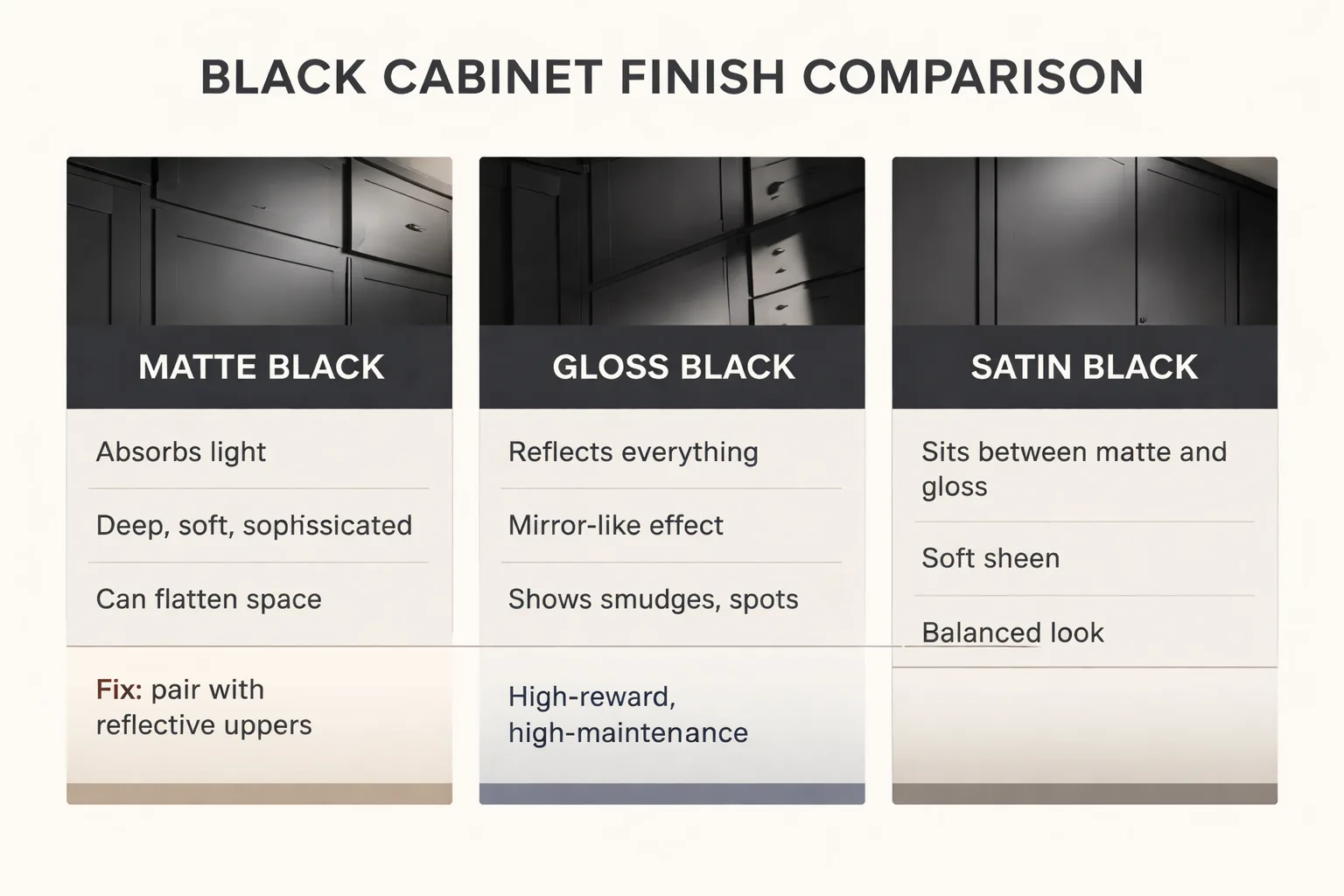
The finish matters more than the color. Three black finishes produce three completely different kitchens, and choosing wrong is the most common mistake homeowners make.
Matte black absorbs light. It reads as deep, soft, and almost fabric-like. In a low-light NYC kitchen with limited natural windows, matte black can feel sophisticated and intimate, but it can also flatten the space if every surface is matte. The fix is contrast: pair matte black lower cabinets with a light reflective upper section, or use matte on the island only and keep perimeter cabinets lighter.
Gloss black reflects everything. Every fingerprint, every smudge, every ceiling light reflection. In a small kitchen with limited wall space, gloss black can create a mirror effect that visually doubles the room. But it demands meticulous maintenance. Gloss shows water spots near sinks, cooking oil near stoves, and dust on every surface. It is high-reward and high-maintenance.
Satin black sits between the two. It has enough sheen to reflect some light and feel alive, but enough texture to hide daily wear. For most NYC homeowners, satin is the safest starting point. It works in open-plan kitchens where the cabinetry is visible from the living area, and it tolerates the reality of urban cooking.
The wood species underneath changes the equation. Cherry has a natural reddish undertone that warms a black stain, producing a black with depth rather than a flat charcoal. Ash has an open grain that adds texture to a black finish, giving it a tactile quality that smooth-grained woods cannot match. These are not trivial distinctions. They are the difference between a kitchen that feels custom and one that feels sprayed on.
The Green Cabinets NY finish process involves testing stain samples on the actual wood species selected, in the actual kitchen space, under the actual lighting conditions. A black stain that looks perfect in a showroom under LED panels can look entirely different under a Brooklyn kitchen's north-facing window with mixed incandescent and natural light.
Consider the specific mechanics of a black lacquer finish versus a black stain. A lacquer is a topcoat that sits on the surface of the wood, creating a uniform film that obscures the grain beneath. It produces a consistent, manufactured look that works well on tight-grained species like maple. A stain penetrates the wood fiber, coloring it while allowing the grain to show through. Stains work best on species with pronounced grain patterns like oak, ash, or mahogany. The choice between lacquer and stain is not just about appearance. It affects how the cabinet ages, how it can be repaired if damaged, and how it interacts with the wood's natural movement. Lacquer can chip and reveal the wood beneath. Stain wears gradually and can be touched up more easily. In a NYC kitchen where humidity fluctuates seasonally, these differences matter.
The application process for a quality black finish involves at least five stages: wood preparation with progressive sanding grits (120, 180, 220), a primer or base coat to seal the grain, an intermediate sanding to level the surface, the color coat itself, and a protective topcoat. Each stage requires drying time and quality inspection. Skipping any stage produces a finish that looks acceptable on day one but fails within a year. This is why custom black cabinetry costs more than stock black cabinetry. The finish process is where the investment becomes visible.
How to Pair Black Cabinets with Countertops and Hardware
Black cabinets are a foundation, not a complete design. The countertop and hardware choices determine whether the kitchen feels curated or flat.
Marble is the classic pairing. Honed Carrara or Calacatta marble against matte black cabinets creates a timeless, high-contrast look that works in both pre-war and new-construction NYC kitchens. The veining in the marble adds movement that prevents the dark cabinetry from feeling heavy. The tradeoff is maintenance: marble etches with acid and requires sealing. In a household that cooks daily with citrus and wine, that matters.
Quartz is the practical alternative. A white or light gray quartz with subtle veining gives the visual effect of marble without the etching. Against black cabinets, light quartz creates the same high-contrast drama but with a surface that survives NYC cooking. For homeowners who want warmth rather than contrast, a butcher block countertop in a light wood like white oak softens black cabinetry and introduces organic texture.
Hardware is where personality enters. Brass and black is a combination that has worked for a century and will work for the next. Warm brass pulls against matte black cabinets create a jewelry effect that elevates the entire kitchen. Brushed nickel is more restrained and modern. Matte black hardware on black cabinets creates a monolithic look that reads as intentional but requires precise finish matching to avoid looking mismatched.
The countertop overhang and edge profile also interact with black cabinetry. A thick, square-edge countertop in a light material creates a strong horizontal line that visually breaks up tall black cabinet runs. A thinner profile with a mitered edge feels more refined and modern. These are decisions that compound: the right countertop, edge profile, and hardware pull together transform black cabinets from a color choice into a designed system.
Concrete countertops deserve consideration for industrial-style Brooklyn lofts. A dark concrete counter against black cabinets creates a monochromatic, textural palette that works in spaces with exposed brick and large windows. The contrast comes from texture rather than color. This is a bolder choice that suits specific architectural contexts but can feel heavy in a standard apartment kitchen.
For hardware sizing, the proportion matters as much as the finish. In a NYC kitchen with narrow cabinet stiles (the vertical frame members), oversized pulls can overwhelm the door panels. A 3-inch pull on a 12-inch-wide drawer is balanced. The same pull on a 24-inch drawer looks undersized. For black cabinets specifically, hardware provides the only visual break on a dark surface, so the hardware becomes a primary design element rather than a secondary one. This means the hardware selection process should happen during cabinet design, not after installation.
The finish of the hardware also interacts with the cabinet finish. Polished brass against gloss black creates a high-contrast, formal look. Satin brass against matte black creates a softer, more approachable palette. Unlacquered brass ages over time, developing a patina that complements the organic aging of real wood cabinets. This is a choice that rewards long-term ownership and does not suit homeowners planning to sell within five years.
Thinking about black cabinets for your NYC kitchen renovation?
Pairing Black Cabinetry with Flooring and Backsplash
The surfaces below and behind black cabinets matter as much as those above them. Flooring and backsplash choices either ground the dark cabinetry or let it float awkwardly.
Light wood flooring is the strongest pairing for black kitchen cabinets in NYC apartments. A natural quartersawn oak floor in a warm tone creates a clear horizontal plane that balances the visual weight of dark cabinetry above. The contrast is the point: dark above, light below. This combination works in brownstones with original wood floors and in new-construction condos where the floor is being installed fresh.
Tile backsplashes need careful consideration. A white subway tile is safe and effective, but it is also the most common choice in NYC kitchens, which means it does nothing to distinguish a custom black kitchen from a standard renovation. A dark grout with white tile adds definition. A full-height slab backsplash in the same stone as the countertop creates a seamless, expensive look that wraps the black cabinetry in material continuity. For a bolder move, a zellige tile in a deep color like forest green or navy creates a layered, rich palette that complements black without competing.
The backsplash also serves a functional role in a black kitchen. Dark cabinets can create shadows around the cooktop and prep areas. A reflective or light-colored backsplash bounces task lighting back into the workspace, counteracting the light absorption of the dark cabinetry. This is not just aesthetics. It is a functional lighting decision disguised as a material choice.
Flooring color theory in a black kitchen follows a simple principle: the floor should not match the cabinets. When floor and cabinet colors are too close, the kitchen loses definition and feels monotonous. A light floor against black cabinets creates a clear horizon line that structures the visual field. A medium-tone floor like birch or natural red oak creates a transitional palette that bridges dark cabinets and light walls. A dark floor with dark cabinets can work in a large, well-lit kitchen but is risky in the compact footprints typical of NYC apartments.
For backsplash materials beyond tile, consider the maintenance profile. Natural stone slabs require sealing and can stain. Glass backsplashes are non-porous and easy to clean but show every speck of cooking splatter behind a stove, which is more visible against a dark cabinet surround. Ceramic and porcelain tiles offer the best balance of durability, cleanability, and design flexibility for NYC kitchens where cooking is daily and space is tight.
How to Avoid Common Mistakes with Dark Cabinetry
The biggest mistake is treating black cabinets like white cabinets with a different color. They behave differently in space, under light, and over time.
Lighting is the failure point. A black kitchen with standard overhead lighting will feel like a cave. NYC apartments often have limited natural light to begin with, and black surfaces absorb what little light exists. The solution is layered lighting: under-cabinet LED strips for task lighting, pendant lights over islands for ambient illumination, and toe-kick lighting for depth. Every black kitchen Green Cabinets NY designs includes a lighting plan developed alongside the cabinetry specs, not as an afterthought.
The spatial illusion cuts both ways. Black can make a small kitchen feel deeper, as discussed, but only if the black is used strategically. An all-black kitchen in a 60-square-foot Manhattan studio will feel oppressive, not dramatic. The rule of thumb: use black on lower cabinets or an island in small spaces, and reserve full-black for kitchens with at least one large window or open connection to a living area.
Maintenance is the hidden cost. Black shows dust more clearly than white or medium-tone wood. This sounds counterintuitive, but dust is light-colored, and it is visible against dark backgrounds. Matte black shows less dust than gloss, but it shows grease smears more readily. The finish choice should account for the household's cooking habits and cleaning tolerance, not just the aesthetic preference.
Material selection is where sustainability enters the conversation. Not all black cabinets are created equal. Pressed wood products like MDF and particleboard, often used in semi-custom kitchen cabinets and stock options, are susceptible to moisture damage and can off-gas formaldehyde. This is a particular concern in NYC's high-humidity environments. The RONBROW sustainability blog emphasizes that eco-friendly cabinet claims require proof beyond labels, specifically certifications like CARB Phase 2 compliance and documented low-VOC finishes. Green Cabinets NY builds black cabinets from solid wood species, not composite substrates, because the material underneath the finish determines both durability and indoor air quality.
The humidity problem in NYC apartments is not theoretical. Older buildings with radiator heat can drop indoor humidity to 20% in winter, causing wood to shrink and joints to open. Summer humidity can spike to 70% or higher without air conditioning, causing wood to swell. MDF and particleboard absorb moisture from the air, expanding permanently. Once swollen, composite materials do not return to their original dimensions. Solid wood moves with humidity changes but returns to its original shape because the movement is reversible within the wood's elastic range. This is why a black-painted MDF cabinet door may develop a visible warp within two years, while a solid wood door with the same finish remains stable. The substrate is the foundation of longevity.
The off-gassing issue compounds in small NYC kitchens. Formaldehyde emissions from composite wood products concentrate in poorly ventilated spaces. A kitchen measuring 60 square feet with MDF cabinetry can have measurably higher formaldehyde levels than the same kitchen with solid wood cabinetry. CARB Phase 2 compliance sets maximum emission levels for composite wood products sold in California, and while New York does not mandate the same standard, reputable manufacturers comply voluntarily. Green Cabinets NY specifies CARB Phase 2 compliant materials for any composite components used in drawer boxes or shelving, and builds all visible cabinetry from solid wood.
What About the Cost of Custom Black Cabinetry?
The cost for custom kitchen cabinets reflects the material, finish process, and fabrication complexity, not the color itself. A black lacquer finish requires more preparation and application steps than a natural clear coat because the surface must be flawless. Any imperfection in the wood or primer shows through a dark finish. That means more sanding, more sealing, and more quality control.
Stock and semi-custom options exist at lower price points, but they compromise on material quality and fit. In a NYC kitchen where every inch matters, stock cabinet dimensions waste space. Custom fabrication fills every corner and maximizes storage in ways that standardized sizes cannot. The Kitchen Search cost guide outlines the general value proposition of custom versus semi-custom versus stock, though specific NYC pricing depends on project scope, wood species, and finish complexity.
For homeowners comparing custom kitchen cabinets prices, the relevant comparison is not just cost per linear foot. It is cost per year of service. A well-built custom black cabinet in solid wood, properly finished, will outlast a stock MDF cabinet by decades. In a humid NYC apartment where MDF can swell and delaminate, that longevity is the real value proposition.
The cost breakdown for black custom cabinetry differs from natural finish cabinetry in specific ways. The sanding process is more labor-intensive because dark finishes highlight every scratch in the substrate. A natural clear coat on oak can tolerate a 150-grit final sand because the grain texture masks minor imperfections. A black lacquer on maple requires a 220-grit final sand minimum, with an intermediate sealer coat sanded to 320-grit between coats. That is roughly 40% more labor in the finishing stage alone.
The wood selection also affects cost. Painted black finishes work best on tight-grained, even-textured species like maple or birch, which are mid-range in price. Stained black finishes work on more open-grained species like white oak or ash. Exotic species like mahogany command a premium but produce a black stain with exceptional depth due to their natural color. The choice of wood species can shift the material cost by 30% or more, and the finish choice can shift labor cost by 20% to 40%. These are the real numbers behind the custom kitchen cabinets cost question.
For developers considering black cabinetry across multiple units, the calculus changes. A consistent black finish across a building's common kitchen design creates brand cohesion, but it requires strict quality control across production runs. Green Cabinets NY has observed that developers who specify black cabinetry without understanding the finish complexity often face change orders when the first batch arrives with visible imperfections. The solution is to prototype one kitchen unit, approve the finish under actual lighting, and then proceed with full production.
How Does Lighting Change Black Cabinet Appearance?
Lighting transforms black cabinetry more than any other design element. The same black finish can read as warm charcoal, cool graphite, or flat void depending on the color temperature and direction of the light source.
Warm light (2700K-3000K) brings out brown and red undertones in black finishes, making them feel richer and more organic. This works well with wood-based black stains on mahogany or cherry. Cool light (4000K+) pushes black toward blue-gray, which reads as modern and crisp but can feel sterile in a residential kitchen. The ideal for most NYC homes is a middle range around 3000K-3500K, which balances warmth and clarity.
Direction matters as much as temperature. Under-cabinet lighting aimed at the backsplash illuminates the workspace and reflects off the counter, creating indirect light that softens the black cabinetry. Pendant lights over an island cast direct pools of light that highlight the cabinet surface texture. Toe-kick lighting creates a floating effect that reduces the visual weight of dark lower cabinets. A black kitchen with all three layers feels dimensional and alive. A black kitchen with only overhead lighting feels flat and heavy.
The testing process should happen before final finish selection. Green Cabinets NY recommends evaluating finish samples under the actual fixtures that will be installed, not under showroom lighting. A black that looks perfect under a 4000K LED panel may look muddy under a 2700K incandescent bulb. This is a small step that prevents a costly and disappointing result.
The quantity of light matters as much as the quality. A black kitchen needs roughly 30% more lumens per square foot than a white kitchen to achieve the same perceived brightness. For a 100-square-foot kitchen, that means planning for approximately 3,000 to 3,500 lumens of task lighting alone, plus ambient and accent layers. Under-cabinet LED strips should deliver 450 to 500 lumens per foot to adequately illuminate the countertop workspace beneath dark upper cabinets. Without this calculation, the kitchen will function poorly regardless of how good it looks in a photograph.
Dimmability is essential. Black cabinetry in a kitchen that opens to a living area needs to transition from bright task lighting during cooking to softer ambient lighting during entertaining. A dimmable LED system with warm-dimming technology (which shifts color temperature from cool to warm as it dims) creates a natural evening transition that flatters dark surfaces. Standard dimmable LEDs that maintain the same color temperature when dimmed can make a black kitchen feel cold at low levels. The lighting control system should be specified during cabinet design, not retrofitted after installation.
When Should You Choose Black Over Other Colors?
Black is not the right choice for every kitchen. It is the right choice for specific conditions and specific homeowners.
Choose black when the kitchen has at least one strong natural light source. A south-facing window, a skylight, or an open connection to an adjacent room with large windows provides enough light to balance the absorption of dark surfaces. Without that, black cabinetry requires significant artificial lighting investment to avoid feeling oppressive.
Choose black when the homeowner wants a design statement rather than a safe backdrop. White kitchens are neutral and resale-friendly. Black kitchens are specific and intentional. They appeal to buyers who want their home to reflect their taste, not to appeal to the widest possible future buyer. In Brooklyn's competitive real estate market, a well-executed black kitchen can actually differentiate a property, but it is a deliberate choice, not a default.
Choose black when the cabinetry quality justifies it. A black finish on high-quality solid wood with proper grain selection and expert finishing looks luxurious. The same black finish on cheap MDF with visible seams and uneven application looks cheap. Black amplifies quality and amplifies flaws equally. This is why Green Cabinets NY approaches black finishes only with premium wood species and a rigorous preparation process.
Do not choose black as a trend follow. The black kitchen cabinet trend will eventually cycle, as all trends do. But a well-designed black kitchen built with quality materials and thoughtful lighting is not a trend. It is a design decision that holds its value because it was made with intention.
The resale question deserves honest treatment. Real estate agents routinely advise against bold kitchen choices, and black cabinetry is frequently flagged as a resale risk. The data is more nuanced. A poorly executed black kitchen with cheap materials and bad lighting will absolutely deter buyers. A well-executed black kitchen with quality materials, proper lighting, and cohesive design can be a selling point, particularly in Brooklyn neighborhoods where buyers value design distinction. The difference is execution. The color itself is neither an asset nor a liability. The quality of the implementation determines whether it adds or subtracts value.
For homeowners planning to stay in their NYC home for ten years or more, the resale argument is less relevant. A kitchen is a daily living space, not a staging environment. Choosing a finish that brings daily satisfaction for a decade outweighs optimizing for a hypothetical future buyer who may never materialize. Green Cabinets NY encourages clients to weigh their own daily experience heavily against resale considerations, while being honest about the tradeoffs.
How to Integrate Black Cabinets into Open-Plan NYC Layouts
Open-plan layouts dominate new NYC kitchen renovations. Brownstone gut renovations frequently remove walls between kitchen, dining, and living areas to create a single flowing space. Black cabinetry in an open-plan context behaves differently than in an enclosed kitchen.
In an open-plan layout, the kitchen is visible from the living area at all times. This means the cabinetry functions as furniture, not just as storage. Black cabinets in this context create a visual anchor that defines the kitchen zone within the larger space. A black island, in particular, serves as a visual divider between cooking and living areas without requiring a wall. The dark mass of the island reads as a deliberate architectural element rather than background storage.
The challenge is managing the visual weight. A full wall of black cabinetry visible from a sofa can feel imposing. The solution is to break up the black with integrated appliances, open shelving, or glass-front cabinets with interior lighting. A run of black cabinets with a panel-ready refrigerator and dishwasher reads as a single dark mass. The same run interrupted by open shelving or light-interior glass cabinets creates rhythm and reduces the monolithic effect.
The ceiling color also matters in open-plan spaces with black cabinetry. A white ceiling reflects light downward onto the dark cabinets, softening their mass. A dark ceiling in a kitchen with black cabinets and an open connection to a living area can make the entire space feel cave-like. Keep ceilings light in open-plan kitchens with black cabinetry, and use the dark elements as deliberate accents within the lighter envelope.
What Wood Species Produces the Best Black Finish?
The wood species determines the character of a black finish more than any other variable. Different species accept black stains and paints in fundamentally different ways.
Maple produces the cleanest, most uniform black painted finish. Its tight, closed grain and even texture create a smooth surface that takes paint without visible grain telegraphing through the finish. This is why maple is the industry standard for painted cabinetry. For a black kitchen that reads as modern and minimal, maple with a satin black lacquer is the strongest choice.
Rift-cut white oak produces a black finish with subtle linear grain visible through the color. The rift-cutting method produces a straight, tight grain pattern that adds organic texture to a dark finish without being busy. A black-stained rift-cut white oak cabinet reads as sophisticated and natural simultaneously. This is a popular choice for Brooklyn homeowners who want darkness with material honesty.
Cherry produces a black finish with warm undertones. Cherry's natural reddish color shifts any black stain toward a warm charcoal rather than a cool black. Over time, cherry darkens naturally, which means a black-stained cherry cabinet will deepen and enrich with age. This is a desirable characteristic for homeowners who want their kitchen to develop character over time.
Ash produces a black finish with pronounced textural grain. Ash has an open grain structure similar to oak but with a bolder pattern. A black stain on ash creates a high-contrast grain effect where the dark pores of the wood stand out against the stained surface. This produces a tactile, organic finish that works well in rustic or industrial design contexts.
Mahogany produces the deepest, richest black stain available. The natural density and color of mahogany create a black finish with exceptional depth, almost like looking into dark water rather than at a painted surface. Mahogany is a premium species, and the cost reflects that, but for homeowners seeking the highest quality black finish, no other species matches its depth.
Where This Approach Breaks Down
Black cabinetry advice fails in three specific scenarios, and pretending otherwise does homeowners a disservice.
First, north-facing kitchens with zero natural light. No amount of clever lighting fully replicates the effect of sunlight bouncing off a surface. In a dark, north-facing Manhattan studio kitchen, black cabinets will absorb what little light exists and the space will feel smaller, not deeper. The depth-creation principle only works when there is some light to create contrast against.
Second, rental properties. Black cabinetry is a bold, specific choice that narrows the tenant pool. Landlords renovating for broad market appeal should stick with neutral finishes. A black kitchen in a rental sits vacant longer and may require repainting between tenants, which defeats the purpose of investing in a quality finish.
Third, budgets that force material compromises. A black finish on low-quality substrate looks worse than a natural finish on the same material because black highlights every seam, every grain mismatch, and every surface imperfection. If the budget forces MDF or low-grade veneer, choose a lighter finish that tolerates those limitations. Black demands quality. Without it, the result is worse than not going black at all.
There is a fourth scenario worth naming: households with young children. Black lower cabinets show finger marks at toddler height more visibly than medium-tone finishes. Every handprint, every sticky palm, every crayon mark is visible against a dark surface. This does not mean families should avoid black cabinetry, but it does mean the finish choice should account for the household's daily reality. Matte black shows finger marks less than gloss, and a scuff-resistant topcoat can mitigate the issue. But the maintenance factor is real, and ignoring it leads to frustration.
How to Maintain Black Cabinets in a NYC Kitchen
Maintenance starts with the finish specification and continues with daily habits. A well-specified black cabinet is not harder to maintain than a white one, but the maintenance is different.
For matte black finishes, the primary concern is grease accumulation near the cooktop. Cooking aerosols settle on surfaces, and on matte black they create a slight sheen that builds over time. The solution is regular wiping with a microfiber cloth and mild dish soap. Avoid abrasive sponges, which can dull the matte finish. A monthly deep clean with a pH-neutral cleaner removes built-up grease without damaging the topcoat.
For gloss black finishes, the enemy is water spots. NYC tap water contains minerals that leave visible deposits on gloss surfaces. Near the sink, this means drying the cabinet surfaces after any splashing. A squeegee or microfiber cloth kept near the sink makes this a 30-second habit rather than a chore. For hard water spots that have already formed, a 50/50 white vinegar and water solution dissolves the minerals without harming the finish, provided the topcoat is intact.
For satin black finishes, maintenance falls between the two. Satin tolerates occasional splashes and smudges better than gloss, and shows grease less than matte. A weekly wipe-down with a damp microfiber cloth keeps satin black looking new. The key is consistency rather than intensity. A weekly five-minute wipe is more effective than a monthly deep scrub.
All black finishes benefit from avoiding wax-based furniture polishes. These products leave a film that builds up over time and creates an uneven sheen on dark surfaces. Stick with water-based cleaners specifically formulated for painted or lacquered surfaces. If the finish ever needs refreshing, a professional recoat restores the original appearance without replacing the cabinets. This is where solid wood construction pays off: a real wood cabinet can be refinished in place, while an MDF cabinet with a damaged veneer cannot.
FAQ
Are black kitchen cabinets hard to keep clean?
Matte and satin black finishes hide most daily wear better than white. Gloss black shows fingerprints and water spots readily. The cleaning frequency depends more on the finish type than the color. Matte black requires less daily wiping than white cabinets, but shows grease smears more visibly. Regular cleaning with a soft cloth and mild soap keeps black cabinetry looking sharp.
Do black kitchen cabinets make a small NYC kitchen feel smaller?
Not necessarily. Black perimeter cabinets can recede visually, creating an illusion of depth. The key is contrast: pair black lower cabinets with lighter uppers or a light countertop. Full-black in a tiny windowless kitchen will feel cramped. Full-black in a kitchen with natural light and an open plan can feel expansive.
What wood species works best for black cabinets?
Rift-cut white oak and maple are popular for painted black finishes because they take paint evenly. Cherry and mahogany work beautifully with black stains because their natural warmth adds depth. Ash offers an open grain texture that adds tactile interest to black finishes. The species choice should match the desired finish type: stain versus paint versus lacquer.
How much do custom black kitchen cabinets cost in NYC?
Custom pricing depends on wood species, finish complexity, kitchen size, and hardware selection. Black lacquer finishes cost more than natural finishes because the preparation process is more intensive. Stock and semi-custom options cost less but compromise on fit and material quality. In NYC's tight kitchens, custom fabrication maximizes every inch of storage space.
Can black cabinets work in a pre-war Brooklyn apartment?
Yes. Pre-war apartments often have the architectural detail, ceiling height, and natural light that support dark cabinetry. Black cabinets pair naturally with the brass hardware, marble, and dark wood floors common in pre-war buildings. The key is respecting the architectural context rather than fighting it.
What lighting is best for a black kitchen?
Layered lighting is essential. Combine under-cabinet LED strips for task lighting, pendant fixtures for ambient light, and toe-kick lighting for depth. Aim for 3000K-3500K color temperature. Plan for approximately 30% more lumens than a white kitchen would require.
Do black cabinets show dust more than white cabinets?
Yes. Dust is light-colored and visible against dark surfaces. Matte black shows less dust than gloss black. Weekly wiping with a dry microfiber cloth manages dust accumulation effectively.
Black kitchen cabinets are not a trend to adopt blindly or avoid out of fear. They are a design tool that, when used with the right materials, lighting, and spatial strategy, produces a kitchen that feels intentional and enduring. Green Cabinets NY has built black cabinetry for Brooklyn brownstones, Manhattan condos, and everything between. The common thread is never the color. It is the craft behind it.
Get a custom black cabinetry consultation with Green Cabinets NY and see your finish samples under real lighting before you commit.