Online Custom Kitchen Cabinets vs. Local Brooklyn Builders: The Real Difference
Online custom kitchen cabinets promise bespoke results at lower prices, but Brooklyn homeowners are discovering the real cost of remote design, shipping damage, and fit issues. Here's what the data actually shows.
By Green Cabinets NY Team
Key Takeaways
- Stock cabinets cost $75–$250 per linear foot while custom cabinets run $500–$1,200+ per linear foot, creating a $15,000+ gap for a full kitchen.
- Online custom kitchen cabinets quote 30-50% lower prices than local Brooklyn builders but frequently deliver results that fall short of their 3D renderings.
- Houzz users report major quality gaps between semi-custom and fully custom cabinets even when the price difference exceeds $10,000.
- Local Brooklyn builders close the rendering-to-reality gap by taking hand measurements in tight walk-up apartments that online configurators cannot replicate.
For most of the twentieth century, Brooklyn homeowners had exactly one option for custom kitchen cabinets: a local craftsman, often an immigrant woodworker operating out of a Sunset Park or Red Hook workshop, who measured your space by hand and built every piece on-site or in a shop around the corner. That model dominated until the mid-2010s, when a new generation of online custom kitchen cabinets companies. Armed with 3D configurators, flat-rate shipping, and venture capital. Began promising the same bespoke result at a fraction of the price. A decade later, the debate between these two worlds is still very much unresolved.
Stock cabinets cost $75–$250 per linear foot, while custom cabinets range from $500–$1,200+ per linear foot, according to Marfa Cabinets, representing a difference of $15,000 or more for a full kitchen. Online custom kitchen cabinets sit somewhere in the middle on price, but the gap between what their renderings promise and what actually arrives in a Brooklyn apartment is where the real cost lives. The Houzz community has documented this disconnect for over a decade, with homeowners reporting significant gaps between semi-custom and fully custom results even when the price difference exceeded $10,000. Green Cabinets NY has built its practice on closing that gap, and the data from the field tells a story the online configurators don't show.
Why NYC Homeowners Are Searching for Online Cabinet Options
The appeal is obvious. A homeowner in a fourth-floor Williamsburg walk-up opens a browser, uploads a rough floor plan, and within minutes is looking at a photorealistic 3D rendering of their dream kitchen. The price quoted is typically 30-50% lower than what a local Brooklyn shop would charge. The timeline looks aggressive. The finish options, at least on screen, appear extensive. For a homeowner who has already spent months navigating NYC Department of Buildings permits, co-op board approvals, and contractor scheduling, the simplicity of an online checkout button feels like a lifeline.
That emotional response is exactly what the online cabinet industry has engineered its marketing around. The search volume tells the story: "ikea kitchen custom cabinets" draws an estimated 38,033 monthly searches, dwarfing every other custom cabinet-related query. "Custom kitchen cabinets home depot" adds another 880. "Lowes custom kitchen cabinets" contributes 677 more. The big-box online configurators are capturing the vast majority of homeowners who begin their research with a search engine, and the DTC custom cabinet startups are capturing the rest.
The 2026 Brooklyn market amplifies these pressures. Apartments here are smaller than almost anywhere else in the country. Kitchens are awkwardly shaped, often wedged into pre-war layouts with out-of-plumb walls, sloping floors, and radiator pipes that eat into usable cabinet depth. Homeowners are desperate for solutions that maximize storage and optimize workflow. When an online configurator promises to solve those problems with a few clicks, the temptation is real. But the question isn't whether online custom kitchen cabinets can generate a beautiful rendering. They can. The question is whether what arrives on a truck six weeks later actually fits the space, matches the finish shown on screen, and can be installed without a cascade of change orders.
What Online Custom Cabinet Services Actually Deliver
The mechanics of how online cabinet companies work matter more than their marketing suggests. Most operate on one of two models: ready-to-assemble (RTA) flat-pack shipping, or fully assembled freight delivery. The RTA model keeps shipping costs low and allows the company to fit an entire kitchen into a few boxes, but it shifts the assembly labor to the homeowner or their hired contractor. The assembled model arrives on a pallet via freight, which sounds better until you try to get a 36-inch-wide base cabinet up a narrow Brooklyn staircase and through a 28-inch apartment doorway.
MasterBrand Cabinets notes that stock cabinets come in 3-inch width increments (12", 15", 18", etc.) and offer 10. 20 finish options. Many online "custom" cabinet companies are actually reselling modified stock or semi-custom lines with a configurator front-end. The customization is real but bounded. You can choose from a menu of widths, heights, and finishes, but you cannot specify a cabinet that is 22.5 inches wide to fit between a radiator pipe and an immovable structural column. You get a 21-inch cabinet and a 1.5-inch filler strip, which is exactly the kind of compromise that makes a kitchen look stock rather than custom.
The finish question is where online services face their toughest test. A homeowner selects "walnut stain" on a configurator and sees a richly grained, warm-toned render. What arrives is a cabinet door finished in a factory spray booth thousands of miles away, with no opportunity for the homeowner to inspect the actual wood color against their countertop sample, their wall paint, or their flooring. Color matching across different wood species and finish batches is one of the hardest problems in cabinetry, and it is essentially unsolvable through a screen. Local shops like Urban Homecraft in Brooklyn solve this by doing in-house finishing where the client can physically stand in the shop, hold a door sample up to their light, and request adjustments before the entire order is sprayed.
Then there's the customer service reality. When a cabinet arrives damaged, or a hinge is misaligned, or the finish has an orange cast that wasn't visible in the render, the online buyer is funneled into a ticketing system. Response times range from 24 hours to two weeks. Replacement parts ship from a warehouse that may be in a different time zone, adding another layer of delay. For a homeowner whose kitchen is already torn apart and whose contractor is charging $200+ per hour to stand around waiting, every day of delay is real money.
Where Local Brooklyn Builders Have the Edge
The advantages of working with a local custom shop like Green Cabinets NY are not abstract. They are physical, measurable, and specific to the realities of NYC housing stock. The first and most critical advantage is field measurement. A local craftsman comes to the apartment, measures every wall, notes every pipe, every offset, every out-of-square corner, and builds to those exact dimensions. There are no filler strips. There are no compromises. The cabinet fits the space because the space was measured before the cabinet was built.
This matters enormously in Brooklyn's older housing stock, where walls can be out of plumb by an inch or more over an eight-foot run. An online configurator that asks for "wall length" has no way to account for this. The resulting cabinets either scribe poorly to the wall, leaving visible gaps, or require on-site modification that voids any warranty the online company offers. A local builder scribes the cabinet side panels to the wall contour during installation, creating a seamless fit that is the defining visual difference between a custom kitchen and a mail-order one.
The second advantage is material inspection. When a client orders custom walnut kitchen cabinets from Green Cabinets NY, they can visit the shop, see the actual walnut flitches selected for their project, and approve the grain direction, color matching, and figure before any cutting begins. This is impossible with an online service. The client is buying a photograph of a material, not the material itself. For a species like walnut, where color can range from deep chocolate to purplish-gray depending on the tree's growing region and the cut's position in the log, this is not a minor concern. It is the difference between a kitchen that looks like it was designed for the space and one that looks like it was ordered from a catalog.
The third advantage is installation accountability. When the same shop that built the cabinets also installs them, there is a single point of responsibility. If a door doesn't hang right, if a drawer binds, if a finish has a defect, the person who built it is standing in the room. There is no finger-pointing between a manufacturer in another state and a local contractor who didn't build the cabinets and has no incentive to fix problems that aren't his fault. This is the issue that Reddit forums frequented by NYC homeowners document over and over: the communication breakdown between the design firm and the installer, where the client is left holding the bag.
Green Cabinets NY eliminates that breakdown by controlling the entire process from design through installation. The designer who sat with the client and reviewed their storage needs is the same person who checks the install. If the client wanted integrated trash bin cabinetry that pulls out smoothly on soft-close slides, and the slide tension needs adjustment after installation, the fix happens the same day. No support ticket. No waiting for a replacement part. No contractor markups for a return visit.
How Does Remote Design Compare to In-Person Collaboration?
Remote design tools have improved dramatically, and the best online configurators can produce surprisingly accurate renderings. But rendering accuracy and design quality are different things. A configurator can show what a kitchen will look like. It cannot tell a homeowner that the drawer placement they've chosen will block the refrigerator door from opening fully, or that the overhead cabinet they've specified will be too high for the primary cook to reach comfortably. These are the insights that come from standing in the space, watching how the client moves through it, and understanding the workflow constraints that a floor plan doesn't capture.
In-person design collaboration at Green Cabinets NY starts with a conversation about how the client actually cooks, cleans, and stores items. Where do they keep their coffee maker? How often do they entertain? Do they buy in bulk from Costco and need deep pantry storage, or do they shop daily and need accessible prep-zone storage? These questions shape the cabinet design in ways that no configurator can replicate, because the configurator doesn't know the client. It knows dimensions.
The small kitchen renovation process in NYC demands this level of personalization. A 60-square-foot galley kitchen in a Park Slope brownstone has different constraints than a 120-square-foot open kitchen in a Williamsburg condo. The online model treats them similarly because the configurator's logic is dimension-based. The local model treats them completely differently because the designer's logic is behavior-based. That distinction is what makes a kitchen feel custom rather than merely installed.
What Happens When Online Cabinets Don't Fit?
This is the scenario that online cabinet companies don't advertise, and it happens more frequently than their marketing suggests. A homeowner orders a full kitchen from an online service. The cabinets arrive. The contractor begins installation. And a cabinet that was supposed to fit between the wall and the window casing is 1.5 inches too wide, because the homeowner's measurement was off, or the wall bowed outward since the measurement was taken, or the online company's production team interpreted the order differently than the configurator displayed.
Now the homeowner faces a choice. They can modify the cabinet on-site, cutting it down and refinishing the exposed edge (which voids the warranty and looks terrible). They can order a replacement, which takes 4-8 weeks and leaves the kitchen half-finished in the meantime. Or they can use filler strips, which is exactly the compromise they were trying to avoid by ordering "custom" cabinets in the first place.
None of these options are free. The contractor's time to troubleshoot, modify, or wait costs money. The replacement cabinet costs money. The filler strips cost visual quality. And the homeowner's time, spent on the phone with customer service trying to resolve an issue that could have been prevented by a field measurement, has a real opportunity cost that never appears in any price comparison.
Local builders don't have this problem because they measure after the space is demoed and before they build. If a wall has moved, they adjust. If a pipe is in a different position than expected, they modify the cabinet design. The build happens in response to the actual conditions, not in response to a measurement taken three months earlier in a different state of the apartment's renovation.
Want a kitchen built to your exact dimensions, not a catalog's? Let's measure your space together.
The Hidden Costs That Shift the Real Math
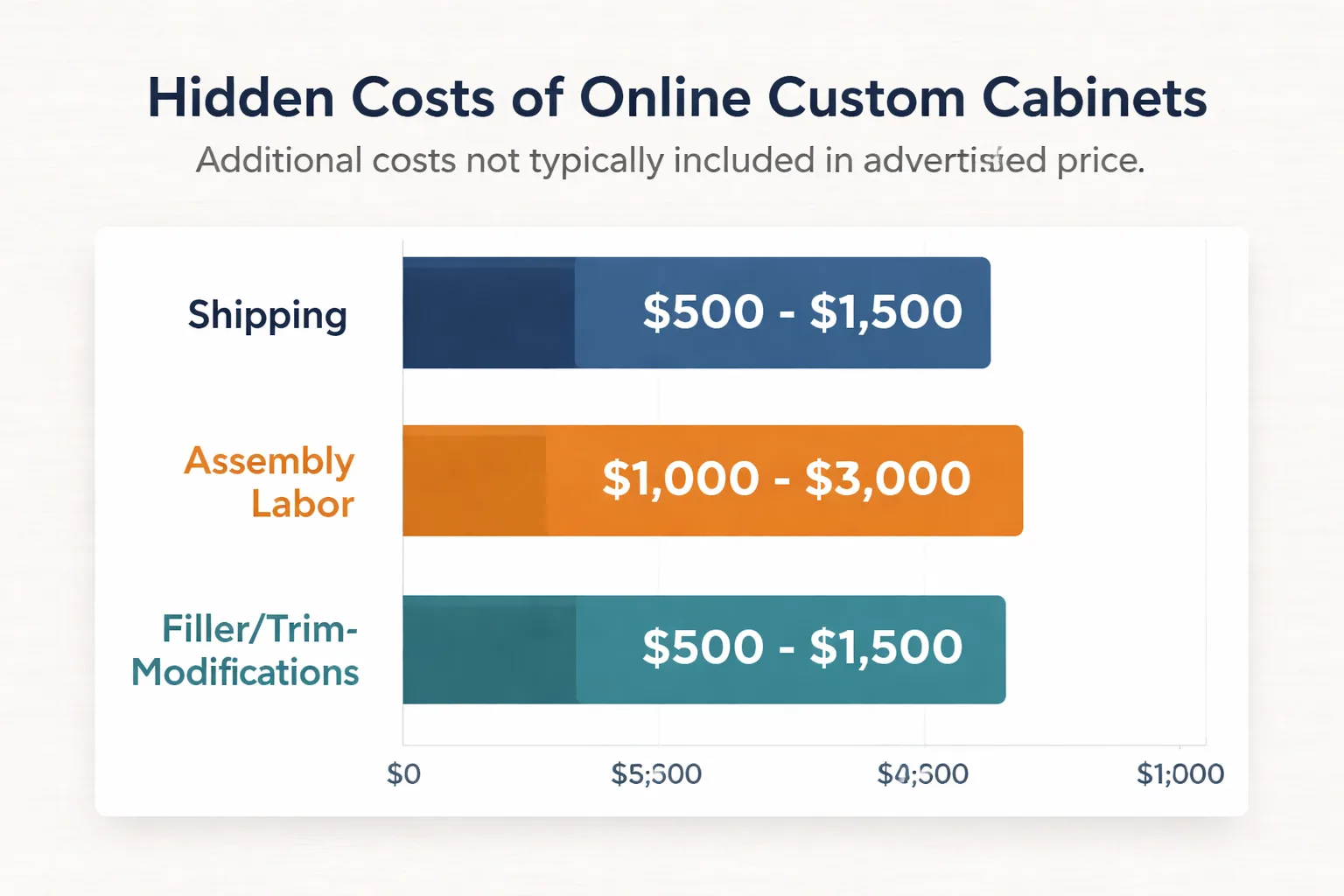
The advertised price of online custom kitchen cabinets is never the total cost of ownership. It is the cabinet cost. The total cost includes shipping, which for a full kitchen can run $500-$1,500 depending on distance and whether the service offers curbside or white-glove delivery. It includes assembly labor if the cabinets are RTA, which adds $1,000-$3,000 in contractor time for a typical kitchen. It includes the filler pieces, trim, and modifications needed to make stock-sized cabinets fit a non-standard space, which can add another $500-$1,500 in materials and labor.
Then there's the damage factor. Freight shipping is rough on cabinets. A corner gets dinged. A finish gets scratched. A door arrives warped. The replacement process takes weeks, and the contractor's time to uninstall the damaged piece and install the replacement is billable. In a worst-case scenario where multiple pieces are damaged in transit, the delay can push the project past the contractor's availability window, forcing the homeowner to find a new installer at a premium rate.
The local custom build has a different cost structure. The advertised price is higher because it includes design, field measurement, custom construction, finishing, and installation. There is no separate shipping charge because the cabinets are built locally and delivered by the shop's own team. There is no assembly labor because the cabinets arrive assembled. There are no filler strips because the cabinets are built to the exact dimensions. And if something is damaged in transit (which is rare, given the short distance), the shop fixes it immediately because they built it and they have the materials and finishes on hand.
The Marfa Cabinets analysis found that custom cabinets range from $500–$1,200+ per linear foot, compared to $75–$250 for stock, with a full-kitchen difference of $15,000 or more. But that comparison doesn't account for the hidden costs that inflate the online route. When a homeowner adds shipping, assembly, filler materials, damage replacement, and contractor delay time to the online cabinet price, the gap narrows considerably. And when they factor in the quality difference, a fit that requires no compromise, and the accountability of a single team handling the entire project, the value proposition shifts.
For developers managing multiple units, the math is even more stark. A NYC gut renovation timeline is already compressed. Adding the uncertainty of freight damage, replacement delays, and fit issues across multiple units creates a risk premium that erases the per-unit savings. Developers need predictability, and local custom builders provide it because they control every variable from measurement through installation.
Why Does the Gap Between Rendering and Reality Persist?
The persistence of the rendering-reality gap comes down to one factor: the online cabinet industry has optimized for the sales moment, not the installation moment. The configurator is designed to convert a browser into a buyer. It is not designed to ensure that what the buyer receives matches what they saw on screen. The two goals are fundamentally different, and the industry has invested its technology in the first, not the second.
This is where the contrarian take lives. The conventional wisdom in 2026 is that online custom kitchen cabinets are disrupting local builders, and that the local shop is a dying breed. The data says otherwise. The search volume for "ikea kitchen custom cabinets" is enormous, but search volume measures interest, not satisfaction. The homeowners who search for affordable custom kitchen cabinets online and then discover that the product doesn't fit their space, doesn't match their finish expectations, and doesn't come with the installation support they need are the same homeowners who end up calling a local shop to fix the problem. The disruption narrative is a marketing story. The field reality is that local builders are picking up the pieces from online cabinet failures every week.
The Brooklyn custom cabinet market comparison shows that local shops like Green Cabinets NY, YD Woodwork, and Urban Homecraft are not just surviving the online disruption. They are thriving because they offer something the online services cannot: accountability for the final result, not just the initial render. The online model sells cabinets. The local model sells kitchens. The difference matters.
Choosing the Right Materials for NYC Kitchens
Material selection is where the online vs. local divide becomes most concrete. Online services typically offer a fixed menu of materials: MDF with painted finishes, maple with clear coat, maybe oak or walnut if the service positions itself as premium. The options are limited because the supply chain is centralized and the finishing is done in batches. You get what the factory is running that week.
A local builder opens the full material world to the client. Green Cabinets NY sources white oak, ash, walnut, and other species based on the client's aesthetic goals, durability requirements, and budget. The client can see the material, feel it, and understand how it will age in their specific environment. This is particularly important for sustainable bathroom vanity options and kitchen cabinets in NYC's older buildings, where humidity fluctuations between seasons can stress materials that weren't selected with local conditions in mind.
The durability question is one that the online cabinet industry doesn't address well. A Brooklyn kitchen in a pre-war building sees humidity swings from 30% in winter (forced heat) to 70%+ in summer (no central air). MDF doors with painted finishes, which are the backbone of most online cabinet lines, can expand and contract enough at these extremes to cause finish checking at the joints. Solid wood doors, properly constructed with frame-and-panel design that allows for movement, handle these swings better. A local builder who understands NYC's climate specifies materials accordingly. An online configurator in Oregon does not.
The Process of Designing and Installing Custom Cabinets in NYC
The process difference between online and local is structural, not just procedural. Online, the process is: measure yourself, configure online, order, receive, hire installer, hope it fits. Local, the process is: consultation, field measurement, design collaboration, material selection, shop build, finishing, delivery, installation, warranty service. The local process has more steps, which is why it costs more and takes longer. But each step exists to prevent a specific failure mode that the online process ignores.
The consultation exists to understand the client's workflow and storage needs. The field measurement exists to capture the actual dimensions of the space. The design collaboration exists to ensure the plan works before construction begins. The material selection exists to match the aesthetic and durability requirements. The shop build exists to control quality at every stage. The finishing exists to allow client approval before the full order is sprayed. The installation exists to ensure the cabinets fit perfectly. The warranty service exists to fix any issues immediately.
Each of these steps adds cost. But each also prevents a failure that would cost more to fix than the step costs to include. That is the value proposition of local custom cabinetry, and it is the reason the local shop model has not been disrupted by online configurators despite a decade of predictions to the contrary.
Maximizing Small Space Kitchens with Custom Solutions
Brooklyn kitchens are small. The median kitchen in a pre-war Brooklyn apartment is under 70 square feet. The median in a post-war building is around 90. These are not spaces where stock cabinet dimensions work well. Every inch matters. A cabinet that is 3 inches too shallow wastes storage. A cabinet that is 2 inches too narrow requires a filler strip that collects dust and looks like an afterthought.
Custom cabinets built to the exact dimensions of the space eliminate these inefficiencies. A local builder can design a cabinet that uses every inch from wall to wall, floor to ceiling. They can build around pipes, radiators, and structural columns without compromise. They can integrate garbage bin storage into a 12-inch cabinet that would be too small for any stock option. They can specify pull-out shelves, spice racks, and utensil dividers that fit the client's actual inventory rather than a generic assumption about what a homeowner stores.
The online configurator model cannot do this because it is built on standard sizes. The "custom" in online custom kitchen cabinets means choosing from a menu, not designing from scratch. For a homeowner with a standard suburban kitchen, that menu may be sufficient. For a homeowner with a Brooklyn kitchen that has a radiator under the window, a gas pipe running through the corner, and a ceiling that slopes from 7'6" to 8'2" across the room, the menu is a constraint, not a solution.
What This Means for Brooklyn Homeowners in 2026
The choice between online custom kitchen cabinets and a local Brooklyn builder is not really a choice between two products. It is a choice between two processes, two levels of accountability, and two definitions of "custom." The online route offers lower advertised prices, faster ordering, and the convenience of a browser-based experience. The local route offers field-verified measurements, material inspection, in-person design collaboration, and single-source installation accountability.
For homeowners who prioritize the lowest possible cabinet cost and are willing to absorb the risk of fit issues, finish mismatches, and installation delays, the online route can work. For homeowners who want a kitchen that fits their space perfectly, matches their aesthetic vision, and is backed by a team that will stand behind the result, the local route is the better investment. The price gap is real but narrower than it appears once total cost of ownership is calculated. And the quality gap is wider than the online marketing suggests once the cabinets are actually installed.
Green Cabinets NY exists because the local model works. Not because it is cheaper (it isn't), or faster (it isn't), or more convenient (it isn't). It works because it produces a better result, and in a Brooklyn kitchen where every inch and every dollar matters, the quality of the result is the only metric that counts. The online custom kitchen cabinets industry has spent a decade promising to disrupt that reality. A decade later, the local shops are still here, still building, and still the best option for homeowners who want their kitchen done right.
FAQ
Are online custom kitchen cabinets actually custom?
Most online services offer semi-custom rather than fully custom cabinets. You choose from standard sizes (typically 3-inch width increments) and a fixed menu of finishes. True custom cabinetry means building to the exact dimensions of your space with no size constraints, which requires a local shop that can field-measure and build to those specifications.
How much do online custom kitchen cabinets cost compared to local?
Online services typically price between stock ($75-$250 per linear foot) and fully custom ($500-$1,200+ per linear foot). However, the online price usually excludes shipping, assembly labor, and filler materials. When total cost of ownership is calculated, the gap between online and local narrows significantly.
Can online cabinet configurators handle NYC's irregular kitchen dimensions?
Configurators work best with standard rectangular spaces. They struggle with out-of-plumb walls, radiator pipes, sloped ceilings, and non-standard openings common in Brooklyn's older housing stock. Local builders measure these conditions on-site and build to accommodate them.
What happens if online cabinets arrive damaged?
Damaged cabinets must be reported to the online company's customer service, which typically processes replacement orders within 24-48 hours but requires 2-8 weeks for manufacturing and shipping. During that time, the kitchen remains partially installed and the contractor's clock keeps running.
Do local Brooklyn cabinet builders offer warranties?
Reputable local builders like Green Cabinets NY offer warranties on both materials and installation. Because the same team builds and installs the cabinets, warranty service is handled directly without the finger-pointing that occurs between online manufacturers and independent installers.
How long does the local custom cabinet process take?
A typical local custom project runs 8-12 weeks from initial consultation through installation, depending on material availability and shop backlog. Online services may advertise shorter lead times, but this excludes the measurement, design collaboration, and installation phases that local builders include in their timeline.
Stop gambling on renderings. Get a field-measured, custom-built kitchen from Green Cabinets NY that fits your Brooklyn space down to the millimeter.