price of custom kitchen cabinets: What NYC Buyers Pay in 2026
Custom kitchen cabinets in NYC cost $500 to $1,200+ per linear foot in 2026, a 2x to 16x premium over stock. Here's what drives that price and when the investment pays off.
By Green Cabinets NY Team
Key Takeaways
- Custom kitchen cabinets in NYC cost $500 to $1,200+ per linear foot in 2026, versus $75 to $250 for stock, creating a 2x to 16x premium that exceeds $15,000 on a typical kitchen.
- U.S. residential kitchen and bath spending hit $235 billion, with cabinets consuming 40-50% of total project costs according to the NKBA 2025 outlook.
- The global kitchen cabinets market will reach $95.95 billion in 2026 and grow at a 5.36% CAGR through 2031, per Mordor Intelligence.
- NYC buyers control custom cabinet prices by negotiating five levers: material species, box construction, finish type, hardware, and installation complexity.
Custom kitchen cabinetry as New Yorkers know it today traces its roots to the postwar millwork shops that lined the outer boroughs in the 1950s, where immigrant craftsmen built made-to-order pieces for a city rapidly filling with new apartments and ambitions. Seventy years later, the craft has been transformed by CNC technology, sustainable sourcing mandates, and a luxury renovation market unlike anywhere else in the country. But the fundamental tension. Bespoke quality versus the price of custom kitchen cabinets. Has never been more relevant for NYC buyers trying to navigate their options in 2026.
Custom kitchen cabinets in 2026 cost $500 to $1,200+ per linear foot, while stock alternatives run $75 to $250 per linear foot, making the premium 2x to 16x depending on specifications. For a typical NYC kitchen, that gap translates to a difference exceeding $15,000. The global kitchen cabinets market is projected to reach $95.95 billion in 2026, growing at a 5.36% CAGR through 2031, according to Mordor Intelligence. The NKBA 2025 Kitchen & Bath Market Outlook reported U.S. residential kitchen and bath spending at $235 billion, with cabinets consuming 40 to 50% of total project cost. In NYC, where labor rates, permitting timelines, and material logistics compound costs, custom kitchen cabinets prices reflect a premium market that operates by different rules than the national averages most online calculators use.
What Drives the Price of Custom Kitchen Cabinets in NYC?
Five cost levers determine what a Brooklyn or Manhattan buyer ultimately pays: material species, box construction, finish type, hardware, and installation complexity. Each lever moves the per-linear-foot price independently, and understanding how they interact is the difference between a quote that feels fair and one that feels like a shock.
Material species is the most visible cost driver. Domestic hardwoods like maple and birch occupy the accessible end of the custom spectrum, while walnut commands a premium for its grain depth and color richness. Exotic species or reclaimed materials push prices further. The choice isn't purely aesthetic. Different species respond differently to NYC's humidity swings, which affect long-term performance. Quarter-sawn oak offers exceptional dimensional stability, making it a pragmatic choice for kitchens subject to seasonal moisture changes. Alder, by contrast, is softer and more susceptible to denting, which matters in high-traffic households or rental units with tenant turnover.
Box construction separates true custom from dressed-up stock. Plywood boxes with dovetailed drawer joints and solid wood face frames cost more than particleboard with cam-lock assembly, but the performance gap is substantial. Plywood resists moisture damage that would swell particleboard in months. In a city where steam heat can push indoor humidity from 25% in winter to 70% in summer, that resilience compounds over a 15 to 20 year lifespan. The sustainable bathroom vanity principles that Green Cabinets NY applies to humidity-prone bathrooms apply equally to kitchens near boiling ranges and dishwashers.
Finish type is where many buyers overspend without realizing it. A multi-step conversion varnish finish (catalyzed for hardness and moisture resistance) outperforms standard lacquer but adds cost. Hand-applied glazes, distressing, and custom stain matching each add labor hours. The practical question: does the finish need to survive a family of five and aggressive cleaning, or is this a powder-room-adjacent kitchen in a lightly used pied-à-terre? Match the finish to the use case.
Hardware includes hinges, drawer slides, pulls, and organizational systems. Soft-close undermount slides cost more than side-mount, but they're standard in quality custom work. Integrated organizers (pull-out pantries, spice racks, trash systems) add linear-foot cost but transform functionality in tight NYC layouts. Installation complexity in NYC is its own cost category. Pre-war buildings with non-plumb walls, elevator restrictions on material delivery, and co-op board work-hour limitations all add labor hours that get priced into the final invoice.
Price Ranges by Cabinet Type and Material in 2026
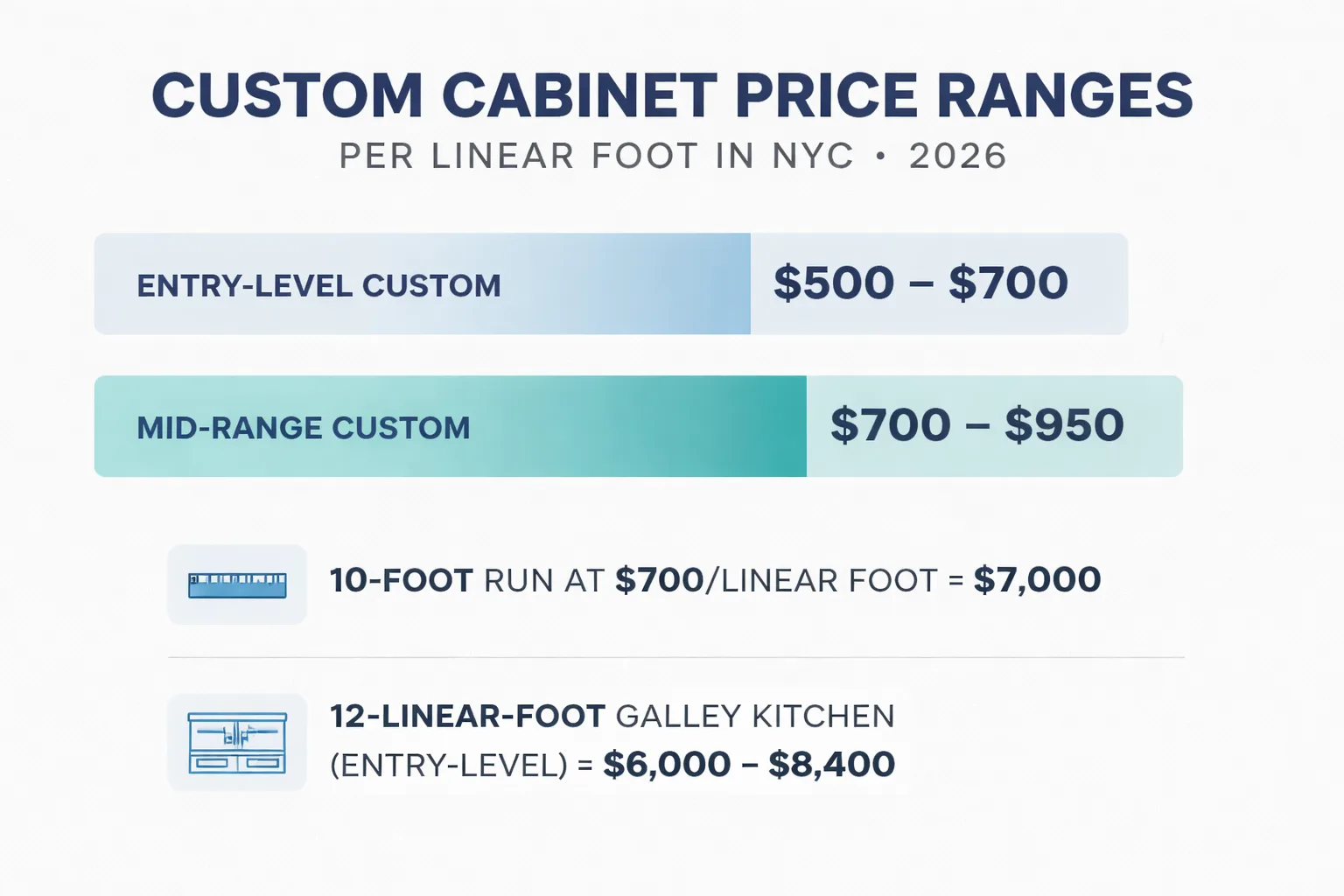
The per-linear-foot framework is the industry standard for comparing cabinet costs, but it requires context to be useful. A linear foot measures the width of cabinet run along the wall, not the square footage of the kitchen. A 10-foot run of custom cabinets at $700 per linear foot equals $7,000 in cabinetry, before countertops, installation, or any structural work.
Entry-level custom cabinetry (domestic hardwood, plywood boxes, standard finishes, basic hardware) typically runs $500 to $700 per linear foot in the NYC market. This tier delivers genuine custom sizing and material quality without ornamental flourishes. For a modest galley kitchen requiring 12 linear feet, the cabinet investment lands between $6,000 and $8,400. Green Cabinets NY frequently works with Brooklyn homeowners in this range, particularly first-time renovators prioritizing durability over decorative detailing.
Mid-range custom ($700 to $950 per linear foot) introduces premium species like walnut, specialized finishes, integrated storage solutions, and higher-grade hardware. A 15-linear-foot L-shaped kitchen at this tier runs $10,500 to $14,250. This is where most Brooklyn townhouse renovations and Manhattan co-op kitchen redos land. The investment buys both performance and design distinction without entering luxury territory.
Premium custom ($950 to $1,200+ per linear foot) covers exotic or reclaimed materials, hand-applied specialty finishes, fully integrated smart storage, and architectural millwork that blurs the line between cabinetry and furniture. A full-wall kitchen with island at 20 linear feet can reach $19,000 to $24,000+ in cabinetry alone. Highland Cabinetry's 2026 cost analysis places high-end custom cabinets nationally at $5,000 to $30,000+, while Cuisine Idéale notes luxury-grade projects run well over $50,000. NYC premium projects cluster at the upper end of these ranges.
The global market data provides macro context. The kitchen cabinets market is projected to grow from $95.95 billion in 2026 to $124.42 billion by 2031, per Mordor Intelligence, reflecting sustained demand that keeps upward pressure on material and labor costs. NYC buyers should expect per-linear-foot prices to rise 3 to 5% annually in line with this growth.
How Custom Cabinet Prices Compare to Semi-Custom and Stock
The cost hierarchy is clear: stock cabinets at $75 to $250 per linear foot, semi-custom at $250 to $500, and custom at $500 to $1,200+. But the price comparison only tells part of the story. The real question is where each tier delivers value for a specific project scope.
Stock cabinets are manufactured in standard 3-inch width increments (12", 15", 18", etc.) with typically 10 to 20 finish options. They work for straightforward layouts where walls are plumb and standard sizes fill the space adequately. In a NYC context, stock cabinets rarely fit pre-war kitchens with irregular angles, soffits, or non-standard ceiling heights without significant filler strips that waste space and look improvised. For a rental unit renovation where the goal is functional improvement at minimum cost, stock may be the right call.
Semi-custom cabinets offer some modification flexibility within manufacturing constraints. Buyers can adjust depths, select from extended finish palettes, and choose organizational accessories. This tier suits homeowners who want more design control than stock allows but don't need the full bespoke approach. Semi-custom works well in post-war NYC apartments with relatively standard dimensions.
Marfa Cabinets argues the investment in custom is "almost always yes" because of perfect fit, unlimited finishes, and tailored interiors. MKE Cabinetry emphasizes that custom lets buyers "pick EVERYTHING you want" in door style, color, wood species, and organizers. These are manufacturer perspectives, but the underlying logic holds: when a kitchen has spatial constraints that stock can't accommodate, or when the buyer's aesthetic vision extends beyond a catalog, custom isn't a luxury. It's a functional necessity.
The contrarian take: custom is over-specified when the project is a flip, a rental, or a kitchen in a home the buyer plans to sell within three years. The premium paid for bespoke cabinetry doesn't fully translate to resale value in short holding periods. Semi-custom or even high-grade stock delivers 80% of the visual impact at 40% of the cost in those scenarios. Custom pays off when the buyer intends to live with the kitchen for 7+ years, values daily functional performance, or needs non-standard sizing that no catalog can address.
For NYC developers working on multiple units, the calculation shifts. Custom millwork creates a differentiated product in a competitive market, and the per-unit cost decreases when a fabricator produces cabinets for multiple identical layouts. Green Cabinets NY works with developers to standardize designs across units while maintaining custom quality, which brings the effective per-linear-foot cost closer to semi-custom territory while delivering custom-grade results.
How to Get an Accurate Quote for Your NYC Kitchen
Getting an apples-to-apples quote from a Brooklyn fabricator requires preparation. Vague requests produce vague estimates, and the variance between a ballpark figure and a binding quote often comes down to the information the buyer provides.
Step 1: Measure the space. Wall-to-wall dimensions, ceiling height, and locations of windows, doors, pipes, and electrical outlets. Note any soffits, bulkheads, or structural elements that affect cabinet depth. A rough sketch with measurements is sufficient for an initial consultation. Green Cabinets NY conducts a formal site measure before finalizing any quote, but having preliminary numbers speeds the conversation.
Step 2: Define the wish list. Number of cabinets, drawer banks, pantry storage, appliance garages, integrated trash and recycling. Specify must-have features (soft-close, pull-out shelves, glass fronts) versus nice-to-haves. The more specific the list, the more accurate the per-linear-foot estimate.
Step 3: Set a realistic timeline. Custom cabinets typically require 8 to 12 weeks from design approval to delivery, plus installation. NYC co-op and condo board approvals can add 4 to 8 weeks. Permit approvals in some NYC jurisdictions can extend timelines by months, and those delays ripple through procurement and construction sequencing. A client who needs a kitchen completed in 6 weeks should be directed to semi-custom or stock, not custom.
Step 4: Establish a budget range. Not a single number, but a range with a hard ceiling. This lets the fabricator propose options that fit. Saying "I want custom cabinets but my budget is $4,000" for a full kitchen saves everyone time. Saying "I have $20,000 to $25,000 for cabinetry" opens a productive conversation about what's achievable at that investment level.
Step 5: Ask the right questions. What material is the box constructed from? What finish system is used and how many coats? What hardware brand and grade? What's included in the installation quote (delivery, old cabinet removal, trim work)? Are permits handled? What's the payment schedule? These questions separate transparent fabricators from those who quote low and upcharge later.
Which Material Species Offer the Best Value?
Material selection is where budget meets performance, and the right choice depends on the kitchen's use pattern, the homeowner's aesthetic preferences, and the building's environmental conditions. NYC's climate creates specific demands: humidity fluctuations between seasons, steam heat that dries air in winter, and summer moisture that can swell inadequately sealed wood.
Maple is the workhorse of custom cabinetry. It's hard, dense, takes finish evenly, and resists denting better than most domestic species. For families, rental units, or high-use kitchens, maple delivers long-term performance at a mid-range price point. Its light color accepts stains from natural to dark, making it versatile for trend-conscious buyers who might want to update finishes over time.
Birch offers similar performance characteristics to maple at a slightly lower cost. It's an underappreciated option in the NYC market, where buyers often default to more familiar species. Birch's fine grain takes paint well, making it suitable for painted finishes that remain popular in Brooklyn townhouse renovations.
Beech provides excellent hardness and a distinctive grain pattern that works in contemporary designs. It's less common than maple or oak, which can make it a conversation piece in a custom kitchen. The cost sits between maple and walnut, offering a middle ground for buyers who want something distinctive without paying exotic-species prices.
Rustic hickory is the boldest choice. Its dramatic grain variation and natural color contrasts make a statement, but that same wildness means no two cabinets look identical. Hickory works in kitchens designed around natural character, not in spaces seeking uniformity. It's hard and durable but can be difficult to stain evenly.
The trend conversation matters here. Brooklyn clients frequently arrive with images of fluted details, natural wood tones, and warm minimalism. These trends have staying power because they're rooted in material honesty rather than applied decoration. The all-white kitchen, by contrast, is reaching the end of its trend cycle. Green Cabinets NY advises clients to incorporate trends through reversible elements (hardware, paint, accessories) rather than permanent structural choices. A natural-finish maple cabinet with brushed brass pulls can shift from trendy to timeless with a hardware swap. An all-white thermofoil cabinet cannot.
What Hidden Costs Should NYC Buyers Expect?
The quoted per-linear-foot price rarely represents the total investment. Hidden costs in NYC kitchen cabinet projects fall into three categories: site preparation, delivery and logistics, and post-installation work.
Site preparation includes removing existing cabinets (often containing lead paint in pre-war buildings, requiring abatement), repairing walls exposed during removal, leveling floors that have settled unevenly over decades, and updating electrical and plumbing rough-ins to meet current code. Co-op buildings may require asbestos testing before any demolition, and the results can trigger abatement protocols that add weeks and thousands of dollars.
Delivery and logistics in NYC are unlike anywhere else. Loading dock reservations, elevator time slots, street parking permits for delivery trucks, and carry-up fees for buildings without service elevators all add cost. A delivery that's free in a suburban home can cost $500 to $1,500 in a Manhattan co-op. These costs may not appear in the cabinet quote because they're site-specific, but they're real and should be discussed during consultation.
Post-installation work includes countertop templating and installation (separate from cabinetry), backsplash tile work, painting, and trim. Cabinet installation can reveal wall irregularities that require shimming and trim carpentry to disguise. In pre-war buildings, achieving a plumb installation against walls that have shifted over 80 years requires skilled carpentry that adds labor hours.
The green kitchen unit principles that guide sustainable cabinet construction also affect cost. FSC-certified wood, low-VOC finishes, and formaldehyde-free plywood cost more than conventional alternatives. For buyers prioritizing indoor air quality (particularly relevant in NYC apartments with limited ventilation), these premiums are investments in health rather than luxury upgrades.
When Does Custom Make Financial Sense?
The decision framework comes down to three factors: timeline, budget, and how long the buyer plans to live with the kitchen.
Custom makes sense when the kitchen has non-standard dimensions that stock can't fill without waste. It makes sense when the buyer wants material quality and construction methods that will last 15 to 20 years without replacement. It makes sense when the homeowner's aesthetic vision requires specific wood species, finishes, or design details unavailable in semi-custom catalogs. And it makes sense for NYC developers building a differentiated product where custom millwork creates market advantage.
Custom doesn't make sense when the timeline is under 8 weeks, when the budget can't absorb $500+ per linear foot, or when the kitchen is in a unit the buyer plans to sell or rent to tenants who won't value the investment. In those cases, semi-custom or high-grade stock deliver better cost-to-outcome ratios.
The cost for custom kitchen cabinets in NYC reflects a market where labor, materials, and logistics all carry urban premiums. But it also reflects a product built to perform in conditions that destroy lesser cabinets. The price of custom kitchen cabinets isn't just a number on a quote. It's the cost of cabinetry designed to fit a specific space, built from materials chosen for that environment, and installed by craftspeople who understand what NYC kitchens demand. Green Cabinets NY builds for those conditions every day, and the difference shows in year ten, year fifteen, and year twenty.
Wondering what your custom kitchen cabinets would actually cost in Brooklyn?
How Does NYC's Humidity Affect Cabinet Material Choices?
NYC's climate creates a brutal environment for cabinetry. Winter steam heat drives indoor humidity below 30%, causing wood to shrink and joints to gap. Summer humidity regularly exceeds 70%, swelling wood fibers and stressing finishes. This swing cycles annually, and over five years it destroys particleboard boxes, cracks inadequately sealed joints, and warps thin veneers.
Solid wood and plywood construction absorb these fluctuations better than engineered alternatives because their cellular structure allows micro-movement without structural failure. The key is acclimatization: custom fabricators like Green Cabinets NY let materials rest in the shop environment for days before cutting, allowing moisture content to equalize. Stock cabinets manufactured in climate-controlled factories and shipped directly to NYC sites skip this step, which is why stock installations often show gaps within the first seasonal cycle.
Sealant quality matters as much as material choice. A catalyzed conversion varnish creates a moisture barrier that standard lacquer cannot match. The aggressive cleaning agents common in NYC households (bleach-based wipes, degreasers, abrasive powders) strip inadequate sealants within months, exposing the substrate to moisture infiltration. A bamboo vanity installed without proper acclimatization or robust sealant can show warping within 12 to 18 months. The same principle applies to kitchen cabinets near dishwashers and boiling ranges, where steam exposure is constant.
Are Sustainable Cabinet Materials Worth the Premium?
Sustainable cabinetry carries a cost premium that typically ranges from 10 to 25% above conventional construction. FSC-certified hardwoods, formaldehyde-free plywood, and low-VOC finishes all cost more to source and apply. The question is whether that premium delivers measurable value.
For NYC apartments with limited ventilation, the answer is often yes. Conventional cabinets off-gas formaldehyde and VOCs for months after installation, and in a 400-square-foot studio with two windows, that off-gassing concentrates at levels that affect indoor air quality. Low-VOC finishes and formaldehyde-free substrates eliminate that exposure. The green kitchen unit approach that Green Cabinets NY follows prioritizes materials that perform in NYC's specific environmental conditions while meeting sustainability standards.
Reclaimed wood offers a different value proposition. It carries character and history that new wood cannot replicate, and it's environmentally responsible. But reclaimed materials require more labor to process (de-nailing, milling, sanding) which adds cost. The premium for reclaimed wood cabinets can reach 30 to 40% above new hardwood. For buyers who value the aesthetic and environmental story, that premium is justified. For buyers purely seeking durability, new FSC-certified hardwood delivers equal performance at lower cost.
What Should Developers Know About Custom Millwork Costs?
Developers face a different cost calculation than individual homeowners. The per-unit price of custom cabinetry decreases when a fabricator produces identical layouts across multiple units. A design that costs $850 per linear foot for a one-off kitchen might drop to $700 per linear foot across a 10-unit building, because the fabricator can batch production, optimize material yield, and reduce setup time.
The benefits of custom millwork for developers extend beyond cost efficiency. Custom cabinetry creates a differentiated product in a market saturated with generic renovations. A buyer walking into a condo with cabinetry designed specifically for that unit's dimensions and lighting perceives higher value than a unit with stock cabinets trimmed to fit. That perception translates to faster sales and higher per-square-foot pricing.
The risk for developers lies in over-customizing. Unique cabinet designs that require special tooling or one-off components can create supply chain bottlenecks. A single non-standard hinge or pull that's back-ordered can delay an entire project. Green Cabinets NY advises developers to standardize hardware and construction methods across units while varying finishes and door styles for visual distinction. This approach maintains the custom feel while keeping procurement predictable.
Timeline planning is critical. Permit approvals in some NYC jurisdictions can take six months, and those delays ripple through procurement and construction sequencing. A custom cabinet order placed before permits clear risks producing cabinets that sit in storage (incurring fees and risking damage). An order placed after permits clear adds weeks to the project timeline. The solution is to finalize designs and specifications during the permitting period, then place the production order the moment permits are approved.
How Do You Maximize Small-Space Kitchens with Custom Solutions?
NYC kitchens are small. The median Manhattan kitchen has roughly 25 to 35 linear feet of cabinet space, compared to 50+ linear feet in a typical suburban home. Every inch matters, and custom cabinetry's primary value in small spaces is eliminating the waste that stock cabinets create.
Stock cabinets come in 3-inch width increments. If a wall is 34 inches wide, a stock solution uses a 30-inch cabinet plus a 4-inch filler. That's 4 inches of dead space. In a small NYC kitchen, 4 inches is a spice cabinet, a cutting board rack, or a vertical tray storage. Custom cabinetry builds to the exact dimension, turning dead space into functional storage.
Ceiling height is another area where custom delivers outsized value in small spaces. Standard upper cabinets are 30, 36, or 42 inches tall. NYC pre-war ceilings often exceed 9 feet. Stock cabinets leave a gap between the cabinet top and ceiling that collects dust and wastes vertical storage. Custom cabinets can extend to the ceiling, adding a full row of storage for rarely used items (holiday platters, serving pieces, bulk pantry goods) without consuming additional floor space.
Depth customization matters in galley kitchens where every inch of counter depth affects walkway clearance. Standard base cabinets are 24 inches deep. If a galley kitchen is 7 feet wide, two rows of standard cabinets leave a 36-inch walkway. Reducing cabinet depth to 21 inches (with custom drawer slides and modified box construction) creates a 42-inch walkway that feels dramatically different in daily use. Stock cabinets cannot accommodate this modification. Semi-custom may offer depth adjustments within limited ranges. Custom delivers exact specifications.
Corner cabinets are the perennial problem in small kitchens. Stock lazy Susans waste space and collect debris. Custom corner solutions (diagonal pull-outs, blind-corner extenders, custom-shaped drawers) maximize every cubic inch. These solutions cost more per unit than stock alternatives, but in a kitchen where total storage is 15 linear feet, the corner cabinet represents 20% of available space. Maximizing it is not a luxury. It's a functional necessity.
What Is the Process of Designing and Installing Custom Cabinets in NYC?
The custom cabinet process in NYC follows a specific sequence that differs from suburban renovations. Understanding this sequence helps buyers plan timelines and budgets accurately.
Phase one is consultation and design. The fabricator visits the site, measures the space, discusses the client's needs and aesthetic preferences, and produces initial design drawings. This phase typically takes 2 to 3 weeks, including revisions. Green Cabinets NY uses this phase to educate clients on material options, finish systems, and hardware choices, ensuring the final design reflects informed decisions rather than impulse selections.
Phase two is engineering and production. Once the design is approved, the fabricator engineers the cabinets (calculating load requirements, drawer slide capacities, hinge specifications) and begins production. CNC machining has reduced production time significantly, but custom work still requires hand assembly, finishing, and quality control. This phase runs 6 to 10 weeks depending on complexity and shop backlog.
Phase three is delivery and installation. In NYC, this phase involves scheduling around building restrictions (service elevator availability, work-hour limitations, noise ordinances). Installation itself takes 3 to 7 days for a typical kitchen, longer if structural modifications are needed. Pre-war buildings frequently require on-site modifications to accommodate out-of-square walls and floors, adding labor hours.
Phase four is punch-list completion. After installation, the fabricator addresses any adjustments (door alignment, drawer tracking, finish touch-ups). This phase takes 1 to 3 days and should be completed before the countertop template is measured, because countertop measurements depend on the final cabinet positions.
The total timeline from consultation to completion runs 12 to 16 weeks under normal conditions. Co-op board approvals, permit delays, and supply chain disruptions can extend this to 20+ weeks. Buyers should plan their renovation schedule around this timeline, not the other way around.
What Trends Are Shaping Custom Kitchen Cabinet Design in Brooklyn?
Brooklyn's design scene in 2026 reflects a tension between trending aesthetics and enduring functionality. The data from client consultations at Green Cabinets NY reveals clear patterns in what buyers want and where those wants collide with practical reality.
Fluted details and reeded textures remain popular. These vertical grooves add tactile interest to cabinet fronts and work well in both painted and natural wood finishes. The concern is maintenance: fluted surfaces collect dust and grease in kitchen environments, requiring more frequent and careful cleaning than flat panels. Green Cabinets NY recommends confining fluted details to less grease-prone areas (pantry walls, island sides) while keeping cooking-area cabinets flat for easier maintenance.
Natural wood tones have replaced the all-white kitchen as the dominant aesthetic preference. Warm walnut, natural oak, and honey-toned maple create kitchens that feel grounded and organic. This trend aligns with durability: natural wood finishes show fewer fingerprints and wear marks than painted surfaces, and they age gracefully. A walnut cabinet that develops a patina over 10 years looks better, not worse. A white painted cabinet that yellows or chips looks degraded.
The all-white kitchen is explicitly reaching the end of its trend cycle. Design forecasts for 2026 identify it as outdated or nearing obsolescence. Clients who committed to all-white kitchens in 2021 are now facing full repaints or refacing to update their look. The lesson: trend-driven choices that require expensive remediation when they fall out of favor are poor long-term investments. Classic designs with trend-responsive accents (hardware, lighting, accessories) offer the same visual currency without the replacement cost.
Two-tone kitchens (light uppers, dark lowers, or vice versa) offer a compromise between trend participation and longevity. They create visual interest without committing to a single aesthetic that may date quickly. Green Cabinets NY has seen increased demand for two-tone designs that pair natural wood uppers with painted lowers, allowing homeowners to update the painted components without replacing the wood elements.
FAQ
What is the average cost for custom kitchen cabinets in NYC?
Custom kitchen cabinets in NYC typically cost $500 to $1,200+ per linear foot. For a standard 12-linear-foot kitchen, the total cabinet investment ranges from $6,000 to $14,400+. The final price depends on material species, box construction, finish type, hardware grade, and installation complexity specific to the building.
How much more do custom cabinets cost compared to stock?
Stock cabinets run $75 to $250 per linear foot, while custom cabinets run $500 to $1,200+. The premium is 2x to 16x depending on specifications. For a full kitchen, the difference typically exceeds $15,000. Semi-custom cabinets ($250 to $500 per linear foot) bridge the gap.
How long does it take to build and install custom cabinets in NYC?
Custom cabinets require 8 to 12 weeks from design approval to delivery, plus 1 to 2 weeks for installation. NYC co-op and condo board approvals can add 4 to 8 weeks. Permit approvals in some jurisdictions can extend timelines further. Buyers should plan for a 4 to 6 month total timeline from consultation to completion.
What material is best for NYC kitchen cabinets?
Maple and birch offer the best value-to-performance ratio for NYC kitchens. They resist humidity fluctuations, take finish evenly, and withstand daily use. Quarter-sawn oak provides superior dimensional stability for kitchens with extreme moisture exposure. Walnut delivers premium aesthetics at a higher price point. The best choice depends on budget, aesthetic goals, and the kitchen's specific environmental conditions.
Do custom cabinets add resale value to a NYC home?
Custom cabinets can add resale value, but the return depends on holding period and market conditions. Buyers who plan to sell within three years may not fully recoup the premium. For longer holding periods (7+ years), custom cabinetry differentiates a property in a competitive market and contributes to faster sales at higher price points.
What should I bring to a cabinet consultation?
Bring rough measurements (wall lengths, ceiling height, window and door locations), a wish list of cabinet types and features, a realistic timeline accounting for board approvals, and a budget range with a hard ceiling. The more specific the information, the more accurate the initial quote will be.
Get a transparent, itemized quote from Green Cabinets NY with no hidden fees and real NYC timelines.