What Are Custom Walnut Kitchen Cabinets? A 2026 Guide
Custom walnut kitchen cabinets cost $500 to $1,200+ per linear foot, built from solid hardwood to exact specifications. This guide covers material properties, construction differences, design styles, and maintenance for NYC homeowners.
By Green Cabinets NY Team
Key Takeaways
- Custom walnut kitchen cabinets cost $500–$1,200+ per linear foot versus $75–$300 for stock alternatives, because they use solid hardwood instead of veneered particleboard.
- Upgrading a typical NYC kitchen from stock to custom walnut cabinetry adds more than $15,000 to the total project cost.
- Stock cabinets are restricted to 3-inch width increments and 10–20 finishes, while custom versions allow unlimited dimensions and finish options.
- Walnut’s combination of workability, dimensional stability, and visual depth delivers precise fits in older NYC apartment layouts that stock cabinets cannot match.
The showroom is quiet except for the sound of a drawer closing. That slow, pneumatic whisper of soft-close hardware doing its job perfectly. The cabinet faces are walnut, dark at the center of each panel and slightly lighter at the edges where the grain opens up. A developer from Greenpoint runs his hand across the surface, checking for seams that aren't there. The project manager pulls out a binder of shop drawings. This is what the custom walnut kitchen cabinet process looks like before a single piece ships to a jobsite. Deliberate, material-focused, and nothing like scrolling through a big-box catalog.
Custom walnut kitchen cabinets are built to exact dimensional specifications from solid walnut hardwood, not veneered particleboard, and they cost between $500 and $1,200+ per linear foot compared to $75 to $300 per linear foot for stock alternatives, according to Marfa Cabinets. That price gap reflects a fundamental difference in material, construction method, and fit precision. stock cabinets come in fixed 3-inch width increments with 10 to 20 finish options. Custom cabinets have no dimensional constraints and unlimited finish possibilities. For a typical NYC kitchen, the cost difference between stock and custom walnut cabinetry exceeds $15,000, and the question is whether that premium buys measurable value or just aesthetic preference. Green Cabinets NY builds custom walnut cabinetry for Brooklyn and Manhattan homeowners who need both the material quality and the dimensional precision that older NYC apartment architecture demands.
What Makes Walnut a Premium Cabinet Wood?
Walnut occupies a specific tier in the hardwood hierarchy. It is not the hardest wood available, but it possesses a combination of workability, dimensional stability, and visual depth that few species can match. The Janka hardness rating for American black walnut sits at approximately 1,010 lbf, which places it below maple (1,450 lbf) and red oak (1,290 lbf) but well above pine (380 lbf) and cedar (900 lbf). That moderate hardness is actually an advantage for cabinetry. It allows precise machining for joinery and hardware mortises without the tear-out that harder species produce. The wood cuts cleanly, holds detail well, and accepts finishes uniformly.
The natural color range of walnut is where its premium positioning becomes obvious. Fresh-cut walnut heartwood ranges from a pale brown to a deep chocolate purple-brown, sometimes with greenish or grayish undertones that shift depending on light source. The sapwood is nearly white, and most quality cabinet shops either select for heartwood-dominant lumber or steam-treat the stock to blend the transition. The grain pattern is straight to slightly wavy, with occasional curl or burl figure that adds visual interest without becoming busy. Unlike oak, which has open, pronounced pores that catch light and shadow aggressively, walnut has a semi-ring-porous structure that produces a smoother surface under finish. This is why walnut cabinets photograph well and why they look consistently rich under both warm and cool lighting.
The price premium over maple and oak comes from three factors: slower growth rates, lower yield per log, and higher demand from the luxury market. Walnut trees take longer to reach harvestable size than maple, and the heartwood ratio in a typical walnut log is lower than in oak. That means more waste per board foot of usable cabinet lumber. The market dynamics compound the supply constraint. Walnut has been the default luxury cabinet species for over a decade, and demand consistently outpaces sustainable harvest capacity. For Green Cabinets NY, walnut sourcing means selecting boards with consistent heartwood content, verifying moisture content between 6% and 8% for NYC's indoor humidity range, and rejecting stock with excessive sapwood or drying defects that could cause movement after installation.
The durability question matters specifically for NYC apartments. Walnut's dimensional stability, measured by its shrinkage coefficient, is superior to oak and comparable to cherry. That means it expands and contracts less with seasonal humidity swings, which is critical in pre-war buildings with radiator heat and in modern buildings with forced-air systems that create dramatic humidity shifts between seasons. A cabinet door that moves 1/16 inch across seasons is acceptable. A door that moves 1/4 inch will gap, bind, or crack its finish. Walnut's stability reduces that risk.
How Custom Walnut Cabinets Differ From Stock and Semi-Custom Options
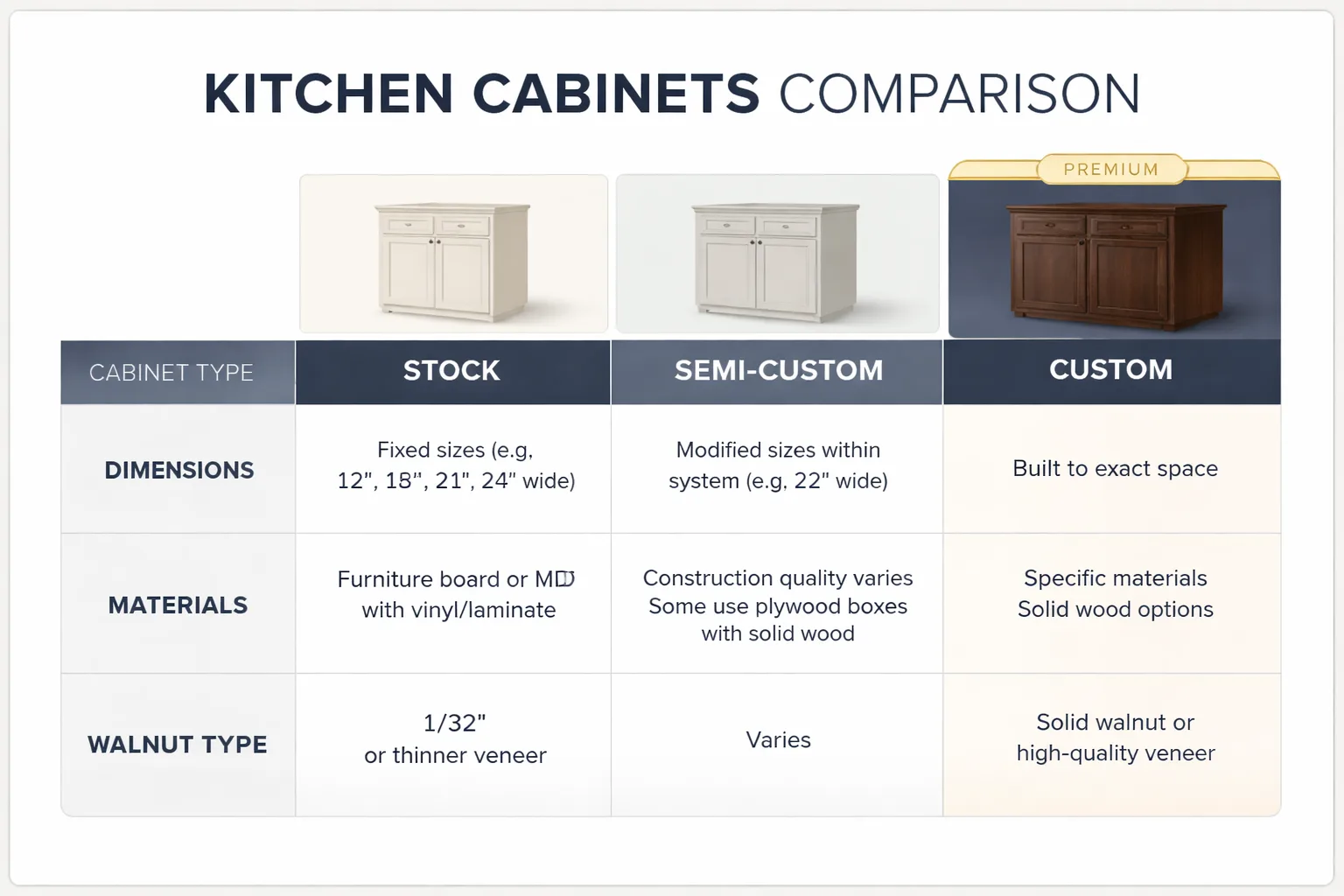
The distinction between custom, semi-custom, and stock cabinets is not a gradient. It is a categorical difference in how the box is built, what materials are used, and how the final product fits the space. Stock cabinets are mass-produced in fixed dimensions, typically in 3-inch width increments (12, 15, 18, 21, 24 inches) with standard heights and depths. The boxes are usually built from furniture board or MDF with a vinyl or laminate exterior. If the product is marketed as "walnut," it almost certainly means a walnut-veneered panel, not solid walnut. The veneer layer is typically 1/32 inch or thinner, applied to a substrate that may or may not be dimensionally stable.
Semi-custom kitchen cabinets bridge some of the gap. They offer modified dimensions within a manufacturer's system, meaning a buyer can order a cabinet at 22 inches wide instead of being forced to choose between 21 and 24. The construction quality varies widely. Some semi-custom lines use plywood boxes with solid wood face frames, which is a meaningful upgrade over stock. Others use the same furniture-board construction with slightly more finish options. The cost for custom kitchen cabinets diverges sharply from semi-custom at this point because the labor model changes entirely. Semi-custom is still factory-built. Custom is shop-built.
A truly custom walnut kitchen cabinet is built from solid walnut for all visible components: face frames, door stiles and rails, drawer fronts, and exposed end panels. The box itself is typically built from furniture-grade plywood with a walnut veneer interior, because solid wood is dimensionally unstable for large flat panels. The joinery is where the difference becomes structural. Custom shops use dovetailed drawer joints, mortise-and-tenon door construction, and dadoed or rabbeted box joints. Stock cabinets use cam locks, staples, and confirmat screws. The hardware budget is also different. Custom builders typically specify soft-close undermount drawer slides rated for 100-pound loads and soft-close hinges with lifetime cycle ratings. Stock cabinets use side-mount slides with lower weight ratings and standard hinges.
The fit question is where NYC buyers feel the difference most acutely. Brownstone kitchens in Brooklyn and pre-war apartments in Manhattan rarely have square walls, level floors, or plumb corners. A stock cabinet system assumes square conditions and uses filler strips to absorb discrepancies. In a 1920s brownstone with walls that deviate 1.5 inches from plumb over an 8-foot run, filler strips become a visual catastrophe. Custom cabinets are scribed to the wall on-site, meaning the cabinet back or filler panel is cut to match the exact contour of the irregular surface. The result is a cabinet that appears to grow out of the wall rather than being bolted to it.
The custom kitchen cabinets price reflects this labor. Scribing, fitting, and installing a custom walnut kitchen in an older NYC building takes two to three times longer than dropping stock cabinets into a new-construction condo. That time is where the $15,000+ cost gap between stock and custom originates. The material cost difference between walnut veneer and solid walnut is significant, but the labor difference is the dominant factor.
Design Styles That Pair Naturally With Walnut
Walnut is not a neutral material. It has a strong visual presence that dictates the design direction of the kitchen. Three styles have emerged as the strongest pairings for walnut cabinetry in NYC renovations, and each uses the material differently.
Mid-century modern is the most obvious match. Walnut was the defining material of American mid-century furniture design, and the grain pattern and color tone read as period-authentic even in a contemporary kitchen. The style works best with flat-slab door fronts (no raised panels), exposed brass or blackened steel hardware, and integrated appliances that disappear behind matching walnut panels. The risk with mid-century walnut kitchens is creating a space that feels like a museum reproduction rather than a functional kitchen. The solution is mixing materials. A walnut island with a honed marble counter, set against white oak perimeter cabinets, creates enough contrast to feel current while honoring the material's design history.
Japandi aesthetics treat walnut differently. The style blends Japanese minimalism with Scandinavian functionality, and it favors light, natural wood tones. Walnut in a Japandi kitchen is used sparingly, often as an accent material rather than the primary cabinetry. A walnut range hood or a single wall of walnut pantry cabinets against white plaster walls and pale ash flooring creates the kind of restrained warmth that defines the style. The door profiles are typically flat with integrated pulls, and the hardware is minimal or absent. This is where the handleless trend that firms like Unique Design Furniture and CABINET MAKER NYC have been pushing in Brooklyn becomes relevant. Handleless walnut cabinets with finger pulls routed into the top edge of the door create a clean, continuous wood surface that reads as architecture rather than furniture.
Transitional design is the most forgiving style for walnut because it borrows from both traditional and contemporary vocabularies. A transitional walnut kitchen might use Shaker-style door profiles in walnut, paired with modern hardware and simple slab backsplashes. The style works in pre-war apartments where a fully contemporary kitchen would feel out of context with the building's architecture, and a fully traditional kitchen would feel dated. Green Cabinets NY frequently builds transitional walnut kitchens for Brooklyn brownstone renovations where the goal is to modernize the kitchen without erasing the building's character. The walnut provides warmth and material quality, while the Shaker profile maintains a connection to the building's period.
The design decision that matters most is not which style to choose but how to manage walnut's color evolution. Walnut lightens over time. Fresh walnut has a deep chocolate tone that many buyers fall in love with in the showroom. Over 12 to 24 months, that color shifts to a warmer, lighter brown as UV exposure oxidizes the surface. This is not a defect. It is the material's natural aging process. But buyers who select walnut based on a showroom sample need to understand that the kitchen will look different in two years. Designers who do not communicate this are setting up expectations that the material cannot meet.
Wondering if walnut cabinetry fits your kitchen budget and space?
Care, Maintenance, and Longevity of Walnut Kitchen Cabinets
Walnut cabinets are not high-maintenance, but they are specific-maintenance. The care regimen differs from painted cabinets, from oak cabinets, and from laminate surfaces. Understanding the difference determines whether the cabinets last 30 years or show visible wear within 5.
The first maintenance question is finish type. Walnut cabinets are typically finished with one of three systems: conversion varnish, polyurethane, or hand-rubbed oil. Conversion varnish is the most common choice for custom shops because it provides a durable, moisture-resistant surface that does not require reapplication. It is a catalyzed finish, meaning it cures through a chemical reaction rather than simple drying, and once cured it is effectively inert. Polyurethane is similar but slightly less durable and more prone to ambering over time. Oil finishes penetrate the wood rather than forming a surface film, which means they enhance the tactile quality of the wood but provide less protection against moisture and stains. Oil-finished walnut requires reapplication every 6 to 12 months. Conversion varnish requires no reapplication for 10 to 15 years.
Cleaning is straightforward but frequently done wrong. The golden rule: no water, no steam, no solvents. A dry microfiber cloth removes dust. A barely damp cloth with a drop of mild dish soap handles most food splatter. The cloth should be wrung out until it is nearly dry, then wiped and immediately buffed with a dry cloth. Steam cleaners, which have become popular for kitchen cleaning, will destroy a conversion varnish finish over time by forcing moisture into the wood through micro-fissures in the coating. Abrasive cleaners, including anything labeled "scrubbing," will haze the finish. The wood does not need conditioning, polishing, or waxing if it has a conversion varnish finish.
Humidity management is the real longevity factor in NYC apartments. Walnut is dimensionally stable, but it is not immune to moisture. The ideal indoor humidity range for walnut cabinetry is 35% to 55% relative humidity. NYC apartments in winter with radiator heat can drop below 20% RH, which causes the wood to shrink and can open gaps at panel joints. Summer humidity in buildings without air conditioning can exceed 70%, which causes swelling and can make doors stick. A $40 hygrometer placed in the kitchen tells the real story. If humidity is consistently outside the 35% to 55% range, a humidifier or dehumidifier is a cheaper solution than cabinet repair.
The refinishing timeline for conversion-varnished walnut is 10 to 15 years under normal conditions. That assumes the finish was applied correctly (three to four coats with proper curing time between each) and that the cabinets have not been subjected to mechanical damage. Refinishing involves stripping the old finish, sanding the wood surface, and reapplying new finish. For solid walnut cabinets, this is straightforward because the wood beneath the finish is sound. For veneered cabinets, refinishing is often impossible because the veneer layer is too thin to sand without burning through to the substrate. This is one of the long-term value arguments for solid walnut custom cabinetry over veneered alternatives. The initial cost is higher, but the material can be refinished multiple times without degradation.
The wear pattern that Green Cabinets NY sees most frequently in Brooklyn kitchens is not finish failure. It is edge wear at high-contact points: the lower edge of upper cabinets where hands reach for handles, the top edge of base cabinets where items are placed and retrieved, and the corners of drawer fronts. These areas see friction that the field of the panel does not. The solution is not a harder finish (conversion varnish is already hard) but thoughtful hardware placement that keeps hands off the wood surface. Integrated pulls, edge pulls, or finger pulls routed into the door edge reduce wood contact and extend the finish life at wear points.
Why Does Walnut Cost More Than Other Cabinet Woods?
The cost structure of walnut cabinetry is driven by material scarcity, yield rates, and market demand, not by any intrinsic superiority in performance. Walnut grows primarily in the eastern United States, and the harvest is managed to prevent overcutting. The trees grow slowly, reaching harvestable diameter in 50 to 80 years, compared to 30 to 50 years for red oak. A typical walnut log yields less usable heartwood than an oak log of similar diameter because walnut has a higher proportion of sapwood, which is not desirable for cabinet-grade lumber. That means more raw log is required to produce the same volume of cabinet-grade walnut.
The market demand for walnut has been consistently high for over a decade, which keeps prices elevated even when harvest volumes are adequate. Walnut is the default "luxury" cabinet wood in the American market, and that designation carries a price premium that is not purely cost-based. Buyers who want the walnut look without the walnut price often turn to alder or cherry with a walnut stain, but neither species matches the grain pattern or color depth of genuine walnut. Alder is softer and more prone to denting. Cherry starts lighter and darkens more dramatically than walnut, which means a stained-cherry kitchen will shift color in ways that a walnut kitchen will not.
The custom kitchen cabinets cost for walnut specifically runs 20% to 40% higher than the same cabinet design in maple or oak, depending on the grade of walnut selected and the proportion of solid wood to veneer in the build. That premium is fixed by the lumber market and cannot be negotiated down by the cabinet shop. What can be controlled is the design efficiency. A kitchen that uses walnut for visible surfaces (door fronts, drawer fronts, exposed end panels) and a less expensive species for concealed components (toe kicks, internal cleats, hidden stretchers) captures 95% of the visual impact at 80% of the cost. This is a standard value-engineering approach that Green Cabinets NY discusses with every client evaluating walnut cabinetry.
When Does Walnut Make Sense for a NYC Renovation?
Walnut is not the right choice for every kitchen. The decision should be driven by three factors: the architectural context of the space, the buyer's timeline expectations for color change, and the total budget allocation for cabinetry as a percentage of the renovation.
In a new-construction condo with square walls and standard ceiling heights, stock or semi-custom cabinets in a walnut finish may deliver 80% of the visual impact at 30% of the cost. The dimensional precision of custom cabinetry adds less value when the space does not require it. In a pre-war brownstone with irregular walls, non-standard ceiling heights, and existing architectural details that need to be respected, custom walnut cabinetry is often the only option that produces a finished result without visible compromise. The scribing and fitting labor that makes custom cabinets expensive is the same labor that makes them look correct in an older building.
The budget allocation question is practical. If the total kitchen renovation budget is $40,000, spending $25,000 on custom walnut cabinetry leaves $15,000 for countertops, appliances, plumbing, electrical, flooring, and labor. That is tight. If the budget is $80,000, a $30,000 custom walnut cabinet package is proportionate and leaves adequate room for the remaining scope. The price of custom kitchen cabinets should be evaluated as a percentage of total renovation cost, not as an absolute number.
The timeline expectation is the factor that catches the most buyers off guard. Walnut darkens slightly after finishing and then lightens over the first 12 to 24 months of UV exposure. Buyers who select walnut based on a showroom sample or a freshly finished door need to understand that the color will shift. This is not a finish failure or a product defect. It is the wood responding to light. If color consistency over time is the primary concern, walnut is the wrong species. Painted maple or lacquered oak will hold their color more consistently. If the buyer values the depth and character of natural wood and accepts that the material will evolve, walnut is the strongest choice available.
Green Cabinets NY approaches the walnut decision with a simple framework. If the building is pre-war, the budget supports the premium, and the buyer understands the color evolution, walnut is recommended. If any of those three conditions are not met, the conversation shifts to alternative species or hybrid approaches that deliver the desired aesthetic within the project's constraints.
What to Ask a Cabinet Builder Before Committing to Walnut
The selection process for a custom walnut cabinet builder should be direct and specific. Generic questions produce generic answers. The following questions are designed to separate builders who work with walnut regularly from builders who will treat it like any other hardwood.
Ask about moisture content. The correct answer is 6% to 8% for NYC indoor environments. Lumber that arrives at the shop at higher moisture content will continue drying after it is built into cabinets, which causes shrinkage, joint failure, and finish cracking. A builder who cannot answer this question with a specific range is not monitoring their material.
Ask about heartwood selection. Walnut sapwood is nearly white and creates a stark contrast against the chocolate heartwood. Some builders accept mixed heartwood and sapwood to reduce lumber costs. Others select for heartwood-dominant stock, which costs more but produces a more uniform appearance. Both approaches are valid, but the buyer should know which they are getting and should see a sample that represents the selection standard.
Ask about the finish system. Conversion varnish, polyurethane, and oil each have different maintenance requirements and different longevity profiles. The builder should be able to explain why they recommend a specific finish for walnut and what the maintenance schedule looks like. A builder who says "we use a standard finish" without specifying the product and application method is not providing enough information for a $25,000+ purchasing decision.
Ask about the installation team. The most common failure point in custom cabinetry is not the build quality but the installation. Cabinets that are built perfectly in the shop can be damaged, misaligned, or improperly shimmed during installation. Green Cabinets NY uses in-house installation crews rather than subcontractors, which eliminates the communication gap between the shop and the jobsite. When a builder uses subcontracted installers, the buyer should ask who is responsible if the installation does not match the shop drawings. The answer should be the builder, not the installer.
Ask about the warranty. A custom walnut cabinet should carry a warranty that covers material defects, joinery failure, and finish issues for a minimum of five years. The warranty should be in writing and should specify what constitutes a defect versus normal wear. Cracking at panel joints due to humidity extremes is a gray area. A well-built cabinet with properly dried material should not crack under normal NYC humidity conditions. If it does, the warranty should address it.
FAQ
How long do custom walnut kitchen cabinets last?
Properly built custom walnut cabinets with a conversion varnish finish last 30 to 50 years. The wood itself is structurally sound indefinitely. The finish requires refinishing every 10 to 15 years. Hardware (hinges, slides) may need replacement at the 15 to 20 year mark depending on usage. Cabinets built with solid walnut components can be refinished multiple times without material loss.
Can walnut cabinets work in a small NYC kitchen?
Yes, but the design approach matters. In a small kitchen, walnut is best used as an accent rather than wrapping every surface. A walnut island or a single wall of walnut cabinets against lighter perimeter cabinets prevents the space from feeling heavy. Flat-slab door profiles without raised panels keep the visual lines clean. Integrated pulls eliminate hardware protrusion into tight walkways.
Does walnut scratch more easily than oak or maple?
Walnut has a lower Janka hardness rating (1,010 lbf) than maple (1,450 lbf) and red oak (1,290 lbf), which means it dents more easily under point impact. However, the finish system provides the primary scratch resistance, not the wood substrate. A conversion varnish finish on walnut provides comparable surface durability to the same finish on maple. Edge wear at high-contact points is the most common issue, and it is managed through hardware placement rather than material selection.
What is the lead time for custom walnut cabinets in NYC?
Custom walnut cabinet projects typically run 8 to 12 weeks from finalized shop drawings to delivery, plus 3 to 5 days for installation. The timeline depends on lumber availability, finish curing time, and the complexity of the design. Stock walnut-look cabinets are available immediately. Semi-custom walnut cabinets run 4 to 8 weeks. Green Cabinets NY provides a fixed production schedule after drawings are approved.
Is walnut a sustainable choice for kitchen cabinets?
American black walnut is harvested from managed forests in the eastern United States, and the species is not listed as threatened. The sustainability concern is not the harvest rate but the yield efficiency. Walnut logs produce more waste per board foot of usable lumber than oak or maple. Buyers concerned about sustainability can ask for FSC-certified walnut, which verifies chain-of-custody from forest to shop. Reclaimed walnut is available but rare in cabinet-grade quantities.
The decision to invest in custom walnut kitchen cabinets comes down to three questions. Does the space require custom dimensions? Does the budget support the material premium? Does the buyer understand and accept how walnut ages? When all three answers are yes, walnut delivers a combination of material quality, visual depth, and longevity that no other cabinet wood can replicate. Green Cabinets NY builds walnut cabinetry for Brooklyn and Manhattan clients who want those properties in a kitchen that fits their space precisely. The showroom drawer closes with that pneumatic whisper for a reason. The hardware, the wood, and the fit were specified for exactly that moment.
Book a walnut sample review and shop drawing consultation with Green Cabinets NY to see the material, discuss your space, and get a fixed production quote.