What Are Inexpensive Custom Kitchen Cabinets? A 2026 Guide
Inexpensive custom kitchen cabinets are not an oxymoron. CNC routing, efficient material usage, and simplified design choices have made genuine custom fit accessible at $300-600 per linear foot. For NYC's irregular pre-war kitchens, stock cabinets are the real false economy.
By Green Cabinets NY Team
Key Takeaways
- The global kitchen cabinets market reached USD 91.07 billion in 2025 and is growing at a 5.36% CAGR through 2031, with North America driving 40.4% of that expansion.
- Custom cabinets now cost $500–$1,500+ per linear foot versus $100–$300 for stock, yet mid-range custom totals of $3,000–$12,000 still represent 41% of a typical kitchen renovation budget.
- CNC routing and flat-pack systems from Brooklyn and Queens millwork shops have made precise custom cabinets affordable again by fitting NYC’s irregular, non-plumb pre-war walls where stock units fail.
- Inexpensive custom kitchen cabinets function as a practical necessity for brownstone renovations rather than a luxury, reversing the mass-manufacturing shift that began in the 1950s.
Before the 1950s, virtually every American kitchen cabinet was custom. Built on-site by a local carpenter to fit the house it lived in. Mass manufacturing changed that almost overnight, and for decades "custom" became a word reserved for wealthy renovators. But by the mid-2020s, CNC routing technology, flat-pack assembly systems, and a new generation of Brooklyn and Queens-based millwork shops have quietly reversed the equation. Inexpensive custom kitchen cabinets are, in a sense, a return to how cabinetry always worked. Just faster, more precise, and now genuinely accessible.
The global kitchen cabinets market reached USD 91.07 billion in 2025 and is projected to grow at a 5.36% CAGR through 2031, with North America accounting for 40.4% of that growth, according to Mordor Intelligence. Yet none of the major market reports isolate NYC-specific adoption data for budget-tier custom work. The gap is telling. While national sources like Technavio track broad 6% CAGR growth through 2030, the Brooklyn market tells a different story. Local shops serving brownstone and pre-war apartment owners are seeing demand driven not by luxury aspirations but by a practical need: stock cabinets simply do not fit NYC's irregular, often non-plumb walls. That structural mismatch is what makes inexpensive custom kitchen cabinets not just a trend but a functional necessity for NYC renovations.
The data points to a clear reality. Custom cabinets run $500 to $1,500+ per linear foot nationally, while stock options range from $100 to $300 per linear foot, according to Bradco Kitchen. Mid-range cabinet totals average $3,000 to $12,000, representing roughly 41% of a kitchen renovation budget (Highland Cabinetry). But those national averages obscure what happens in a Brooklyn brownstone where walls are 3 inches out of square and the floor slopes toward a 100-year-old drainpipe.
What 'Inexpensive Custom' Actually Means in 2026
The phrase "inexpensive custom kitchen cabinets" sounds like an oxymoron. It is not. The term describes cabinets that are built to the specific measurements and layout of a kitchen but manufactured using cost-reducing techniques that do not compromise structural integrity. This is distinct from stock cabinets (mass-produced in fixed 3-inch size increments with immediate availability) and semi-custom cabinets (which allow modifications to sizes, door styles, and organizational inserts). As CabStone notes, custom cabinets offer "unlimited design freedom" but require "the highest investment". Semi-custom provides a balance of personalization and value.
The cost reduction in inexpensive custom work comes from three places. First, material selection. A shop can use paint-grade maple or birch rather than premium walnut and still deliver a fully custom fit. Second, simplified door profiles. Shaker doors require less machining than intricate raised panels. Third, modular sizing within a custom build. A cabinet shop can design around standard sheet-goods dimensions (4x8 feet plywood) to minimize waste, then cut every piece to the kitchen's exact measurements.
That last point matters more than most buyers realize. The difference between custom and stock is not about the wood species or the finish. It is about whether the cabinet fits the space. In a Brooklyn kitchen where the wall behind the stove is 34.5 inches at the top and 33.75 inches at the bottom, a stock cabinet will leave a visible gap or require a filler strip that looks like an afterthought. A custom cabinet, even an inexpensive one, is built to that 0.75-inch taper.
Green Cabinets NY operates in this space. The focus is on custom-built solutions that meet the specific dimensions and aesthetic preferences of NYC homeowners and developers, without the premium pricing that the word "custom" usually triggers. The goal is not to compete with big-box retailers on price. It is to deliver genuine custom fit and quality at a price point that makes sense for a Brooklyn renovation budget.
The confusion around terminology is real. When someone searches for custom kitchen cabinets home depot or lowes custom kitchen cabinets, what they often find is semi-custom cabinetry. These are stock cabinet lines with limited modification options, not true custom builds. The same applies to ikea kitchen custom cabinets, which use a modular system that can be customized with third-party fronts but still relies on standard cabinet box dimensions. True inexpensive custom kitchen cabinets are built from scratch to the kitchen's measurements. That distinction is the whole point.
What Makes Custom Kitchen Cabinets Cost Less Without Sacrificing Quality?
Several levers reduce cost without compromising durability or fit. Understanding them helps buyers evaluate whether a quote represents genuine value or corner-cutting.
Material selection is the biggest lever. Custom walnut kitchen cabinets will always cost more than custom cabinets built from paint-grade maple. But a well-constructed maple cabinet with a durable conversion varnish finish will outlast a poorly constructed walnut cabinet with a soft lacquer. The wood species matters less than the joinery and finish. A shop that uses solid wood face frames, dovetailed drawer boxes, and mortise-and-tenon or pocket-screw joinery with glue is building to last. A shop that uses stapled butt joints and thin veneers is not, regardless of the wood species.
The millwork industry is expected to reach $36.1 billion in revenue in 2026, down 0.4% from 2025, with a five-year CAGR decline of 2.6% due to housing cycle volatility and lumber price fluctuations. That pressure has pushed many shops to optimize their processes. CNC routing, which allows a machine to cut parts to precise specifications from digital files, reduces labor time and material waste. A shop that invests in CNC equipment can produce custom cabinet parts faster and with less waste than a shop cutting everything by hand. Those savings can be passed to the buyer.
Door profile simplification is the second lever. A flat-panel Shaker door requires two router passes. A raised-panel door with an ogee edge profile requires five or six. Over a kitchen with 30 doors and drawer fronts, that difference adds up to hours of machine time. Choosing a simpler profile does not make a cabinet less custom. It makes it less expensive to produce.
Modular sizing within a custom build is the third. Cabinet shops buy sheet goods in standard 4x8-foot sheets. Designing cabinet carcases to use those sheets efficiently (rather than designing odd sizes that require cutting small pieces from full sheets) reduces waste. A well-designed custom kitchen might use 85% of each sheet. A poorly designed one might use 55%. The difference in material cost is significant, and a shop that designs for material efficiency can offer lower prices without cutting corners on construction quality.
The CPCustoms Hospitality blog identifies five common millwork mistakes that drive up costs and cause failures: poor material selection, neglecting functionality, inadequate planning, installation errors, and moisture damage. The first three are directly relevant to the cost question. A shop that selects materials appropriate for the environment (moisture-resistant composites in bathroom-adjacent kitchens, hardwoods in high-traffic areas), plans the layout to minimize waste, and designs for functionality rather than just aesthetics will produce a better product at a lower cost. A shop that does not do these things will produce an expensive product that fails prematurely.
One cost lever that should never be pulled: skipping the finish. A kitchen custom cabinet's finish is its primary defense against moisture, grease, and wear. Conversion varnish (a catalyzed finish) costs more than lacquer but lasts two to three times longer in a kitchen environment. A shop that offers inexpensive custom cabinets should be transparent about what finish they use. If the answer is "lacquer," the price may be lower but the cabinet will need refinishing within five to seven years. If the answer is "conversion varnish," the cabinet should last 15 to 20 years with normal care.
How Do Inexpensive Custom Cabinets Compare to Stock Options?
The comparison comes down to four factors: cost, lead time, fit, and longevity. Each tells a different part of the story.
| Factor | Stock Cabinets | Inexpensive Custom Cabinets |
| Cost per linear foot | $100 to $300 | $300 to $600 |
| Lead time | Immediate (in-stock) or 2 to 4 weeks | 4 to 8 weeks |
| Fit in irregular NYC kitchens | Poor (requires filler strips, scribe moldings) | Exact (built to field measurements) |
| Longevity | 10 to 15 years (thinner materials, stapled joinery) | 15 to 25 years (solid wood face frames, dovetailed drawers) |
| Storage optimization | Limited to standard sizes and configurations | Unlimited (corner cabinets, pull-outs, integrated organizers) |
| Resale value impact | Neutral to negative (buyers recognize stock brands) | Positive (custom fit signals quality renovation) |
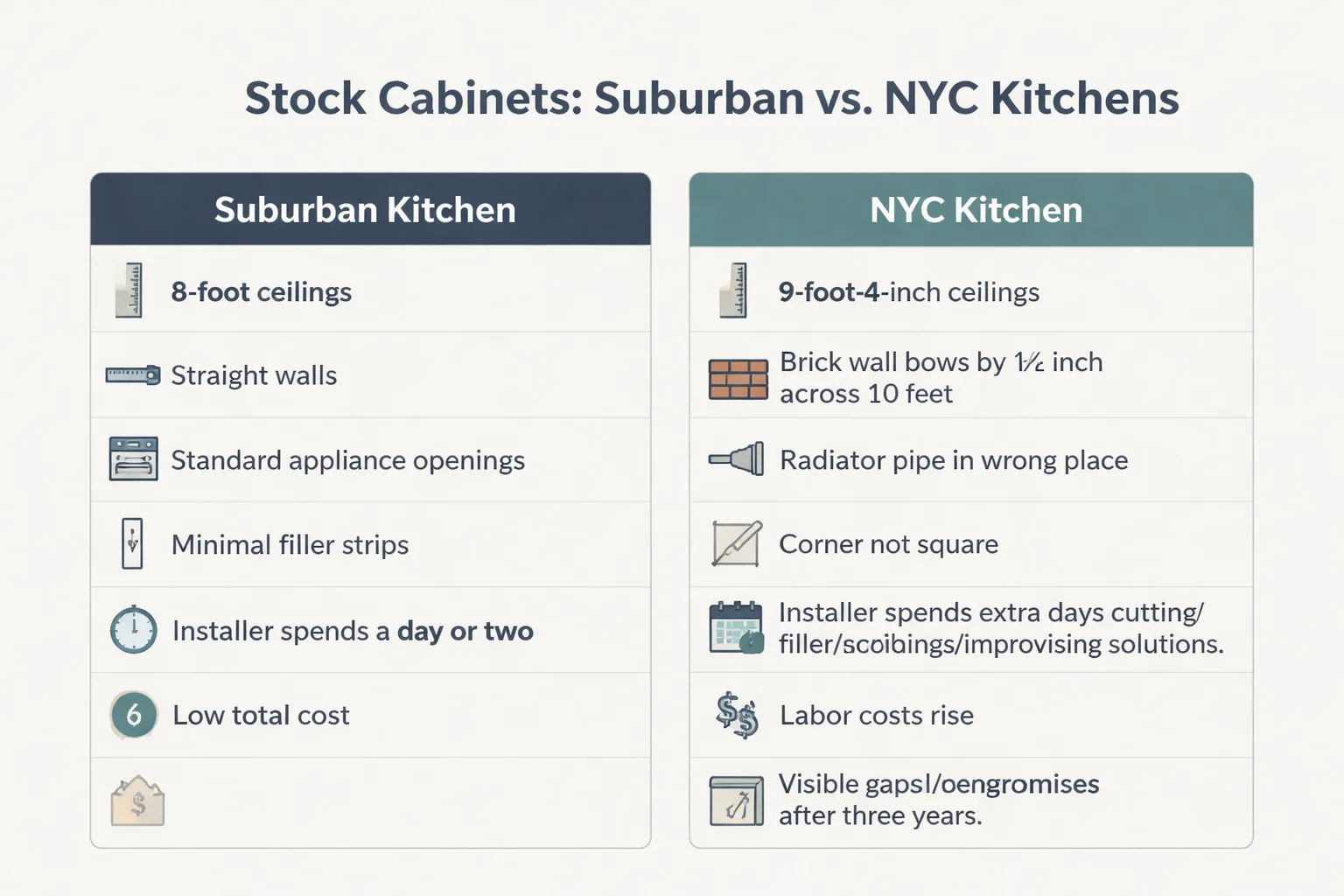
Stock cabinets win on speed and upfront cost. They lose on fit, storage optimization, and longevity. In a new-construction suburban kitchen with perfectly square walls and standard dimensions, stock cabinets can work well. In a 1920s Brooklyn brownstone with plaster walls, non-standard ceiling heights, and odd angles, stock cabinets are a false economy. The money saved on the cabinets themselves gets spent on labor to install filler strips, scribe moldings, and custom panels to make stock sizes look intentional. And the result often looks exactly like what it is: stock cabinets forced into a space they were not designed for.
The storage optimization point deserves emphasis. NYC kitchens are small. A typical Brooklyn galley kitchen might be 8 feet wide and 12 feet long. Every cubic inch of storage matters. Stock cabinets come in fixed widths (12, 15, 18, 24, 30 inches) and fixed depths (12 inches for wall cabinets, 24 inches for base cabinets). If the wall between the stove and the corner is 27 inches, a stock cabinet will be 24 inches with a 3-inch filler. A custom cabinet will be 27 inches, and that extra 3 inches of width across a 30-inch-deep base cabinet adds 810 cubic inches of storage. In a small NYC kitchen, that is the difference between a cabinet that holds a set of pots and one that holds a set of pots plus a baking sheet collection.
Stock cabinets in irregular NYC kitchens are a false economy. The upfront savings disappear into installation labor and wasted space, and the result looks like a compromise. Custom built kitchen cabinets designed for the specific kitchen eliminate both problems.
The lead time difference is real but manageable. Stock cabinets are available immediately or within 2 to 4 weeks. Custom cabinets typically take 4 to 8 weeks from final measurements to installation. For a renovation where the kitchen is already non-functional, that extra 4 to 6 weeks can feel like a lifetime. But for a renovation that is being planned (as most are), the lead time is simply a scheduling factor, not a barrier.
A note on the big-box options. When buyers search for custom kitchen cabinets online, they encounter results from Home Depot, Lowe's, and IKEA. These are not custom cabinet makers. Home Depot and Lowe's offer semi-custom lines from manufacturers like KraftMaid and Schuler. IKEA offers a modular system that can be dressed up with third-party custom fronts from companies like Semihandmade and Reform. These options have their place. They are better than stock cabinets in terms of customization. But they are not inexpensive custom kitchen cabinets. They are semi-custom or modular systems that approximate custom work. The distinction matters because the price often approaches true custom pricing without delivering true custom fit.
What to Look for When Choosing an Inexpensive Custom Cabinet Maker in Brooklyn
Not all shops that claim to offer inexpensive custom kitchen cabinets deliver the same thing. The following checklist helps buyers evaluate whether a shop is genuinely offering custom quality at an accessible price or simply cutting corners to hit a price point.
Joinery methods. Ask the shop how they construct their cabinet boxes and drawer boxes. Dovetailed drawer joints are the standard for quality custom work. Mortise-and-tenon or pocket-screw joinery with glue for face frames is acceptable. Stapled butt joints are not. If a shop cannot explain their joinery or gets defensive about the question, that is a signal.
Finish durability. Ask what finish they use and how many coats they apply. Conversion varnish (catalyzed) is the gold standard for kitchen cabinets. It is moisture-resistant, heat-resistant, and does not yellow over time. Lacquer is acceptable for less-used areas but will break down faster in a kitchen. Water-based finishes are improving but still lag behind conversion varnish for durability. A shop should be able to tell you the specific product they use and why they chose it.
Warranty terms. A quality custom cabinet shop should stand behind their work. Look for a warranty of at least 5 years on construction (joinery, box integrity) and at least 2 years on the finish. A shop that offers no warranty or a vague "we will fix any problems" without a written policy is a risk. Green Cabinets NY provides clear warranty terms because the construction methods and materials justify the confidence.
Local fabrication vs. imported flat-pack. This is where the Brooklyn market gets interesting. Some shops that market themselves as custom cabinet makers are actually importing flat-pack components (cut and drilled overseas) and assembling them locally. This is not inherently bad. The components can be well-made. But it is not the same as a shop that cuts, assembles, and finishes cabinets in-house. Local fabrication means the shop controls every step of the process and can make adjustments on the fly. It also means shorter lead times for corrections and a more direct relationship between the design and the final product.
Design accuracy and the rendering-to-installation gap. This is a pain point that does not get enough attention. The frequent disconnect between initial design renderings and the final installed product is a problem in the NYC market. Cabinets that are not perfectly flush to the ceiling as designed, or layouts that do not fit into the measured space, indicate a communication breakdown between the design firm and the installer. When evaluating a shop, ask about their process for field measurements. Do they measure themselves or rely on contractor measurements? Do they produce shop drawings for approval before cutting? How do they handle discrepancies between the design and the actual space? A shop with clear answers to these questions is one that takes responsibility for the final result.
Material transparency. A shop should be able to tell you exactly what materials go into their cabinets. What species is the face frame? What is the cabinet box made of (plywood vs. particleboard)? What is the drawer slide rated for (75 lb, 100 lb, 150 lb)? What hinge brand do they use (Blum, Grass, Hafele)? If a shop is vague about materials or uses generic terms like "hardwood" without specifying the species, that is a signal to dig deeper.
For buyers exploring material options, understanding wood species characteristics is essential. Walnut delivers richness and depth but commands a premium. Ash offers durability and a distinctive grain at a lower cost. Paint-grade maple provides a smooth surface for painted finishes and represents one of the best values in custom cabinetry. The right material choice depends on the aesthetic goals, the budget, and the kitchen's environmental conditions.
Why NYC Kitchens Make Stock Cabinets a Costly Compromise
The structural realities of NYC housing stock make stock cabinets a particularly poor fit. Pre-war apartments (built before 1940) often have plaster walls that are out of plumb by 1 to 3 inches over an 8-foot run. Floors slope. Ceilings are rarely level. Corners are rarely square. These conditions are not defects. They are the character of old construction. But they make stock cabinets, which assume square, level, and plumb surfaces, a problem.
A contractor installing stock cabinets in a pre-war Brooklyn kitchen will spend significant time cutting filler strips, scribing face frames to walls, and shimming base cabinets to level. That labor is not free. A filler strip that is 2.5 inches wide at the top and 1.75 inches at the bottom is visible evidence that the cabinets do not fit the space. Scribe molding covers the gap but does not eliminate the visual impression that something is off.
Custom cabinets eliminate these issues because they are built to the actual conditions. A custom cabinet shop measures the space (accounting for the taper, the slope, and the out-of-square corners) and builds cabinets that fit those conditions. The installation is faster and cleaner because the cabinets are designed for the space rather than adapted to it.
The cost comparison changes when labor is included. Stock cabinets at $200 per linear foot plus 30 hours of installation labor at $75 to $100 per hour (filler strips, scribing, shimming) for a 20-foot kitchen comes to $4,000 in cabinets plus $2,250 to $3,000 in labor. Custom cabinets at $450 per linear foot plus 15 hours of installation labor (cabinets fit the space, minimal adjustment needed) comes to $9,000 in cabinets plus $1,125 to $1,500 in labor. The total project cost is $6,250 to $7,000 for stock vs. $10,125 to $10,500 for custom. The custom option is still more expensive, but the gap narrows significantly. And the custom option delivers a better fit, more storage, and a higher-quality result that does not look like a compromise.
For small NYC kitchens specifically, the storage optimization that custom cabinets allow is not a luxury. It is a necessity. A custom corner cabinet with a pull-out carousel uses space that a stock corner cabinet wastes. A custom 27-inch-wide base cabinet where a stock 24-inch cabinet would have gone adds 810 cubic inches of storage. A custom cabinet that integrates a trash bin pull-out eliminates a freestanding trash can that takes up floor space. These are not aesthetic improvements. They are functional ones that make a small kitchen work better.
Wondering if your Brooklyn kitchen needs custom cabinets or if stock will work? The answer depends on your walls.
The Material Question: Eco-Friendly vs. Traditional Hardwoods
The conversation about inexpensive custom kitchen cabinets inevitably touches on material choice, and the eco-friendly vs. traditional hardwood debate is part of that. The research on this topic is thinner than it should be. Public-facing sources acknowledge that eco-friendly cabinets use renewable materials (bamboo, FSC-certified wood, low-VOC finishes) and offer health and environmental benefits. But pricing parity with traditional hardwoods is not quantified in any available source. No source provides space efficiency metrics comparing eco-friendly to standard cabinets.
What is known: traditional hardwoods (oak, maple, cherry) have a lifespan of 20 to 50 years and are widely available. Eco-friendly materials like bamboo are rapidly renewable (bamboo matures in 5 to 7 years vs. 50+ years for oak) but their long-term durability in high-moisture NYC kitchen environments lacks specific failure data. The absence of documented failure cases does not mean failures do not occur. It means the data is not being collected or shared publicly.
For practical purposes, the material choice in inexpensive custom kitchen cabinets comes down to budget and aesthetic preference. Paint-grade maple with a conversion varnish finish is one of the best value propositions in custom cabinetry. It costs less than walnut, takes paint beautifully, and provides a durable substrate. For buyers interested in sustainable options, FSC-certified woods and low-VOC finishes are available from shops that prioritize environmental responsibility. The key is to ask about sourcing and certifications rather than accepting vague claims of "eco-friendly."
The minor kitchen remodel resale recovery rate of 70 to 80% (cited by Bradco Kitchen) suggests that kitchen renovations retain significant value. Custom cabinets, which signal quality and permanence to buyers, likely perform at the higher end of that range. Stock cabinets, which savvy buyers can identify by brand and construction, may perform at the lower end.
What About Those Big-Box Custom Cabinet Options?
The search volume tells a story. IKEA kitchen custom cabinets generates 38,033 monthly searches. Custom kitchen cabinets home depot generates 880. Lowes custom kitchen cabinets and custom kitchen cabinets lowes together generate over 1,300. These numbers reflect genuine buyer interest in affordable customization. But they also reflect confusion about what "custom" means in these contexts.
Home Depot and Lowe's offer semi-custom cabinet lines. These are mass-produced cabinets with limited modification options. Buyers can select door styles, finishes, and some organizational accessories. The cabinet boxes come in standard sizes with 3-inch increments. This is not custom cabinetry. It is customizable stock.
IKEA's system is different. The cabinets are modular (standard sizes) but can be paired with custom fronts from third-party manufacturers. This creates a hybrid: a standard cabinet box with a custom-looking exterior. The result can be attractive and functional. But the cabinet boxes themselves are still standard sizes, which means the fit issues in irregular NYC kitchens remain. The gaps, the filler strips, and the scribing are still part of the installation.
For buyers who are drawn to these options by price, the question to ask is: what is the total project cost including installation labor? A semi-custom line at $250 per linear foot plus 25 hours of installation labor (filler strips, scribing, adapting to non-standard walls) may cost more than a true custom build at $450 per linear foot plus 12 hours of labor. The per-foot price is lower. The total project cost may not be.
This is not an argument against big-box options. They serve a market and they have their place. It is an argument for comparing total project costs rather than per-unit prices. Inexpensive custom kitchen cabinets from a local Brooklyn shop may cost more per linear foot but less in total project cost when installation efficiency and storage optimization are factored in.
For a broader comparison of Brooklyn's custom cabinet landscape, this analysis of top providers and 2026 design trends provides additional context.
The Durability Factor: Why Finish Quality Trumps Material Choice
A pattern that shows up repeatedly in NYC cabinet installations is the speed at which surfaces look worn. In older Brooklyn apartments with cramped layouts, dirt and daily wear accumulate rapidly. Clients are looking at refacing or significant repairs within 3 to 5 years. This is not always about material choice. It is often about finish quality and the building's inherent design problems (insufficient ventilation, poor lighting that makes every smudge visible, tight spaces that increase contact with cabinet surfaces).
The finish is the cabinet's armor. A high-quality conversion varnish finish, properly applied in multiple coats with adequate curing time, will resist moisture, grease, and abrasion for 15 to 20 years. A lower-quality lacquer finish will show wear patterns within 5 to 7 years. The difference in cost between these finishes is modest (perhaps $200 to $400 for a typical kitchen). The difference in longevity is dramatic.
This is why finish quality should be a non-negotiable criterion when evaluating inexpensive custom kitchen cabinets. A shop that uses premium materials but cuts corners on the finish is delivering a product that will look old before its time. A shop that uses mid-range materials but applies a top-tier finish is delivering a product that will look good for a decade and a half. The second option is the better value.
The five common millwork mistakes identified by CPCustoms include moisture damage and poor material selection. Both are relevant here. Moisture damage in a kitchen comes from steam, cleaning, and plumbing leaks. A conversion varnish finish resists all three. A lacquer finish does not. Poor material selection means choosing materials that cannot handle the environment. In a kitchen, that means avoiding particleboard in areas near the sink or dishwasher, using solid wood or moisture-resistant plywood in those zones, and ensuring that any exposed edges are sealed.
The Smart Storage Imperative for Small NYC Kitchens
The dominant trend in Brooklyn custom kitchen cabinets for 2026 is not a material or a finish. It is smart storage. Clients are asking for kitchens that work better, not just look better. The focus is on maximizing space and optimizing workflow in small, often awkwardly shaped NYC kitchens. If a design does not solve a fundamental space problem, it is a non-starter.
This is where inexpensive custom kitchen cabinets have their strongest advantage over stock options. Custom cabinets allow storage solutions that stock cabinets cannot provide. Pull-out pantries in spaces that would otherwise be filler strips. Drawer organizers sized to specific utensils. Corner cabinets with carousel systems that use the dead space in an L-shaped kitchen. Integrated trash bin cabinets that eliminate freestanding trash cans. Over-sink cabinets with built-in drying racks. These are not luxury features. They are functional necessities in a kitchen where counter space is measured in inches.
The smart storage trend does come with trade-offs that are not discussed enough. Handleless and minimalist styles with integrated push-to-open mechanisms look clean and modern. But the hardware can fail, and repairs require accessing the cabinet interior in ways that are more complex than replacing a standard hinge. Integrated lighting and charging ports add convenience but introduce electrical components that will eventually need service or replacement. Buyers should ask about the long-term maintenance implications of these features, not just the initial wow factor.
Planning Your Custom Cabinet Project in NYC
The process of designing and installing custom cabinets in NYC follows a predictable sequence, but one that requires careful coordination. Understanding the steps helps buyers plan effectively and avoid the rendering-to-installation gap that plagues many projects.
The process starts with a consultation where the shop learns the client's needs, aesthetic preferences, and budget. Next comes field measurement. This step is critical and should be done by the shop itself, not delegated to a contractor. The shop that builds the cabinets should measure the space. Third, the shop produces detailed shop drawings for client approval. These drawings show every cabinet, every dimension, every door style, and every finish. The client approves them before any cutting begins. Fourth, the cabinets are cut (often via CNC), assembled, and finished in the shop. Fifth, delivery and installation. Sixth, a final walkthrough to confirm everything fits and functions as designed.
For a gut renovation, the planning process is more involved because the cabinet design must coordinate with plumbing, electrical, and appliance specifications. But the sequence remains the same: design, measure, draw, build, install, verify.
The rendering-to-installation gap that frustrates so many NYC homeowners typically occurs when the design firm and the installation team are different entities with poor communication. A shop that handles both design and installation (or has a tightly integrated process with their installer) eliminates this gap. The drawings reflect what will actually be built because the same team is responsible for both.
What This Means for Brooklyn Homeowners in 2026
Inexpensive custom kitchen cabinets are not a myth. They are a legitimate category that exists because CNC technology, efficient material usage, and simplified design choices have reduced the cost of producing custom cabinetry without reducing its quality. The category is distinct from stock cabinets (which are mass-produced in fixed sizes) and semi-custom cabinets (which allow limited modifications to stock lines). It is also distinct from premium custom cabinetry (which uses high-end materials and complex construction methods that drive the price to $1,000+ per linear foot).
For Brooklyn and NYC homeowners, the value proposition is clear. In housing stock with irregular walls, non-standard dimensions, and limited space, custom fit is not a luxury. It is a functional necessity. Stock cabinets in these spaces create gaps, waste storage, and look like compromises. Semi-custom lines from big-box retailers offer some flexibility but still rely on standard cabinet box sizes. Inexpensive custom kitchen cabinets built by a local shop like Green Cabinets NY deliver genuine custom fit, smart storage solutions, and durable construction at a price point that is accessible for a typical renovation budget.
The key to getting value from this category is knowing what to evaluate. Joinery methods, finish quality, warranty terms, local fabrication, and field measurement processes are the criteria that separate genuine value from corner-cutting. Material choice matters but is secondary to construction quality and finish durability. Smart storage features should be evaluated for long-term maintainability, not just initial convenience.
The Brooklyn market in 2026 is well-served by shops that understand the specific challenges of NYC kitchens. The best shops combine CNC precision with traditional joinery, offer material options across price points, and take responsibility for the entire process from design through installation. That is what inexpensive custom kitchen cabinets should mean. Not cheap. Not cut-rate. Accessible custom quality, built to fit the space it will live in.
FAQ
What are inexpensive custom kitchen cabinets?
Inexpensive custom kitchen cabinets represent a modern return to pre-1950s practices where cabinets were built on-site to fit specific homes, now enabled by CNC routing and flat-pack systems from local millwork shops. They offer precision and accessibility that mass-produced options lack, particularly for irregular spaces. This approach has made custom work viable for average renovators rather than just the wealthy.Why are custom cabinets a necessity in NYC renovations?
Stock cabinets often fail to fit NYC's non-plumb and irregular walls in brownstones and pre-war apartments, creating a structural mismatch that drives demand for custom solutions. Local Brooklyn and Queens shops report this as a practical need rather than a luxury trend. National market data shows strong growth, but NYC-specific adoption highlights this functional gap.How do prices for custom cabinets compare to stock options?
Custom cabinets typically range from $500 to $1,500+ per linear foot, while stock options cost $100 to $300 per linear foot. Mid-range custom totals average $3,000 to $12,000, often comprising 41% of a kitchen renovation budget. These figures reflect broader market accessibility through new manufacturing methods.What is the projected growth for the kitchen cabinets market?
The global kitchen cabinets market reached USD 91.07 billion in 2025 and is expected to grow at a 5.36% CAGR through 2031, with North America accounting for 40.4% of that expansion. Broader reports indicate around 6% CAGR through 2030, though local NYC demand adds unique momentum from practical renovation needs.Get a free custom cabinet consultation with Green Cabinets NY and discover how affordable genuine custom fit can be for your NYC kitchen.