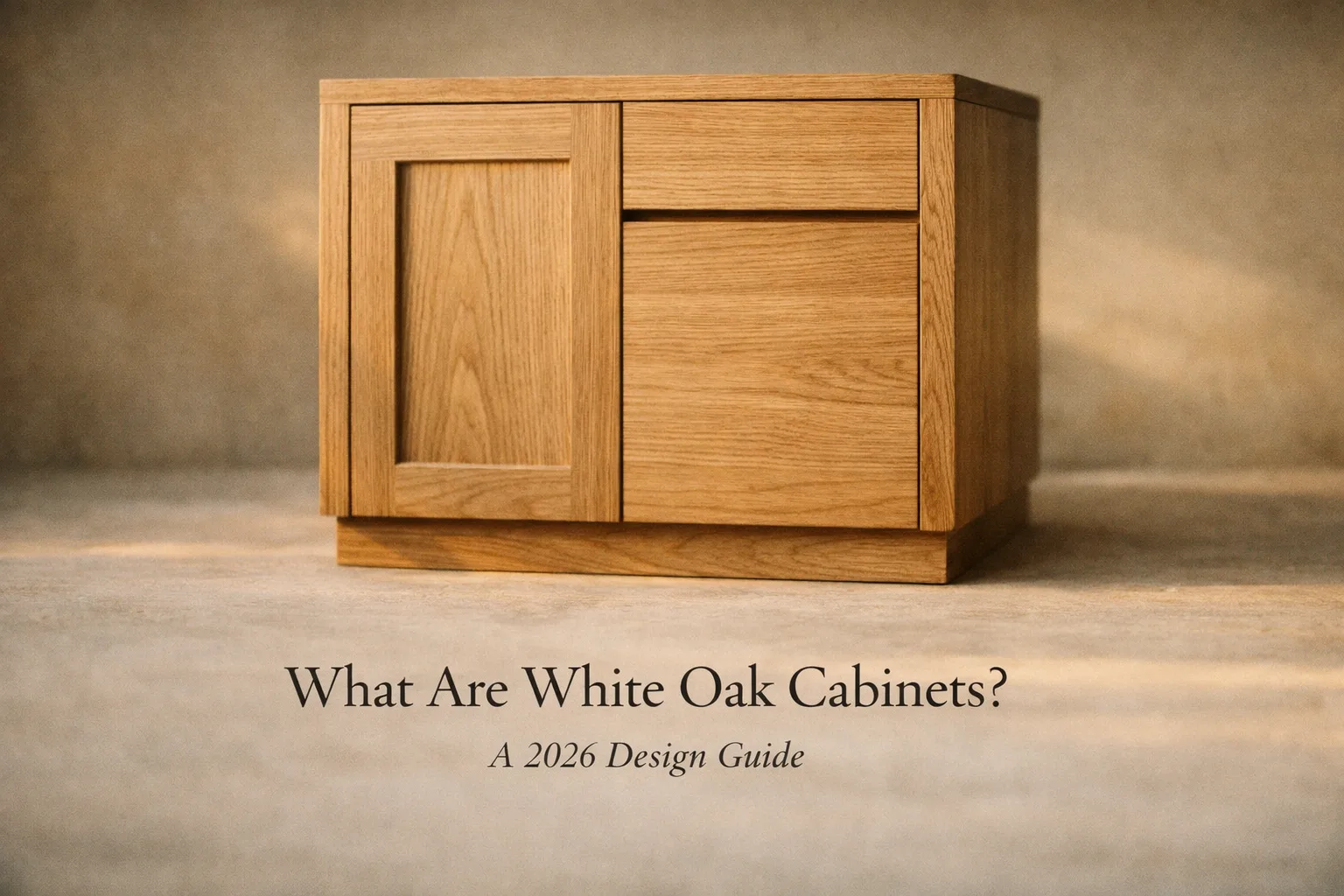
What Are White Oak Cabinets? A 2026 Design Guide
White oak cabinets dominate 2026 kitchen design for good reason: unmatched moisture resistance, a tight grain that takes finish beautifully, and a 25-year lifespan. This guide breaks down why 59% of designers now prefer it.
By Green Cabinets NY Team
Key Takeaways
- *59% of designers prefer white oak as their primary cabinet material in 2026**, driven by biophilic design and warm minimalism trends (NKBA data).- **White oak's closed-cell structure (tyloses) makes it waterproof**, outperforming red oak, maple, and MDF in humid NYC bathrooms and kitchens.- **Solid white oak cabinetry lasts 25-30 years**, making the higher upfront cost more economical over a lifecycle than cheaper alternatives requiring replacement every 8-12 years.- **Rift-cut and quarter-sawn white oak offer distinct grain patterns** for modern and traditional designs, with low-VOC finishes meeting CARB Phase 2 standards for indoor air quality.
White oak cabinets are the most important material decision your kitchen renovation will make.
White oak cabinets dominate 2026 kitchen design because the species offers a rare combination of hardness, moisture resistance, and a tight grain pattern that takes finish beautifully. The NKBA 2025 Kitchen Trends Report found that 59% of designers now prefer white oak as their primary cabinet material, driven by a wellness-focused design movement where 72% of homeowners seek a greater connection to nature through their kitchen spaces. One Virginia distributor reported a 65% rise in white oak cabinet inquiries over just six months in 2025, per In Stock Today Cabinets data shared via USA Today. The pattern is clear: white oak has moved past emerging-trend status and become the default spec for custom residential work.
What Makes White Oak Different from Other Cabinet Woods
White oak (Quercus alba) is a dense, closed-grain hardwood native to eastern North America. Its cellular structure contains tyloses, which are natural growths that seal the pores and make the wood effectively waterproof. This is the same reason white oak has been the traditional choice for whiskey barrels and boat building for centuries. Red oak (Quercus rubra), by contrast, has open pores and lacks tyloses, making it more porous and far less suitable for humid environments like NYC bathrooms or steamy Brooklyn restaurant kitchens.
The Janka hardness scale quantifies what your fingertips already sense. White oak rates 1,360 lbf, which sits comfortably above red oak's 1,290 lbf and well above pine's 380 lbf. Maple is harder at 1,450 lbf, but its tight, uniform grain reads as flat and clinical under many finishes. Walnut is softer at 1,010 lbf and significantly more expensive, with a dark chocolate tone that limits finish flexibility.
White oak's natural color ranges from pale straw to a warm golden-tan, with subtle pink undertones in some boards. The grain is straight, tight, and consistent. It does not have the dramatic cathedrals of red oak or the busy figure of hickory. This restraint is precisely why designers gravitate toward it. The wood provides texture and warmth without competing with other materials in the room. A slab of rift-cut white oak delivers a nearly flawless, linear grain that reads as modern and architectural.
When comparing options side by side, the practical advantages stack up quickly:
| Property | White Oak | Red Oak | Maple | Walnut |
| Janka Hardness | 1,360 lbf | 1,290 lbf | 1,450 lbf | 1,010 lbf |
| Moisture Resistance | High (closed pore) | Low (open pore) | Medium | Medium |
| Grain Character | Tight, straight | Open, pronounced | Tight, minimal | Smooth, flowing |
| Finish Flexibility | Excellent | Good | Fair | Limited (dark) |
| Relative Cost | Medium-High | Medium | Medium | High |
The table tells the story. White oak does not win every category, but it is the only species that performs well across all of them. Maple is harder but lacks character. Walnut is beautiful but soft and expensive. Red oak is affordable but porous and busy. White oak is the compromise that requires no compromise.
For Brooklyn homeowners dealing with pre-war apartment irregularities and humidity swings, that moisture resistance is not a luxury. It is a structural necessity. Cabinets that absorb ambient moisture warp, swell, and fail at the joints. Green Cabinets NY has observed this failure mode repeatedly in MDF and particleboard vanities installed in NYC bathrooms, where deterioration can appear within 12 to 24 months.
Consider the specific mechanics of MDF failure in a NYC bathroom. Steam from a shower raises the ambient humidity to 80% or higher. Standard MDF panels absorb this moisture, expanding by up to 10% in thickness at the edges. Once the panel swells, the veneer or paint film cracks, exposing the raw fiber beneath. The material never returns to its original dimension. Each subsequent humidity cycle accelerates the degradation. By contrast, solid white oak's dimensional change coefficient is approximately 0.00373 per 1% change in moisture content, making it exceptionally stable across seasonal humidity shifts.
Why White Oak Cabinets Are Trending in NYC Kitchens in 2026
Three forces are driving white oak's dominance in the NYC custom kitchen market this year. The first is the warm minimalism movement, which rejects the sterile white kitchens of the 2010s in favor of natural materials that age gracefully. The second is Scandinavian design influence, where light woods and clean lines create spaces that feel calm and intentional. The third is biophilic design, the practice of connecting interior spaces to natural elements.
The data backs this up. The NKBA reports that 72% of homeowners want a stronger connection to nature in their kitchen design. White oak delivers that connection through its organic grain, warm undertones, and the way it interacts with natural light. A USA Today press release covering In Stock Today Cabinets confirms that showroom trends mirror the NKBA findings, with the distributor attributing demand to wellness-driven design preferences.
In Brooklyn brownstones and Manhattan lofts, white oak serves a specific aesthetic function. Brownstone kitchens often suffer from limited natural light, especially in garden-level units. White oak's pale tone reflects light rather than absorbing it, making small spaces feel larger. The warm undertone prevents the space from feeling cold, which is the common failure mode of all-white painted cabinetry. In lofts with exposed brick and large windows, white oak provides a material counterpoint that softens industrial hardness without introducing a competing texture.
Green Cabinets NY has watched this trend accelerate across NYC projects. Clients who once requested painted shaker doors in white or gray now ask for white oak with a clear or lightly tinted finish. The shift is not just aesthetic. It reflects a deeper change in how homeowners think about their kitchens. The room is no longer a purely functional workspace. It is the emotional center of the home, and the material palette needs to reflect that.
Prime Cabinetry's analysis notes that white oak has moved beyond emerging-trend status and now represents a business opportunity with faster sales cycles and stronger margins. That observation aligns with what Green Cabinets NY sees in the field. White oak projects move from consultation to approval faster because clients respond to the material viscerally. They can see and feel the difference.
The trend also reflects a broader cultural shift away from disposable design. Homeowners are increasingly skeptical of trend-chasing renovations that look dated within five years. White oak offers visual longevity because it is a neutral, organic material that transcends specific style categories. A white oak kitchen built in 2026 will not look dated in 2036 because the material itself is timeless. The same cannot be said for high-gloss lacquer finishes or bold colored cabinetry, which carry the timestamp of their trend cycle.
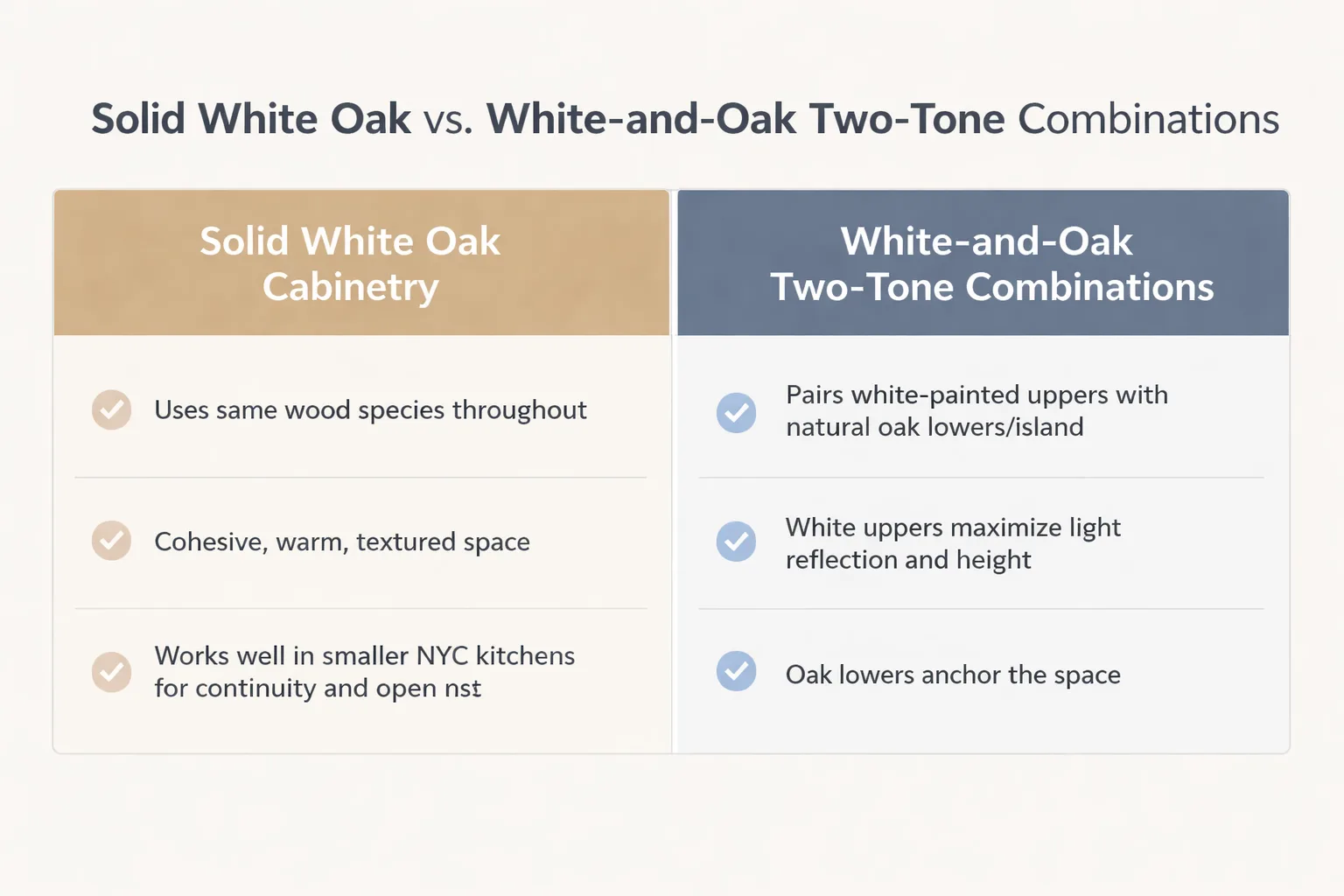
White Oak vs. White-and-Oak Two-Tone Combinations
A common point of confusion in kitchen design consultations is the difference between solid white oak cabinetry and white-and-oak two-tone combinations. These are fundamentally different design approaches with different spatial effects, cost implications, and maintenance profiles.
Solid white oak cabinetry uses the same wood species throughout the kitchen. Every door, drawer front, and frame is white oak, finished with a clear coat, tinted oil, or stain. The result is a cohesive, warm, and textured space. This approach works particularly well in smaller NYC kitchens where visual consistency creates a sense of continuity and openness.
White and oak cabinets, by contrast, pair white-painted cabinetry (typically on upper wall cabinets) with natural oak on lower base cabinets or an island. This two-tone strategy has been popular for several years and offers a different set of benefits. The white uppers maximize light reflection and create a sense of height, while the oak lowers anchor the space visually and add warmth at the ground level.
The choice between these approaches depends on three factors.
Kitchen size and ceiling height. In compact Brooklyn galley kitchens under 70 square feet, solid white oak throughout can feel busy if the grain is too pronounced. A rift-cut white oak minimizes this issue with its tight, linear grain. Two-tone designs with white uppers can make a small kitchen feel taller and more open, which is valuable in pre-war apartments with 8-foot ceilings.
Natural light exposure. North-facing kitchens with limited direct sunlight benefit from white upper cabinets to maximize available light. South-facing kitchens with abundant natural light can handle solid white oak without feeling dark. The wood actually comes alive under direct sunlight, where the grain pattern becomes more visible and the warm undertones intensify.
Maintenance and wear. White-painted cabinets show scuffs, fingerprints, and grease splatter more readily than natural oak. In a household that cooks frequently, oak lowers conceal wear better and develop a patina over time that many homeowners find appealing. Painted white uppers, positioned above counter height, are less exposed to daily wear and easier to clean.
The cost difference between these two approaches is worth noting. Solid white oak cabinetry requires more raw material and more finishing labor, which affects the overall cost of custom kitchen cabinets. Two-tone designs can partially offset this by using paint-grade materials like maple or birch for the painted components, reserving white oak for the visible lower cabinets and island.
Green Cabinets NY frequently recommends a hybrid approach for NYC renovations. Use solid white oak for the island and perimeter base cabinets where durability matters most, and use white-painted uppers where light reflection is the priority. This balances performance, aesthetics, and budget.
How Does White Oak Perform in Humid NYC Bathrooms?
White oak's closed-cell structure makes it the best domestic hardwood for bathroom vanity applications in New York City's humidity-prone older housing stock. The tyloses that seal the wood's pores provide natural moisture resistance that open-grain species like red oak simply cannot match. This biological difference is why white oak has been used in boat building and barrel-making for centuries.
NYC bathrooms present a uniquely hostile environment for cabinetry. Pre-war buildings often have inadequate ventilation, steam radiators that create temperature swings, and plumbing configurations that limit airflow behind and under vanities. Green Cabinets NY has observed premature failures in supposedly eco-friendly vanities that rely on pressed wood products like MDF or particleboard. These materials, often bonded with formaldehyde-containing adhesives, are highly susceptible to moisture damage and off-gassing. Deterioration within one to two years is not uncommon.
The sustainable vanity market has a transparency problem. Tom Kelly, CEO of Neil Kelly Cabinets, was quoted in Green Builder Media's guide to green kitchen cabinets warning that manufacturers are making green claims that deserve scrutiny. The article highlights Neil Kelly's use of low-VOC finishes and Agraboard structure in some lines, but the broader market remains saturated with unsubstantiated sustainability marketing.
For homeowners seeking genuinely sustainable bathroom vanities, the material specification matters more than the marketing label. Solid white oak, finished with low-VOC water-based coatings, outperforms nearly every engineered alternative in both durability and indoor air quality. The NYU Stern Center for Sustainable Business reports that 63 million U.S. consumers are willing to pay up to a 20% premium for sustainable products. The premium is justified when the product actually lasts.
Green Cabinets NY constructs bathroom vanities from solid white oak with mortise-and-tenon joinery, avoiding the engineered substrates that fail in humid conditions. The approach costs more upfront than ready-to-assemble alternatives, but the lifecycle math favors solid wood. A vanity that lasts 25 years costs less per year than one that needs replacement after three.
Thinking about white oak cabinets for your NYC kitchen or bathroom renovation?
What Finish Options Work Best for White Oak?
White oak's tight grain and natural color make it the most finish-flexible hardwood available for cabinetry. The same wood can produce five distinctly different looks depending on the finish technique. Understanding these options is essential for matching the cabinetry to the overall design vision.
Clear coat (natural). A water-based polyurethane or conversion varnish with no pigment. This finish showcases white oak's natural straw-to-golden color. It is the best choice for homeowners who want maximum warmth and the most honest representation of the wood. Clear-coat finishes are the most popular choice in Green Cabinets NY's Brooklyn projects because they age gracefully and never look dated.
Cerused or wire-brushed. A technique where the soft grain is intentionally removed with a wire brush, then filled with a contrasting pigment (traditionally white). This creates a textured, hand-crafted appearance that highlights the grain structure. Cerused white oak has a distinctly European sensibility and pairs well with brass hardware and marble countertops.
Tinted oil. A penetrating oil finish with a small amount of pigment, typically in warm gray, taupe, or brown tones. Oil finishes penetrate the wood rather than forming a film on top, which means they enhance the tactile quality of the wood but offer less protection against water and stains. Tinted oils are popular for low-traffic applications like pantry cabinetry or display areas.
Fumed or ammonia-treated. A process where the wood is exposed to ammonia fumes, which react with the tannins naturally present in white oak to produce a rich, dark brown color throughout the wood. Unlike a stain, fuming colors the wood from within, so scratches do not reveal a lighter underneath. This is a premium finish with a distinct artisanal character.
Stained. Traditional pigment stains can make white oak appear darker, but they mask the natural beauty of the wood. Green Cabinets NY generally advises against heavy stains on white oak because they defeat the purpose of selecting a premium hardwood. If a darker tone is desired, fuming or a tinted oil produces a more sophisticated result.
The finish choice should be made with physical samples in the actual kitchen space. Lighting transforms wood color dramatically. A white oak sample that looks perfect under showroom LED lighting can shift gray or yellow under the warm incandescent bulbs common in Brooklyn brownstones. The color temperature of light sources varies significantly. A 2700K bulb (warm white, common in residential settings) pulls out the amber and gold undertones in white oak. A 4000K bulb (cool white, common in commercial showrooms) pushes the same wood toward neutral or slightly gray. Green Cabinets NY always provides 12-inch by 12-inch finish samples for clients to test in their actual kitchen space for at least 72 hours, observing the wood under morning light, afternoon light, and artificial evening light before making a final decision.
How Does Custom Millwork Maximize Small NYC Kitchens?
Custom millwork is the difference between a kitchen that fits your space and a kitchen that fights it. In NYC, where kitchen footprints range from 40 square feet in studio apartments to 200 square feet in brownstone renovations, every inch matters. Stock and semi-custom cabinetry, built in 3-inch increments, cannot address the irregular walls, angled corners, and utility obstructions that define New York City apartments.
The advantage of custom white oak cabinets is dimensional precision. A custom shop builds each cabinet to the exact dimensions of the space, accounting for out-of-plumb walls, floor slope, and ceiling irregularities. In a typical Brooklyn pre-war kitchen, walls can be out of plumb by up to 1.5 inches over an 8-foot run. Stock cabinetry handles this with filler strips and scribe molding, which are functional but visually compromise the design.
Custom millwork also allows for integrated storage solutions that maximize every cubic inch. Floor-to-ceiling pantries with pull-out shelving, toe-kick drawers for flat items, and corner cabinets with specialized hardware (like the Lazy Susan or magic corner systems) can increase usable storage by 30 to 40% compared to stock configurations. In a 60-square-foot kitchen, that additional storage is the difference between a functional cooking space and a frustrating one.
Green Cabinets NY approaches small kitchen design with a specific methodology. The process begins with a detailed site measurement, including laser-leveled floor and wall scans. The design phase prioritizes storage density and workflow efficiency, with appliance placement optimized for the cooking triangle (sink, stove, refrigerator). The fabrication phase uses solid white oak for visible components and quarter-sawn white oak for drawer boxes, where the dimensional stability of the rift-sawn grain prevents warping in high-use applications.
The cost for custom kitchen cabinets reflects this level of precision. Custom work is more expensive than semi-custom kitchen cabinets, but the value proposition is different. Semi-custom gives you a better-fitting version of a standard product. Custom gives you a purpose-built solution for a specific space. In small NYC kitchens where storage and workflow are existential concerns, the custom premium pays for itself in daily functionality.
Are White Oak Cabinets Worth the Investment?
The cost question is unavoidable. White oak is a premium hardwood, and custom fabrication adds labor cost on top of material cost. The total investment for a full white oak kitchen in NYC typically ranges higher than painted maple or birch alternatives. But the value calculation extends beyond the initial price tag.
Durability is the first factor. White oak's hardness and moisture resistance mean the cabinets will last decades, not years. A well-built white oak kitchen can serve 25 to 30 years with proper maintenance. Over that lifespan, the annual cost is competitive with cheaper alternatives that need replacement every 8 to 12 years. The environmental cost is also lower. The EPA estimates that 9.8 million tons of old cabinets reach U.S. landfills annually. Choosing a material that lasts three times longer reduces that waste stream proportionally.
Resale value is the second factor. According to NKBA data, 59% of designers now specify white oak as their primary cabinet material. That means buyers in the 2026 market expect to see it. A kitchen with white oak cabinetry signals quality and design awareness to potential buyers. It is a material that real estate listings highlight, not one that gets replaced before listing.
Adaptability is the third factor. White oak cabinetry can be refinished rather than replaced. If design trends shift or the homeowner wants a new look, the existing cabinets can be sanded and refinished in a different tone. Painted cabinets can also be repainted, but the substrate quality matters. Solid wood takes refinishing far better than engineered materials.
Green Cabinets NY advises clients to think about cabinetry as a 20-year decision, not a 5-year one. The material choice should reflect that timeline. White oak is not the cheapest option, but it is the option most likely to still look current and perform well two decades from now.
The comparison to red oak is instructive here. Red oak costs 15 to 20% less than white oak on a per-board-foot basis. But its open pores trap grease and moisture, its grain is busier and harder to pair with contemporary finishes, and it lacks the moisture resistance needed for bathroom applications. The savings disappear when a red oak vanity needs replacement after five years of NYC humidity.
Stock vs. Custom Cabinetry for NYC Renovations
The decision between stock, semi-custom, and fully custom cabinetry is the first fork in any renovation roadmap. Each tier offers a different balance of cost, fit, and material quality. Understanding the trade-offs is essential for setting realistic expectations and budgeting appropriately.
Stock cabinetry is mass-produced in standard sizes (typically 3-inch width increments from 9 to 48 inches) and shipped flat-packed or pre-assembled. The primary advantage is cost. Stock cabinets are the least expensive option and are available for immediate purchase. The disadvantage is fit. NYC apartments rarely have standard wall dimensions. A 1920s Brooklyn brownstone kitchen might have walls that taper from 92 to 89 inches across a 10-foot run. Stock cabinets cannot accommodate this without filler strips that waste usable space and create visual discontinuity.
Semi-custom kitchen cabinets bridge the gap. Manufacturers offer a wider range of sizes, finish options, and door styles. Some modifications (like reducing cabinet depth by an inch or adding a glass insert) are possible within the manufacturer's system. Semi-custom is a strong choice for budget-conscious renovations where the space is relatively standard and the design goals are achievable within a catalog. The limitation is that you are still working within someone else's engineering constraints.
Fully custom cabinetry, like the work Green Cabinets NY produces, removes all dimensional and design constraints. Every cabinet is built to the exact specification of the space. Material choices are unlimited. Storage configurations are purpose-built. The cost for custom kitchen cabinets is higher, but the result is a kitchen where every inch is utilized and every detail is intentional.
For NYC renovations specifically, the stock vs. custom decision often comes down to one question: how irregular is the space? In a new-construction Manhattan condo with plumb walls and level floors, semi-custom cabinetry can perform well. In a pre-war Brooklyn brownstone with settling walls, sloped floors, and non-standard ceiling heights, custom millwork is the only option that delivers a finished result without compromise.
How Green Cabinets NY Sources and Crafts White Oak Cabinetry
The supply chain for white oak cabinetry matters because it determines both material quality and environmental impact. Green Cabinets NY sources white oak from sustainable North American forests, primarily in the Appalachian and Great Lakes regions. These forests are managed under certification programs that ensure replanting and responsible harvesting practices.
The fabrication process begins with raw lumber selection. Green Cabinets NY's shop grades each board for color consistency, grain pattern, and defect-free surfaces. Boards with wild grain, knots, or color variation are separated and used for hidden components like drawer boxes and cabinet backs. Only the cleanest, most consistent boards become visible door fronts and paneling.
The milling process converts rough lumber into dimensioned components. Green Cabinets NY offers several grain orientations, each with a distinct visual character. Plain-sawn white oak produces the classic cathedral grain pattern with broad, arching figures. Rift-cut white oak produces a tight, linear grain with minimal cathedrals, which is the preferred choice for modern and minimalist designs. Quarter-sawn white oak produces the distinctive medullary ray figure, a shimmering pattern that has been prized in fine furniture since the Arts and Crafts movement.
The finishing process uses low-VOC water-based coatings that meet California Air Resources Board (CARB) Phase 2 standards, which are the strictest emissions standards in the United States. These finishes protect indoor air quality while providing durable protection against daily wear. Green Cabinets NY applies multiple coats with sanding between each layer to build a finish that is smooth to the touch and resistant to water, grease, and UV fading.
For developer projects across NYC, Green Cabinets NY manages the full millwork process from design documentation through installation. This includes coordination with general contractors, plumbing and electrical trades, and building management. The firm has observed that developer projects often suffer when millwork contractors deviate from design documents, leading to resubmissions and schedule delays. Green Cabinets NY addresses this by maintaining strict adherence to approved shop drawings and requiring formal change orders for any field modifications.
The installation phase is where quality control matters most. Even perfectly built cabinets can fail if installed poorly. Green Cabinets NY's installation teams use laser levels, shimming protocols, and sequential installation sequences that ensure each cabinet is plumb, level, and securely fastened. In NYC buildings with plaster walls, uneven floors, and limited access, this level of installation precision is not optional. It is the difference between cabinets that function flawlessly and cabinets that bind, sag, or separate at the seams.
What This Means for Your 2026 Renovation
White oak cabinets represent the intersection of durability, aesthetics, and sustainability that defines good kitchen design in 2026. The data is unambiguous: 59% of designers prefer the material, demand is rising sharply, and its physical properties make it uniquely suited to NYC's challenging residential environments. The species outperforms alternatives in moisture resistance, finish flexibility, and longevity. It costs more upfront, but the lifecycle value justifies the investment.
The contrarian position here is worth stating plainly. Most kitchen renovation advice focuses on the wrong things. It obsesses over hardware finishes, countertop edge profiles, and appliance brands while treating cabinet material as an afterthought. This is backwards. The cabinet material is the largest visible surface in the kitchen. It determines how the space ages, how it wears, and how it feels to interact with daily. White oak is the material that performs best across the widest range of criteria. Choosing anything else is a compromise that should be made consciously, not by default.
Green Cabinets NY builds white oak cabinetry for homeowners and developers across Brooklyn and NYC who want materials that last decades, not years. The firm's approach prioritizes sustainable sourcing, precision fabrication, and installation quality over the shortcut-driven practices that plague the NYC millwork market. For a kitchen renovation that will define the home's character for the next 20 years, white oak cabinets are the foundation that makes everything else work.
FAQ
How long do white oak cabinets last?
Properly constructed white oak cabinets can last 25 to 30 years or more. The species' natural hardness (1,360 Janka) and moisture resistance prevent the warping, swelling, and joint failure that shorten the lifespan of softer or engineered materials. Regular maintenance involves cleaning with mild soap and water and periodic inspection of finish integrity.
Can white oak cabinets be used in bathrooms?
Yes. White oak's closed-cell structure, with natural tyloses sealing the pores, makes it the best domestic hardwood for bathroom vanity applications. It resists the humidity and moisture common in NYC bathrooms far better than open-grain species like red oak or engineered materials like MDF and particleboard.
How do you clean white oak cabinets?
Use a soft cloth with warm water and mild dish soap. Avoid abrasive cleaners, ammonia-based products, or excessive water. Dry the surface immediately after cleaning. For finished cabinets, a periodic application of furniture wax can restore luster. Avoid leaving standing water on any wood surface.
Is white oak more expensive than red oak?
Yes, white oak typically costs 15 to 20% more than red oak per board foot. The price difference reflects white oak's superior moisture resistance, tighter grain, and greater demand in the custom cabinetry market. The premium is justified by the material's longer lifespan and broader application range.
Can white oak cabinets be painted?
White oak can be painted, but it is generally not recommended. The species' open grain requires significant filling to achieve a smooth painted surface, and painting obscures the natural beauty that justifies the material's premium cost. If a painted look is desired, paint-grade species like maple or birch are more cost-effective choices.
What is the difference between rift-cut and quarter-sawn white oak?
Rift-cut white oak produces a tight, linear grain with minimal cathedrals, ideal for modern designs. Quarter-sawn white oak is cut at a specific angle to reveal medullary rays, producing a distinctive shimmering figure prized in traditional and Arts and Crafts furniture. Both are premium cuts that cost more than plain-sawn white oak.
Get a custom white oak cabinetry consultation with Green Cabinets NY and see why 59% of designers choose this material for 2026 renovations.