What Custom Kitchen Cabinets at Home Depot Actually Miss
Home Depot's "custom" kitchen cabinets are actually semi-custom, built in standard increments that fight NYC's irregular apartment walls. Here's what big-box cabinetry misses and when a Brooklyn custom builder is the smarter investment.
By Green Cabinets NY Team
Key Takeaways
- Home Depot's "custom" cabinets allow only standard 3-inch width adjustments rather than the millimeter-precise builds NYC pre-war kitchens require.
- MasterBrand's industry breakdown places Home Depot firmly in the semi-custom tier, offering limited finishes on modified stock sizes instead of true bespoke construction.
- Genuine custom cabinetry commands higher prices because it uses exact specifications for irregular spaces, unlike the modular adjustments sold as "custom" at big-box retailers.
- NYC homeowners should confirm local craftsmanship and sustainable materials before booking a free consultation, since the fine print reveals semi-custom limitations.
What exactly are you getting when you order custom kitchen cabinets through Home Depot. And is it actually custom? For homeowners in New York City, where kitchens routinely defy standard dimensions, where pre-war buildings have walls that are never quite plumb, and where sustainable materials and local craftsmanship are increasingly non-negotiable, that question carries real financial weight. Before you book your free design consultation and assume the big-box process will deliver a kitchen built around your space, it's worth slowing down and reading the fine print hidden inside the word "custom."
The data on what big-box retailers label "custom" reveals a uncomfortable gap between marketing language and delivered product. According to MasterBrand Cabinets' own breakdown of stock vs. custom cabinetry, the cabinetry industry operates on a spectrum: stock (pre-built, fixed dimensions), semi-custom (modified standard sizes with limited finish and door options), and truly custom (built to exact specifications for a specific space). Home Depot's "custom" cabinet line sits firmly in the semi-custom category, offering size modifications in standard increments (typically 3-inch width adjustments) rather than the millimeter-precise builds that NYC apartments actually require. Research from Kitchen Search's 2026 cost analysis confirms that genuine custom cabinetry involves bespoke construction, not modular adjustments, and the price differential reflects that fundamental distinction.
What Does Home Depot Actually Offer for Custom Cabinets?
Home Depot's kitchen cabinet offering centers on what the industry calls "semi-custom" cabinetry. The distinction matters enormously, especially for NYC homeowners dealing with non-standard layouts.
Here is how the product actually works. Home Depot partners with national manufacturers (KraftMaid, American Woodmark, Thomasville) to deliver cabinets built in factory-standard width increments. A homeowner selects from a catalog of door styles, finishes, and organizational accessories. A store associate or contracted designer inputs measurements into design software, which configures standard modular units to fit the space as closely as possible. Fillers, trim pieces, and decorative panels bridge the gaps where standard sizes don't align with actual wall dimensions.
That process is not custom. It is configuration.
MasterBrand's cabinetry guide draws the line clearly: custom cabinetry means built-to-spec construction where every dimension, material choice, and joinery method is selected for a specific installation. Semi-custom gives you choices within pre-determined parameters. The difference shows up in the final product.
Consider a typical Brooklyn brownstone kitchen. The walls are plaster over brick, which means they are never perfectly straight. The ceiling height might be 9 feet 4 inches, not the 9 feet that standard cabinetry assumes. There is a structural column that protrudes 6 inches into the cabinet run. A radiator sits under what should be the sink wall. These conditions are normal for New York City. They are not normal for semi-custom cabinetry.
When semi-custom cabinets meet these conditions, the solution is filler strips. Those are narrow pieces of matching finish material that close gaps between cabinets and walls. In a straight-wall suburban kitchen with standard dimensions, fillers might be 1/2 inch wide and barely visible. In a Brooklyn pre-war kitchen, fillers can be 3 to 5 inches wide, and they are very visible. They signal that the cabinetry was not built for the space. It was forced into the space.
The finish options tell a similar story. Home Depot's semi-custom lines offer perhaps 15 to 25 door styles across a handful of wood species and paint colors. Those are real choices, and for many homeowners they are sufficient. But they are catalog choices, not design choices. A homeowner cannot specify a custom door profile, a specific grain orientation, a non-catalog wood species, or a proprietary paint color matched to a tile selection. The catalog defines the design vocabulary. The homeowner selects within it.
Material quality deserves scrutiny here as well. The cabinet boxes in most semi-custom lines are constructed from furniture board (a higher-grade particleboard) or MDF, not solid plywood. Door fronts may be solid wood, but the internal construction relies on engineered panels that perform differently under NYC humidity cycles. According to Kitchen Search's cost breakdown for 2026, the material tier is one of the primary cost drivers separating semi-custom from custom, and the performance gap is real over a 15-year ownership horizon.
This is not an indictment of Home Depot's product. Semi-custom cabinetry serves a legitimate market segment. For a homeowner in a standard-dimension space with a moderate budget, it can be the right choice. But it is not custom, and the marketing language that frames it as custom creates expectations that the product cannot meet, especially in a city where standard dimensions are the exception.
Where Big-Box Cabinets Fall Short in NYC Homes
New York City kitchens break the assumptions that big-box cabinetry is built around. The failure points are specific and predictable.
Dimensional mismatches are the most common and most expensive problem. Pre-war buildings in Brooklyn and Manhattan routinely feature walls that deviate from plumb by an inch or more over a 10-foot run. Ceilings in pre-war apartments often range from 9 to 11 feet, well beyond the 36-inch to 42-inch upper cabinet heights that semi-custom lines are designed around. Radiators, structural columns, bulkheads, and exposed pipes consume wall space that standard cabinet runs cannot account for without significant modification.
When a semi-custom installation encounters these conditions, the contractor relies on fillers, scribes, and on-site modifications. A scribe is a technique where the cabinet side is cut to follow an irregular wall. Done well by a skilled installer, it can look acceptable. Done poorly, it looks exactly like what it is: a standard cabinet forced into a non-standard space.
The material limitations compound the problem. Home Depot's semi-custom lines offer limited options for sustainable or locally sourced materials. A homeowner who wants FSC-certified plywood boxes, reclaimed wood door fronts, or low-VOC finishes will find the selection thin or nonexistent. The national manufacturers that supply big-box retailers operate at scale, which means their material sourcing prioritizes cost efficiency and supply consistency over sustainability certifications or local provenance.
For homeowners and developers who prioritize eco-friendly cabinetry, this is a significant gap. Green Cabinets NY has built its practice around material transparency and sustainable sourcing because the Brooklyn market demands it. When a client specifies a formaldehyde-free plywood box or a water-based finish system, the answer should be "yes, here is the spec sheet," not "let me check if that is in the catalog."
Door style limitations matter more than they might seem. A high-end NYC interior often features specific design language: thin shaker profiles, flat-slab modern fronts, inset doors with exposed hinges, or custom arch-top panels. Semi-custom catalogs offer approximations of these styles, but the profiles, reveals, and construction details are fixed by the manufacturer. A homeowner designing around a specific aesthetic will notice the difference between a catalog shaker door and a custom-built shaker door with a 1/2-inch reveal and a specific bead profile.
Then there is the installation question. Home Depot contracts installation through third-party services. The installer may be excellent, adequate, or problematic, and the homeowner has limited control over who shows up. In NYC, where building regulations, co-op board approval, and logistical constraints (freight elevator scheduling, limited work hours, parking restrictions) dominate a renovation, the installer relationship matters enormously. A local custom builder who understands these constraints, has relationships with building management, and can sequence work around co-op requirements delivers value that a rotating cast of third-party contractors cannot match.
The NYC kitchen cabinet installation process involves logistical hurdles that big-box systems are not designed to navigate gracefully. Permit approvals in some NYC jurisdictions can take months, and those delays ripple through procurement and construction sequencing. A custom builder embedded in the local market anticipates these timelines. A national retailer's scheduling system does not.
Consider the co-op board approval process alone. A typical Brooklyn Heights or Park Slope co-op requires a renovation application, contractor insurance certificates, a work schedule, and often a security deposit before any demolition can begin. The process can take 4 to 8 weeks. Home Depot's third-party installer may not have experience navigating these requirements, which can lead to delays, rejected applications, or fines from building management. A local custom builder has done this dozens of times and knows what each building's management company expects.
Then there is the freight elevator problem. Many NYC buildings restrict freight elevator access to specific hours (typically 9 AM to 4 PM on weekdays, sometimes less). Cabinet deliveries must be scheduled within those windows, and the delivery team must be prepared to carry cabinets through tight hallways and around corners that were never designed for modern furniture dimensions. A semi-custom delivery from a national manufacturer arrives on a pallet on a truck. Getting that pallet from the loading dock to a 5th-floor apartment is a logistical challenge that the retailer's delivery system does not fully solve.
How Does Green Cabinets NY Build True Custom Cabinetry?
A genuinely custom cabinet build starts where semi-custom ends: with the actual space, measured precisely, and a material selection process that has no catalog ceiling.
The process begins with an in-home consultation and measurement session. Not a software estimate based on homeowner-provided dimensions. A site visit where every wall is measured at multiple heights (because walls are never straight), every obstruction is documented (pipes, radiators, structural elements), and every relevant condition is noted (floor levelness, ceiling contours, adjacent millwork). This measurement becomes the foundation for a build that fits the space rather than a configuration that approximates it.
Material selection follows. Green Cabinets NY works with clients to specify every material in the cabinet, not just the visible surfaces. That means choosing the plywood grade for box construction, the wood species and cut for door fronts, the finish system (conversion varnish, water-based lacquer, hand-rubbed oil), the hardware brand and model, and the organizational accessories. There is no catalog. There are specifications.
For homeowners exploring custom walnut kitchen cabinets or other specific wood species, the conversation covers grain orientation, board selection, and finish behavior over time. These are not catalog choices. They are design decisions made with a craftsperson who understands how the material will perform.
Joinery is where custom construction separates itself decisively from factory production. Semi-custom cabinets use dowel construction, cam-lock fasteners, or staples because those methods are fast, consistent, and suited to automated assembly. Custom cabinets use dovetail joints, mortise-and-tenon construction, and dadoed panels because those methods produce stronger, longer-lasting casework. The difference is not aesthetic. It is structural. A dovetailed drawer joint will outlast a stapled one by decades, and the cost difference is labor, not materials.
The fabrication happens in a shop, not on an assembly line. Each cabinet is built to the specific dimensions measured during the site visit. Fillers are not needed because the cabinets are sized to the space. Scribes are not needed because the cabinet backs and sides are cut to follow wall contours. The installation is performed by the same team that built the cabinets, or by installers who work directly with the fabricator.
This process is slower than semi-custom. A Home Depot order might deliver in 4 to 8 weeks. A custom build typically runs 8 to 14 weeks, sometimes longer for complex projects. That timeline reflects the reality of bespoke construction. Every cabinet is built once, for one space, and the fabrication schedule reflects that specificity.
For developers managing multi-unit projects, the custom millwork process for Brooklyn renovations offers consistency advantages that semi-custom cannot match. When every unit in a building has slightly different dimensions (and in NYC, they do), a custom builder can adapt each kitchen to its specific conditions while maintaining a consistent design language across the project. Semi-custom forces every unit into the same modular grid, which means every unit gets the same fillers, the same compromises, and the same gaps.
Consider a 12-unit condo conversion in a former Williamsburg warehouse. The building has exposed brick walls that vary by an inch or more between units. The ceiling heights range from 10 feet 2 inches to 11 feet 6 inches depending on where the original beams sit. Three units have structural columns in different positions. A semi-custom approach would treat each unit identically, ordering the same cabinet configuration and using fillers to address the dimensional variations. The result is 12 kitchens that look approximately the same but fit each space differently, with visible compromises in the units where the variations are most extreme. A custom builder approaches each unit as a separate project, adjusting cabinet depths, heights, and configurations to fit the specific conditions while maintaining a consistent door style, finish, and hardware package across all 12 units. The design language is consistent. The fit is precise in every unit.
The hardware specification process also differs fundamentally. Semi-custom lines offer a fixed set of hardware options (typically a dozen or so knob and pull designs from national brands). Custom construction allows the client to specify any hardware from any manufacturer, including European brands with specific mechanical tolerances, soft-close mechanisms, or integrated lighting systems. The hardware is not an add-on. It is part of the design specification from the beginning.
Unsure whether your NYC kitchen needs custom or semi-custom cabinets?
What Does the Cost Comparison Actually Look Like?
The cost question is where homeowners most often default to the big-box option, and it is where the analysis is most frequently oversimplified.
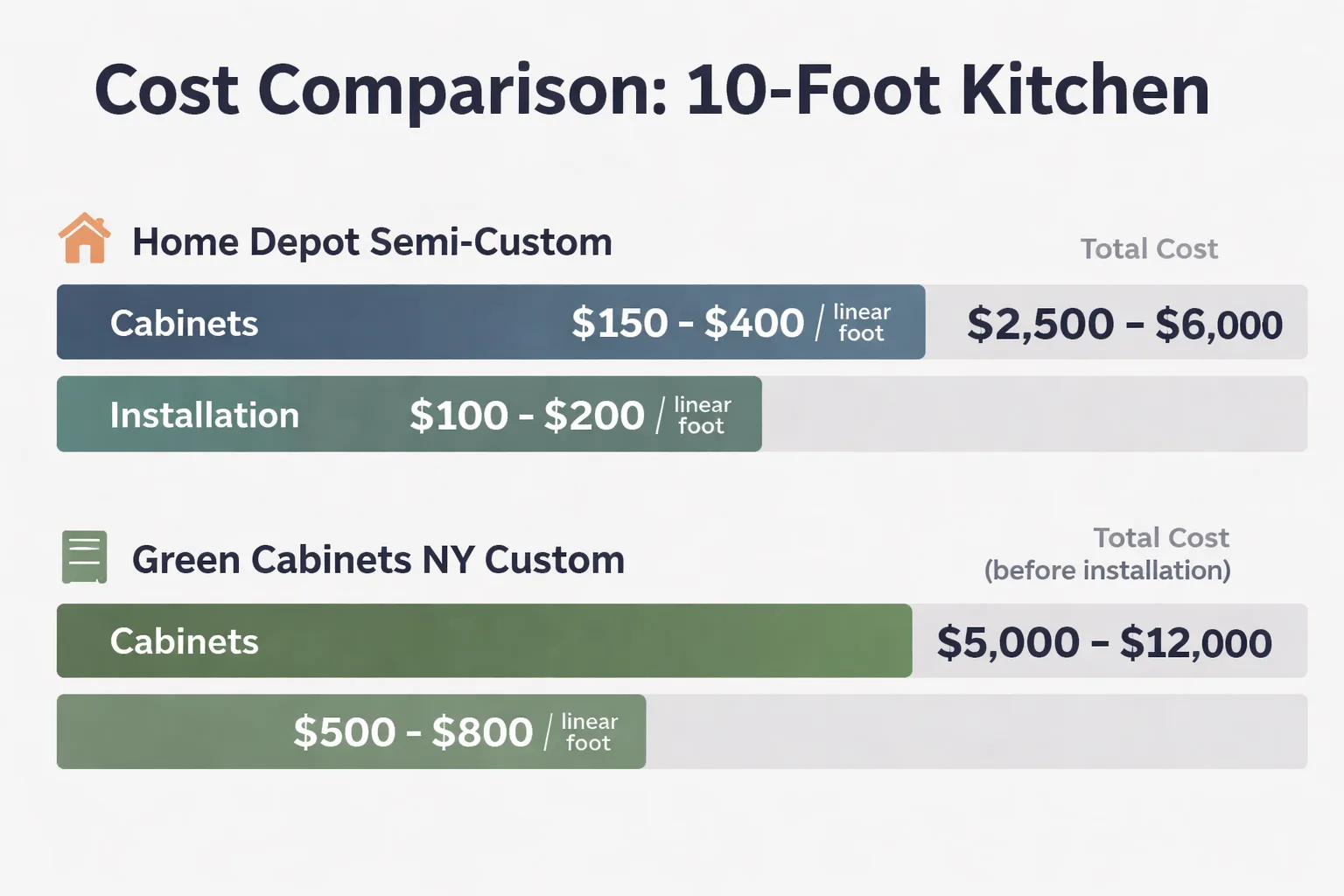
Home Depot's semi-custom cabinet lines typically range from $150 to $400 per linear foot, depending on the door style, wood species, and finish level. Installation adds another $100 to $200 per linear foot. A typical 10-foot NYC kitchen might land between $2,500 and $6,000 in cabinetry and installation, before countertops, plumbing, or electrical work.
Genuine custom cabinetry from a Brooklyn builder like Green Cabinets NY runs higher. The custom kitchen cabinets cost typically starts around $500 to $800 per linear foot for painted hardwood construction with plywood boxes and quality hardware. Premium materials (walnut, white oak, exotic veneers) and complex configurations push that higher. A 10-foot kitchen in custom cabinetry might land between $5,000 and $12,000, before installation.
That gap is real. But it is not the whole picture.
The first hidden cost of semi-custom cabinetry is the fill. When standard cabinets do not fit the space, the contractor uses filler strips, modified panels, and on-site adjustments to make them work. Those modifications cost labor time, and they produce a finished product that visibly compromises. A 4-inch filler strip next to a wall is not a design feature. It is evidence that the cabinetry was not built for the space.
The second hidden cost is longevity. Semi-custom cabinetry with furniture-board boxes and stapled joints has a shorter service life than custom cabinetry with plywood boxes and dovetailed joinery. The wood species selection for NYC kitchen cabinets directly impacts how the cabinetry performs under humidity cycling, tenant turnover, and daily use. A semi-custom kitchen that needs replacement or significant repair in 12 to 15 years has a higher lifetime cost than a custom kitchen that lasts 25 to 30 years.
The third hidden cost is adaptability. Custom cabinetry can be refinished, reconfigured, or repaired because it was built by a specific fabricator who understands the construction. Semi-custom cabinetry is harder to modify because the construction methods and materials are optimized for factory assembly, not field modification. When a door gets damaged, the replacement comes from the manufacturer's catalog. If the line has been discontinued, the replacement may not exist.
A recent Facebook discussion in a kitchen renovation group highlighted this dynamic. A homeowner received a $45,000 custom cabinet quote from a contractor recommended by their general contractor in New York City. The context was limited (no kitchen size or material specifications were shared), but the price point reflects the reality of bespoke cabinetry in the NYC market. That number sounds high compared to a big-box quote. It sounds different when you factor in a 25-year service life, material transparency, and a fit that does not rely on fillers.
For homeowners weighing the price of custom kitchen cabinets against semi-custom alternatives, the calculation should include lifetime cost, not just initial outlay. A kitchen that costs $8,000 and lasts 15 years costs $533 per year. A kitchen that costs $12,000 and lasts 30 years costs $400 per year. The more expensive option is cheaper over time.
There is also the question of what happens when something goes wrong. A semi-custom cabinet with a chipped door or a damaged drawer box requires a replacement part from the manufacturer. If the cabinet line is still in production, the replacement might arrive in 4 to 6 weeks. If the line has been discontinued (which happens every 5 to 7 years as manufacturers refresh their offerings), the replacement may not be available at all. The homeowner is left with the choice of accepting the damage, replacing the entire kitchen, or finding a custom fabricator to build a matching replacement piece. That third option is often more expensive than the original cabinet because it requires matching an existing finish, profile, and construction method.
Custom cabinetry does not have this problem. The fabricator who built the cabinets can build a replacement door, drawer, or panel because they have the original specifications, the same tooling, and the same material sourcing. The repair is straightforward and relatively inexpensive. This repairability is a long-term value that is difficult to quantify in a side-by-side price comparison but becomes very real when a drawer track fails in year 8 or a door gets damaged during a move in year 12.
How to Decide Which Route Fits Your Kitchen
The decision framework is not complicated, but it requires honest answers to three questions.
Question 1: What are your actual wall dimensions? If your kitchen walls are straight, plumb, and close to standard heights (8 to 9 feet), semi-custom cabinetry can work well. If your walls are irregular, out of plumb, or non-standard height, custom construction will produce a visibly better result. Most NYC pre-war apartments fall into the second category.
Question 2: How long do you plan to own the space? If the answer is 3 to 5 years, semi-custom may serve your needs adequately. The buyer of your apartment will not deduct value for filler strips in a kitchen that looks clean and functions properly. If the answer is 10 to 20 years, the longevity and repairability of custom construction delivers measurable value. The cost per year of ownership favors the longer-lasting product.
Question 3: How specific are your material and design requirements? If you are satisfied with catalog door styles, standard wood species, and manufacturer-specified finishes, semi-custom offers genuine choice within those parameters. If you need a specific wood species, a custom door profile, a proprietary finish, or sustainable material certifications, custom construction is the only route that can deliver those specifications.
For developers, the calculation shifts slightly. Multi-unit projects benefit from the consistency and adaptability of custom millwork, even when the per-unit cost is higher. The commercial millwork process in NYC allows a developer to maintain design consistency across units while adapting to the dimensional variations that are inevitable in older NYC buildings. Semi-custom forces every unit into the same modular grid, which means every unit gets the same compromises.
For homeowners exploring sustainable cabinetry options, the material transparency question is often decisive. Big-box retailers cannot provide the sourcing documentation, certification chain, or finish chemistry that sustainability-conscious clients require. A custom builder can specify FSC-certified plywood, formaldehyde-free construction, and low-VOC finishes because they control the material specification at every stage.
The process of choosing affordable custom cabinetry without compromising on quality involves understanding where costs accumulate and where they can be managed. Custom does not mean unlimited budget. It means the budget is spent on specifications that matter to the client, not on catalog options that are close enough.
There is a fourth question that experienced renovators ask: what is the cost of getting it wrong? A semi-custom installation that produces visible gaps, misaligned doors, or filler strips that collect dust and grease is not just an aesthetic problem. It is a financial one. The homeowner either lives with the compromise for the life of the kitchen, or they replace the cabinetry sooner than planned. Neither outcome is free. The cost of correcting a poor fit often exceeds the premium for custom construction in the first place, because correction means demolition, reordering, and reinstallation.
What About Semi-Custom Kitchen Cabinets as a Middle Ground?
The term "semi-custom" deserves direct examination because it is where most homeowners land, and it is the category that Home Depot's offering actually occupies.
Semi-custom kitchen cabinets occupy the space between stock (fully pre-built, fixed dimensions, take-it-or-leave-it) and custom (built to exact specifications). The semi-custom manufacturer offers a range of standard cabinet sizes in 3-inch width increments (9, 12, 15, 18, 21, 24 inches, and so on), a selection of door styles (typically 15 to 30 options), a limited set of wood species (oak, maple, cherry, hickory, and sometimes painted MDF), and a range of finish colors. The homeowner can also select organizational accessories (pull-out shelves, lazy Susans, wine racks) from a catalog of options.
The appeal is obvious. Semi-custom gives the homeowner more choices than stock cabinetry at a lower price than custom. For a suburban kitchen with standard dimensions, it is often the right answer. The modular sizes fit the space reasonably well, the catalog offers enough variety to achieve a personalized look, and the price point is accessible.
The problem is that NYC kitchens are not suburban kitchens. The 3-inch increment system assumes that walls are straight and that the available space divides neatly into standard modules. In a Brooklyn pre-war kitchen where the wall length is 10 feet 7 inches and the corner is not square, the 3-inch increment system produces a 4-inch gap that must be filled with a filler strip. That filler strip is not a design choice. It is a compromise forced by the modular system.
Semi-custom also limits what can be done with internal configurations. A homeowner who wants a specific drawer arrangement, a pull-out pantry in a non-standard width, or a custom-sized appliance garage will find that the semi-custom catalog does not offer these options. The manufacturer's catalog defines what is possible. The homeowner's needs do not define what is possible. That is the fundamental inversion that separates semi-custom from custom.
The quality of semi-custom construction also varies significantly by price tier. At the lower end ($150 to $250 per linear foot), cabinet boxes are furniture board with veneered interiors, doors are solid wood but with engineered cores, and hardware is basic (non-soft-close hinges, simple roller drawer slides). At the higher end ($300 to $400 per linear foot), boxes may upgrade to plywood, doors may feature solid wood construction, and hardware improves to soft-close hinges and undermount drawer slides. But even at the top of the semi-custom range, the construction methods are optimized for factory assembly, not for the specific conditions of an NYC kitchen.
When Does Building Custom Kitchen Cabinets Make Sense?
The phrase "building custom kitchen cabinets" implies a process that is fundamentally different from ordering from a catalog. It is worth examining when that process is justified and when it is overkill.
Building custom kitchen cabinets makes sense when the space demands it. NYC pre-war apartments with irregular walls, non-standard ceiling heights, and structural obstructions are the clearest case. When a semi-custom installation would require more than 2 inches of total filler material across the kitchen, the space is telling you that modular cabinetry is not the right tool. Custom construction eliminates the fillers by building each cabinet to the specific dimension it needs to occupy.
Custom also makes sense when the homeowner's design vision extends beyond catalog options. A client who wants flat-slab white oak doors with a specific grain pattern, a custom stain matched to existing flooring, and integrated finger pulls machined into the door edge cannot achieve that vision through semi-custom. The catalog does not offer those options because they cannot be mass-produced. Custom construction exists to serve exactly these requirements.
For homeowners who prioritize sustainability, building custom is often the only way to get full material transparency. A custom builder can document the source of every material in the cabinet: the plywood manufacturer, the wood species origin, the finish chemistry, the hardware country of origin. Semi-custom manufacturers are not obligated to provide this level of detail, and most do not. The material safety data sheet for a semi-custom finish might list "proprietary blend" where a custom builder can specify "water-based acrylic lacquer, VOC content under 50 grams per liter."
The timeline question is real. Building custom kitchen cabinets takes longer than ordering semi-custom. A typical custom build runs 8 to 14 weeks from signed contract to delivery, compared to 4 to 8 weeks for semi-custom. For a homeowner on a tight renovation schedule, that difference matters. But the timeline should be weighed against the outcome. A kitchen that takes 6 weeks longer to deliver but fits perfectly and lasts 25 years is a better investment than a kitchen that arrives 6 weeks sooner but requires visible compromises and needs replacement in 15 years.
When Semi-Custom Is the Right Answer
Not every kitchen needs custom cabinetry. That is an honest statement, and pretending otherwise undermines credibility.
A homeowner in a new-construction condo with straight walls, standard ceiling heights, and a 5-year ownership horizon is well served by quality semi-custom cabinetry. The dimensions fit, the catalog options are sufficient, and the ownership timeline does not justify the premium for bespoke construction. That is a rational decision.
A homeowner with a modest budget (under $5,000 for cabinetry in a standard 10-foot kitchen) is also better served by semi-custom. Custom construction at that budget is not realistic, and attempting it will produce compromises in material quality or construction methods that defeat the purpose. A well-installed semi-custom kitchen with quality hardware and a clean finish is a better outcome than a poorly executed custom kitchen.
The mistake is not choosing semi-custom. The mistake is choosing semi-custom when the space, timeline, or design requirements clearly call for custom, because the initial price quote looked more attractive. NYC pre-war apartments with irregular walls, homeowners planning to stay 15+ years, and clients with specific material requirements are not well served by semi-custom cabinetry. The fillers, the compromised fit, and the shorter service life are costs that show up later.
There is also a category of homeowner who should choose semi-custom even when they could afford custom: the homeowner who does not have strong design preferences and simply wants a functional, clean-looking kitchen. Custom construction involves a series of design decisions (wood species, door profile, reveal width, hinge type, finish chemistry, drawer slide brand) that some homeowners find overwhelming rather than empowering. For that homeowner, the semi-custom catalog simplifies the process by limiting the choices to a manageable set. That is a legitimate reason to choose semi-custom, and it has nothing to do with budget.
What This Means for Your Next Kitchen Renovation
The choice between semi-custom and custom cabinetry is not a choice between good and bad. It is a choice between adequate and excellent, between configuration and construction, between a product that fits approximately and a product that fits precisely.
For NYC homeowners, the calculation is skewed toward custom by the realities of the housing stock. Pre-war walls are not straight. Apartment dimensions are not standard. Building logistics are not simple. These conditions reward cabinetry that is built for the specific space, not adapted to it.
The cost difference is real, and it should not be minimized. Custom cabinetry costs more upfront. But the lifetime cost, measured in years of service, repairability, and the absence of visible compromise, often favors custom. A kitchen that costs 50% more but lasts twice as long is the cheaper kitchen.
Green Cabinets NY builds custom cabinetry for Brooklyn and NYC homeowners who need their kitchens to fit their spaces, not the other way around. The process is slower, the cost is higher, and the result is a kitchen that looks like it belongs in the apartment it was built for. That is what custom actually means.
The custom kitchen cabinets Home Depot sells are not bad products. They are mislabeled. Understanding that distinction is the first step toward making a renovation decision that serves the space, the budget, and the timeline honestly.
Frequently Asked Questions
Are Home Depot custom kitchen cabinets actually custom?
No. Home Depot offers semi-custom cabinetry from national manufacturers, which means size modifications in standard increments, catalog door styles, and pre-set finish options. True custom cabinetry is built to exact specifications for a specific space, with bespoke material selection and joinery methods. MasterBrand's cabinetry guide confirms this industry distinction.
How much do custom kitchen cabinets cost in NYC?
Genuine custom cabinetry from a Brooklyn builder typically starts around $500 to $800 per linear foot for painted hardwood with plywood boxes. Premium materials and complex configurations push higher. A 10-foot NYC kitchen in custom cabinetry generally lands between $5,000 and $12,000 before installation, according to Kitchen Search's 2026 cost analysis.
Can I get sustainable materials through Home Depot cabinets?
Limited. National manufacturers prioritize cost-efficient, consistent sourcing over sustainability certifications. FSC-certified plywood, formaldehyde-free construction, and low-VOC finishes are difficult to source through big-box semi-custom lines. A custom builder can specify these materials because they control the material chain.
How long do custom cabinets last compared to semi-custom?
Custom cabinetry with plywood boxes and dovetailed joinery typically lasts 25 to 30 years. Semi-custom cabinetry with furniture-board boxes and stapled joints generally lasts 12 to 15 years before requiring significant repair or replacement. The lifetime cost per year often favors custom construction.
When is semi-custom cabinetry the right choice?
Semi-custom works well for homeowners in standard-dimension spaces with straight walls, a 3 to 5 year ownership horizon, and satisfaction with catalog design options. New-construction condos with regular layouts are the most common fit. Pre-war NYC apartments with irregular walls and long ownership plans are not.
What happens if a semi-custom cabinet door gets damaged years later?
If the cabinet line is still in production, a replacement can be ordered from the manufacturer, typically arriving in 4 to 6 weeks. If the line has been discontinued (which happens every 5 to 7 years), a matching replacement may not be available. Custom cabinetry does not have this problem because the original fabricator can build a replacement from the original specifications.
Book a free in-home consultation with Green Cabinets NY and get cabinetry built to your exact walls, not someone else's catalog.