What Is a Custom Made Cabinet? A 2026 Buyer's Guide
A custom made cabinet is built to exact space dimensions with buyer-selected materials and joinery. In NYC's humidity and pre-war layouts, stock cabinetry fails predictably. Here is what custom actually costs and why it lasts.
By Green Cabinets NY Team
Key Takeaways
- Custom cabinets are built to exact dimensions with buyer-chosen materials and joinery, making them the only practical option for NYC's pre-war layouts and irregular walls.
- The global custom cabinet market reached $7.38 billion in 2024 and is projected to hit $10.52 billion by 2035.
- Particleboard in stock cabinets absorbs moisture at 0.42 g/m²·hr at 80% RH, causing swelling and failure within 18 months in NYC bathrooms at 95-100% humidity.
- Specify bamboo for custom cabinets because it regenerates in 3-5 years versus decades for hardwoods, while prioritizing EPA-recommended humidity control to prevent mold.
Custom made cabinets are not a luxury upgrade. They are, for most New York City homes, the only practical choice. The premise that stock or semi-custom cabinetry represents a smart, budget-conscious alternative quietly ignores the reality of pre-war layouts, irregular walls, and the spatial mathematics of kitchens that were never designed with a big-box retailer's standard dimensions in mind. In 2026, as material costs narrow the price gap between stock and custom options, the old argument for "good enough" cabinetry is weaker than it has ever been.
A custom made cabinet is built to the exact dimensions of a specific space, using materials, joinery, and finishes chosen by the buyer. The global custom cabinet market reached $7.38 billion in 2024 and is projected to hit $10.52 billion by 2035. Particleboard (the backbone of stock cabinetry) absorbs moisture at rates up to 0.42 g/m²·hr at 80% relative humidity. In NYC bathrooms where steam pushes localized RH to 95-100%, that absorption rate means swelling, warping, and failure within 18 months. Bamboo, a leading sustainable material, regenerates in 3-5 years compared to decades for hardwoods, according to NC State Bioresources research. The EPA's mold and moisture guidance identifies humidity control as the single most important factor in preventing cabinet degradation.
What Makes a Cabinet Truly Custom Made?
The cabinet industry uses three tiers: stock, semi-custom, and custom. The differences are not cosmetic. They are structural.
Stock cabinets come in preset widths (typically 9-inch increments), fixed depths, and a narrow selection of finishes. They are manufactured in bulk, stored in warehouses, and designed to fit the widest possible range of spaces. The problem for NYC homeowners is obvious. A 1920s Brooklyn brownstone kitchen with walls that bow inward by an inch and a half does not accommodate preset widths. Gaps get filled with filler strips. Filler strips collect grease, warp faster than the cabinetry, and visually announce that the homeowner settled.
Semi custom kitchen cabinets offer more flexibility. Buyers can adjust depths, select from a broader finish palette, and sometimes modify door styles. But the core boxes still come from a catalog. The internal dimensions, joinery methods, and material options remain constrained by what the manufacturer's production line supports. Semi-custom is a compromise. It works for some spaces. It does not work for the spaces that most Brooklyn and NYC homeowners actually live in.
A custom made cabinet starts from a blank sheet. Every dimension is cut to the millimeter of the installation space. Every material is selected for its performance characteristics in that specific environment. Every joint is chosen based on the load it will bear and the humidity it will endure. The finish is mixed and applied by hand, not sprayed on a production line.
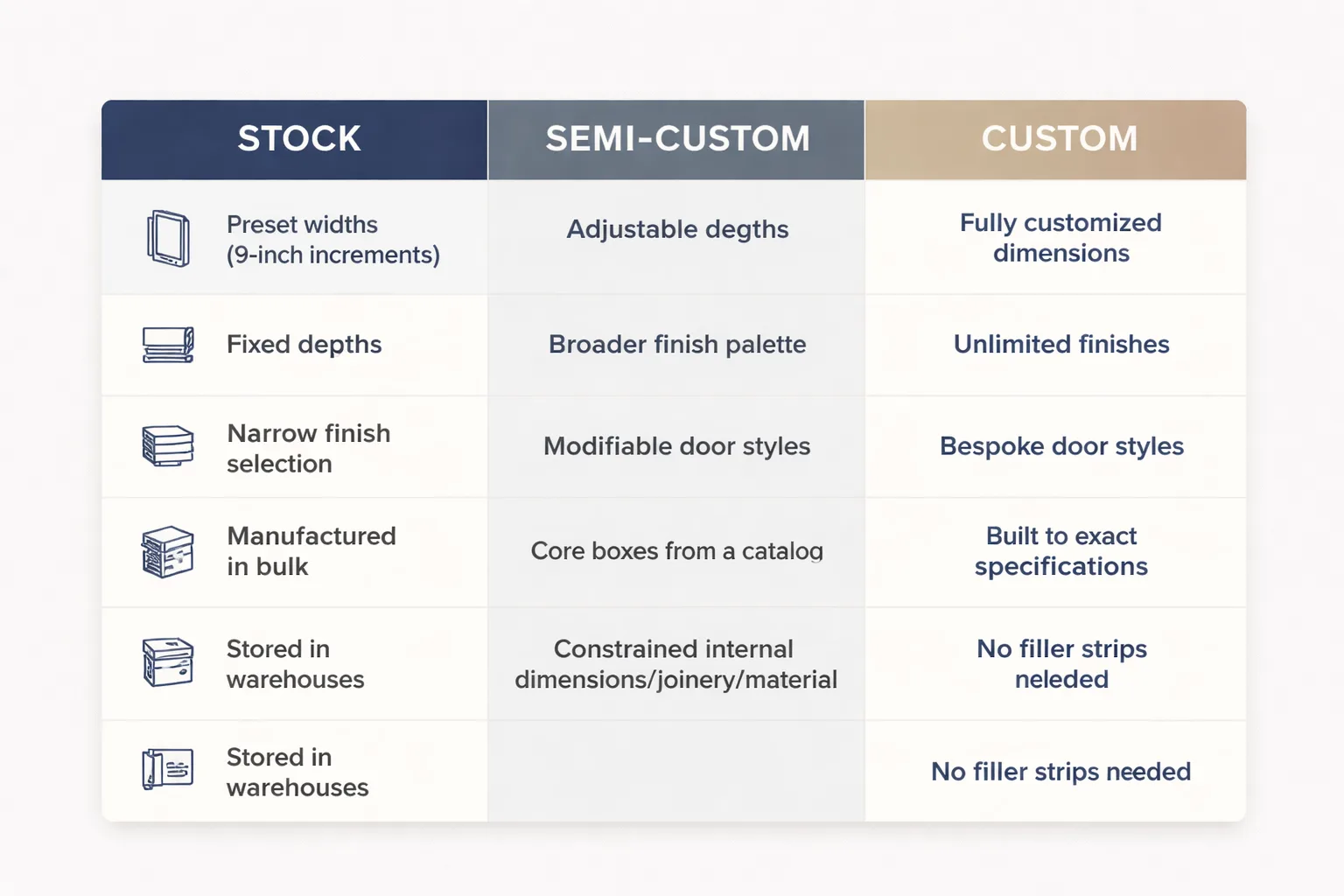
The distinction matters most in older housing stock. Pre-war buildings in Brooklyn and Manhattan have non-plumb walls, uneven floors, and spatial quirks that no catalog can address. A custom builder measures each wall, accounts for the variance, and fabricates boxes that fit flush. No filler strips. No gaps. No visual apologies.
Consider a typical Brooklyn Heights co-op kitchen measuring 9 feet 4 inches wide. Stock cabinets come in 9-inch increments. Two 36-inch base cabinets plus a 36-inch sink base equals 9 feet exactly. That leaves a 4-inch gap filled with a filler strip. A custom builder fabricates a 40-inch sink base and two 36-inch base cabinets. The fit is exact. The 4-inch filler strip is eliminated. The visual difference is immediate and permanent.
The same logic applies to vertical dimensions. Ceilings in pre-war buildings vary by as much as 2 inches across a single 10-foot wall. Stock cabinetry comes in standard heights (30, 36, or 42 inches). If the ceiling is 97 inches and the stock combination reaches 94 inches, the 3-inch gap gets covered with crown molding. That molding becomes a dust trap and a visual compromise. Custom cabinetry is fabricated to reach the ceiling exactly, with integrated molding cut to match the ceiling's actual contour.
How Custom Made Cabinets Are Built
The fabrication process separates a real custom shop from a glorified assembler. Green Cabinets NY follows a multi-stage build process that begins with material sourcing and ends with hand-finishing. Each stage has specific quality checkpoints.
Material sourcing comes first. Solid hardwoods like walnut, maple, and quartersawn oak are selected for grain consistency, moisture content, and structural integrity. Plywood (not particleboard) forms the cabinet boxes for humidity resistance. The EPA's guidance on mold and moisture makes clear that moisture intrusion is the primary driver of cabinet failure. Plywood handles humidity fluctuations far better than particleboard, which absorbs moisture at rates up to 0.42 g/m²·hr at 80% RH and swells transversely by 0.8-1.2% within four hours of exposure.
That is not a theoretical concern in NYC. Post-cooking air in a typical kitchen reaches 75-85% relative humidity. Bathroom steam pushes localized RH to 95-100% near vanities. Particleboard cabinetry in those conditions will show measurable degradation within months, not years.
Once materials are sourced and acclimatized to the shop environment (typically 48-72 hours), CNC cutting begins. Computer-controlled routing ensures precision to within 0.5mm. Every panel, stile, and rail is cut to exact specifications. The CNC stage is where custom fabrication diverges from manual carpentry. Hand-cutting introduces variance. CNC eliminates it.
Joinery follows. Dovetail joints for drawer boxes. Mortise-and-tenon for door frames. These are not decorative choices. They are structural decisions that determine how long the cabinet will hold up under daily use. A dovetailed drawer joint distributes weight across interlocking fingers that resist pulling apart. A cam-lock joint (standard in stock cabinetry) relies on a metal fastener pressed into particleboard. Guess which one fails first.
Finishing is the final stage. Sanding, sealing, staining or painting, and topcoat application happen by hand. The topcoat is where durability lives. A properly applied conversion varnish or polyurethane topcoat protects the wood from moisture, UV degradation, and chemical exposure from cleaning agents. Stock cabinetry typically receives a single spray coat. Custom cabinetry receives multiple coats with sanding between each, building a finish that lasts 10-15 years before refinishing is needed.
Quality control happens at every stage, not just at the end. After CNC cutting, each panel is checked for dimensional accuracy. After joinery, drawer boxes are test-assembled and cycled to confirm smooth operation. After finishing, the topcoat is inspected under directed light for uniformity, orange peel, and coverage. These checkpoints catch problems before they become installation failures. A cabinet that arrives at a job site with a misaligned door or an uneven finish wastes installation time and erodes buyer confidence. The checkpoint system exists to prevent that.
What Does a Custom Made Cabinet Cost in NYC?
This is where most buyers get nervous. And where most articles get vague.
The cost for custom kitchen cabinets in NYC varies based on three factors: material tier, hardware selection, and installation complexity. The global custom cabinet market was valued at $7.38 billion in 2024 with projected growth to $10.52 billion by 2035 at a 3.27% CAGR. That growth is driven partly by rising material costs and partly by demand for personalization. In 2026, those trends have only accelerated.
Here is what buyers should expect.
Material is the largest cost variable. Paint-grade maple and birch sit at the entry level for custom builds. Stain-grade species like ash and beech occupy the mid-range. Premium species like walnut and quartersawn oak carry the highest material costs. The price spread between entry and premium species can be significant, but the durability difference is often proportionate. A walnut cabinet will outlast a paint-grade maple cabinet by years, not months.
Hardware is the second cost driver. Soft-close hinges and drawer slides are standard in custom builds. Upgrading to premium hardware (Blum, Salice, Hettich) adds cost but extends functional life. Undermount drawer slides with full extension cost more than side-mounted slides, but they support more weight and allow full access to drawer contents. In a NYC kitchen where every inch of storage matters, full-extension slides are not a luxury. They are a functional necessity.
Installation is the third variable. NYC installation costs are higher than national averages due to building logistics, elevator access restrictions, parking limitations, and labor rates. A custom installation in a walk-up Brooklyn brownstone costs more than the same installation in a ground-level suburban home. That is not a markup. It is the reality of moving materials through narrow hallways and up multiple flights of stairs.
The honest answer is that custom kitchen cabinets prices in NYC reflect the cost of doing things right. Stock cabinetry appears cheaper on the quote. It costs more over time when it needs replacement after five years in a high-humidity environment.
Buyers evaluating the cost of custom kitchen cabinets should also consider the cost of not choosing custom. A stock cabinet installation that fails after five years requires removal, disposal, re-purchasing, and re-installation. That second installation costs as much as the first, sometimes more if the removal reveals water damage behind the cabinets. The total cost of two stock installations over ten years typically exceeds the cost of one custom installation over the same period. This is the calculation that most buyers skip, and it is the one that matters most.
Wondering if your kitchen or bathroom needs custom cabinetry? Share your space dimensions and we will tell you straight.
Why Does Material Selection Matter So Much?
Material choice determines how long a cabinet survives in a NYC home. This is not a matter of aesthetics. It is a matter of physics.
Solid wood and plywood are the standard for custom builds in NYC. Solid wood offers dimensional stability when properly dried and sealed. Plywood provides excellent moisture resistance for cabinet boxes. Both materials outperform particleboard and MDF in high-humidity environments.
The data supports this. Particleboard absorbs moisture at rates up to 0.42 g/m²·hr at 80% RH and swells transversely by 0.8-1.2% within four hours. In a bathroom where steam elevates localized RH to 95-100%, particleboard cabinetry is on a failure clock from day one. Door stiles bow outward up to 2.3mm at mid-height over 12-18 months of humidity exposure. That bow is visible. It means doors stop aligning, gaps appear, and the cabinet looks old before its time.
Solid wood behaves differently. It absorbs and releases moisture in response to humidity changes, but properly sealed solid wood does so without structural deformation. The key phrase is "properly sealed." A custom builder controls the sealing process. Stock manufacturers do not.
For sustainable options, bamboo has emerged as a legitimate alternative. NC State Bioresources research confirms bamboo regenerates in 3-5 years compared to decades for hardwoods. That makes it a genuinely renewable resource, not a marketing label. But bamboo requires the same attention to sealing and acclimatization as any other material. A bamboo vanity installed without proper acclimatization in a NYC bathroom will warp. The material is sustainable. The installation must be professional.
Buyers looking for eco-friendly cabinetry should verify specific compliance markers. CARB Phase 2 compliance for formaldehyde emissions. FSC certification for responsible sourcing. Low-VOC finishes for indoor air quality. These are measurable standards, not vague claims. The EPA's mold and moisture guidance provides additional context on moisture management, which is the single most important factor in cabinet longevity.
The difference between a material that lasts and a material that fails often comes down to details that are invisible after installation. The moisture content of the wood when it enters the shop. The type of adhesive used in plywood construction. The number of coats of sealant applied to exposed surfaces. The compatibility of the finish system with the wood species. These are decisions that a custom builder makes deliberately. A stock manufacturer makes them based on cost optimization.
How Do Humidity and Climate Affect Cabinet Longevity?
NYC's climate is brutal on cabinetry. Summers bring sustained humidity above 70%. Kitchens generate steam. Bathrooms generate more. The combination creates an environment where inferior materials fail predictably.
Post-cooking air in a typical kitchen reaches 75-85% relative humidity. Bathroom steam elevates localized RH to 95-100% near vanities. These are not peak spikes. They are daily occurrences. Every time someone cooks pasta or takes a hot shower, the cabinetry absorbs moisture.
The practical guidance from Alibaba LifeTips is worth noting: leaving cabinet doors open 2-4 hours daily reduces interior RH by up to 38% within 90 minutes and cuts VOC concentrations by 52% over 72 hours. That is preventive maintenance, not a design strategy. The design strategy is choosing materials that do not require daily intervention to survive.
This is where the conversation about sustainable bathroom vanities gets real. Reclaimed wood and bamboo are environmentally responsible choices. But NYC bathrooms are high-humidity environments where inadequate sealing leads to warping within 12-18 months. The aggressive cleaning agents many NYC homeowners use can strip inadequate sealants and expose sustainable materials to moisture damage. A green choice becomes a premature replacement.
The solution is not to avoid sustainable materials. It is to specify them correctly. Proper acclimatization (48-72 hours in the installation environment before fabrication). Robust sealant systems (multiple coats with sanding between each). Material-appropriate joinery. These are the details that separate a sustainable vanity that lasts 20 years from one that needs replacement in two.
Green Cabinets NY addresses these challenges directly in its approach to sustainable bathroom vanities for NYC homes. The emphasis is on materials that perform in high-humidity environments, not just materials that sound eco-friendly on a spec sheet.
Consider what happens in a typical Brooklyn bathroom during a morning routine. Two residents shower sequentially. The bathroom door is closed. The exhaust fan runs but cannot keep up with the steam volume. Localized RH near the vanity hits 95% within 10 minutes and stays above 80% for 45 minutes after the second shower ends. That cycle repeats daily. Over 12 months, that is 365 humidity exposure events. A particleboard vanity absorbs moisture during each event and never fully releases it. The cumulative effect is measurable swelling, door bow, and joint failure. A properly sealed solid wood or bamboo vanity absorbs and releases moisture without structural change. The difference is not theoretical. It is visible in every NYC bathroom that has stock cabinetry older than three years.
When Should You Choose Custom Over Stock?
The decision tree is simpler than most buyers think.
Custom is the right choice when the space has non-standard dimensions. Pre-war buildings, converted lofts, galley kitchens under 8 feet wide, and bathrooms with angled walls all qualify. If a stock cabinet would require filler strips wider than 2 inches to bridge a gap, the space needs custom.
Custom is the right choice when the buyer plans to stay in the home for more than seven years. The amortized cost of custom cabinetry over a 15-year horizon is lower than replacing stock cabinetry twice. Solid wood custom cabinets need refinishing every 10-15 years. Stock particleboard cabinets need replacement every 5-8 years in NYC humidity conditions. The math is straightforward.
Custom is the right choice for developers building multi-unit properties. Consistent quality across units, material durability for tenant turnover, and design flexibility for different unit layouts all favor custom. The upfront cost is higher. The lifecycle cost is lower. Developers who specify stock cabinetry to save on construction costs often eat that savings in turnover maintenance within the first lease cycle.
Custom is the right choice when sustainability is a priority. Stock cabinetry is rarely FSC-certified. Stock finishes rarely meet low-VOC standards. Stock materials (particleboard, MDF) off-gas formaldehyde for months after installation. A custom builder can specify FSC-certified wood, low-VOC finishes, and materials that meet CARB Phase 2 standards. For buyers who want eco-friendly cabinetry, custom is the only reliable path.
The decision also depends on the room. Kitchens and bathrooms are the two highest-humidity, highest-traffic rooms in any home. They are also the rooms where cabinetry failure is most visible and most expensive to remediate. A custom cabinet in a kitchen or bathroom is an investment in durability. A stock cabinet in those same rooms is a calculated risk.
What Design Trends Actually Last in Brooklyn Kitchens?
Here is the contrarian take that most design blogs will not publish.
The all-white kitchen is dead. Fluted details are trending toward oversaturation. The "modern farmhouse" aesthetic that dominated Brooklyn renovations from 2018 through 2024 is now explicitly identified by trend forecasters as outdated. Yet buyers still request these styles because they saw them on Instagram.
The problem is not aesthetic preference. People should choose what they like. The problem is that trend-locked cabinetry loses appeal within 3-5 years and requires a full refinish or replacement to update. That is an expensive way to chase a trend.
The better approach is to invest in a classic foundation and layer trends as removable elements. Solid wood cabinetry in a natural finish is timeless. It works in 2016, 2026, and 2036. Cabinet door styles like shaker and flat-panel have endured for decades. Hardware can be swapped in 20 minutes. A brass pull that feels dated in 2028 costs $15 per door to replace. A fluted cabinet door that feels dated in 2028 costs $400 per door to replace.
Natural wood tones are trending in 2026, and unlike all-white or farmhouse styles, they have genuine staying power. Species like alder and rustic hickory offer warm, organic finishes that complement both contemporary and traditional design schemes. They also age gracefully. A walnut cabinet darkens and richens over time. A white painted cabinet shows every chip and scuff.
For buyers who want darker aesthetics, black kitchen cabinets can work when executed with the right material and finish. The key is using stain-grade wood with a deep penetrating stain, not paint. Stain interacts with the wood grain. Paint sits on top of it. Stain can be refreshed. Paint must be stripped and reapplied.
The trend conversation also intersects with the material conversation. A fluted detail on a solid wood door panel is a design choice that can be sanded and refinished if tastes change. A fluted detail on an MDF panel is a permanent commitment because MDF cannot be sanded or refinished without exposing the composite core. Buyers who want trend-forward details should ensure they are specified on materials that allow future modification. That is only possible with custom construction.
Who Should Invest in Custom Made Cabinets?
The strongest candidates for custom cabinetry share specific characteristics.
Homeowners with odd-dimension spaces are the primary candidates. If a kitchen has a wall that bows, a ceiling that slopes, or a corner that is not square, stock cabinetry will fight the space. Custom cabinetry fits the space as it exists. No structural modifications needed. No filler strips. No visual compromises.
Buyers undertaking high-end renovations should choose custom. A $75,000 kitchen renovation with stock cabinetry looks like a $75,000 kitchen renovation with stock cabinetry. The cabinetry is the single largest visual element in a kitchen. It is where quality is most visible and where corners cut are most apparent.
Developers benefit from custom millwork for consistency and durability across units. Tenant turnover is hard on cabinetry. Stock particleboard cabinets do not survive multiple tenants. Custom plywood and solid wood cabinets do. The lifecycle math favors custom for any project with a hold period longer than five years.
Sustainability-focused buyers should choose custom because it is the only tier where material sourcing, finish chemistry, and construction methods are fully transparent. A custom builder can document FSC certification, CARB Phase 2 compliance, and VOC content. A stock manufacturer provides a spec sheet and a marketing brochure.
How Long Does a Custom Cabinet Project Take in NYC?
Timeline expectations need to be realistic. NYC adds friction that other markets do not.
A typical custom cabinet project runs 10-16 weeks from signed contract to installation. That breaks down into design and engineering (2-3 weeks), material sourcing and acclimatization (2-3 weeks), fabrication (4-6 weeks), finishing (2-3 weeks), and installation (1-2 weeks). These are working timelines for a single kitchen.
The variable is permitting. NYC permit approvals can take up to six months in some jurisdictions. That is not a cabinet shop delay. It is a bureaucratic process that affects every tradesperson on the project. When permits delay construction, cabinet fabrication gets pushed back because installation cannot begin until the space is ready.
The cascading effect is real. A permit delay pushes back the cabinet installation date. The cabinet shop must store completed cabinetry (which requires climate-controlled space). Other trades (countertop fabricators, plumbers, electricians) must reschedule around the new installation date. A two-week permit delay can become a six-week project delay when the ripple effects settle.
Buyers should build buffer into their timelines. If the target installation date is September 1, the contract should be signed by May 1. That allows 16 weeks of fabrication time plus buffer for permit delays and material sourcing issues. Projects that start late and have no buffer are the projects that go sideways.
What Should You Ask a Custom Cabinet Builder?
The questions buyers ask reveal whether a builder is qualified.
Ask about material specifications. A qualified custom builder will specify plywood box construction, solid wood face frames and doors, and specific hardware brands. If the answer is "MDF with a wood veneer," the builder is not producing custom cabinetry. They are producing semi-custom with a custom label.
Ask about joinery methods. Dovetail drawer construction. Mortise-and-tenon door frames. These are standard for custom builds. If the builder uses cam locks, staples, or pocket screws for primary joinery, the construction is not custom-grade.
Ask about finishing. How many coats? What type of topcoat? How is it applied? A proper custom finish involves multiple coats with sanding between each. The topcoat should be a conversion varnish or catalyzed lacquer, not a simple polyurethane from a hardware store.
Ask about humidity management. Does the builder acclimatize materials before fabrication? What sealant system is used? How does the builder address high-humidity environments like bathrooms? If the builder cannot answer these questions specifically, they have not built for NYC conditions.
Ask about timeline and permitting. A builder who promises six weeks from contract to installation in NYC is either lying or does not understand the market. Realistic timelines are 10-16 weeks minimum, with buffer for permitting delays.
How Does Custom Millwork Benefit NYC Developers?
Developers face a different calculus than individual homeowners. The decision is not about personal taste. It is about lifecycle cost, tenant satisfaction, and turnover efficiency.
Custom millwork gives developers consistency across multiple units. When every unit has the same cabinet dimensions, hardware, and finish, maintenance is simplified. A maintenance team can order replacement parts without measuring each unit. Drawer slides, hinges, and pulls are standardized across the portfolio. That standardization reduces turnaround time between tenants.
Durability is the other factor. Tenant turnover is destructive. Moving furniture, cleaning aggressively, and general wear hit cabinetry hard. Particleboard cabinets that survive a homeowner's gentle use for five years may not survive a tenant's two-year lease. Custom plywood and solid wood cabinets absorb that abuse without structural failure. The upfront cost is higher. The replacement cost is zero for the first decade.
The math for developers is straightforward. If a 10-unit building uses stock cabinetry at $8,000 per kitchen, the total cabinet cost is $80,000. If half those kitchens need cabinet replacement at year five (conservative for NYC rental conditions), the replacement cost is $40,000 plus installation and disposal. Total ten-year cost: $120,000 minimum. If the same building uses custom cabinetry at $14,000 per kitchen, the total cabinet cost is $140,000. No replacements needed in ten years. Total ten-year cost: $140,000. The premium for custom is $20,000 over a decade. That is $2,000 per unit per year for cabinetry that does not fail, does not generate tenant complaints, and does not require turnover delays.
What Are the Best Materials for NYC Kitchen Cabinets?
Material selection for NYC kitchens is not about what looks best in a showroom. It is about what performs in an environment that combines high humidity, aggressive cleaning, and heavy daily use.
Solid hardwoods are the gold standard. Maple and birch are dense, tight-grained species that take paint well and resist denting. They are the standard for painted custom cabinetry. Walnut offers rich color and natural durability without stain. Quartersawn oak provides dimensional stability that plain-sawn oak cannot match, making it ideal for wide panels and humid environments. Ash and beech offer excellent strength-to-weight ratios and work well in both painted and stained applications.
Plywood is the correct choice for cabinet boxes. Unlike particleboard, plywood does not swell irreversibly when exposed to moisture. It is more expensive, but it is the single material decision that most directly determines cabinet longevity in a NYC kitchen. A solid wood door on a particleboard box is a waste of money. The door will survive. The box will fail.
For sustainable options, bamboo offers legitimate environmental benefits. It regenerates in 3-5 years, sequesters carbon efficiently, and has hardness ratings comparable to many hardwoods. But bamboo's performance depends entirely on how it is processed and sealed. Strand-woven bamboo with a proper conversion varnish topcoat is a durable, sustainable choice. Laminate bamboo with inadequate sealing is a failure waiting for the first humid summer.
What Are Common Mistakes When Ordering Custom Cabinets?
The most common mistake is not understanding the timeline. Buyers sign contracts late, expect installation in six weeks, and then panic when the project runs 14 weeks. NYC custom cabinetry takes 10-16 weeks minimum. Permitting can add months. The timeline is not a suggestion. It is a constraint.
The second mistake is under-specifying hardware. Buyers focus on door styles and finishes and treat hardware as an afterthought. Hardware is what you touch every day. Cheap hinges squeak, sag, and fail. Cheap drawer slides stick, drop, and frustrate. Premium hardware (Blum, Salice, Hettich) costs more upfront and performs for decades. The functional difference between a $4 hinge and a $12 hinge is immediately noticeable and permanent.
The third mistake is choosing materials based on appearance alone. A beautiful wood species that is not properly sealed for a bathroom environment will warp. A painted finish in a high-traffic kitchen will chip. Material selection must account for the specific room, the specific humidity conditions, and the specific cleaning habits of the household.
The fourth mistake is not verifying sustainability claims. "Eco-friendly" is a marketing term. FSC certification, CARB Phase 2 compliance, and low-VOC finishes are measurable standards. If a builder cannot document these, the sustainability claim is unsupported.
The fifth mistake is skipping the acclimatization step. Wood that is fabricated without acclimatizing to the installation environment will expand or contract after installation. That movement causes doors to bind, gaps to appear, and finishes to crack. Acclimatization takes 48-72 hours. It is not optional.
FAQ
What is the difference between custom and semi-custom cabinets?
Custom cabinets are built to exact space dimensions with buyer-selected materials, joinery, and finishes. Semi-custom cabinets start from a manufacturer's catalog with limited modifications to depth, width, and finish. Custom uses solid wood and plywood construction. Semi-custom typically uses particleboard or MDF boxes with wood veneer faces. The construction methods, material quality, and dimensional precision are fundamentally different.
How much do custom kitchen cabinets cost in NYC?
The cost for custom kitchen cabinets in NYC varies based on material tier, hardware selection, and installation complexity. Material is the largest variable, with paint-grade species at entry level and premium species like walnut at the top. NYC installation costs run higher than national averages due to building logistics, elevator restrictions, and labor rates. The global custom cabinet market was valued at $7.38 billion in 2024 with growth to $10.52 billion by 2035.
How long do custom cabinets last?
Solid wood custom cabinets last 20-30 years with proper maintenance, requiring refinishing every 10-15 years. Stock particleboard cabinets typically need replacement every 5-8 years in NYC humidity conditions. The lifecycle cost of custom cabinetry is lower than stock when amortized over a 15-year horizon, even though the upfront investment is higher.
Are sustainable cabinet materials durable enough for NYC bathrooms?
Sustainable materials like bamboo and reclaimed wood are durable when properly sealed and acclimatized. NC State Bioresources research confirms bamboo regenerates in 3-5 years. However, NYC bathrooms reach 95-100% localized RH during shower use. Without proper acclimatization (48-72 hours) and robust multi-coat sealant systems, sustainable materials will warp within 12-18 months. Material selection must account for the environment.
Can custom cabinets be installed in NYC apartments with strict building rules?
Yes, but timelines must account for building logistics. Elevator access restrictions, parking limitations, and noise ordinances affect delivery and installation scheduling. Walk-up buildings add labor costs for material transport. Permit approvals in some NYC jurisdictions can take up to six months, which delays the entire construction timeline. A qualified NYC cabinet builder will factor these variables into the project schedule.
What wood species are best for NYC kitchen cabinets?
Maple and birch are ideal for painted finishes due to their tight grain and density. Walnut offers natural richness and durability without stain. Quartersawn oak provides superior dimensional stability for humid environments. Ash and beech work well in both painted and stained applications. Plywood should always be specified for cabinet boxes instead of particleboard for moisture resistance.
What This Actually Means for NYC Buyers
The case for a custom made cabinet in 2026 is not about luxury. It is about physics, economics, and the specific conditions of New York City housing stock.
Particleboard fails in NYC humidity. Stock dimensions do not fit pre-war layouts. Semi-custom compromises solve neither problem. Custom cabinetry addresses both because the materials are specified for the environment and the dimensions are cut to the space.
The cost conversation has shifted. Material costs have narrowed the gap between stock and custom. When buyers factor in replacement cycles (stock every 5-8 years versus custom lasting 20-30 years), the amortized cost favors custom for anyone planning to stay in their home beyond seven years. For developers, the math is even clearer. Tenant turnover destroys stock cabinetry. Custom survives it.
The sustainability conversation has matured. Bamboo, reclaimed wood, and FSC-certified species are legitimate choices. But they require the same engineering attention as any other material: proper acclimatization, robust sealing, and joinery that accounts for humidity exposure. A custom builder controls those variables. A stock manufacturer does not.
Green Cabinets NY builds custom made cabinets for Brooklyn and NYC homeowners and developers who need cabinetry that fits their space, survives their climate, and reflects their design priorities. The process is transparent. The materials are documented. The construction is built to last. In a market where "good enough" cabinetry fails predictably and expensively, custom is not the premium option. It is the practical one.
Get a custom cabinetry consultation with Green Cabinets NY and receive material recommendations, timeline estimates, and transparent pricing for your Brooklyn or NYC project.