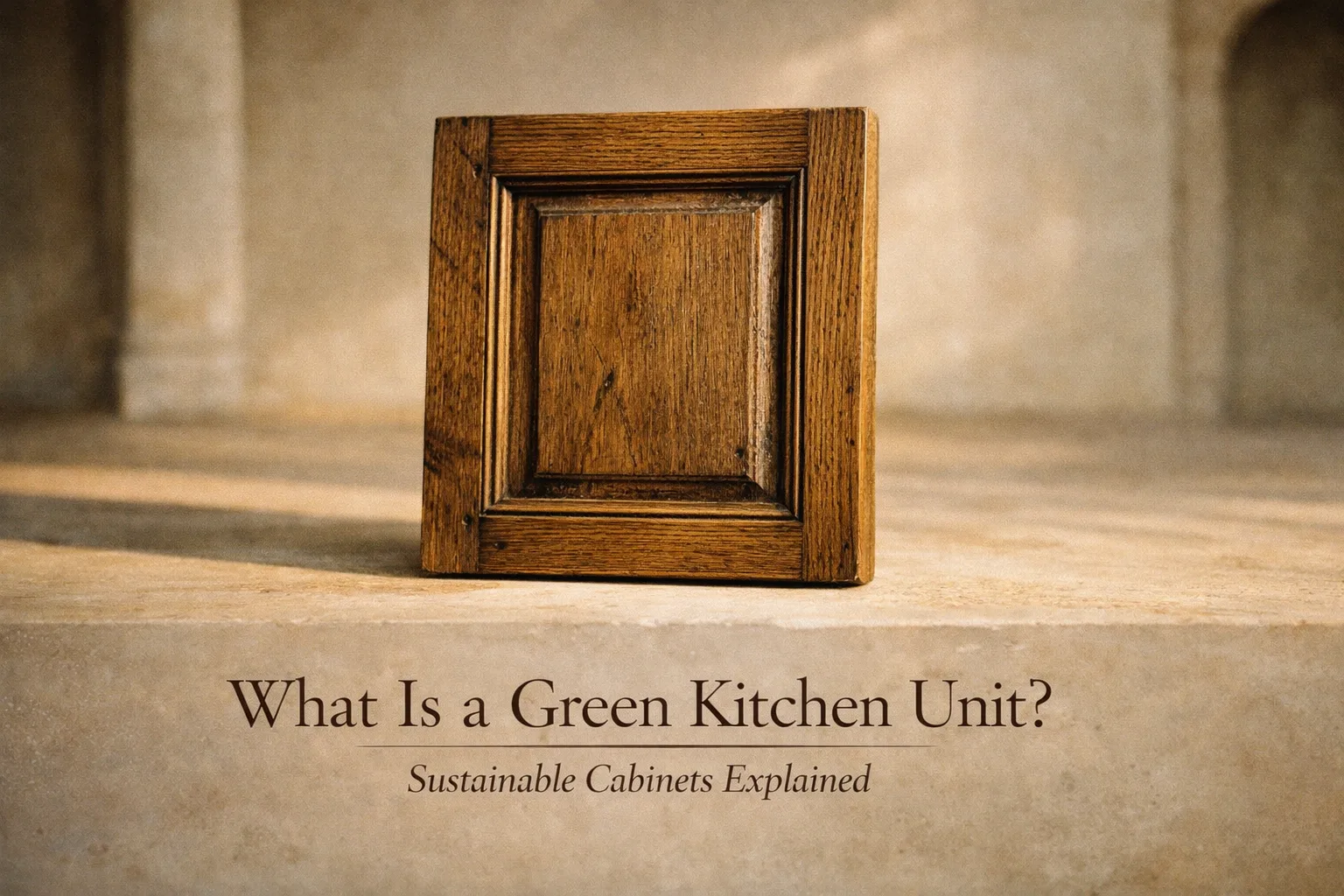
What Is a Green Kitchen Unit? Sustainable Cabinets Explained
A green kitchen unit means two things in 2026: cabinetry built from sustainable materials and cabinets finished in green tones. Here is how to get both right in a NYC renovation.
By Green Cabinets NY Team
Key Takeaways
- The global kitchen cabinets market is projected to grow from USD 95.95 billion in 2026 to USD 124.42 billion by 2031 at a 5.36% CAGR, fueled by demand for eco-certified builds.
- Bamboo regenerates in 3-5 years, offering a faster renewable cycle than the decades required for traditional hardwoods in cabinet construction.
- Select units like IKEA's FRÖJERED fronts, which incorporate recycled paper cores and plant-based glue to reduce environmental impact.
- Specify FSC-certified wood and low-VOC finishes from custom makers like Green Cabinets NY to achieve durable, non-toxic cabinetry that lasts through a child's high school years.
Maria had gutted her Carroll Gardens kitchen twice in twelve years. The first time, she'd chosen stock cabinets from a big-box store. They warped within four years. The second round, she upgraded to mid-range units that off-gassed a chemical smell for months and eventually delaminated at the edges. When she sat down with a Brooklyn custom millwork studio for the third renovation, she arrived with a single non-negotiable: nothing that would end up in a landfill before her daughter finished high school. That conversation led her to her first green kitchen unit.
The term "green kitchen unit" carries two distinct meanings in 2026, and both matter. A green kitchen unit refers either to cabinetry built from environmentally sustainable materials or to cabinets finished in green tones like sage, forest, and olive. The global kitchen cabinets market is projected to grow from USD 95.95 billion in 2026 to USD 124.42 billion by 2031 at a 5.36% CAGR, and a meaningful share of that growth comes from homeowners demanding eco-certified construction. Bamboo, one of the most renewable cabinetry materials available, regenerates in 3-5 years compared to decades for hardwoods. IKEA's FRÖJERED kitchen fronts use recycled paper cores and plant-based glue, signaling that even mass-market manufacturers are shifting toward bio-based materials. Green Cabinets NY builds custom kitchen cabinets using FSC-certified wood species and low-VOC finishes for Brooklyn and NYC homeowners who want both sustainability and longevity.
What 'Green Kitchen Unit' Actually Means in 2026
The search intent behind "green kitchen unit" splits cleanly down the middle. One homeowner is typing that phrase looking for cabinetry painted in sage, forest, or olive. Another is researching eco-friendly construction. Both deserve real answers, and conflating them creates confusion.
On the sustainability side, a green kitchen unit means cabinets built with materials and processes that minimize environmental harm. That covers FSC-certified wood, low-VOC finishes, formaldehyde-free panels, reclaimed timber, and rapidly renewable resources like bamboo. It also covers the manufacturing process itself: waste reduction, energy-efficient production, and supply chain transparency.
On the color side, green has become one of the most requested cabinet finishes in NYC renovations. Sage green works beautifully in Brooklyn brownstones with their warm wood floors and original moldings. Forest green pairs well with marble countertops in modern condos. Olive tones bridge the gap between traditional and contemporary. The color trend is real and worth exploring, but it is a separate conversation from whether the cabinet underneath that paint is environmentally responsible.
The overlap is where things get interesting. A homeowner can have both: a sustainably built cabinet finished in a green tone. That is the sweet spot, and it is exactly what Green Cabinets NY specializes in delivering. The custom millwork studio sources FSC-certified white oak and maple for clients who want durable, environmentally responsible cabinetry that also happens to look stunning in a sage or forest finish.
Here is the contrarian take: most homeowners chasing "green" cabinets fixate on the color and ignore the construction. They will spend hours debating sage versus olive and zero minutes asking whether the cabinet box contains urea-formaldehyde. The color is the fun part. The material composition is the part that affects indoor air quality and landfill timelines.
This disconnect plays out repeatedly in Brooklyn renovation projects. A client arrives with a Pinterest board full of sage green shaker cabinets, excited about the aesthetic. When the conversation shifts to material selection, the questions stop. "Is the box plywood or particleboard?" draws a blank stare. "What kind of finish goes on the doors?" gets a shrug. The studio's job is to bridge that gap without lecturing. The approach that works is showing, not telling. A sample door cut from formaldehyde-free plywood, finished in low-VOC sage, placed next to a stock cabinet door off-gassing in a sealed bag. The difference is immediate and visceral. One smells like a forest. The other smells like a factory.
The dual meaning of "green kitchen unit" is not going away. If anything, it is intensifying. Design blogs push green color trends hard in 2026, and environmental awareness is rising among NYC homeowners who have lived through stock cabinet failures. The phrase captures two genuine consumer desires: beauty and responsibility. A truly green kitchen unit satisfies both.
Sustainable Materials That Make a Kitchen Unit Truly Green
FSC-Certified Wood: The Foundation
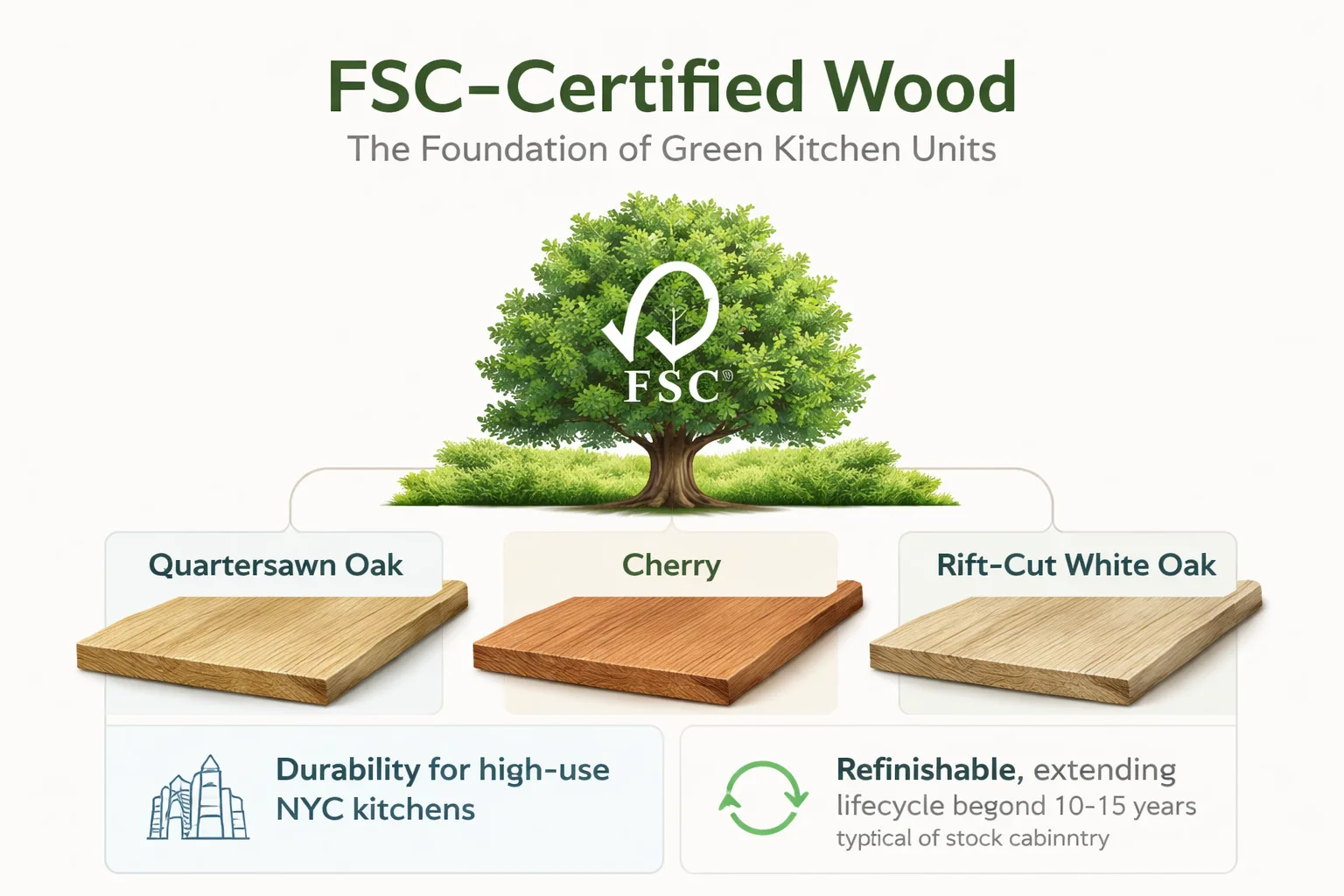
Forest Stewardship Council (FSC) certification means the wood comes from forests managed to specific environmental, social, and economic standards. The certification tracks chain-of-custody from forest to mill to fabricator, so the buyer can verify the claim.
Green Cabinets NY builds with FSC-certified species including quartersawn oak, cherry, and rift-cut white oak. These species offer the durability needed for high-use NYC kitchens. Solid wood construction means the cabinets can be refinished rather than replaced, extending their lifecycle well beyond the 10-15 year window typical of stock cabinetry.
A comprehensive life cycle assessment of 25 furniture pieces published in Nature's Scientific Reports confirms that material selection drives the majority of a furniture piece's environmental impact. The study found that wood-based furniture generally outperforms composite panel alternatives on embodied energy and end-of-life recyclability, though the specific findings vary by product category and manufacturing process.
The mechanics of FSC certification matter because not all "sustainable" labels carry the same weight. FSC certification requires independent third-party audits of forest management practices, including biodiversity protection, indigenous rights, and harvest rate limits. Other labels, such as SFI (Sustainable Forestry Initiative) or PEFC (Programme for the Endorsement of Forest Certification), exist but have different standards and varying levels of rigor. For homeowners who care about verifiable sustainability, FSC remains the gold standard because its chain-of-custody tracking follows the wood from stump to finished product.
The practical implication for a Brooklyn kitchen renovation is this: when Green Cabinets NY specifies FSC-certified rift-cut white oak, the homeowner can request the chain-of-custody certificate number and verify it through the FSC database. That level of traceability does not exist for stock cabinets sourced from overseas manufacturers with opaque supply chains.
Low-VOC Finishes and Formaldehyde-Free Construction
Volatile organic compounds (VOCs) are chemicals that off-gas from paints, adhesives, and composite wood panels. That "new cabinet smell" is often formaldehyde and other VOCs entering the air. In a small NYC kitchen with limited ventilation, that matters.
Low-VOC finishes use water-based formulations that emit significantly fewer harmful compounds. Green Cabinets NY specifies low-VOC and zero-VOC finishes across all custom builds. For the cabinet boxes themselves, formaldehyde-free plywood and Medex (a formaldehyde-free MDF alternative) replace conventional particleboard and MDF.
IKEA's FRÖJERED kitchen fronts demonstrate how even large manufacturers are adopting bio-based materials, using sustainable bamboo with a recycled paper core and plant-based glue. While IKEA's sustainability reports describe the material composition, they do not surface quantified carbon reduction metrics in web-accessible formats. The material description is verifiable; the measured environmental outcomes are not publicly available.
The technical distinction between low-VOC and zero-VOC finishes matters for indoor air quality. Conventional cabinet lacquers can emit VOCs at rates of 350-450 grams per liter. Low-VOC water-based finishes typically emit under 150 grams per liter. Zero-VOC formulations emit under 5 grams per liter. For a NYC kitchen in a pre-war building with a single window and no mechanical ventilation, that difference compounds over time. The off-gassing from conventional finishes can persist for months, while low-VOC finishes cure and stabilize within days.
Formaldehyde-free construction addresses the cabinet box itself, not just the finish. Conventional particleboard and MDF use urea-formaldehyde resins as binders. These resins release formaldehyde gas gradually, a process that accelerates in heat and humidity. NYC kitchens generate both. The California Air Resources Board (CARB) Phase 2 standard sets maximum formaldehyde emission levels for composite wood products, and while it represents an improvement over unregulated panels, it does not eliminate emissions entirely. Formaldehyde-free plywood uses alternative adhesives (typically soy-based or polyurethane) that emit no measurable formaldehyde. Green Cabinets NY defaults to formaldehyde-free panels for all sustainable builds.
Bamboo: Rapidly Renewable and Kitchen-Ready
Bamboo regenerates in 3-5 years compared to the decades required for hardwood species to reach harvest maturity. This rapid growth cycle makes bamboo one of the most renewable structural materials available for cabinetry.
Bamboo also offers practical performance benefits for kitchens. Multiple sources, including Conestoga Wood Specialties and Homebaa, describe bamboo as moisture-resistant and durable enough for kitchen and bathroom applications. However, neither source provides numerical benchmarks comparing bamboo's moisture resistance or expected lifespan against FSC-certified wood. The qualitative claims are consistent across manufacturers, but side-by-side performance data does not exist in publicly available sources.
This is an honest gap. A homeowner asking "will bamboo cabinets last as long as oak?" will find confident marketing claims but no peer-reviewed lifespan comparison. What is verifiable: bamboo grows fast, resists moisture qualitatively, and offers a distinctive grain pattern that works in both modern and transitional kitchen designs.
The sustainability calculation for bamboo also includes transportation. Most bamboo used in US cabinetry is harvested in China and shipped overseas. The carbon footprint of that shipping is real, even if the material itself is rapidly renewable. For NYC homeowners who prioritize local sourcing, FSC-certified North American hardwoods may actually represent a lower total carbon footprint than imported bamboo, depending on the specific supply chain. Green Cabinets NY discusses this trade-off openly with clients and lets the project's priorities drive the material choice.
Reclaimed and Recycled Content
Reclaimed wood from demolished buildings, fallen trees, and deconstructed barns offers another path to a green kitchen unit. The environmental benefit is straightforward: no new trees are harvested, and the embodied carbon from the original harvest is preserved rather than released.
Green Cabinets NY works with reclaimed ash and birch when clients want the character and sustainability story of salvaged timber. Reclaimed wood typically costs more than new stock because of the labor involved in de-nailing, milling, and preparing the material, but it delivers a look that cannot be replicated with new lumber.
The character of reclaimed wood is genuinely unique. Old-growth timber harvested a century ago has tighter grain patterns than modern plantation-grown wood because the trees grew more slowly in denser, undisturbed forests. A reclaimed birch panel from a 1920s Brooklyn factory floor will show grain density and color variation that no newly harvested birch can match. For homeowners who want their kitchen to tell a story, reclaimed wood is the material that does it most authentically.
The challenge with reclaimed wood is consistency. Every board is different. Some have nail holes, some have insect tracks, some have water stains. For some clients, that variation is the appeal. For others, it reads as damage. Green Cabinets NY sorts reclaimed stock by visual character and presents sample boards so clients understand exactly what they are getting before the build begins.
Which Green Tones Work in Brooklyn Kitchens?
Green cabinetry is not a monolith. The specific shade changes everything about how a kitchen reads. A forest green kitchen in a Park Slope brownstone feels grounded and historical. The same shade in a Williamsburg loft might feel heavy and dark. The context of the space dictates which green works.
Sage Green for Brownstone Kitchens
Sage green is the most versatile green tone for NYC kitchens. It sits between gray and green on the color wheel, which means it reads as neutral in most lighting conditions. In Brooklyn brownstones with original woodwork, exposed brick, or warm-toned floors, sage provides color without competing with the existing architectural character.
Pair sage cabinets with brass or unlacquered bronze hardware. The warmth of the metal offsets the cool undertone in the sage. For countertops, a honed Carrara marble or a warm white quartz keeps the palette calm. Avoid high-gloss finishes on sage cabinets; a matte or satin finish absorbs light and gives the color depth.
The specific sage tone matters more than people realize. A sage with too much yellow reads muddy under incandescent lighting. A sage with too much gray reads cold in a north-facing kitchen. The difference between a sage that works and a sage that falls flat can come down to a single tint adjustment. Green Cabinets NY mixes custom sage formulations for each project rather than relying on off-the-shelf paint codes, because the same sage that looks perfect in a sun-drenched DUMBO condo will look wrong in a ground-floor Gowanus garden apartment.
Forest Green for Modern Condos
Forest green is bolder. It works in kitchens with abundant natural light, high ceilings, or white walls that provide contrast. In a modern condo with clean lines and minimal trim, forest green cabinetry becomes the design statement.
Forest green pairs well with black hardware, soapstone countertops, and white oak flooring. The key is balancing the darkness of the cabinets with lighter elements elsewhere in the room. A kitchen that is entirely forest green with dark counters and dark floors will feel like a cave.
The psychological effect of forest green in a kitchen is worth noting. Deep greens are associated with calm and focus, qualities that matter in a space where people gather and cook. A forest green kitchen with warm under-cabinet lighting and a light stone countert creates a jewel-box effect: rich, enclosed, and intentional. This works in condos where the kitchen is part of an open-plan living area because the green cabinetry defines the kitchen zone without needing walls.
Olive and Deep Green for Transitional Spaces
Olive green bridges warm and cool tones, making it ideal for transitional kitchens that blend traditional and contemporary elements. It works particularly well with rustic hickory accents or open shelving. Deep greens like hunter or emerald are high-commitment choices that pay off when the rest of the kitchen is restrained.
Green Cabinets NY approaches color consultation by testing samples in the actual kitchen space. Paint chips viewed under showroom lighting look different from the same color in a north-facing Brooklyn kitchen with limited windows. The studio provides sample doors finished in the client's chosen green tone, placed in the actual space, and observed across different times of day before the final order is placed.
This testing process is not optional. The number of variables that affect how a green finish reads in a specific kitchen is large: natural light direction, artificial light temperature, wall color, floor color, countertop material, and even the time of year. A sage green sample approved in July under summer sunlight may look entirely different in November when the sun angle drops and the kitchen relies more on artificial lighting. The studio recommends observing samples for at least one week across morning, afternoon, and evening conditions before committing.
Want a green kitchen unit built to last decades, not years?
How to Commission a Green Kitchen Unit in NYC
Commissioning a custom green kitchen unit in NYC follows a structured process. Green Cabinets NY breaks it into five phases, each with specific deliverables and decision points.
Phase 1: Material Selection and Sustainability Goals
The first conversation covers what "green" means to the client. Some prioritize FSC certification. Others care most about low-VOC finishes for indoor air quality. Some want reclaimed wood for the environmental story. Most want a combination.
This phase also covers wood species selection. The choice between red oak, mahogany, or maple affects both the sustainability profile and the aesthetic outcome. FSC-certified availability varies by species and by harvest season, so the studio confirms sourcing before committing to a species.
The material selection conversation also addresses the tension between sustainability and budget. FSC-certified rift-cut white oak costs more than non-certified flat-sawn red oak. Reclaimed birch costs more than new birch. Low-VOC finishes cost more than conventional lacquers. These are real cost differences that add up across a full kitchen. Green Cabinets NY presents a tiered material matrix that lets clients see exactly what each sustainability upgrade costs and decide which ones matter most to them. Some clients go all-in on every sustainable option. Others choose FSC certification and formaldehyde-free panels but opt for a conventional finish to manage budget. Both are valid choices made with full information.
Phase 2: Design and Color Specification
Once materials are selected, the design phase begins. For green-toned cabinets, this is where the specific shade is chosen, tested, and finalized. The studio produces CAD drawings showing the cabinet layout, door styles, and finish specifications.
This phase also addresses functional design. Brooklyn kitchens often have irregular layouts: offset windows, non-standard ceiling heights, shallow alcoves in pre-war buildings. Custom millwork exists precisely to solve these challenges. A stock 24-inch deep cabinet that protrudes into a narrow galley kitchen is not a solution. A custom cabinet built to 21 inches deep, with adjusted interior configurations, is.
The design phase is where aspirational trends collide with functional reality. A client may want handleless cabinets with integrated appliance panels for a seamless minimalist look. In a narrow Brooklyn galley kitchen, handleless cabinets require finger pulls routed into the door edge, which reduces the clean aesthetic the client wants. A fully integrated refrigerator panel in a kitchen with an offset ceiling line requires custom filler panels that break the seamless look. The studio's designers walk clients through these trade-offs during the CAD review, showing exactly where the design will need to compromise and why.
The color specification sub-phase includes the sample door process described above. By the end of Phase 2, the client has approved a specific wood species, a specific green finish formulation, a specific door style, and a specific hardware selection. All of these are documented in a build specification sheet that travels with the project through fabrication.
Phase 3: Fabrication
Green Cabinets NY fabricates all cabinetry in-house. This controls quality and reduces the environmental impact of shipping finished goods long distances. The fabrication process includes cutting, assembly, sanding, and finishing.
For sustainable builds, the finishing stage is where low-VOC and zero-VOC coatings are applied. The studio uses a controlled spray environment to ensure even coverage and proper curing. Waste from the fabrication process, including wood offcuts and sawdust, is collected and repurposed or recycled where possible.
In-house fabrication also means the studio controls the material yield. CNC routing software optimizes cutting layouts to minimize waste from each sheet of plywood or panel. Offcuts that are too small for cabinetry become toe-kick fillers, cleats, or test samples. Sawdust is collected through a dust collection system and donated to local urban agriculture projects for compost. None of this is glamorous, but it is how a custom shop materially reduces its environmental footprint compared to a mass-production facility that optimizes for speed over material efficiency.
The fabrication timeline for a custom green kitchen unit typically runs 4-8 weeks depending on kitchen size and complexity. This is longer than ordering stock cabinets from a warehouse, but the studio is building every cabinet to the specific dimensions of the client's kitchen, not pulling standard sizes from inventory.
Phase 4: Delivery and Installation
NYC installations present unique logistical challenges. Co-op board approvals, freight elevator scheduling, parking restrictions, and building-specific renovation hours all affect the timeline. Green Cabinets NY manages these logistics as part of the installation process.
Installation typically takes 2-5 days for a standard kitchen, depending on complexity. The studio's installers are employees, not subcontractors, which maintains quality control and accountability through the final phase.
The co-op board approval process deserves its own discussion because it is where many NYC kitchen renovations stall. Most Brooklyn co-ops require a renovation agreement, proof of insurance, a detailed scope of work, plumber and electrician licenses, and sometimes a security deposit. The process can take 4-8 weeks before work begins. Green Cabinets NY provides all documentation the board needs, including material specifications (which help demonstrate that low-VOC finishes will not create odor issues for neighbors) and installation timelines that comply with building noise restrictions.
For condo owners, the approval process is typically simpler but still requires coordination with building management for freight elevator reservations, loading dock scheduling, and renovation waste disposal. The studio handles these logistics so the homeowner does not have to.
Phase 5: Post-Installation Care
The final phase covers care and maintenance. Solid wood cabinets with low-VOC finishes require specific cleaning products and periodic resealing. The studio provides written care instructions and recommends a maintenance schedule. For green-toned cabinets, touch-up paint is provided in case of chips or scratches.
The maintenance schedule for custom solid wood cabinets is straightforward. Wipe spills immediately with a damp cloth. Clean monthly with a mild soap solution. Avoid abrasive cleaners, ammonia-based products, and excessive water. Refinish every 10-15 years depending on wear. For green-toned cabinets, UV exposure can cause slight color shifting over time, particularly on south-facing exposures. The studio uses UV-resistant finish formulations to minimize this, but some shift is natural and expected over a decade of use.
What Does a Sustainable Bathroom Vanity Share With a Green Kitchen?
The principles behind a green kitchen unit apply equally to a sustainable bathroom vanity. In fact, bathroom vanities face harsher conditions than kitchen cabinets: higher humidity, direct water exposure, and limited ventilation. The material choices matter even more.
A sustainable bathroom vanity built with FSC-certified wood, formaldehyde-free panels, and low-VOC finishes performs better in moist environments than conventional MDF construction. MDF swells when water penetrates its edge banding. Plywood and solid wood can be resealed and refinished.
For NYC co-op owners, the sustainability challenge often extends beyond the vanity itself. Co-op board approvals, plumbing inspections, and renovation timelines can derail a project before the vanity is even ordered. The "sustainability" of a bathroom renovation in NYC is partly about materials and partly about whether the project can actually get completed without exhausting the homeowner's budget and patience.
Green Cabinets NY builds custom bathroom vanities using the same sustainable material standards as its kitchen cabinetry. The vanities are sized to fit the specific bathroom, which is critical in NYC where standard vanity depths often do not work in compact pre-war bathrooms.
The material requirements for a bathroom vanity differ slightly from a kitchen. Moisture resistance becomes the primary performance criterion. Green Cabinets NY typically recommends marine-grade plywood for bathroom vanity boxes, which uses a water-resistant adhesive and is rated for humid environments. For the vanity top, the studio avoids materials that require chemical sealants in favor of solid surface options that are inherently non-porous. The finish used on bathroom vanities includes a mildewcide additive that inhibits mold growth without increasing VOC emissions.
The size constraints in NYC bathrooms are often more extreme than in kitchens. A pre-war Brooklyn bathroom may have only 18-20 inches of depth available for a vanity, compared to the standard 21 inches. Stock vanities at 21 inches deep will not fit. A custom vanity built to 18 inches, with a wall-mounted faucet to save counter space and a shallow basin to maximize usable surface, solves the problem. This is where custom millwork earns its cost: the vanity fits the space perfectly, uses every available inch, and is built from materials that will survive the humidity.
Stock vs. Custom: The Sustainability Gap
The sustainability argument for custom cabinetry over stock is straightforward but worth stating plainly. Stock cabinets are mass-produced in standard sizes. When a standard size does not fit a non-standard NYC kitchen, the options are fillers, soffits, or compromises in layout. None of those options improve the kitchen's function or appearance.
Custom cabinetry is built to the exact dimensions of the space. There are no fillers, no wasted gaps, no awkward protrusions. The material is used efficiently because every piece is cut for a specific location.
The cost difference is real. Custom kitchen cabinets cost more than stock or semi-custom options, and homeowners should understand that going in. But the comparison is not apples to apples. Stock cabinets typically need replacement within 10-15 years. Custom solid wood cabinets can last 30-50 years with proper maintenance and refinishing. The per-year cost of custom cabinetry is often lower than the per-year cost of stock when measured over the cabinet's actual lifespan.
There is also the waste factor. When stock cabinets are replaced, the old ones go to a landfill. MDF and particleboard cannot be recycled. Custom solid wood cabinets can be refinished, reconfigured, or even donated and reused. The end-of-life story is fundamentally different.
The EPA's analysis of environmental impacts from food waste includes a broader framework for thinking about the lifecycle of consumer goods. While the document focuses on food waste, its lifecycle assessment methodology applies to durable goods like cabinetry: the environmental cost of manufacturing, transporting, using, and disposing of a product must all be considered together.
The carbon math on cabinet replacement is stark when you run the numbers. A stock kitchen cabinet set costs roughly $8,000-$15,000 and lasts 10-15 years. Replacing it twice over 30 years means three sets of cabinets manufactured, shipped, and installed, and two sets sent to a landfill. A custom solid wood kitchen costs more upfront but is refinished rather than replaced. One set of cabinets, one manufacturing cycle, one delivery, zero landfill contributions over the same 30-year period. The environmental savings compound with each avoided replacement cycle.
Semi-custom kitchen cabinets occupy a middle ground. They offer some size modifications and finish options but are still built on standard chassis dimensions. For homeowners who want more customization than stock allows but cannot commit to full custom pricing, semi-custom is a reasonable compromise. However, semi-custom cabinets still typically use conventional particleboard or MDF construction with urea-formaldehyde resins, so the sustainability gains over stock are minimal. The material construction, not the size customization, is what determines a cabinet's environmental profile.
The Cost Question: What Do Custom Kitchen Cabinets Actually Cost?
The cost of custom kitchen cabinets varies widely based on wood species, finish complexity, hardware, and kitchen size. Semi-custom kitchen cabinets offer a middle ground for homeowners who want some customization without the full price tag of bespoke millwork.
What matters for the sustainability conversation is that the cost of custom kitchen cabinets includes the cost of doing it right. FSC-certified wood costs more than uncertified wood. Low-VOC finishes cost more than conventional lacquers. Formaldehyde-free panels cost more than standard MDF. These are not markups. They are the actual costs of better materials.
Green Cabinets NY provides transparent pricing that breaks down material costs, fabrication labor, and installation separately. Clients can see exactly where their money goes and make informed trade-offs. A client who wants FSC-certified rift-cut white oak but needs to manage budget might choose a simpler door style to offset the material cost. The studio's role is to present those trade-offs clearly.
The cost for custom kitchen cabinets in NYC typically falls into three tiers. A straightforward custom kitchen using maple or birch with standard finishes runs at the entry level. Moving to FSC-certified rift-cut white oak or quartersawn oak with low-VOC finishes and premium hardware pushes into the mid tier. The top tier includes reclaimed wood, exotic FSC-certified species like mahogany, and complex custom features like integrated appliance panels or curved cabinetry. Each tier represents a real difference in material cost and labor, not arbitrary pricing.
The price of custom kitchen cabinets also depends on the kitchen's layout complexity. A simple straight-wall galley kitchen with standard appliance placements costs less to build than an L-shaped kitchen with an island, a pantry wall, and integrated appliances. More cabinets, more custom cuts, more installation time. Green Cabinets NY provides a detailed quote after the design phase that accounts for every cabinet, every panel, and every linear foot of toe kick. There are no surprise line items.
For homeowners searching "custom kitchen cabinets near me" in Brooklyn or the broader NYC area, the value of working with a local shop extends beyond convenience. Local fabrication means the homeowner can visit the shop, see the materials in person, watch the fabrication process, and meet the people building their cabinets. It means the cabinets are built by craftspeople who understand NYC building quirks, not by a distant factory producing generic sizes. And it means the environmental impact of shipping finished goods across the country is eliminated.
Why Green Kitchen Units Outlast Trend Cycles
Trend cycles in kitchen design are accelerating. What is popular on Instagram today will be "dated" in three years. The all-white kitchen, the overdone farmhouse aesthetic, and certain hardware finishes are already being flagged as nearing the end of their trend life in 2026 design forecasts.
A green kitchen unit, whether defined by sustainable construction or by a green color finish, has better staying power than most trend-driven choices. Sage green has been used in kitchens for decades. Forest green has historical precedent in traditional design. Sustainable construction is not a trend at all. It is a response to the reality that cabinets are large, expensive, and long-lived objects that should not be disposable.
The homeowners who get the most satisfaction from their kitchen renovation are the ones who chose materials and colors with longevity in mind. They picked a wood species they liked, a finish that complemented their home's architecture, and a construction method that would last. They did not chase a look they saw on a design blog.
The trend trap is particularly dangerous with green cabinetry because green is having a moment. Sage green kitchens are everywhere on social media in 2026. The risk is that a homeowner chooses sage green because it is trendy, pairs it with materials that do not complement it, and then feels trapped by the choice when the trend fades. The solution is not to avoid green. It is to choose green intentionally, with a clear understanding of why it works in the specific space and how it will read in five years.
Green Cabinets NY addresses this by separating the color decision from the trend conversation. The studio asks clients: "Would you love this color if you never saw it on Instagram?" If the answer is yes, the color is a genuine personal choice that will age well. If the answer is hesitation, the studio explores why the client is drawn to the color and whether a different shade or application might serve them better. This is not about discouraging green cabinetry. It is about making sure the choice is durable in both material and aesthetic terms.
The durability argument extends to the cabinet construction itself. A custom solid wood cabinet built with FSC-certified materials and low-VOC finishes is a 30-50 year asset. The finish can be updated without replacing the cabinet. The color can change from sage to white to natural wood over the cabinet's lifespan. The construction underneath remains sound. That is the real value of a green kitchen unit: not the color or the certification alone, but the fact that the cabinet is built to adapt rather than be discarded.
Green Cabinets NY has built its practice on that philosophy. The studio's custom kitchen cabinets are designed to be refinished, not replaced. The sustainable materials are chosen for performance as well as for environmental credentials. And the green tones, when selected, are tested in the actual space before commitment.
That is what a green kitchen unit means in 2026. Not a marketing label. Not a paint color. A cabinet built to last, finished responsibly, and designed for the specific home it lives in.
Frequently Asked Questions
Are green kitchen cabinets more expensive than standard cabinets?
Sustainable materials like FSC-certified wood, low-VOC finishes, and formaldehyde-free panels cost more than conventional alternatives. However, custom solid wood cabinets last 30-50 years with proper maintenance, compared to 10-15 years for stock cabinets. The per-year cost over the cabinet's lifespan is often lower for custom builds.
Can I get both sustainable construction and a green color finish?
Yes. Green Cabinets NY builds custom cabinets using FSC-certified wood and low-VOC finishes, then applies green-toned finishes like sage, forest, or olive. The sustainability of the construction and the color of the finish are independent choices that can be combined.
How long do bamboo cabinets last compared to wood?
Bamboo is described as durable and moisture-resistant by manufacturers like Conestoga Wood Specialties, but no peer-reviewed study provides a direct lifespan comparison between bamboo and FSC-certified wood cabinets. Both materials are considered long-lasting when properly maintained.
Do I need co-op board approval for a sustainable bathroom vanity installation?
In most NYC co-ops, yes. Board approval typically requires submitting the vanity specifications, plumbing plans, and contractor insurance documentation. Green Cabinets NY manages this process as part of its installation service for Brooklyn and NYC clients.
What is the difference between semi-custom and custom kitchen cabinets?
Semi-custom kitchen cabinets are manufactured in standard sizes with limited modification options. Custom cabinets are built to the exact dimensions and specifications of the kitchen. Custom cabinetry accommodates irregular layouts, non-standard depths, and specific material or finish requirements that semi-custom cannot.
How do I verify that cabinets are genuinely sustainable?
Look for FSC certification on the wood, request low-VOC or zero-VOC finish specifications, and ask about formaldehyde-free panel options. Green Cabinets NY provides material documentation and chain-of-custody information for all sustainable builds.
Can existing cabinets be refinished instead of replaced?
If the existing cabinets are solid wood with sound construction, refinishing is often possible and preferable from a sustainability standpoint. Refinishing involves stripping the old finish, sanding, and applying a new low-VOC coating. Cabinets with water damage, structural failure, or MDF construction that has swollen are not good candidates for refinishing.
Book a consultation with Green Cabinets NY to specify sustainable materials and test green tones in your actual kitchen space before committing.