Rustic Hickory
The hardest domestic hardwood — with knots, color swings, and farmhouse soul.
Rustic hickory is character-grade hickory selected for visible knots, mineral streaks, and dramatic heartwood-sapwood contrast. It is the signature wood of mountain modern, farmhouse, and lodge-style kitchens.
Carya ovata (with character grade) · Eastern & Central U.S.
Janka Hardness
1,820 lbf
Cost Tier
$$
Workability
Moderate
Stain Take
Good
Stability (1–5)
3
Specific Gravity
0.72
Color
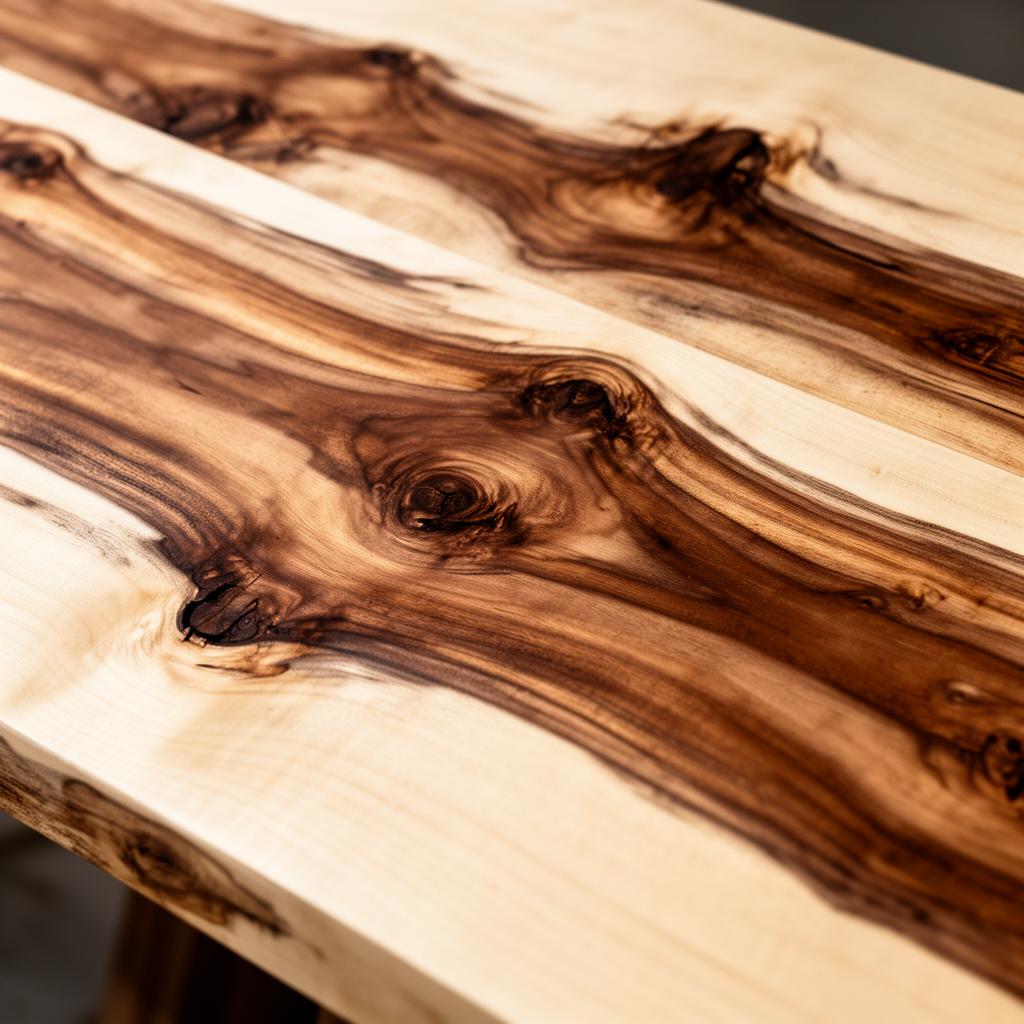
Dramatic creamy white sap to reddish-brown heart with knots
Grain
Bold, open, often wavy, with mineral streaks and tight knots
About Rustic Hickory
Rustic hickory (Carya ovata, character grade) is the same species as standard hickory — but instead of selecting clean, uniform boards, the rustic grade celebrates the wood's natural variation. Expect dramatic contrast between creamy white sapwood and deep reddish-brown heartwood, prominent knots (sound and tight), mineral streaks, and occasional bark inclusions. Every door tells a different story, which is exactly the point.
Hickory in any grade is the hardest commercial domestic hardwood, with a Janka hardness of 1,820 lbf — roughly 25% harder than hard maple and 40% harder than red oak. That makes it functionally bulletproof for kitchen cabinets. Doors and drawer fronts shrug off impacts that would visibly dent maple or oak. For families with kids, dogs, or active cooking households, hickory is the most damage-tolerant wood you can specify.
The aesthetic is unmistakable: warm, rustic, and unapologetically Americana. Rustic hickory is the defining wood of Aspen ski lodges, Tahoe mountain houses, Texas hill-country ranches, and the contemporary farmhouse trend that swept American interiors after 2015. In NYC it works particularly well in Catskills weekend houses, Hamptons farmhouses, and Brooklyn brownstones aiming for warmth against industrial counters.
Working with rustic hickory requires planning. The wood is dense, hard on tooling, and prone to splitting if pre-drilled inadequately — we specify sharper bits and slower feed rates than for maple work. Color sorting takes longer because the goal is intentional variation, not consistency. Expect 10-15% more fabrication time than for clean-grade material, which we factor into pricing.
Cost-wise, rustic hickory typically runs 10-15% less than clean-grade hickory because more of the log is usable when knots and color variation are features, not defects. In the NYC market, rustic hickory runs roughly $9-$11/board foot — comparable to red oak. That makes it the most cost-effective way to get a true farmhouse-character wood without the price tag of walnut or cherry.
Finish to enhance the natural variation: hardwax oils, satin conversion varnishes, and amber shellacs all let the heartwood-sapwood contrast and grain figure read clearly. Avoid heavy pigment stains that flatten the variation — if you wanted uniform color you should have specified clean-grade. For a more refined take, a thin clear coat over raw hickory delivers maximum character with minimal sheen.
Close-up of rustic hickory grain — bold, open, often wavy, with mineral streaks and tight knots.
The Honest Tradeoffs
What we love
- Hardest domestic cabinet wood — Janka 1,820 lbf
- Distinctive farmhouse and mountain-modern character
- More affordable than clean-grade hickory (10-15% less)
- Hides dents, scratches, and dings exceptionally well
What to watch for
- Strong visual character not for minimalist kitchens
- Hard on tooling — slightly higher labor cost
- Less dimensionally stable than oak or maple in humidity swings
- Requires intentional color sorting to balance panels
Common Uses
- •Farmhouse kitchens
- •Mountain modern
- •Lodge-style cabinetry
- •Heavy-use family kitchens
- •Mudroom built-ins
Best Finishes
- •Clear hardwax oil
- •Satin conversion varnish
- •Amber shellac
- •Light natural stain
Door Styles That Suit It
- •Shaker
- •Raised panel
- •Beaded inset
- •Plank-style slab
Rustic Hickory Cabinet FAQs — Knots, Color Range & Care
6 questions
- What's the difference between rustic and clean-grade hickory?
- Same species, different selection. Clean-grade hickory is sorted to minimize knots and color variation for a more uniform look. Rustic (or character) grade celebrates knots, mineral streaks, and dramatic heartwood-sapwood contrast. Rustic actually costs 10-15% less because more of the log is usable.
- Is hickory really the hardest domestic cabinet wood?
- Yes. Hickory's Janka hardness of 1,820 lbf is the highest of any commercially harvested North American hardwood used in cabinetry — roughly 25% harder than hard maple, 40% harder than red oak, and 80% harder than walnut. For high-impact use, nothing else comes close.
- Does rustic hickory work outside of farmhouse style?
- Yes — it's increasingly popular in mountain modern and transitional kitchens that want warmth and character without going full farmhouse. Pair with concrete or quartz counters and matte black hardware to dial back the rustic feel. It's a tougher sell for pure minimalist or contemporary kitchens.
- How much do rustic hickory cabinets cost in NYC?
- Rustic hickory runs roughly $9-$11/board foot in the NYC market, which is comparable to red oak and about 30% less than walnut. For a typical 30-linear-foot kitchen, expect rustic hickory to cost $2,000-$3,000 less than clean-grade hickory and roughly $4,000-$6,000 less than walnut of equivalent construction.
- Will the heartwood-sapwood contrast bother me over time?
- If contrast is a concern, rustic hickory is the wrong choice — that contrast is the entire aesthetic. Both heartwood and sapwood will mellow slightly with UV exposure, but the dramatic difference between them is permanent. Clients who love rustic hickory after install almost always cite the contrast as their favorite feature.
- Does rustic hickory hold up in humid kitchens?
- Reasonably well — better than walnut, not as well as white oak. Hickory is dense and strong but not exceptionally dimensionally stable. For NYC kitchens we recommend a quality conversion varnish or hardwax oil topcoat and running the HVAC during humidity peaks. Avoid raw hickory next to dishwashers or sinks without splash guards.
Rustic Hickory Comparisons
Choosing between species or cuts? These head-to-head guides break down grain, cost, durability, and best use.
Start a project
Let’s measure your room.
Tell us about the space and we’ll book a free in-home consultation. We bring the samples.
By appointment only in Brooklyn, Manhattan, Queens and Staten Island.