5 Best Cabinet Woodwork Styles for Brooklyn Kitchens
Shaker, flat-panel, inset, two-tone, or reclaimed: the cabinet woodwork style chosen for a Brooklyn kitchen determines function, durability, and value for decades. Here is how the five best styles compare.
By Green Cabinets NY Team
Key Takeaways
- Custom kitchen cabinets in Brooklyn range from $200 to $1,500 per linear foot installed, depending on style, wood species, and construction method.
- 61% of homeowners rank sustainability among their top three renovation priorities, making material choice an environmental decision that addresses 9.8 million tons of cabinets reaching US landfills annually.
- The US millwork industry projects $36.1 billion in revenue for 2026 with a -2.6% CAGR, signaling consolidation toward fewer, better-built investments.
- Cabinet woodwork style determines how doors swing, drawers bear weight, and the kitchen ages over twenty years in Brooklyn's pre-war buildings with uneven floors and high humidity.
Picture a Boerum Hill kitchen on a Sunday morning: pale winter light coming through a garden-level window, a wide-plank white oak island anchoring the room, inset cabinet doors with their barely-there reveals sitting flush against painted plaster walls. Nothing shouts. Everything fits. That kind of effortless coherence does not happen by accident. It is the result of a deliberate cabinet woodwork decision made months before the first board was cut. Brooklyn kitchens, whether they live in a landmarked rowhouse or a Williamsburg new-build, rise or fall on that single early choice.
The US millwork industry projects $36.1 billion in revenue for 2026, with a declining five-year CAGR of -2.6% according to IBISWorld's Millwork Industry Analysis. That contraction signals consolidation: homeowners are spending more per project but choosing fewer, better-built investments. Custom kitchen cabinets in Brooklyn typically range from $200 to $1,500 per linear foot installed, depending on style, wood species, and construction method. 61% of homeowners rank sustainability among their top three renovation priorities, per Conestoga Wood Specialties' Eco-Friendly Cabinetry Guide. 9.8 million tons of old cabinets reach US landfills annually, making material choice an environmental decision, not just an aesthetic one. Green Cabinets NY approaches every build with these realities in mind, crafting cabinetry that solves space problems, withstands NYC humidity, and earns its place in a home for decades.
Why Cabinet Woodwork Style Defines Your Kitchen
Cabinet woodwork is not a surface decision. It is the structural and aesthetic backbone of a kitchen, determining how doors swing, how drawers bear weight, how light interacts with surfaces, and how the room ages over twenty years of daily use. In Brooklyn, where pre-war brownstones have uneven floors, co-op buildings have tight service elevators, and humidity swings from soggy Augusts to radiator-dry Januaries, the woodwork style chosen dictates whether a kitchen feels inevitable or improvised.
Consider what happens when a homeowner selects flat-panel slab doors for a garden-level apartment with limited natural light. The clean lines look striking in a showroom. In a dim Brooklyn kitchen, those same flat surfaces reflect nothing, absorb shadows, and can read as cold and institutional. Shaker-style cabinet woodwork, with its recessed center panel, introduces shadow lines that add visual depth and warmth even under suboptimal lighting. The style choice interacts with the architecture in ways that renderings rarely capture.
Then there is the functional dimension. Inset cabinet woodwork, where doors sit flush within the face frame, requires tolerances measured in fractions of millimeters. When executed properly, the result is furniture-grade joinery that can outlast the building itself. When executed poorly, seasonal humidity causes inset doors to stick in summer and gap in winter. The difference between heirloom and headache is not the style. It is the craft behind it.
Brooklyn's custom cabinet market in 2026 is driven by two forces: maximizing storage in small, awkwardly shaped kitchens, and optimizing workflow for how people actually cook. Firms like Urban Homecraft emphasize in-house craftsmanship and finishing as their core value proposition. Green Cabinets NY shares that philosophy. If a design does not solve a fundamental space problem, it is a non-starter. The woodwork style is the vehicle for that solution, not the destination.
The recurring debate on platforms like Houzz centers on whether semi-custom lines like KraftMaid can match true custom cabinetry. The answer depends entirely on the woodwork style and the space. Semi-custom cabinets work well for standard galley kitchens with plumb walls and regular dimensions. Brooklyn rarely offers those conditions. When walls are out of square by an inch and a half over ten feet, when a structural column interrupts a run of uppers, when a radiator pipe chase eats into a corner base cabinet, only custom woodwork adapts to the building rather than forcing the building to adapt to the cabinet.
How We Ranked These Woodwork Styles
The ranking methodology prioritizes five criteria grounded in what Brooklyn homeowners actually experience, not what looks best in a catalog.
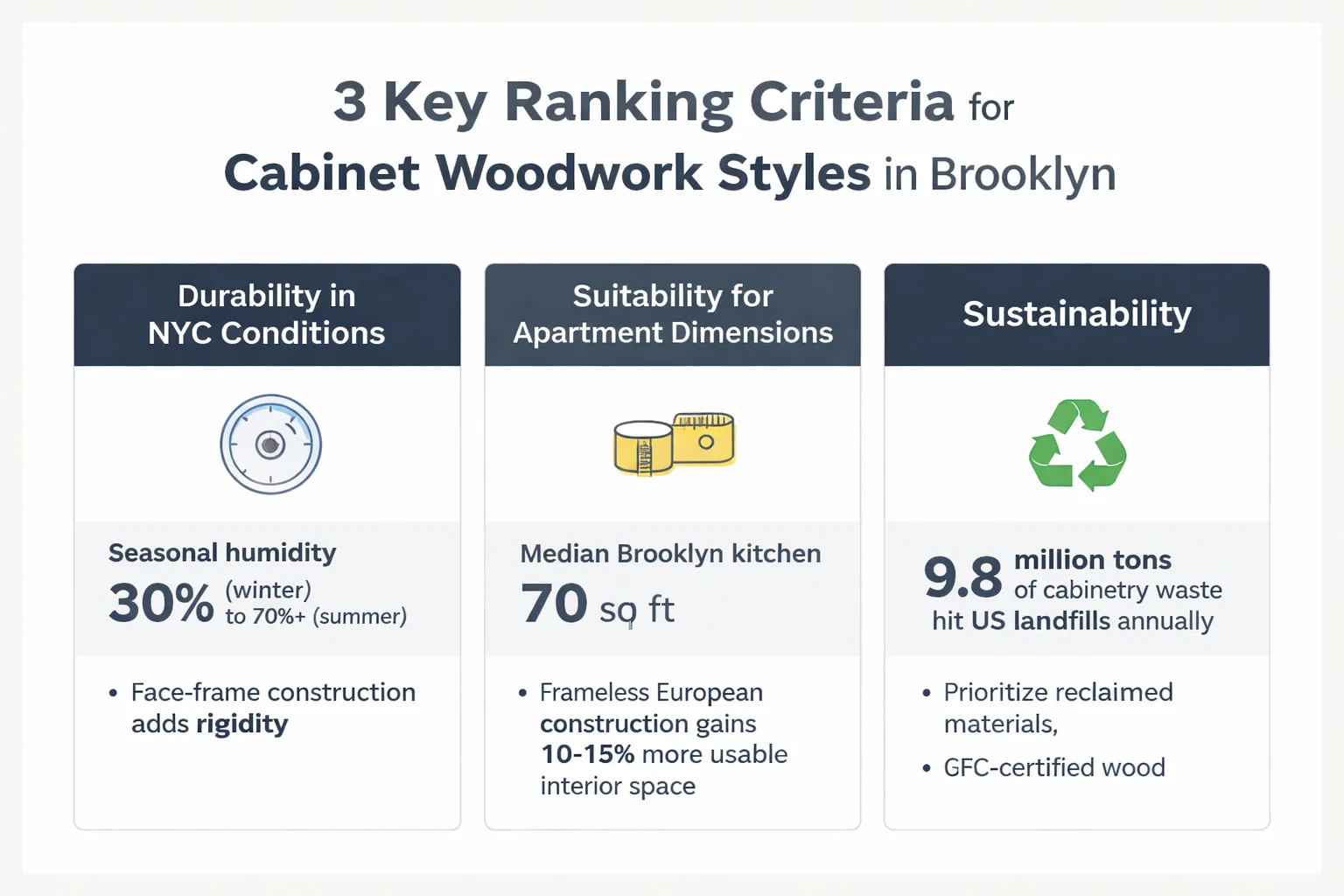
Durability in NYC conditions. Seasonal humidity in Brooklyn ranges from 30% relative humidity in winter (with radiators running) to 70%+ in summer. Wood species and construction methods must accommodate that swing without warping, cracking, or finish failure. Face-frame construction adds rigidity that matters in older buildings where floors settle and walls shift.
Suitability for apartment dimensions. The median Brooklyn kitchen is under 70 square feet. Cabinet woodwork styles that maximize interior storage volume relative to exterior footprint score higher. Frameless European construction earns marks here because it eliminates the face frame and gains 10-15% more usable interior space per cabinet.
Sustainability. With 9.8 million tons of cabinetry waste hitting US landfills annually, styles that support reclaimed materials, FSC-certified hardwoods, or bamboo construction score higher. The environmental cost of a kitchen renovation is not hypothetical. It is measurable.
Design versatility. A style that works in a Crown Heights brownstone, a DUMBO loft, and a Midwood semi-attached home earns a higher rank than one that only suits a single architectural context. Versatility also means the style can adapt to different hardware, countertop materials, and finish trends without looking dated in five years.
Client demand at Green Cabinets NY. This is not a theoretical ranking. It reflects what Brooklyn homeowners actually request, what developers specify for multi-unit projects, and what design-build architects recommend after walking a space. Styles that consistently solve real problems for real clients rank higher than styles that win design awards but fail in daily use.
How do cabinet woodwork styles compare?
| Style | Wood Species | Finish Options | Cost Range (per linear foot, installed) | Ideal Kitchen Type |
| Shaker | Maple, oak, cherry, paint-grade maple | Paint, stain, natural | $200–$800 | Brownstones, co-ops, transitional spaces |
| Flat Panel (Slab) | Wood veneer, walnut, lacquer | High-gloss, matte, natural | $400–$1,200+ | Contemporary condos, new construction |
| Inset | Cherry, maple, oak, walnut | Paint, stain, natural | $800–$1,500 | Historic townhouses, luxury renovations |
| Two-Tone | Mixed species and finishes | Paint + stain combinations | $600–$1,000 | Style-forward kitchens, designer-led projects |
| Reclaimed & Sustainable | Reclaimed wood, bamboo, FSC hardwoods | Natural, clear coat, stain | $300–$1,200 | Eco-conscious homes, LEED projects |
Pricing varies based on wood species selection, finish complexity, hardware integration, and the degree of customization required. The ranges above reflect Brooklyn market rates for 2026 and include installation by a licensed custom builder like Green Cabinets NY.
For homeowners researching custom kitchen cabinets cost, the style choice is the single biggest price driver after wood species. Inset construction can cost two to three times more than overlay construction in the same wood, simply because of the labor required to achieve flush tolerances.
1. Shaker Style Cabinet Woodwork. Best for Brooklyn brownstones and co-ops
Best for: Brooklyn homeowners renovating pre-war brownstones or co-ops who want a timeless, versatile cabinet woodwork style that complements both vintage architecture and modern appliances.
Shaker is the most enduringly popular cabinet woodwork style in Brooklyn kitchens, and the reasons are structural as much as aesthetic. The five-piece door frame with a recessed center panel creates shadow lines that add visual depth without ornamentation. That restraint lets Shaker cabinetry sit comfortably in an 1890s rowhouse with original plaster moldings and in a 2019 condo with integrated appliances. Few styles span that range.
Key features: - Five-piece door frame with recessed center panel for timeless visual depth. Compatible with neutral color schemes and natural wood species like maple, oak, and cherry. Works seamlessly with both modern hardware (matte black, brushed nickel) and traditional brass pulls. Highly adaptable to Brooklyn brownstone layouts and open-concept floor plans
Pricing: Custom Shaker cabinets in Brooklyn typically start around $500–$800 per linear foot installed; semi-custom options begin near $200–$350 per linear foot depending on wood species and finish.
The honest assessment: Shaker is not the right choice for homeowners seeking a dramatic, statement-making kitchen. It is deliberately quiet. Recessed panel grooves also collect grease and dust more readily than flat-panel surfaces, requiring more detailed cleaning. But for the majority of Brooklyn renovations, where the goal is a kitchen that looks as good in year fifteen as it does in year one, Shaker remains the safest and most versatile bet. Shaker-style cabinet woodwork accounts for the majority of custom kitchen cabinet requests from Brooklyn homeowners, and that demand is not accidental. It reflects a style that solves problems across architectural contexts.
Green Cabinets NY recommends Shaker for first-time renovators who want a kitchen that will survive multiple design trend cycles without looking dated. Pair it with a white oak island for warmth, or paint it a soft sage green for a contemporary edge that still reads as classic.
2. Flat Panel (Slab) Modern Cabinet Woodwork. Best for contemporary condos and new construction
Best for: Design-forward Brooklyn condo and new-construction homeowners seeking a contemporary, minimalist kitchen aesthetic with maximum storage efficiency.
Flat-panel slab cabinet woodwork is the dominant style in Brooklyn's new-construction market, and the reasons go beyond aesthetics. The frameless European-style box construction that typically accompanies slab doors maximizes interior storage volume by eliminating the face frame. In a 60-square-foot kitchen where every cubic inch matters, that 10-15% storage gain is the difference between a functional kitchen and a frustrating one.
Key features: - Flat, unadorned door fronts in wood veneer, lacquer, or high-gloss finishes for a streamlined look. Frameless (full-access) European-style box construction maximizes interior storage space. Pairs naturally with quartz countertops, integrated appliances, and handleless push-to-open hardware. Available in darker tones like walnut, ebony, and matte black popular in urban NYC settings
Pricing: Flat-panel custom cabinets start around $400–$700 per linear foot installed in Brooklyn; European frameless construction versions can range up to $1,200+ per linear foot for high-gloss or lacquered finishes.
The trade-off is maintenance. High-gloss and dark matte finishes show fingerprints, smudges, and water spots with punishing visibility. A kitchen that looks pristine in a photograph requires near-daily wiping in real life. Flat-panel slab woodwork also lacks the architectural warmth of Shaker or inset styles, which can make smaller Brooklyn kitchens feel sterile rather than serene. For homeowners who prioritize clean lines and storage efficiency above all else, these trade-offs are acceptable. For those who want a kitchen that feels like a living space rather than a laboratory, the style can underdeliver.
Green Cabinets NY often recommends flat-panel woodwork for clients in new-construction buildings where the architecture already leans contemporary. The style should match the shell, not fight it. For those considering integrated appliances, explore appliance panel integration to maintain visual continuity.
3. Inset Cabinet Woodwork — Best for luxury townhouse renovations

Best for: Luxury renovation clients and Brooklyn developers restoring historic townhouses or Park Slope brownstones who want furniture-quality cabinetry as a long-term investment.
Inset cabinet woodwork is the highest expression of the cabinetmaker's craft. Doors and drawer fronts sit flush within the face frame, requiring tolerances so tight that a sheet of paper barely fits between the door edge and the frame. The result is a seamless, built-in furniture appearance that reads as permanent architecture rather than installed cabinetry. There is no overlay, no visible gap, no compromise.
Key features: - Doors and drawer fronts set flush within the face frame for a seamless, built-in furniture appearance. Requires precision craftsmanship and tight tolerances, making it a hallmark of high-end custom millwork. Pairs beautifully with exposed hinges (like traditional butt hinges) for an authentic period look. Highly durable face-frame construction adds structural rigidity ideal for older Brooklyn buildings
Pricing: Inset custom cabinets are among the most expensive woodwork styles, typically starting at $800–$1,500 per linear foot installed in Brooklyn due to the precision joinery required.
The limitation is real and worth stating plainly. Wood expands and contracts with humidity changes. Inset doors that fit perfectly in January may stick in August when Brooklyn humidity peaks. A skilled cabinetmaker accounts for this by calculating seasonal movement into the tolerances, but there is always a trade-off between gap size and seasonal function. This is not a flaw in the style. It is the nature of wood. Homeowners who choose inset should understand that they are investing in a living material that responds to its environment.
Inset cabinet woodwork can cost two to three times more than overlay construction in the same wood species, and that premium buys craftsmanship, not just aesthetics. For Brooklyn developers restoring historic townhouses, the investment is justified because inset cabinetry signals quality to buyers and appraisers. For homeowners on a tighter budget, the same visual effect can be approximated with tight-overlay Shaker doors at a fraction of the cost.
Green Cabinets NY approaches inset projects with particular attention to wood species selection and moisture content at the time of construction. Dovetail drawer boxes are standard on inset builds because the joinery quality must be consistent throughout.
4. Two-Tone Cabinet Woodwork. Best for style-conscious homeowners and designers

Best for: Style-conscious Brooklyn homeowners and interior designers who want a personalized, on-trend kitchen that stands out while still feeling cohesive and timeless.
Two-tone cabinet woodwork is not a construction method. It is a design strategy that combines two contrasting colors or materials, typically dark lowers with light uppers, to add depth and visual dynamism. The approach has gained significant traction in Brooklyn because it solves a specific problem: making small kitchens feel larger without sacrificing personality. Light upper cabinets reflect light and create a sense of airiness, while dark lowers anchor the room and hide scuff marks from daily use.
Key features: - Combines dark lower cabinets with lighter upper cabinets for a stylish, layered contrast. Popular pairings include navy with white, olive green with warm walnut, or charcoal with white oak. Allows mixing of woodwork styles (e.g., flat-panel lowers with Shaker uppers) for a transitional look. Adds perceived height and spatial depth. Especially valuable in smaller Brooklyn apartment kitchens
Pricing: Two-tone custom cabinet projects in Brooklyn generally start at $600–$1,000 per linear foot installed, with pricing varying based on the wood species, finish combinations, and degree of customization chosen.
The risk with two-tone woodwork is coherence. Two colors do not automatically create depth. They can create visual noise if the pairing is arbitrary. The most successful two-tone kitchens in Brooklyn share a common thread: the two tones relate to each other through undertone, material, or architectural context. Navy lowers and white uppers work because both are cool-toned and paint-grade. Charcoal lowers and white oak uppers work because the wood grain warms the charcoal's coolness. Random pairings fail.
Green Cabinets NY guides clients through two-tone decisions by starting with the fixed elements: countertop stone, flooring, wall color, and appliance finishes. The cabinet tones should respond to those elements, not dictate them. For small kitchens specifically, review strategies for renovating without losing storage before committing to a two-tone scheme that might reduce cabinet count.
5. Reclaimed and Sustainable Wood Cabinet Woodwork. Best for eco-conscious homeowners and LEED projects

Best for: Environmentally conscious Brooklyn homeowners, developers pursuing LEED certification, and design clients who want one-of-a-kind custom kitchen cabinets with authentic, organic character.
Reclaimed and sustainable wood cabinet woodwork is the fastest-growing segment in Brooklyn's custom cabinetry market, driven by a convergence of environmental awareness and aesthetic preference. 61% of homeowners rank sustainability among their top three renovation priorities, and reclaimed wood delivers on that value with material that has a story. Each board carries grain patterns, knots, and character marks that cannot be replicated in new lumber. The result is a kitchen that feels rooted and specific rather than generic.
Key features: - Uses reclaimed wood, bamboo, or recycled materials to reduce environmental impact and carbon footprint. Each cabinet features unique grain patterns, knots, and character marks that cannot be replicated. Compatible with transitional design styles. Pairs naturally with brass fixtures and stone countertops. Aligns with NYC green building standards and appeals to Brooklyn's eco-conscious homeowner demographic
Pricing: Reclaimed and sustainable wood custom cabinets in Brooklyn typically start at $700–$1,200 per linear foot installed; bamboo cabinet options can be more affordable, starting near $300–$500 per linear foot.
The practical challenge with reclaimed wood is consistency. Reclaimed lumber varies in density, moisture content, and dimensional stability. A board salvaged from a 1920s warehouse beam behaves differently than one rescued from a 1950s schoolhouse gymnasium floor. Expert millwork is essential to mill, dry, and stabilize reclaimed material before it enters a kitchen. Sufficient matching material for a large kitchen can extend project timelines by weeks or months, and that timeline should be factored into the renovation schedule from the start.
Bamboo offers a more affordable and consistent alternative for eco-conscious homeowners who want sustainability without the sourcing complexity. It grows to harvest maturity in five to seven years versus decades for hardwood, and it performs well in NYC humidity when properly sealed. Green Cabinets NY works with both materials and helps clients weigh the trade-offs between character (reclaimed) and consistency (bamboo).
For developers considering sustainable cabinetry at scale, commercial millwork expertise becomes essential. Multi-unit projects require material sourcing strategies that single-home renovations do not.
Which cabinet woodwork style fits your Brooklyn kitchen's architecture, lifestyle, and budget?
Which Cabinet Woodwork Style Lasts Longest in NYC Humidity?
NYC humidity swings from 30% relative humidity in radiator-heated winters to 70%+ in summer. That 40-point swing tests every cabinet in every Brooklyn kitchen. The data from two decades of custom cabinet woodwork in NYC points to one clear answer: face-frame construction in quartersawn oak or cherry with a conversion varnish finish outperforms everything else.
Face-frame construction adds structural rigidity that helps cabinets resist racking when buildings settle. Quartersawn lumber expands and contracts primarily in thickness rather than width, which means door panels move less across their visible face. Conversion varnish (a catalyzed finish) cures harder than standard lacquer and resists humidity penetration more effectively.
Inset cabinet woodwork, paradoxically, is both the most vulnerable and the most durable style. It is vulnerable because flush tolerances leave no room for seasonal movement without visible gaps or sticking. It is durable because the craftsmanship required to build it properly means the underlying construction is usually superior. The style does not fail. Poor execution of the style fails.
For homeowners who want maximum durability without inset pricing, Shaker-style cabinet woodwork in quartersawn white oak with a natural oil-and-varnish finish is the sweet spot. The recessed panel hides seasonal movement better than a flat slab, and the face-frame construction adds rigidity. Green Cabinets NY has installed this configuration in Brooklyn kitchens that still look new after fifteen years of daily use.
Can You Mix Cabinet Woodwork Styles in One Kitchen?
Yes, and the best Brooklyn kitchens often do. Mixing woodwork styles is not a compromise. It is a design strategy that adds depth and functionality when executed with intention.
The most successful mixing pattern in Brooklyn kitchens pairs Shaker uppers with flat-panel lowers. The Shaker doors on upper cabinets add shadow lines and visual interest at eye level, while the flat-panel lowers create a clean, unbroken base that anchors the room. This combination works because the two styles share a common geometric language: straight lines, right angles, no curved profiles.
Two-tone woodwork is inherently a mixing strategy. It can involve mixing colors on the same style (navy Shaker lowers with white Shaker uppers) or mixing both color and style (flat-panel walnut lowers with painted Shaker uppers). The principle is the same: the mix should feel deliberate, not accidental. One element should dominate. The other should accent.
The mistake to avoid: mixing more than two styles in a single kitchen. A kitchen with Shaker uppers, flat-panel lowers, inset glass-front display cabinets, and open shelving in a third wood species has no hierarchy. It reads as indecision rather than design. Green Cabinets NY recommends choosing one primary style for 70-80% of the cabinetry and one secondary style for the remaining 20-30%, typically in a feature area like an island or a pantry wall.
What Does Custom Cabinet Woodwork Actually Cost in Brooklyn?
The cost of custom kitchen cabinets in Brooklyn spans a wide range because the inputs vary dramatically. A simple Shaker kitchen in paint-grade maple with semi-custom construction might run $200-$350 per linear foot. An inset kitchen in quartersawn white oak with custom finishing and integrated hardware can exceed $1,500 per linear foot. The style, wood species, construction method, finish, and hardware all compound.
For a typical Brooklyn kitchen of 15-20 linear feet of cabinetry, the budget ranges look like this:
- Entry-level semi-custom Shaker: $3,000-$7,000 (materials and installation) - Mid-range custom Shaker or flat-panel: $7,500-$16,000 - High-end custom inset or two-tone: $12,000-$30,000+ - Reclaimed or sustainable custom: $10,500-$24,000+
These are 2026 Brooklyn market rates. They include materials, fabrication, finishing, delivery, and installation by a licensed contractor. They do not include countertops, plumbing, electrical, or demolition.
The value calculation should account for lifespan. Custom cabinet woodwork that lasts 25-30 years costs less per year of service than semi-custom cabinetry replaced every 12-15 years. The US millwork industry is projected to decline 0.4% in 2026, per IBISWorld, which means manufacturers are consolidating and semi-custom quality may erode as competition decreases. Custom builders like Green Cabinets NY maintain quality control because the work is done in-house, not outsourced to a factory line.
How Long Does Custom Cabinet Woodwork Take to Install?
The timeline for custom cabinet woodwork in Brooklyn runs 10-16 weeks from signed contract to final installation. That breaks down into roughly four phases.
Design and engineering takes 2-4 weeks. This includes field measurements, shop drawings, wood species selection, finish sampling, and hardware specification. In Brooklyn co-ops, this phase also includes board approval submissions, which can add 2-6 weeks depending on the building's review cycle.
Material sourcing and milling takes 3-5 weeks. Reclaimed wood projects can extend to 8-10 weeks if matching material is scarce. Green Cabinets NY sources materials concurrently with design finalization to compress this phase where possible.
Fabrication and finishing takes 3-4 weeks. This is where the cabinet woodwork style matters: inset construction requires more shop time than overlay construction because tolerances are tighter and adjustments are made by hand.
Installation takes 1-2 weeks for a typical Brooklyn kitchen. In co-op buildings with limited elevator access and restricted work hours, installation can stretch to 2-3 weeks. Permit approvals in some NYC jurisdictions can take up to 6 months, and those delays ripple through procurement and construction sequencing. A seemingly minor issue like a non-standard cabinet dimension can cascade into major project overruns when dealing with tight NYC layouts.
Making the Right Woodwork Choice for Your Brooklyn Kitchen
The decision framework is straightforward. Start with the architecture, then layer in lifestyle, then let budget resolve the remaining options.
Architecture first. A landmarked Park Slope brownstone with original moldings, high ceilings, and plaster walls calls for inset or Shaker cabinet woodwork. A Williamsburg loft with concrete floors and exposed ductwork calls for flat-panel slab or two-tone. The cabinet style should respond to the room's existing architectural vocabulary, not impose a foreign one.
Lifestyle second. A household that cooks daily with heavy pots and pans needs durable finishes and robust drawer construction. A household that primarily orders takeout and uses the kitchen for entertaining can prioritize aesthetics over industrial-grade durability. Families with young children should avoid high-gloss finishes that show fingerprints. Pet owners should consider the height of lower cabinets relative to feeding stations.
Budget third. Budget is not the starting point. It is the filter that resolves the shortlist. If the architecture calls for inset and the budget allows only semi-custom Shaker, the answer is tight-overlay Shaker in a species and finish that approximates the inset look. The style is a compromise. The quality does not have to be.
Green Cabinets NY works with homeowners and developers across Brooklyn and the wider NYC area to navigate these decisions. The process starts with a site visit to assess the space, understand the architectural context, and identify the functional problems the cabinetry needs to solve. From there, the woodwork style emerges naturally from the constraints of the project rather than being imposed on it.
For homeowners also planning bathroom renovations, the same woodwork principles apply. Sustainable bathroom vanity options can extend the design language of the kitchen into adjacent spaces, creating cohesion without repetition.
The contrarian take worth stating: the trend toward smart kitchen features, integrated lighting, and app-controlled hardware is accelerating in Brooklyn, but the cabinet woodwork industry is silent on the 5-10 year lifecycle of these technologies. Custom-built environments are not smartphones. When an integrated lighting strip fails in year seven, repairing it requires disassembling custom cabinetry. Green Cabinets NY addresses this by designing tech integrations that are serviceable: LED channels that can be accessed without removing door fronts, docking stations that can be swapped without re-milling panels. The woodwork should outlast the technology it houses, not the other way around.
FAQ: Cabinet Woodwork in NYC Kitchens
What wood species lasts longest in NYC humidity?
Quartersawn white oak and cherry are the most stable wood species for NYC's humidity swings. Quartersawn lumber expands primarily in thickness rather than width, which minimizes visible door panel movement. Cherry darkens beautifully with age and develops a rich patina that masks minor wear. Both species accept conversion varnish finishes that cure harder than standard lacquer and resist moisture penetration. Maple is durable but prone to blotching when stained, requiring significant extra prep work that can add cost to the project.
Can I mix cabinet woodwork styles in one kitchen?
Yes, mixing styles is a legitimate design strategy when done with intention. The most successful pattern pairs Shaker uppers with flat-panel lowers, creating visual interest at eye level while maintaining a clean base. Limit the mix to two styles maximum. One style should cover 70-80% of the cabinetry. The secondary style should appear in a feature area like an island or pantry wall. Mixing more than two styles creates visual noise without hierarchy.
How long does custom cabinet woodwork take to install in Brooklyn?
Expect 10-16 weeks from signed contract to final installation. Design and engineering take 2-4 weeks. Material sourcing takes 3-5 weeks (longer for reclaimed wood). Fabrication and finishing take 3-4 weeks. Installation takes 1-2 weeks. Co-op board approval can add 2-6 weeks. NYC permit approvals can take up to 6 months in some jurisdictions. Inset construction requires more shop time than overlay due to tighter tolerances.
Is semi-custom cabinetry a viable alternative to custom in Brooklyn?
Semi-custom cabinetry works in kitchens with standard dimensions, plumb walls, and no structural interruptions. Brooklyn rarely offers those conditions. When walls are out of square, when structural columns interrupt cabinet runs, when radiator pipes eat into corner bases, only custom woodwork adapts to the building. Semi-custom is a cost-effective choice for straightforward galley kitchens in newer construction. For pre-war brownstones and irregular layouts, custom is the better investment.
What is the most sustainable cabinet woodwork option?
Bamboo is the most affordable sustainable option, starting near $300-$500 per linear foot. It grows to harvest maturity in 5-7 years and performs well in NYC humidity when properly sealed. Reclaimed wood offers superior character and environmental credentials but costs $700-$1,200 per linear foot and requires expert milling to handle variable density and moisture content. FSC-certified hardwoods split the difference, offering verified sustainability with more consistent material properties.
Should I choose painted or stained cabinet woodwork?
Painted cabinetry offers color flexibility and works well with Shaker and inset styles. Stained cabinetry showcases wood grain and suits flat-panel and reclaimed styles. Paint-grade maple is the most cost-effective painted option. For stained finishes, avoid hard maple unless the client is prepared for potential blotching and added prep cost. Quartersawn white oak and cherry stain predictably and beautifully. The finish choice should follow the wood species, not the other way around.
Cabinet woodwork is the decision that quietly determines whether a Brooklyn kitchen works for twenty years or frustrates the homeowner by year three. The style sets the visual tone. The construction method sets the functional ceiling. The wood species sets the durability curve. Green Cabinets NY builds cabinetry that honors all three, delivering custom kitchen cabinets that solve real Brooklyn problems: tight spaces, humidity swings, co-op logistics, and the desire for a kitchen that feels inevitable in its context. The right cabinet woodwork style is not the one that wins a design award. It is the one that makes the kitchen feel like it was always meant to be there.
Get a custom cabinet woodwork consultation with Green Cabinets NY and build a kitchen that fits your space for decades, not trends.