How to Order Custom Kitchen Cabinets Online Without the Risk
Ordering custom kitchen cabinets online can save you money and expand your options, but only if you know how to vet suppliers, lock down specs, and avoid the five most common pitfalls that plague NYC buyers.
How to Order Custom Kitchen Cabinets Online Without the Risk
By Green Cabinets NY Team
Key Takeaways
- Demand written specs, sample policies, and transparent lead times from online custom cabinet vendors to ensure you receive exactly what you paid for.
- Upload measurements and configure your layout online to receive same-day pricing instead of waiting two weeks for showroom quotes.
- Verify that out-of-state vendors account for Brooklyn and NYC pre-war layouts, tight doorways, and elevator restrictions before ordering.
- Lock down all specs on unlimited custom sizing and configurations to prevent project failures caused by wood species, finish complexity, or box construction variations.
Ordering custom kitchen cabinets online is actually safer than walking into a showroom. If you know the process. That might sound backwards. Showrooms feel reassuring: you touch the wood, you meet a designer, you trust the handshake. But showrooms also carry enormous overhead that gets baked into your quote, and their sales staff are incentivized to upsell, not to match your actual needs. Online custom cabinet vendors, by contrast, live or die by documentation, written specs, and reviewable track records. Transparency isn't optional for them. It's the entire business model.
The custom kitchen cabinets online market rewards buyers who demand written specs, sample policies, and transparent lead times. Research from Kitchen Search confirms that custom cabinetry pricing varies dramatically based on wood species, finish complexity, and box construction, making documentation the single best predictor of whether you'll get what you paid for. MasterBrand's comparison of stock versus custom cabinetry notes that custom options offer unlimited sizing and configuration, but that freedom also means more ways for a project to go sideways if specs aren't locked down. Brooklyn and NYC buyers face an added layer of risk: pre-war layouts, tight doorways, and elevator restrictions that online vendors in other states don't account for by default.
Why NYC Homeowners Are Searching for Cabinets Online
Brooklyn renovators have figured out something the rest of the country is still catching up to. The old model, where you visit three showrooms in Manhattan and Queens, sit through design consultations, and wait two weeks for a quote, is slow and expensive. Online cabinet ordering compresses that timeline. You upload measurements, configure your layout in a browser, and get pricing the same day. For a city where every hour of contractor time costs money, that efficiency matters.
The appeal breaks down into three drivers. Convenience is obvious. A homeowner in Park Slope can compare wood species, finishes, and hardware options at midnight without booking a sitter. Price transparency is the second draw. Online vendors publish base pricing per linear foot, and the math is visible before you commit to a conversation. A showroom quote, by contrast, arrives as a single number with no breakdown, and you're left guessing whether the upcharge is for the dovetail joinery or the salesperson's commission.
Selection is the third factor. Online catalogs show hundreds of door styles, finish options, and organizational accessories in one place. A physical showroom displays maybe thirty. For homeowners who want to see the full range of semi-custom kitchen cabinets before deciding, the internet wins on breadth alone.
But here's the friction. The same transparency that makes online ordering appealing also exposes its weaknesses. When you buy from a distant vendor, you absorb the shipping risk, the measurement risk, and the installation risk. A showroom in Brooklyn can send someone to your apartment to verify that your 1920s doorway will actually accommodate a 36-inch base cabinet. An online vendor in Ohio cannot. The convenience of browsing from your couch is real. So is the cost of getting it wrong.
The data shows the pattern clearly. Kitchen Search's 2026 cost analysis breaks down how custom kitchen cabinets cost anywhere from $500 to $1,200 per linear foot depending on specifications, and that range is wide enough that vague online quotes are essentially meaningless without a detailed spec sheet. A vendor who won't itemize materials, construction method, and finish process is a vendor who is hiding something.
There's a generational shift underneath this trend. Brooklyn homeowners in their 30s and 40s are managing renovations alongside full-time jobs, and the ability to handle design decisions asynchronously, outside business hours, is not a luxury. It is a necessity. Online tools that let you save configurations, compare door styles side by side, and revisit your quote days later fit that lifestyle. Showroom appointments require you to block out a Saturday, travel to a location, and make decisions under pressure with a salesperson watching. The transactional comfort of online ordering is not about being lazy. It is about controlling the pace of a high-stakes purchase.
That said, the convenience ceiling is real. Online configuration tools work well for rectangular kitchens with standard appliance cutouts. They break down the moment you introduce a non-standard element: a radiator enclosure, a structural column that needs cladding, a soffit that needs to be integrated rather than ignored. The tool stops being a time-saver and becomes a source of false confidence. You configure something that looks correct on screen, approve production, and discover too late that the configuration tool assumed your walls are plumb and your corners are square. In Brooklyn brownstones built before 1940, they almost never are.
What Can Go Wrong When You Order Custom Cabinets Online
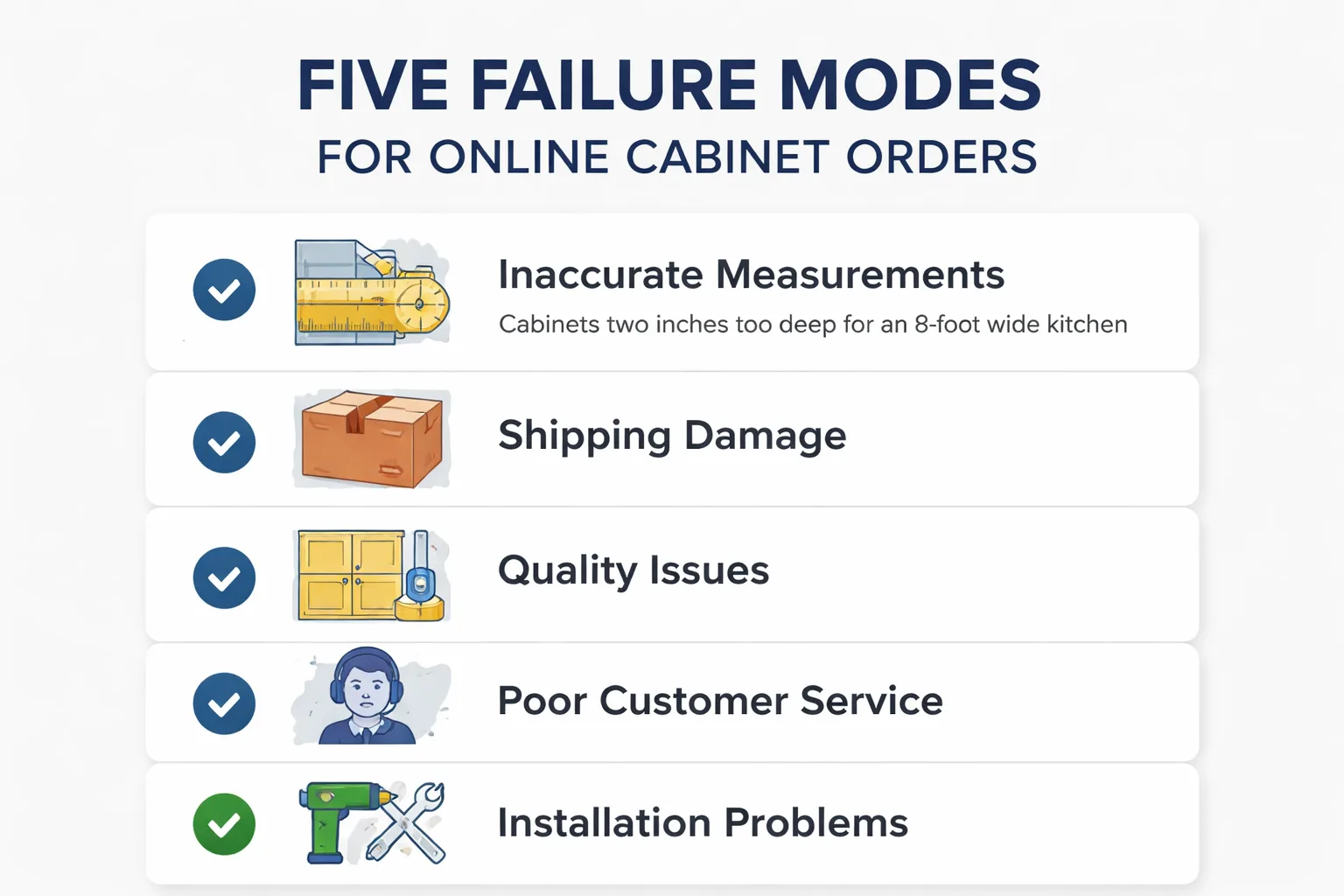
The horror stories follow predictable patterns. Here are the five failure modes that hit NYC buyers hardest.
Inaccurate measurements. This is the number one source of online cabinet disasters. A homeowner measures their kitchen, submits the numbers, and the cabinets arrive two inches too deep for the space. In a Brooklyn brownstone where the kitchen is 8 feet wide, two inches is the difference between functional and unusable. Online vendors who don't require professional measurement verification, or who don't offer a measurement review service, are setting you up for a costly mistake. The fix is to hire an independent NYC kitchen cabinet installer to measure, or to work with a vendor who includes measurement review as part of their process. Green Cabinets NY's installation service handles this locally, which eliminates the gap entirely.
The measurement problem compounds when you consider that most online tools ask for wall-to-wall dimensions but don't account for what is inside those walls. A 1920s Brooklyn kitchen has plaster over brick, sometimes with furring strips that create a wall depth variation of half an inch or more from one end of the run to the other. The online form has a field for "wall length." It does not have a field for "wall length at floor level versus counter height versus ceiling height" because in new construction those numbers are the same. In pre-war construction they can differ by three-quarters of an inch, and that difference is enough to prevent a cabinet from fitting flush.
Poor material quality masked by good photography. A walnut finish on a website looks rich and consistent. The cabinet that arrives might be poplar with a dark stain that blotches under your kitchen's recessed lighting. This is where the difference between custom and semi-custom matters most. MasterBrand's stock versus custom comparison explains that stock and semi-custom lines use standardized materials to keep costs down, while true custom cabinetry lets you specify exact wood species, grade, and cut. If your online vendor can't tell you the lumber grade of the face frames, you're buying a photograph, not a specification.
The walnut question is worth pausing on. Green Cabinets NY has documented why walnut performs better than other species for dark, textured applications. Its natural color eliminates the staining problems that plague maple and alder, and its dimensional stability means fewer issues in NYC apartments where humidity swings between seasons. For anyone ordering dark cabinets online, insisting on walnut (not "walnut finish") is the single most effective quality control you can exercise. The walnut cabinet guide breaks down what to look for in a spec sheet.
Hard maple tells a cautionary tale here. Homeowners love its pale, clean aesthetic and its reputation for durability. But hard maple is notoriously difficult to stain evenly because its dense, tight grain absorbs pigment inconsistently. What starts as a light, natural finish can develop blotchy patches that are visible only after installation, under your kitchen's specific lighting. The prep work required to prevent this (sanding sealers, gel stains, controlled drying environments) adds labor and cost that most online vendors don't build into their base pricing. The result is a cabinet that looks beautiful in the vendor's product photography and disappointing in your actual kitchen. This is a problem that a physical sample, viewed in your space under your lighting, can expose before you commit to a full order.
No local installation support. Cabinets arriving in flat-pack boxes is fine if you have a contractor lined up. It's a crisis if you don't. Online vendors typically ship to your curb and consider the transaction complete. Getting boxes up a fourth-floor walkup in Carroll Gardens, through a 29-inch apartment door, and assembled in the correct order is your problem. Some online vendors offer installation referrals, but those referrals are rarely vetted for NYC-specific building requirements like elevator reservations, COI (Certificate of Insurance) minimums, and plumbing rerouting in pre-war walls.
The installation gap also affects sequencing. In a typical NYC renovation, the cabinet installer is one of four or five trades working in the same space over a two to three week period. The plumber needs to know where the sink base goes before the cabinets arrive. The electrician needs to know where the under-cabinet lighting wires should terminate. The tile setter needs to know the cabinet depth to calculate the backsplash height. An online vendor ships boxes. They do not coordinate with your plumber, electrician, or tile setter. A local builder like Green Cabinets NY manages that sequencing because they are on site, talking to your trades, adjusting the plan when the plumber discovers a 100-year-old pipe that wasn't on any drawing.
Hidden shipping and handling costs. The quoted price per linear foot rarely includes freight, residential delivery surcharges, liftgate fees, or the white-glove service you'll need if your building doesn't have a loading dock. These add-ons can push the actual cost of custom kitchen cabinets 15 to 25 percent above the sticker price. A reputable vendor itemizes these before you commit. A questionable one reveals them at checkout.
The freight math for NYC deliveries is particularly punishing. A standard LTL (less-than-truckload) shipment to a residential address in Brooklyn incurs a residential delivery surcharge of $75 to $150. If the building lacks a loading dock and the truck needs a liftgate, add $50 to $100. If the driver won't carry boxes inside (and most won't), you need a two-person moving team for $200 to $400. If your building requires delivery before 7 AM or after 4 PM to avoid disrupting other residents, some carriers charge an appointment fee. A $10,000 cabinet order can accumulate $600 to $900 in delivery costs that were not in the original quote.
Defect resolution from a distance. When a cabinet arrives with a cracked face frame or a misaligned drawer slide, the resolution path is where online vendors separate themselves. The good ones have a clear written policy: photo documentation within 48 hours, replacement part shipped within two weeks, no restocking fee. The bad ones ask you to repackage a 60-pound cabinet and ship it back at your expense. Read the returns policy before you buy, not after something goes wrong. If the policy reads "all sales final on custom orders," walk away.
The defect timeline matters more in NYC than elsewhere because your renovation window is constrained. If you are renting a temporary apartment while your kitchen is under construction, every week of delay costs $2,500 to $4,000 in rent. A replacement part that takes two weeks to fabricate and ship is not just an inconvenience. It is $5,000 in additional living expenses that the online vendor will not reimburse. A local builder can often fabricate a replacement part in their shop within 48 hours and deliver it the same week, because the shop is in Brooklyn, not across the country.
How to Vet an Online Cabinet Supplier Before You Buy
A supplier evaluation checklist is the difference between a smooth renovation and a four-month dispute. Here is what to verify, in order of importance.
1. Ask for a material specification sheet. Not a brochure. A spec sheet. It should list the wood species, lumber grade, construction method (dovetail, mortise-and-tenon, or dowel), box material (plywood versus particleboard), hinge brand, and finish process. If the vendor can't produce this document, they are not selling custom cabinetry. They are selling a product line with a custom label. True custom builders like Urban Homecraft in Brooklyn emphasize in-house finishing and material transparency as core to their process, and any online vendor claiming to match that standard should have equivalent documentation.
The spec sheet tells you where the vendor is cutting corners. Plywood box construction with dovetail joinery is the standard for quality custom cabinetry. Particleboard with dowel joints is what you get in big-box stock cabinets. The difference in lifespan is significant: plywood resists moisture and holds fasteners over decades of use, while particleboard swells at the first sign of water and loses screw grip after a few years of heavy use. If the spec sheet says "furniture-grade particleboard," that is marketing language for the same material used in mass-produced bookshelves. Insist on plywood, minimum half-inch thickness for the box, three-quarter inch for the face frames.
2. Request physical samples before committing. Wood finish looks different on a screen than it does in your kitchen under your lighting. A reputable online vendor sends door samples for a refundable deposit. If they refuse, that's a signal. The sample tells you whether the finish is consistent, whether the grain matches your expectations, and whether the color actually works in your space. This step is non-negotiable for dark finishes, where screen calibration can shift a color by two full shades.
Take the sample into your actual kitchen. Hold it next to your countertop. View it in morning light, afternoon light, and under your overhead fixtures at night. Wood finish is not a single color. It is a range of tones that shifts depending on the light source, the angle, and the surrounding surfaces. A walnut door sample that looks perfect in the vendor's photography studio might look muddy and flat under your kitchen's 4000K LED recessed lights. This is not the vendor's fault. It is the nature of wood and light. But it is your problem to discover before you order 15 doors, not after.
3. Verify their customization limits. "Custom" means different things to different vendors. Some online sellers offer custom widths but standard depths and heights. Others let you modify every dimension but charge exorbitant fees for non-standard sizes. Ask directly: what is the minimum cabinet width you'll build? Can you do a 14-inch pullout instead of the standard 15? What is the upcharge for an 8-foot ceiling height versus standard 9-inch crown? The answers tell you whether you're buying true custom or semi-custom with a flexible marketing department.
The distinction between custom and semi-custom kitchen cabinets is not semantic. It determines what you can actually build. Semi-custom lines start with a catalog of standard cabinet sizes (typically in 3-inch width increments from 9 to 48 inches) and allow you to modify some dimensions within a range. You can usually adjust the depth by an inch or two. You can sometimes select a different door style or finish. But you cannot build a cabinet that doesn't exist in the catalog. If your kitchen needs a 17-inch-wide drawer base to fill a gap between the range and the wall, and the catalog only offers 15 and 18, a semi-custom vendor will sell you an 18-inch cabinet and a 2-inch filler panel. A true custom builder builds a 17-inch cabinet. The filler panel is the tell. If your design includes filler panels, you are buying semi-custom, not custom.
4. Compare lead times honestly. Online vendors often advertise 4 to 6 week lead times. Local custom builders in NYC typically run 6 to 10 weeks. But the comparison isn't apples to apples. The online vendor's clock starts when you approve final drawings, which can take two to three weeks of back-and-forth. The local builder's clock starts when you sign the contract, and design consultation is included in that timeline. When you factor in the design phase, the actual difference is often two weeks, not four. For a renovation where every week of delay costs you rent on a temporary apartment, that matters.
5. Check for certifications and insurance. Look for KCMA (Kitchen Cabinet Manufacturers Association) certification, which indicates the cabinets meet ANSI performance standards for structural integrity and finish durability. Verify the vendor carries product liability insurance. If they're shipping to NYC, ask whether they have experience with co-op board approvals and whether they can provide the insurance certificates your building requires.
NYC co-op and condo buildings have insurance requirements that catch out-of-state vendors off guard. A typical Brooklyn co-op board requires contractors to carry $1 million to $2 million in general liability insurance, naming the building as an additional insured, with a COI on file before any delivery is scheduled. Some buildings require 72 hours' notice for freight deliveries. Some require that the building superintendent be present. Some restrict deliveries to specific hours. An online vendor who has never shipped to a NYC co-op will not know any of this, and the discovery process can delay your installation by weeks while paperwork is exchanged.
6. Read reviews that mention problems, not just praise. Five-star reviews tell you nothing. The informative reviews are the two-star and three-star ones where something went wrong and the customer describes how the vendor responded. Did they replace the damaged cabinet? Did they argue? Did the customer end up filing a credit card dispute? The pattern of problem resolution tells you more about a vendor than their best-case scenario reviews.
Not sure if your kitchen qualifies as 'standard' or 'complex'? That question alone tells you which path to take.
When Does Local Custom Beat Online Every Time?
Online ordering works well for straightforward kitchens in standardized spaces. It struggles, badly, in five scenarios that are common across Brooklyn and Manhattan.
Complex layouts with angled walls, soffits, or non-standard ceiling heights. A pre-war Brooklyn brownstone kitchen with a sloped ceiling, a radiator under the window, and a structural column in the middle of the run is not a configuration you can spec on a website. These layouts require a designer who can visit the space, identify the constraints, and build solutions into the cabinetry itself. Green Cabinets NY handles this kind of work routinely, and the custom millwork guide for Brooklyn renovations walks through what that process looks like in practice.
Sustainable material requirements. If your renovation priorities include FSC-certified wood, low-VOC finishes, or locally sourced materials, online vendors will struggle. Their supply chains are optimized for cost and speed, not for the specific sustainability criteria that matter in NYC's eco-conscious market. A local builder can source FSC lumber from regional suppliers, apply water-based finishes in a controlled shop environment, and document the material chain from forest to installation. The green kitchen unit guide covers what to ask for and what certifications actually mean.
Tight timelines with coordination needs. When a renovation involves a plumber, electrician, tile setter, and cabinet installer all working in the same 200-square-foot kitchen over three weeks, someone needs to coordinate sequencing. Online vendors ship boxes. Local builders coordinate trades. If your GC needs the cabinets measured against rough plumbing that isn't finalized yet, you need a cabinet maker who will come to the site, verify the rough-ins, and adjust the build accordingly. That is not something an online vendor in another state will do.
Projects where in-person design consultation changes the outcome. There is a category of kitchen where the design itself is the variable. Maybe you're deciding between an L-shape and a galley layout. Maybe you're trying to integrate a dining nook into the cabinetry. Maybe you're choosing between different wood species and you need to see how each one looks next to your countertop slab. In these cases, the design conversation is the value. An online form cannot replace a designer who walks your space, asks questions about how you cook, and suggests a layout you hadn't considered.
Bathroom vanities and non-standard spaces. Bathroom cabinetry is a different animal. The vanity has to integrate with plumbing, accommodate storage around existing pipes, and fit a space that is often 24 inches wide with zero tolerance. Custom bathroom vanity work on the Upper West Side and across NYC routinely involves scribe-fitting to tile, notching around shut-off valves, and matching existing millwork in a co-op where the vanity sits in a visible hallway. Online vendors are not set up for this level of site-specific fabrication.
Beyond these five scenarios, there is a reliability dimension that gets overlooked. A custom cabinet has a 15 to 20 year service life. Over that period, hinges need adjustment, drawer slides wear out, and finishes may need refinishing. A local builder is a phone call away when a soft-close mechanism fails in year seven. They have the original specs, the same wood species in stock, and the shop capacity to fabricate a replacement part. An online vendor that offered a great price in 2026 may not exist in 2033. The companies that survive tend to be the ones with local reputations to protect, not the ones with the lowest shipping costs.
How to Make the Right Call for Your NYC Kitchen
The decision between online ordering and a local custom builder comes down to four factors. Here is the framework.
| Factor | Online Ordering Works | Local Custom Builder Wins |
| Budget | Under $15,000 for a small to medium kitchen | $15,000 and up, or where quality per dollar matters more than lowest price |
| Layout complexity | Standard runs, right-angle corners, typical appliance sizes | Angled walls, soffits, structural columns, non-standard ceiling heights |
| Timeline | 8-12 weeks from order to delivery, you handle installation | 6-10 weeks build time with design and installation included |
| Renovation scope | Cabinet replacement only, no layout changes | Full renovation with plumbing, electrical, or layout modifications |
The budget question deserves nuance. The cost of custom kitchen cabinets is not just the cabinet itself. It is the cabinet plus shipping plus installation plus the cost of fixing anything that goes wrong. A $12,000 online quote becomes $16,500 after freight, residential delivery, and hiring an independent installer. A $16,000 local quote that includes design, delivery, and installation is actually the better value. The affordable custom cabinets guide walks through how to evaluate this math honestly.
For developers and investors, the calculation shifts. If you are renovating three units in a Brooklyn multifamily building and need consistent quality across all three, a local builder who can produce, deliver, and install all three simultaneously, with a single point of accountability, is the lower-risk choice. Commercial millwork in NYC follows a different cost structure than residential, and the economies of scale favor a local shop that can batch production.
The recurring pattern is this: online ordering wins on price transparency and selection for simple projects. Local custom wins on risk reduction, coordination, and quality control for anything complex. The mistake is assuming your project is simple when it isn't. Most NYC kitchens, especially in pre-war and early post-war buildings, are not simple. The walls aren't square. The floors aren't level. The doorways weren't designed for modern appliance depths. What looks like a straightforward cabinet replacement on paper becomes a custom fabrication project the moment you open the wall.
What Is the True Cost of Custom Kitchen Cabinets?
The price of custom kitchen cabinets is the number that gets the most attention and the least scrutiny. Most buyers see a per-linear-foot figure, compare it to a showroom quote, and make a decision. That comparison is almost always misleading because it compares different things.
An online vendor quoting $400 per linear foot for "custom walnut cabinets" is likely quoting a semi-custom line with walnut veneer over plywood, standard dowel joinery, and a catalyzed finish sprayed in a production booth. A local builder quoting $800 per linear foot for custom walnut cabinets is quoting solid walnut face frames, dovetail drawer boxes, half-inch plywood boxes with mortise-and-tenon assembly, and a hand-rubbed oil finish applied in a controlled shop environment. Both quotes use the word "custom." Both use the word "walnut." They are not the same product.
The inexpensive custom cabinets guide breaks down where cost accumulates in a custom cabinet build and which upgrades actually matter. The short version: construction method and finish quality account for 40 to 50 percent of the price difference between a budget custom quote and a premium one. Wood species accounts for another 20 to 30 percent. Hardware (hinges, slides, pulls) accounts for 10 to 15 percent. The remaining variance is design time, shop overhead, and installation.
When you compare an online quote to a local quote, normalize for these variables. If the online vendor uses particleboard boxes and the local builder uses plywood, add 15 percent to the online quote to account for the material downgrade. If the online vendor uses dowel joinery and the local builder uses dovetail, add 10 percent for the structural difference. If the online vendor's finish is a single coat of conversion varnish and the local builder does three coats with hand-sanding between each, add 20 percent for the finish difference. After normalization, the price gap between online and local often shrinks to single digits, and the local builder includes design and installation that the online vendor charges extra for.
What This Won't Fix
Knowing the process won't protect you from a vendor who lies. Documentation, sample policies, and vetting checklists all assume the vendor operates in good faith. A supplier who sends a perfect spec sheet, a flawless door sample, and a transparent quote can still ship a different product. The only protection against outright fraud is a credit card payment (not wire transfer) and a contract that specifies materials, dimensions, and finish with enough detail that a chargeback dispute has evidence behind it. If a vendor insists on wire transfer or cashier's check for the full amount upfront, that is not a custom cabinet purchase. That is an unsecured loan to a stranger.
The second thing this process won't fix is your own building. A co-op board in Brooklyn Heights can reject a contractor who doesn't meet their insurance requirements, delay your installation by six weeks while paperwork clears, or require that all deliveries happen between 9 AM and 4 PM on weekdays only. No amount of online vetting prepares you for a building superintendent who won't reserve the service elevator. These are NYC-specific coordination problems that a local builder navigates routinely because they have relationships with building managers and know the paperwork requirements by heart.
A third boundary: this process won't fix a bad layout decision. If you configure your kitchen online and choose a layout that doesn't work for how you actually cook, no amount of spec sheet rigor or sample review will save you. The cabinets will arrive exactly as specified, fit perfectly, and still make your kitchen worse to use. Layout decisions (where the sink goes relative to the range, whether the refrigerator opens into a walkway, whether the dishwasher door blocks a traffic path when open) require someone who understands workflow, not just dimensions. This is where in-person design consultation earns its keep, and it is the one variable that no online tool has successfully replicated.
FAQ
Is it cheaper to order custom kitchen cabinets online than to buy from a local NYC builder?
Sometimes, but not always. The base price per linear foot is often lower online, but the total cost after shipping, residential delivery surcharges, and hiring an independent installer typically narrows the gap to 5 to 10 percent. For complex layouts that require site measurement and design consultation, a local builder is frequently the better value because those services are included in the price rather than added on.
What should be on a cabinet specification sheet from an online vendor?
A legitimate spec sheet lists wood species, lumber grade, box construction material (plywood or particleboard), joinery method, hinge and slide brands, finish type and process, and all dimensions including depth and height. If the vendor cannot produce this document, they are selling a product line, not true custom cabinetry.
How do I handle measurements when ordering cabinets online for a Brooklyn kitchen?
Hire a professional to measure. Do not self-measure for a custom cabinet order. In NYC, where walls are rarely square and floors are rarely level, a professional measurement that accounts for out-of-plumb walls, floor slope, and ceiling irregularities is essential. Some local builders, including Green Cabinets NY, offer measurement as part of their design process.
Can I return custom cabinets if they don't fit?
Most online vendors have a "all sales final on custom orders" policy. This is why measurement verification and spec review are critical before production begins. Some vendors offer a measurement review service where they check your submitted dimensions against their production drawings, which reduces (but does not eliminate) the risk of a fit failure.
What is the lead time difference between online and local custom cabinets?
Online vendors typically advertise 4 to 6 weeks. Local NYC builders run 6 to 10 weeks. However, the online timeline usually excludes the design and drawing approval phase, which adds 2 to 3 weeks. When you compare total project time, the difference is often 1 to 2 weeks, not the 4 weeks the advertised lead times suggest.
How do I compare custom kitchen cabinet prices between vendors?
Normalize the comparison. Check whether both quotes use the same box material (plywood versus particleboard), the same joinery (dovetail versus dowel), the same wood species and grade, and the same finish process. Add shipping, delivery, and installation costs to the online quote before comparing. If the quotes differ by less than 10 percent after normalization, the local builder is the better choice because they include design consultation and on-site measurement.
What wood species should I choose for dark kitchen cabinets?
Walnut is the strongest choice for dark, textured cabinet applications. Its natural color eliminates the staining problems that plague lighter species like maple and alder, and its dimensional stability performs well in NYC apartments where humidity fluctuates between seasons. Avoid species that require dark stain to achieve the look, as staining consistency is difficult to control and can result in blotchy, uneven finishes.
Ordering custom kitchen cabinets online is a viable path for the right project. The key is knowing which project is yours. If your kitchen is standard, your timeline is flexible, and you have a reliable installer, the online route saves money and expands your options. If your kitchen is anything other than standard, the risk and hidden cost of going it alone will eat whatever you saved on the sticker price. Green Cabinets NY exists for the second scenario, and the first scenario is yours to navigate with the checklist above.
Get a free design consultation with Green Cabinets NY and find out whether online ordering or local custom is the right call for your Brooklyn kitchen.