Is a Custom Bathroom Vanity Worth It for NYC Homes?
Stock vanities come in fixed widths. NYC bathrooms do not care. A custom bathroom vanity fits the exact dimensions of your space, lasts 15 to 20 years, and costs less over a decade than replacing a warped stock vanity twice.

By Green Cabinets NY Team
Key Takeaways
- Stock vanities in 24, 30, 36, 48, and 60-inch widths leave unusable gaps or block doors in irregular NYC spaces like 33-inch alcoves with radiator pipes.
- Solid wood vanities last 15-20 years while engineered MDF lasts 10-15 years, or just 6-8 years in humid, poorly ventilated NYC bathrooms.
- 61% of homeowners rank sustainability among their top three renovation priorities, yet 9.8 million tons of cabinets reach U.S. landfills yearly.
- A custom vanity built once avoids the cost of replacing warped stock units every 8 years and the resale drag of a box-store bathroom.
Your NYC bathroom is too small for a vanity that almost fits.
Stock vanities come in 24, 30, 36, 48, and 60-inch widths. NYC bathrooms do not care about those numbers. A pre-war Brooklyn co-op might have a 33-inch alcove with a radiator pipe running through the left side. A Manhattan studio could have a 27-inch gap between the shower door and the opposite wall. The result is the same: a stock vanity either leaves an unusable gap that collects dust and hair, or it sticks out past the door frame and blocks swing clearance. A custom bathroom vanity solves this by fitting the exact dimensions of the space, not the other way around. That sounds expensive. It is not, when measured against the cost of replacing a warped stock vanity every 8 years, or the resale drag of a bathroom that looks like a box-store afterthought.
The data backs this up. Most bathroom vanities last 10 to 20 years depending on material quality and maintenance, with solid wood and stone options reaching the upper range (15 to 20 years) while engineered wood typically lasts 10 to 15 years. Solid wood vanities last 15 to 20 years; engineered MDF vanities last 10 to 15 years. The gap matters more in NYC because humidity, steam, and aggressive cleaning chemicals accelerate degradation. A stock MDF vanity that lasts 12 years in a dry suburban bathroom might fail in 6 to 8 years in a poorly ventilated NYC bathroom with a radiator pipe sweating behind it.
Then there is the sustainability question. 61% of homeowners rank sustainability among their top three renovation priorities, and 9.8 million tons of old cabinets reach U.S. landfills annually. A sustainable bathroom vanity NYC homeowners actually need is not just about bamboo and reclaimed wood. It is about building something once that lasts 20 years instead of building something twice that lasts 8.
Why NYC Bathrooms Demand a Different Approach
NYC bathrooms are governed by constraints that do not exist anywhere else in American housing. The footprints are narrow. The plumbing is old and oddly placed. The buildings have rules.
Consider the plumbing. A 1920s Brooklyn brownstone has supply lines that come up through the floor, not out of the wall. A stock vanity with a standard backsplash cutout will not accommodate floor-mounted supply lines without modification. That modification, done by a plumber at NYC rates, eats the savings from buying stock. A custom vanity is built around the plumbing, with notches and cutouts designed into the carcass before installation. The plumber connects. The vanity fits. No on-site hacking with a jigsaw and a prayer.
Co-op boards add another layer. Many Manhattan and Brooklyn co-ops require alteration agreements, insurance riders, and approved contractor lists before a bathroom renovation can begin. Some require specific noise and dust containment protocols. A custom cabinet maker who works in NYC regularly knows these requirements. They deliver vanities in protective wrapping, schedule deliveries around freight elevator hours, and coordinate with building superintendents. A stock vanity ordered online arrives on a pallet in a truck that cannot park on a narrow Brooklyn street. The homeowner carries it up four flights. It does not fit. They return it. They lose six weeks.
The structural reality is that NYC bathrooms often have walls that are not square, floors that are not level, and corners that are not 90 degrees. A stock vanity assumes all three. A custom vanity is scribed to the wall, shimmed to the floor, and finished on-site to look like it grew there. That visual difference is what buyers and appraisers notice. It is the difference between a bathroom that looks renovated and a bathroom that looks designed.
The dimensional constraints of NYC bathrooms extend beyond width. Depth is often the real problem. A standard vanity is 21 inches deep. Many NYC bathrooms, especially in pre-war buildings and tenement conversions, have a clear floor depth of 48 to 60 inches from the door to the opposite wall. A 21-inch deep vanity plus a 24-inch door swing leaves 3 to 15 inches of clearance. Building code in many jurisdictions requires a minimum 21-inch clearance in front of a vanity. A stock vanity at 21 inches deep, installed in a 48-inch-deep bathroom, leaves exactly 27 inches of clearance minus the door swing. That is tight. A custom vanity can be built at 18 inches deep, gaining 3 inches of floor clearance, while still housing a sink and functional storage. Those 3 inches change the room from claustrophobic to usable. Stock vanities cannot do this because the sink cutout and drawer slide geometry are fixed. A custom vanity can use a shallower sink basin, offset the drain, and redesign the drawer stack to work at 18 inches. This is the difference between a bathroom that functions and one that feels like a closet with plumbing.
The height issue is similar. Standard vanity height is 34.5 inches plus the countertop, landing around 36 inches total. That height was designed for a 5-foot-4-inch average. In a household where one person is 6-foot-2 and the other is 5-foot-1, the standard height is a compromise that satisfies nobody. A custom vanity can be built at 38 inches for a taller user, or at 33 inches for a shorter user, or at two different heights in a double vanity. The plumbing stays the same. The cabinet changes. This is not possible with stock or semi-custom, where the height is fixed by the manufacturer's mold.
What Does a Custom Bathroom Vanity Actually Include?
A custom bathroom vanity is not just a box with a sink hole cut into it. It is a coordinated system of dimensions, materials, storage logic, hardware, and finish, all specified for one bathroom.
Bespoke dimensions mean the vanity is built to the inch. Width, depth, and height are all variable. A vanity can be 27 inches wide and 19 inches deep to fit a specific alcove. It can be 34 inches tall instead of the standard 36 because the homeowner is shorter, or because a wall-mounted faucet requires a specific clearance. The toe kick can be recessed deeper to accommodate a baseboard heater. The back panel can be notched for a pipe. None of this is possible with stock.
Material selection is where custom separates from semi-custom and stock. A custom builder offers solid hardwoods like walnut, oak, maple, and beech. Green Cabinets NY offers a range of wood species including walnut, beech, alder, quartersawn oak, maple, rustic hickory, and birch. Each has different hardness, grain pattern, and moisture resistance. The carcass (the box itself) can be solid wood, plywood, or a combination. For a bathroom, plywood is often the smart choice for the carcass because it is dimensionally stable and resists warping better than MDF in high humidity.
Sustainable options include FSC-certified wood, low-VOC finishes, and adhesives that meet CARB2 compliance. Green Cabinets NY checks for FSC certification and CARB2 compliance when sourcing sustainable cabinetry, as RONBOW's sustainable cabinetry checklist recommends. A green kitchen unit and a green vanity share the same sourcing principles: certified wood, low-emission finishes, and construction that lasts long enough to justify the environmental cost of manufacturing.
Integrated storage means the drawer layout is designed for what the homeowner actually stores. A custom vanity can have a tower of three shallow drawers on the left for toiletries, a false-front drawer tip-out for sponges and cleaning supplies, and a deep bottom drawer for a hair dryer and tall bottles. Stock vanities offer one or two door compartments and maybe a drawer. The storage efficiency difference is significant. A 30-inch custom vanity with well-designed drawers can hold more usable items than a 48-inch stock vanity with two doors and a single shelf.
Hardware choices include soft-close hinges, full-extension drawer slides, and pulls or knobs in finishes that match the bathroom fixtures. These are not upgrades on a stock vanity. They are standard on a custom build.
The design process itself is where the custom build diverges most from the stock experience. A stock vanity is selected from a catalog. A custom vanity is designed in a collaborative process between the homeowner, the cabinet maker, and often the contractor or plumber. Green Cabinets NY starts with a site visit to measure the space, note the plumbing locations, assess the wall condition, and discuss the homeowner's storage habits. A homeowner who stores 14 skincare bottles, two hair tools, and a stack of washcloths needs a different drawer configuration than one who keeps three items on the counter and everything else in a linen closet. The design phase produces shop drawings that show every dimension, every drawer, every hinge, and every cutout. The homeowner reviews and approves these drawings before any wood is cut. This process eliminates the guesswork that makes stock vanity installation a gamble. The vanity arrives knowing it will fit because it was designed to fit.
The finishing process is equally important. A custom vanity is finished in a controlled environment, not on-site in a dusty bathroom. This means the finish cures properly, adheres to the wood, and provides the moisture barrier that determines whether the vanity lasts 8 years or 20. On-site finishing in a bathroom is always compromised: dust settles in the wet finish, the humidity level is uncontrolled, and the curing time is rushed because the homeowner needs the bathroom back. A shop-finished vanity arrives ready to install, with a finish that will hold for a decade or more.
Not sure if your bathroom needs custom or stock? Ask us about your specific dimensions.
Custom vs. Stock vs. Semi-Custom: The Real Cost Comparison
The sticker shock is real. A stock vanity costs $400 to $1,200. A semi-custom vanity costs $1,200 to $3,000. A custom bathroom vanity from a NYC maker runs $2,500 to $6,000 depending on materials, size, and finish complexity. The jump from stock to custom looks like 4x to 5x the price.
It is not. Here is why.
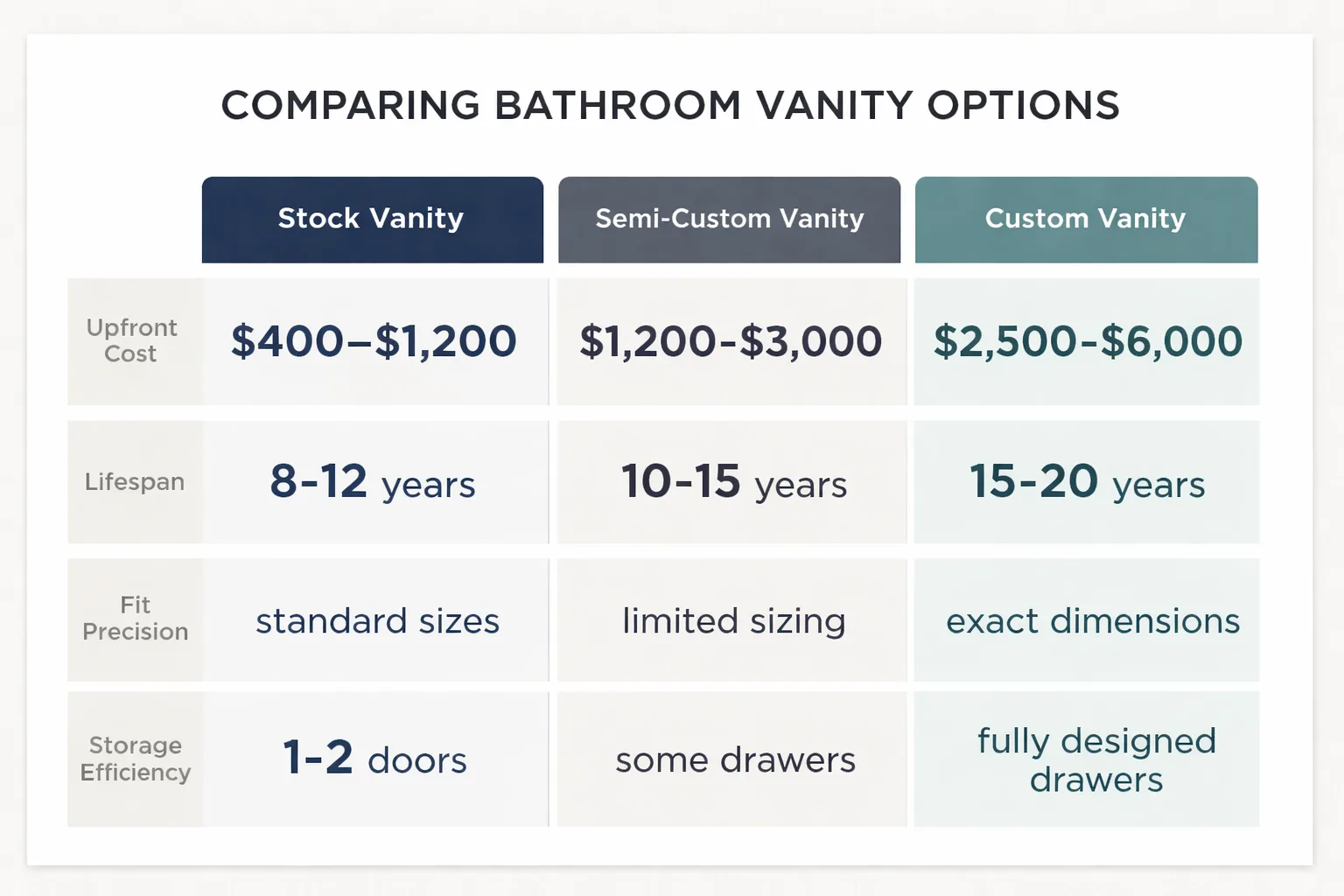
Stock vanities fail faster in NYC bathrooms. The 10 to 20 year lifespan benchmark assumes proper maintenance and moderate humidity. A stock MDF vanity in a Brooklyn bathroom with poor ventilation and radiator heat will warp, swell, and delaminate in 6 to 10 years. Replacing it means another renovation: demolition, plumbing disconnect, new vanity, plumbing reconnect, new countertop (because the old one cracked during removal), new sink fixture (because the old one corroded), and new tile work (because the demolition damaged the surround). That second renovation costs more than the first. The custom vanity that lasted 20 years never needed a second renovation.
The 10-year cost of ownership favors custom. A $3,000 custom solid wood vanity that lasts 20 years costs $150 per year. A $800 stock MDF vanity that lasts 8 years in a NYC bathroom costs $100 per year in materials alone. But the stock vanity requires a full replacement renovation at year 8, which adds $2,000 to $4,000 in demolition, disposal, plumbing, and installation costs. Over 10 years, the stock vanity path costs $800 + $3,000 (replacement renovation) = $3,800. The custom vanity path costs $3,000 + $0 (no replacement needed in 10 years) = $3,000. Custom is cheaper over a decade.
Resale value matters in NYC. A bathroom with a custom vanity, integrated storage, and a countertop that fits the space looks designed. Appraisers and buyers notice. A bathroom with a stock vanity that has a 3-inch gap on one side, covered by a filler strip, looks like a flip. In a Brooklyn brownstone where bathroom quality signals overall home quality, that visual difference affects offers.
The cost comparison parallels what happens with custom kitchen cabinets. The cost of custom kitchen cabinets runs higher than stock, but the 10-year ownership cost is lower because the materials last longer and the fit eliminates the gaps and workarounds that make a kitchen look cheap. The same logic applies to bathroom vanities, compressed into a smaller footprint where fit matters even more.
The hidden costs of stock vanities in NYC extend beyond replacement. Installation of a stock vanity in a non-standard space requires a carpenter to build filler strips, scribe moldings, and modify the vanity to fit the space. That labor costs $300 to $800 in NYC. A stock vanity that cost $600 now costs $1,100 to $1,400 installed. A custom vanity that cost $2,500 installed requires no modification labor because it was built to fit. The installed cost gap between stock and custom is smaller than the sticker price gap suggests. When you factor in the labor to make a stock vanity fit a non-standard NYC bathroom, the custom vanity is only $1,000 to $1,500 more, not $2,000 more. And that $1,000 to $1,500 buys 10 to 12 additional years of lifespan, better storage, and a finish that will not fail.
The semi-custom option deserves scrutiny. Semi-custom vanities from big-box retailers or online suppliers offer a range of widths (typically in 3-inch increments) and a selection of finishes and hardware. They are better than stock, but they still assume standard depth (21 inches), standard height (34.5 inches), and standard plumbing locations. In a NYC bathroom where the depth needs to be 18 inches or the plumbing comes through the floor, semi-custom offers no advantage over stock. The homeowner pays $1,200 to $3,000 for a vanity that still does not fit, still needs modification, and still has an MDF carcass that will swell in 8 years. Semi-custom is the worst value in the NYC market because it charges a premium without solving the core problem.
How to Choose the Right Materials for a NYC Bathroom Vanity
Material selection in a NYC bathroom is not about aesthetics first. It is about moisture resistance first, aesthetics second. The two are not in conflict, but the order matters.
Moisture-resistant hardwoods for the face frames and doors include walnut, quartersawn oak, maple, and beech. These are dense, closed-grain woods that resist water absorption better than open-grain woods like oak (red oak, not quartersawn) or hickory. Walnut is a premium choice: it is hard, stable, darkens beautifully with age, and has natural water resistance. Maple is a workhorse: it is hard, takes paint and clear finish well, and is dimensionally stable. Quartersawn oak is a classic choice that resists warping better than plain-sawn oak because the grain orientation is more stable.
Plywood vs. MDF carcasses is the most important material decision for a bathroom vanity. MDF (medium-density fiberboard) is flat, smooth, and cheap. It is also a sponge. MDF absorbs moisture from the air and from any water that gets past a seal. It swells. It does not un-swell. In a NYC bathroom with daily showers and limited ventilation, MDF is a ticking clock. Plywood is layered wood veneers bonded with waterproof glue. It resists moisture, does not swell, and holds fasteners better than MDF. A custom builder will offer plywood carcasses with solid wood face frames and doors. This is the construction that lasts 20 years.
Eco-friendly finishes include low-VOC water-based polyurethane, conversion varnish, and natural oil finishes. The finish is the vanity's first line of defense against moisture. A poorly finished solid wood vanity will warp. A well-finished plywood vanity will not. Green Cabinets NY uses low-VOC finishes that meet CARB2 compliance, which means the finish does not off-gas volatile compounds into a small NYC bathroom. This matters more in a bathroom than in a kitchen because the room is smaller and the door is often closed.
Countertop pairings should consider the vanity material. A solid wood vanity pairs well with quartz, marble, or a matching wood top. Quartz is the most practical choice for a NYC bathroom: it is non-porous, does not stain, does not etch, and requires no sealing. Marble is beautiful but etches with acidic products (toothpaste, face cleansers). A wood top is warm and natural but requires more maintenance and is riskier in a wet environment. The edge profile matters too. A custom vanity can have an integrated wood edge that matches the vanity, creating a seamless look that stock vanities cannot achieve.
The hardness of the wood matters in a bathroom because vanities get hit. A faucet wrench slips. A perfume bottle drops. A child swings a toothbrush. Softer woods like alder and birch dent more easily than harder woods like maple or hickory. That does not make them wrong choices, but it means the finish needs to be harder (conversion varnish rather than oil) and the homeowner needs to accept that the vanity will show wear. In a powder room that gets occasional guest use, alder is fine. In a master bathroom that sees daily use by two adults, maple or walnut is the better long-term choice. The Janka hardness scale (which measures wood resistance to denting) puts maple at 1,450, walnut at 1,010, alder at 590, and birch at 1,260. The numbers are not abstract. They translate directly to how the vanity will look in 10 years.
The finish application process is as important as the finish material. A conversion varnish, which is the standard for custom bathroom vanities, requires a spray booth with controlled temperature and humidity. The varnish is applied in multiple thin coats, with sanding between each coat. This process cannot be replicated on-site. A bathroom that is being renovated has dust, humidity from the shower, and temperature fluctuations from the window or radiator. A finish applied in that environment will not cure properly. It will be softer, more prone to water damage, and will need refinishing sooner. Green Cabinets NY finishes all vanities in-house, in a controlled shop environment, before delivery. This is a non-negotiable for a bathroom vanity that needs to last 20 years.
The hardware selection deserves more attention than it usually gets. In a bathroom, the hardware is the moving part that fails first. Hinges corrode from humidity. Drawer slides stick from toothpaste residue and hair. A custom vanity uses stainless steel or brass hardware with ball-bearing slides and soft-close mechanisms. These are rated for 50,000 to 100,000 cycles, which is 20 to 40 years of daily use. Stock vanities use stamped steel hinges and friction slides that fail in 3 to 5 years in a bathroom environment. The hardware is not visible, so it is where stock manufacturers cut costs. A custom builder does not cut costs on hardware because the hardware determines whether the drawer still slides smoothly in year 15.
What to Ask Before You Commission a Custom Vanity in Brooklyn
The questions below are what separates a smooth custom vanity project from a six-month ordeal. Ask them before signing anything.
Lead times. A custom bathroom vanity in NYC typically takes 6 to 10 weeks from design approval to delivery. That timeline can stretch to 12 to 14 weeks if the project requires unusual materials or if the shop is backed up. Ask the maker for their current lead time and whether it includes finishing. Some shops quote 6 weeks for the build but add 2 weeks for finishing and 1 week for delivery. Get the total.
Permit considerations. Bathroom renovations in NYC often require a Department of Buildings permit, especially if plumbing is moving. A custom vanity that fits the existing plumbing may not require a permit, but if the vanity design involves relocating the sink or changing the drain, a permit is likely. Co-op and condo boards may have their own alteration agreements that add weeks to the timeline. Ask the maker if they have experience with NYC permits and building requirements. Green Cabinets NY, as a Brooklyn-based maker, works within these constraints regularly.
Delivery logistics. NYC buildings have freight elevator hours, loading dock schedules, and street parking restrictions. A custom vanity is a large, heavy item. Ask the maker how they handle delivery: do they use their own truck, do they coordinate with the building, do they carry the vanity up stairs if there is no elevator. A maker who cannot answer these questions has not done enough NYC work.
Questions to vet a custom cabinet maker. Ask to see examples of bathroom vanities they have built, not just kitchens. Bathrooms have different moisture and plumbing requirements. Ask what carcass material they use (plywood is the right answer for bathrooms). Ask what finish they use and whether it is rated for high-humidity environments. Ask whether they handle installation or subcontract it. Ask for references from NYC clients. Ask whether they are familiar with FSC certification and CARB2 compliance if sustainability matters to you.
Green Cabinets NY is positioned to answer all of these questions affirmatively. As a Brooklyn-based custom cabinet maker, they build vanities to the inch, source sustainable materials, finish in-house, and coordinate delivery within NYC building constraints.
The measurement and design phase is where most custom vanity projects go right or wrong. A good maker visits the site, takes precise measurements of the alcove, notes the location of every pipe, valve, and outlet, and checks the floor for level. They ask about the homeowner's daily routine: what products they use, how many people share the bathroom, whether they prefer drawers or doors. They produce shop drawings that show the vanity from every angle, with dimensions on every component. The homeowner reviews these drawings, requests changes, and approves a final version. Only then does production begin. This process takes 1 to 3 weeks, depending on the complexity of the design and the number of revisions. It is the most important phase of the project because it prevents every problem that makes a vanity installation go sideways. A maker who skips the site visit or produces a sketch on a napkin is not building a custom vanity. They are building a stock vanity with slightly different dimensions.
The installation phase is the final variable. A custom vanity should be installed by the maker's own crew or by a contractor who works with the maker regularly. The maker knows the vanity's quirks, the intended fit, and the finish requirements. A random contractor who has never seen the vanity may not know how to scribe the side panel to a wavy wall without damaging the finish. Installation takes 4 to 8 hours for a single vanity, or 1 to 2 days for a double vanity with a countertop. The maker should be present for the plumbing connections to ensure the plumber does not over-tighten fittings and crack the finish inside the vanity. This level of coordination is what makes a custom project feel seamless.
How Does Custom Millwork Benefit NYC Developers?
For developers managing multi-unit renovations in Brooklyn and Manhattan, the vanity decision is multiplied by the number of units. A stock vanity that costs $600 per unit across 12 units seems like a $7,200 spend. But if each of those vanities needs $400 in modification labor to fit non-standard bathrooms, the real cost is $12,000. And if each vanity lasts 8 years instead of 20, the developer faces a full replacement cycle across all 12 units within a decade. That is another $12,000 in materials plus labor, plus tenant disruption and turnover costs.
Custom millwork, produced at scale for a multi-unit project, can bring the per-unit cost down significantly. A custom builder producing 12 identical vanities for a Brooklyn development can offer a per-unit price that approaches semi-custom territory, while delivering the fit, material quality, and longevity that stock cannot match. The benefits of custom millwork for developers include consistent dimensions across units, standardized plumbing cutouts that simplify installation, and a finish that holds up to tenant turnover. A developer who installs custom vanities in 12 units today is not replacing them in 8 years. A developer who installs stock vanities is budgeting for replacement before the next tenant moves in.
The consistency argument extends to maintenance. A building with 12 custom vanities built by the same maker has uniform hardware, uniform finishes, and uniform plumbing layouts. The building superintendent can replace a drawer slide or adjust a hinge without guessing the manufacturer or hunting for proprietary parts. Stock vanities across multiple units often come from different production runs, with slightly different hardware and finishes that make maintenance a guessing game. Custom millwork standardizes the building's maintenance burden.
When Custom Does Not Make Sense
Custom is not always the right answer. There are scenarios where stock or semi-custom is the rational choice.
A rental apartment where the owner plans to sell or rent within 2 years. The custom vanity will not pay back in that timeframe. A stock vanity that fits adequately and costs $600 is the right call. The buyer or tenant will not pay more for a custom vanity in a bathroom they are about to renovate themselves.
A bathroom with standard dimensions and no unusual plumbing. If the alcove is exactly 36 inches wide, the plumbing comes out of the wall at standard heights, and the floor is level, a high-quality semi-custom vanity from a reputable brand will fit and function. The premium for custom is not justified.
A budget under $1,500. Custom starts around $2,500 for a small vanity. If the budget is $1,500, semi-custom is the better path. A poorly built custom vanity (from a maker who cuts corners to hit a low price) is worse than a well-built semi-custom vanity.
A gut renovation where the walls are being rebuilt and the plumbing is being relocated. In this scenario, the developer or homeowner can set the alcove dimensions to fit a stock vanity. The wall framing is designed around the vanity, not the other way around. This is the one case where stock makes sense in NYC: when the space is being created to fit the vanity, rather than the vanity being created to fit the space.
FAQ
How much does a custom bathroom vanity cost in NYC?
A custom bathroom vanity in NYC typically costs between $2,500 and $6,000, depending on size, materials, and finish complexity. A small 24-inch vanity with a plywood carcass and maple face frame starts around $2,500. A large 60-inch double vanity with walnut, integrated storage, and a quartz top can reach $6,000 or more. The price includes design, materials, construction, finishing, and delivery. Installation is often separate.
How long does a custom bathroom vanity last?
A custom bathroom vanity built with solid wood or plywood carcass construction, proper finish, and quality hardware lasts 15 to 20 years. This assumes the bathroom has functioning ventilation and the vanity is maintained with appropriate cleaning products. Stock vanities with MDF carcasses typically last 10 to 15 years, and often less in high-humidity NYC bathrooms.
What is the best material for a bathroom vanity in NYC?
Plywood carcass with solid wood face frames and doors is the best construction for a NYC bathroom. Plywood resists moisture and warping. Solid hardwoods like walnut, maple, or quartersawn oak provide durability and aesthetic quality. MDF should be avoided for bathroom vanity carcasses in high-humidity environments because it absorbs moisture and swells.
Do I need a permit to install a custom bathroom vanity in NYC?
If the custom vanity installation does not involve moving plumbing or changing the electrical, a permit is typically not required. If the sink or drain is being relocated, or if new electrical is being added for lighting or outlets, a Department of Buildings permit is likely. Co-op and condo boards may have their own alteration requirements regardless of permit needs.
Can a custom bathroom vanity be sustainable?
Yes. A custom bathroom vanity can be built with FSC-certified wood, low-VOC finishes, and CARB2-compliant adhesives. The most sustainable choice is one that lasts 20 years instead of 8, because the environmental cost of manufacturing and disposing of two stock vanities exceeds the cost of one custom vanity. Green Cabinets NY sources sustainable materials and finishes for all custom builds.
How do I maintain a custom bathroom vanity?
Run the exhaust fan during and after every shower for at least 20 minutes. Wipe down the vanity surface with a soft cloth after use to prevent water from sitting on the finish. Avoid abrasive cleaners, scouring pads, and acidic products that can strip the sealant. Refinish the surface every 7 to 10 years if the finish shows wear. Check drawer slides annually for smooth operation and tighten any loose hardware. With proper maintenance, a custom vanity will outlast two stock vanities.
A custom bathroom vanity is worth it for NYC homes when the bathroom has non-standard dimensions, the homeowner plans to stay 5 or more years, and the budget can accommodate a $2,500 to $6,000 investment. The fit, longevity, and storage efficiency justify the cost over a decade. For standard bathrooms in short-term holdings, stock or semi-custom is the rational choice. The decision comes down to how long the vanity needs to last and how well it needs to fit.
Get a free custom vanity consultation with Green Cabinets NY and see exactly what your bathroom can hold.