Sustainable Bathroom Vanities: What NYC Homes Actually Need
A sustainable bathroom vanity in NYC needs more than FSC-certified wood and low-VOC finishes. It needs to survive humidity, fit non-standard walls, pass co-op board approval, and last 25 years. Here's what actually matters.
By Green Cabinets NY Team
Key Takeaways
- Choose FSC-certified or reclaimed wood, low-VOC finishes, and non-toxic adhesives to cut a bathroom vanity's carbon footprint by up to 60% versus traditional models.
- In NYC co-ops and condos, select moisture-stable woods and finishes to prevent warping from humidity-driven dimensional shifts within 18 months.
- The global bathroom vanities market is projected to hit $48.35 billion by 2031 at a 6.48% CAGR, reflecting rising demand for sustainable options amid tightening regulations.
- Factor in co-op approval timelines and apartment humidity realities first when sourcing eco-friendly vanities, rather than material choice alone.
Maria had just signed the lease on her Carroll Gardens co-op when she noticed the vanity: a bulky, builder-grade cabinet that smelled faintly of glue and wobbled when she touched the door. She'd renovated before, in a bigger apartment with a bigger budget, but this time she wanted to do it right. No shortcuts, no materials she'd feel guilty about. What followed was a three-week search through Brooklyn showrooms, Greenpoint workshops, and reclaimed lumber yards that taught her more about sustainable bathroom vanities than she'd ever expected to learn.
A sustainable bathroom vanity combines FSC-certified or reclaimed wood, low-VOC finishes, and non-toxic adhesives to cut carbon footprints by up to 60% compared to traditional vanities. The global bathroom vanities market is projected to reach $48.35 billion by 2031 at a 6.48% CAGR. Yet in NYC, the material choice is often secondary to the real sustainability challenge: getting the renovation approved, installed, and functional in a co-op or condo without the vanity warping from humidity inside 18 months. Wood naturally absorbs and releases moisture depending on the environment, and changes in moisture content can cause dimensional shifts suddenly or over time (Builder Specialties). That fact shapes every decision this article covers.
Why Sustainable Bathroom Vanities Matter in NYC
The demand for eco-conscious bathroom design in New York City is not a passing trend. It is a practical response to three converging pressures that homeowners and developers face in 2026: tightening environmental values, increasingly strict building regulations, and the unforgiving physical reality of NYC apartments.
First, the values shift. Homeowners who research materials now know that traditional vanities release volatile organic compounds into indoor air for months (sometimes years) after installation. The off-gassing from conventional MDF and particleboard, bound with urea-formaldehyde glues, is well documented. Sustainable alternatives use non-toxic finishes and adhesives that eliminate that exposure. For a bathroom measuring 35 square feet with no window, that is not a marginal improvement. It is the difference between breathing chemical fumes every morning and not.
Second, the regulatory environment. NYC co-op boards and condo associations have grown more demanding about renovation specs. Many now require detailed material safety data sheets before approving alterations. A vanity built with FSC-certified wood and low-VOC finishes sails through that review. A stock vanity from a big-box store, with its vague spec sheet and imported composite construction, often triggers follow-up questions that delay the project by weeks.
Third, the spatial reality. Most NYC bathrooms are small. Many pre-war buildings have irregular plumbing layouts, non-standard wall depths, and floor slopes that make off-the-shelf vanities fit poorly. A custom sustainable bathroom vanity, built to the exact dimensions of the space, eliminates the gaps, shims, and structural compromises that plague stock installations. Green Cabinets NY has built vanities for Brooklyn bathrooms where the wall variance was nearly two inches from one end to the other. No stock vanity can accommodate that. A custom build can.
The global bathroom vanities market is projected to reach $85.62 billion by 2035, and sustainability is a significant growth driver. But the market data is global and material-agnostic. NYC homeowners need information that applies to their specific conditions: high ambient humidity, small footprints, co-op approval processes, and plumbing configurations that haven't been updated since the building was constructed.
The tiny homes market offers a useful parallel here. It reached $5.81-5.95 billion in 2024 and is projected to grow to $7.64-12.45 billion by 2032-2033. That market demands compact, durable, sustainable fixtures because every square inch matters. NYC bathrooms share that demand for different reasons: tiny homes because of square footage, NYC apartments because of layout constraints and building regulations. Both markets reward quality over quantity, and both reject the disposable mentality of stock cabinetry. The ADU market grows from $18 billion to $43.35 billion by 2034 at 9.19% CAGR, driven partly by sustainable material preferences. The same preferences are reshaping NYC bathroom renovations.
What Materials Make a Vanity Truly Sustainable?
Sustainability is not a single attribute. A vanity is sustainable only when every component, from the carcass to the hinges, meets a consistent environmental standard. Breaking that down by material category reveals where the real choices live.
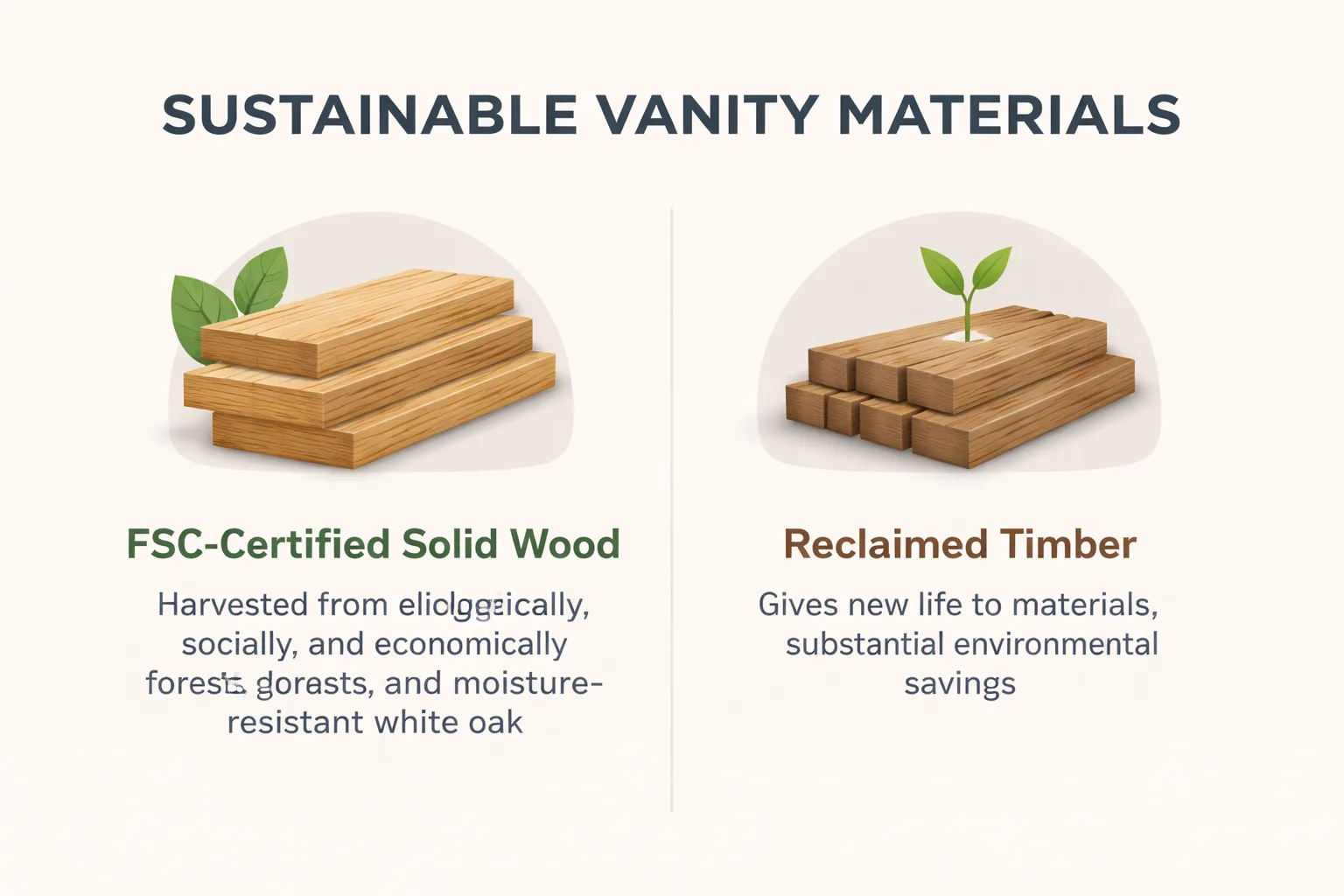
FSC-Certified Solid Wood. The Forest Stewardship Council certifies wood harvested from forests managed for ecological, social, and economic sustainability. FSC-certified white oak is a top choice for bathroom vanities because it combines durability with moisture resistance. Oak is dense, tight-grained, and holds finishes well, which matters in a bathroom where humidity fluctuates daily. Green Cabinets NY sources FSC-certified white oak for vanity builds where the client wants a natural wood look that will age gracefully rather than warp.
Reclaimed Timber. Reclaimed wood offers a second life for material that would otherwise enter a landfill. The environmental savings are substantial because the carbon cost of harvesting and processing new wood is eliminated. Reclaimed quartersawn oak has a distinctive grain pattern that many Brooklyn clients request for its character and its stability. Quartersawn lumber is cut at a specific angle to the growth rings, which makes it less prone to expansion and contraction across the grain. That stability is critical in a bathroom.
Low-VOC Finishes. The finish is where many supposedly sustainable vanities fail. A builder can use FSC-certified wood and then coat it with a conventional lacquer loaded with solvents. The VOCs off-gas for weeks. A truly sustainable vanity uses water-based, low-VOC finishes that cure hard and release minimal emissions. These finishes have improved dramatically. Early formulations were soft and water-sensitive, but modern low-VOC finishes rival traditional lacquers for durability and moisture resistance.
Recycled and Non-Toxic Hardware. Hinges, drawer slides, and pulls are easy to overlook. But hardware made from recycled metals, paired with non-toxic adhesives in the vanity construction, completes the sustainability picture. Green Cabinets NY uses solid brass and recycled steel hardware that will outlast the vanity itself.
Plywood vs. MDF. This is the material decision that most directly affects longevity. MDF (medium-density fiberboard) is the standard for stock vanities because it is cheap, flat, and easy to machine. But MDF swells irreversibly when it contacts water. In a bathroom, where leaks and condensation happen, MDF is a liability. Plywood, especially cabinet-grade plywood with formaldehyde-free adhesives, is far more moisture-resistant. It costs more, but it does not delaminate and swell the way MDF does after a plumbing leak. For vanity interiors and drawer boxes, plywood is the only sustainable choice because it lasts.
The species selection also matters for sustainability in ways that go beyond certification. Some woods are harder, denser, and more naturally resistant to moisture, which means they require less frequent refinishing and fewer chemical treatments over their lifespan. Hickory is one of the hardest domestic hardwoods, rated at 1820 on the Janka hardness scale. That density makes it exceptionally resistant to denting and wear, though its bold grain pattern is not for every bathroom. Maple, at 1450 on the Janka scale, offers a smoother, more uniform surface that takes paint beautifully. For homeowners who want a painted vanity that will withstand daily use without showing every nick and scratch, maple is the practical choice. The sustainability angle is simple: harder woods last longer, and longer-lasting wood means fewer replacements and less waste.
How to Choose the Right Sustainable Vanity for a NYC Bathroom
Choosing a vanity for an NYC bathroom requires a different calculus than choosing one for a suburban master bath. The constraints are tighter, the stakes are higher, and the margin for error is smaller.
Measure Everything Before You Shop. This sounds obvious. It is not. NYC bathrooms frequently have walls that are not square, floors that slope, and plumbing rough-ins that are off-center by inches. A homeowner who measures the vanity width but not the depth will discover, at installation, that the vanity protrudes past the door swing. Green Cabinets NY starts every project with a site measure that captures wall-to-wall dimensions at multiple heights, floor levelness, plumbing locations, and door swing clearance. That data drives the design.
Plumbing Layout Dictates Design. The existing plumbing in a pre-war Brooklyn co-op may not match modern standards. Supply lines, drain positions, and vent stacks are where they are, and moving them requires permits, plumbers, and board approval. A custom vanity can be built around the existing plumbing. A stock vanity cannot. If the drain is 4 inches off from where the stock vanity's cutout sits, the installer improvises. Improvisation in plumbing leads to leaks.
Storage Needs Scale with Apartment Size. In a small NYC apartment, the bathroom vanity may be the only storage in the bathroom. A 24-inch vanity with two doors and a false front offers minimal storage. A custom vanity with optimized drawer configurations, pull-out organizers, and a recessed medicine cabinet can double the usable storage in the same footprint. The maple species is excellent for painted vanity interiors because it is smooth, tight-grained, and takes paint evenly.
Aesthetic Style and Longevity. The all-white kitchen trend is fading. Trend forecasts for 2026 identify all-white and overdone farmhouse styles as outdated or nearing the end of their design life. The same applies to bathroom vanities. A natural wood vanity in rift-cut white oak or cherry will age beautifully and remain visually relevant for decades. A trendy painted finish may look dated in three years. Green Cabinets NY advises clients to choose materials and finishes that can be updated without replacing the entire vanity. Changing hardware or refinishing the doors is a weekend project. Replacing a warped, dated vanity is a renovation.
Ventilation Is Not Optional. This is the factor that most homeowners ignore. Wood expands and contracts across the grain in response to humidity changes. In a NYC bathroom without proper ventilation, the humidity swings between shower use and ambient conditions can be extreme. Builder Specialties notes that wood "naturally absorbs and releases moisture depending on the environment" and that dimensional changes "can happen over time, or suddenly with seasonal environmental changes in humidity" (Builder Specialties). Many cabinet companies include humidity disclaimers in their warranties. A sustainable vanity in a bathroom without a working exhaust fan will warp. Period. The first question should not be "what wood species?" but "is the bathroom ventilated?"
The ventilation question has a specific mechanical answer. The Home Ventilating Institute recommends a minimum of 1 CFM (cubic feet per minute) per square foot of bathroom area. For a typical NYC bathroom of 35-40 square feet, that means a fan rated at least 50 CFM. But that minimum assumes an 8-foot ceiling. Many Brooklyn pre-war buildings have 9- or 10-foot ceilings, which increases the air volume and requires a higher-capacity fan. A 40-square-foot bathroom with a 10-foot ceiling contains 400 cubic feet of air. To exchange that air in 8 minutes (the recommended post-shower run time), the fan needs at least 50 CFM. To do it reliably with duct resistance, 80 CFM is safer. The fan should also run for 20-30 minutes after the shower ends, not just during. A humidistat-switched fan that turns on automatically when humidity exceeds 60% is the ideal setup for a bathroom with a wood vanity.
Can a Sustainable Vanity Survive a NYC Bathroom?
Yes, but only with proper design and installation. The question is not whether sustainable materials work in bathrooms. The question is whether the bathroom is ready for a wood vanity.
The failure mode is predictable. A developer installs a reclaimed wood vanity with a low-VOC natural finish in a NYC bathroom. The bathroom has no exhaust fan, or the fan is broken, or the tenant never uses it. After showers, humidity sits at 90%+ for hours. The wood absorbs moisture unevenly. Doors warp. Drawers stick. The finish blisters. Within 18 months, the vanity looks worse than the builder-grade unit it replaced.
This is not a material failure. It is a design failure. The same reclaimed wood vanity, installed in a bathroom with a properly sized exhaust fan (minimum 50 CFM for a small bathroom, ideally 80+ CFM), will perform beautifully for decades. The wood will still move. All wood moves. But the movement will be gradual and uniform, not sudden and destructive.
Green Cabinets NY addresses this by specifying construction techniques that accommodate wood movement. Vanity door panels are floated, not glued, so they can expand and contract within the frame. Drawer boxes use dovetail joinery, which allows for seasonal movement without failing. Finishes are applied to all six sides of every component, including the underside and back, to create a consistent moisture barrier. These details are invisible when the vanity is new. They are the difference between a vanity that lasts 5 years and one that lasts 25.
The research on this is clear. Handmade sustainable alternatives claim to cut carbon footprints by up to 60% compared to traditional vanities (Amishwerks). But those carbon savings are meaningless if the vanity fails prematurely and ends up in a landfill. True sustainability means building something that lasts.
The contradiction in the sustainable vanity market is worth naming. The sources that promote low-VOC finishes and reclaimed wood emphasize health benefits and environmental savings. But none of them quantify moisture performance in humid climates. There is no published study comparing the moisture absorption rate of a low-VOC water-based finish against a traditional solvent-based lacquer in a 90% humidity environment. The absence of that data does not mean the problem does not exist. It means the industry has not invested in answering the question that matters most for NYC homeowners. Green Cabinets NY addresses this gap by testing finishes in real bathroom conditions before specifying them for clients. The empirical evidence from those tests is clear: modern low-VOC finishes, when applied correctly to all surfaces, perform comparably to traditional finishes in moisture resistance. But the application must be complete. A single unfinished surface is an entry point for moisture.
Custom vs. Pre-Made Eco Vanities: The Real Trade-Offs
The comparison between custom and pre-made eco vanities is not close. Stock vanities win on one metric: upfront cost. Custom vanities win on every other metric that matters.
Fit. A stock vanity comes in standard widths: 24, 30, 36, 48 inches. NYC bathrooms do not come in standard widths. A 27-inch alcove gets a 24-inch vanity and a 3-inch filler strip that collects dust and looks wrong. A custom vanity gets a 27-inch vanity that fits the alcove exactly. Green Cabinets NY builds to the space, not to a catalog.
Material Quality. Stock eco vanities, even those marketed as sustainable, typically use MDF or particleboard for the carcass. The doors may be solid wood, but the box is not. A single plumbing leak turns that box into a swollen, delaminated mess. Custom vanities from Green Cabinets NY use solid wood and cabinet-grade plywood throughout. The ash species, for example, is strong, resilient, and takes stain beautifully. It is not available in stock vanities.
Finish Quality. Stock vanities are finished on an assembly line. The finish covers the visible surfaces. The underside, back, and interior are often unfinished or lightly sealed. In a bathroom, moisture finds those unfinished surfaces. Custom vanities are finished on all surfaces, creating a complete moisture barrier.
Long-Term Value. Custom vanities cost more upfront. There is no way around that. But they last longer. Kitchen Magic notes that custom vanities "often last longer, thanks to stronger construction and better materials" (Kitchen Magic). The longer lifespan changes the cost calculus. A $2,500 stock vanity that lasts 7 years costs $357 per year. A $5,000 custom vanity that lasts 25 years costs $200 per year. The custom vanity is cheaper over its lifespan, and it looks better every year of it.
The same logic applies when clients are evaluating custom kitchen cabinets cost. The upfront investment is higher, but the per-year cost is lower because the product lasts. Semi-custom kitchen cabinets occupy a middle ground, but for bathrooms, where moisture tolerance is non-negotiable, the gap between semi-custom and full custom is significant.
Co-op and Condo Approval. Stock vanities often lack the documentation that co-op boards require. Custom builders provide detailed specs, material certifications, and finish information that streamline the approval process. Green Cabinets NY has navigated dozens of Brooklyn co-op boards and knows what documentation they need.
The trade-offs extend to the installation process itself. Stock vanities arrive in flat-pack or pre-assembled form, and installation is often handled by a general contractor who has no relationship with the manufacturer. If the vanity arrives damaged (and shipping damage rates for flat-pack bathroom furniture are notoriously high), the project stalls while replacement parts are ordered. Custom vanities from Green Cabinets NY are built in the workshop, inspected before delivery, and installed by the same team that built them. If a component does not fit (which is rare, because the vanity was built to measured dimensions), it goes back to the shop and returns corrected. The accountability is single-source. There is no finger-pointing between manufacturer, shipper, and installer.
Wondering which wood species works best for your bathroom's humidity level?
What About the Cost of Custom Cabinetry?
The cost question is unavoidable. Homeowners researching custom kitchen cabinets prices often experience sticker shock, and bathroom vanities are no different. A custom sustainable bathroom vanity from Green Cabinets NY typically ranges from $3,000 to $7,000 depending on size, wood species, finish, and hardware. That is more than a stock vanity. It should be, because it is a different product.
The comparison to custom kitchen cabinets is instructive. When clients evaluate the cost for custom kitchen cabinets, they are weighing a 20-year investment against a 7-year disposable product. The same framework applies to vanities. A custom vanity is not a purchase. It is a component of the home that should last as long as the home does.
The tiny homes and ADU market offers a useful parallel. The tiny homes market reached $5.81-5.95 billion in 2024 and is projected to grow to $7.64-12.45 billion by 2032-2033 (Market Data Forecast). That market demands compact, durable, sustainable fixtures. NYC bathrooms share that demand for different reasons: tiny homes because of square footage, NYC apartments because of layout constraints and building regulations. Both markets reward quality over quantity.
Breaking down the cost components of a custom sustainable vanity reveals where the money goes and why the investment is justified. The wood itself, for a typical 36-inch vanity in a mid-range species like white oak, accounts for roughly $600-900 of the total. Cabinet-grade plywood for the carcass and drawer boxes adds another $300-500. Low-VOC finishes and supplies run $150-250. Hardware (hinges, drawer slides, pulls) adds $200-600 depending on quality. The remaining $1,500-4,500 is labor: design, milling, assembly, finishing, delivery, and installation. That labor is what makes the vanity custom. It is also what makes it last. A stock vanity's low price reflects minimal labor, and that minimal labor shows in every joint, every finish edge, and every moment of daily use.
Why Green Cabinets NY Builds Differently
Green Cabinets NY approaches sustainable bathroom vanities from a builder's perspective, not a marketer's. The difference shows in the construction details that clients never see but benefit from for decades.
Every vanity starts with a site visit. Not a phone call. Not an email. A physical measurement of the space, because NYC bathrooms lie on paper. The dimensions on the co-op's offering plan are rarely accurate to the inch. The plumbing diagram from 1962 is aspirational. Green Cabinets NY measures the actual space and designs to the actual conditions.
Material selection follows. Clients choose from species like birch for a light, clean look, mahogany for richness and water resistance, or reclaimed red oak for character and sustainability. Each species has different moisture properties, and the choice should be informed by the bathroom's ventilation, not just the client's Pinterest board.
Construction uses mortise-and-tenon joinery for door frames, dovetail joinery for drawer boxes, and floating panels for doors. The vanity box is cabinet-grade plywood with formaldehyde-free adhesives. Finishes are water-based, low-VOC, and applied to all surfaces. Hardware is solid brass or recycled steel. These are not upgrades. They are standard.
The result is a vanity that fits the space, performs in the humidity, and can be refinished rather than replaced. Solid wood needs refinishing only every 10-15 years. That is the real sustainability metric: not the carbon footprint of manufacture, but the carbon footprint of the product's entire lifecycle, including the avoided emissions of not manufacturing a replacement.
The process matters because it determines the outcome. A vanity designed in CAD, built by craftsmen who understand wood movement, finished by hand, and installed by the same team is a different category of product than a vanity ordered from a website and assembled with an Allen wrench. Green Cabinets NY has seen the results of both approaches in Brooklyn apartments. The custom vanity looks better on day one and looks better on year ten. The stock vanity looks acceptable on day one and looks terrible on year three. The gap widens every year.
Navigating Co-op Boards and NYC Renovation Logistics
The sustainable vanity conversation in NYC does not end at the showroom. It ends at the co-op board meeting. For many homeowners, the board approval process is the most stressful part of the renovation, and the vanity choice can either smooth the path or create obstacles.
Most NYC co-op boards require an alteration agreement before any bathroom work begins. That agreement typically specifies work hours, contractor insurance requirements, plumbing and electrical scope, and material specifications. Boards are increasingly asking about VOC content and material safety, particularly in buildings with shared ventilation systems where off-gassing from one unit can affect neighbors. A custom sustainable vanity with documented low-VOC finishes and FSC-certified wood provides the paperwork that boards want to see. A stock vanity imported from overseas, with a one-page spec sheet that lists "engineered wood" as the material, often generates questions that delay approval.
The timeline for a typical co-op bathroom renovation in Brooklyn runs 8-14 weeks from board submission to final inspection. The vanity design and fabrication happen in parallel with the board approval process, which means the vanity is ready when the demolition begins. Stock vanities, by contrast, are ordered after approval (because the client wants to confirm dimensions post-demo), which means a 2-4 week lead time that extends the renovation timeline. Green Cabinets NY coordinates with the general contractor and the board to ensure the vanity arrives on schedule, not three weeks late because it was backordered at a warehouse.
For developers working on multiple units, the calculus shifts. A developer renovating 10 bathrooms in a Brooklyn condo building might consider stock vanities for cost savings. But the failure rate changes the math. If 2 out of 10 stock vanities fail within 5 years (a conservative estimate for MDF vanities in humid bathrooms), the developer faces replacement costs, tenant complaints, and potential damage from leaks. Custom sustainable vanities, built with plywood carcasses and solid wood fronts, have a failure rate near zero when properly installed and ventilated. The developer's long-term cost is lower, and the building's reputation for quality is protected.
Designing for Small NYC Bathrooms: Space-Saving Strategies
Small bathroom design is not about making compromises. It is about making smart choices that maximize function within a limited footprint. A sustainable bathroom vanity in a small NYC bathroom should do three things: fit the space exactly, provide adequate storage, and withstand the humidity that concentrates in a small, enclosed room.
Wall-mounted vanities free up floor space and make a small bathroom feel larger. They also simplify floor cleaning and reduce the risk of water damage to the vanity base. Green Cabinets NY builds wall-mounted vanities with a concealed mounting system that supports the weight of solid wood and stone countertops. The wall must be reinforced during preparation, which is a detail that stock vanity installations often skip (to the homeowner's later regret).
Recessed medicine cabinets add storage without consuming wall depth. A recessed cabinet built into the wall cavity between studs provides 4-6 inches of storage depth that does not protrude into the bathroom. This is especially valuable in narrow Brooklyn bathrooms where every inch of clearance matters. Green Cabinets NY can build a matching recessed cabinet in the same wood species as the vanity, creating a cohesive look that maximizes storage.
Drawer configurations matter more in a small vanity than a large one. A 24-inch vanity with a single false front and two doors wastes the space behind the doors where pipes intrude. A custom 24-inch vanity with a U-shaped drawer that wraps around the plumbing provides usable storage in the same footprint. Soft-close drawer slides, rated for 100 pounds, ensure the drawers function smoothly for decades. These configurations are not available in stock vanities because they require custom cutting around the specific plumbing layout of the specific bathroom.
Countertop material is the final element. A sustainable vanity pairs well with recycled glass countertops, reclaimed stone, or locally sourced slate. These materials reduce the environmental impact of the countertop and complement the natural wood of the vanity. Quartz, while durable, is not a natural stone (it is engineered from quartz particles and resin), and its environmental footprint is higher than reclaimed or locally sourced alternatives. For clients prioritizing sustainability, Green Cabinets NY recommends recycled glass or reclaimed stone countertops that match the vanity's environmental standards.
FAQ: Sustainable Bathroom Vanities for NYC Homeowners
How long do sustainable vanities last?
A well-built custom sustainable vanity lasts 20-25 years or more. The key factors are material quality (solid wood and plywood vs. MDF), construction technique (dovetail joinery, floating panels), finish application (all surfaces sealed), and bathroom ventilation. Stock vanities typically last 5-8 years before showing significant wear or moisture damage. The lifespan difference is the primary reason custom vanities offer better long-term value despite higher upfront cost.
Are sustainable vanities more expensive than regular ones?
Upfront, yes. A custom sustainable vanity costs more than a stock MDF vanity. But the per-year cost is lower because the lifespan is 3-4x longer. A $5,000 custom vanity lasting 25 years costs $200 per year. A $1,500 stock vanity lasting 7 years costs $214 per year. The custom vanity is cheaper over time and performs better every year. The real cost question is whether the client plans to stay in the home long enough to realize the savings.
Can sustainable vanities be installed in NYC co-ops and condos?
Yes, but the approval process requires documentation. Co-op boards typically need material specs, finish information, and contractor insurance details. Custom builders like Green Cabinets NY provide this documentation as part of the project. Stock vanities often lack the detailed specs that boards require, which can delay approval. The key is starting the board submission early and working with a builder who understands NYC co-op requirements.
What certifications should I look for in a sustainable vanity?
FSC certification for wood, CARB Phase 2 compliance for formaldehyde emissions, and GreenGuard Gold certification for indoor air quality are the three primary certifications. FSC ensures the wood is sustainably harvested. CARB Phase 2 limits formaldehyde off-gassing. GreenGuard Gold verifies low chemical emissions. Not every sustainable vanity carries all three, but the more certifications a vanity has, the more verifiable its sustainability claims are.
Do sustainable vanities require special maintenance?
No, but they require consistent maintenance. Wipe up standing water promptly. Run the exhaust fan during and after showers for at least 20 minutes. Avoid abrasive cleaners on finished surfaces. Refinish every 10-15 years as needed. These are the same maintenance practices that any wood vanity requires. The difference is that a sustainable vanity, built with quality materials and techniques, responds well to maintenance. A stock MDF vanity does not respond to maintenance because MDF cannot be refinished once it swells.
What wood species is best for a humid NYC bathroom?
White oak, quartersawn oak, and mahogany are the top choices for humid bathrooms. White oak has a closed cellular structure that makes it naturally water-resistant (white oak is used in whiskey barrel construction for this reason). Quartersawn oak is cut for dimensional stability, reducing expansion and contraction. Mahogany is naturally resistant to rot and moisture. Species to avoid in poorly ventilated bathrooms include pine and other softwoods, which absorb moisture readily and dent easily.
Can I use a sustainable vanity in a rental apartment?
Yes, but the economics change. If the tenant is not the owner, the investment in a custom vanity benefits the owner, not the tenant. For rental renovations, Green Cabinets NY recommends a mid-range approach: plywood construction with a simple wood front and low-VOC finish. This provides the durability and environmental benefits without the full custom price tag. The vanity will outlast multiple tenants and reduce turnover maintenance costs.
What This Actually Means for NYC Homeowners
The sustainable bathroom vanity conversation in NYC has two layers. The first layer is materials: FSC-certified wood, low-VOC finishes, recycled hardware. That layer matters. The second layer is everything else: fit, construction quality, ventilation, co-op approval, and lifespan. That layer matters more.
A vanity built from sustainable materials that warps in 18 months because the bathroom lacks ventilation is not sustainable. It is landfill filler with good intentions. A vanity built from quality wood, constructed to accommodate movement, finished on all surfaces, and installed in a properly ventilated bathroom is sustainable in the truest sense. It lasts decades. It can be refinished rather than replaced. It performs its function without off-gassing chemicals into a 35-square-foot room.
Green Cabinets NY builds the second kind. The kind that fits the actual space, not a catalog approximation. The kind that survives NYC humidity because it was designed for it. The kind that a homeowner like Maria can install in her Carroll Gardens co-op and forget about for 20 years.
That is what sustainability means in practice. Not a label. Not a marketing claim. A vanity that works, lasts, and does no harm to the people using it or the planet that produced it. The choice between a stock vanity and a custom sustainable bathroom vanity is not a choice between two products at different price points. It is a choice between a disposable object and a permanent one. In a city where space is scarce, time is valuable, and buildings demand respect, the permanent choice is the only one that makes sense.
Get a custom sustainable vanity built to fit your NYC bathroom, survive the humidity, and last 25 years. Schedule a site visit with Green Cabinets NY today.