Quartersawn Oak
Iridescent ray fleck and the soul of Mission and Greene & Greene.
Quartersawn oak is sliced perpendicular to the growth rings, exposing the medullary rays as shimmering silver-gold ribbons. It is the defining wood of Arts & Crafts, Mission, and Stickley furniture.
Quercus alba / Quercus rubra (quartersawn) · Eastern U.S.
Janka Hardness
1,360 lbf
Cost Tier
$$$$
Workability
Good
Stain Take
Excellent
Stability (1–5)
5
Specific Gravity
0.68
Color
Tan to medium brown with shimmering ray fleck
Grain
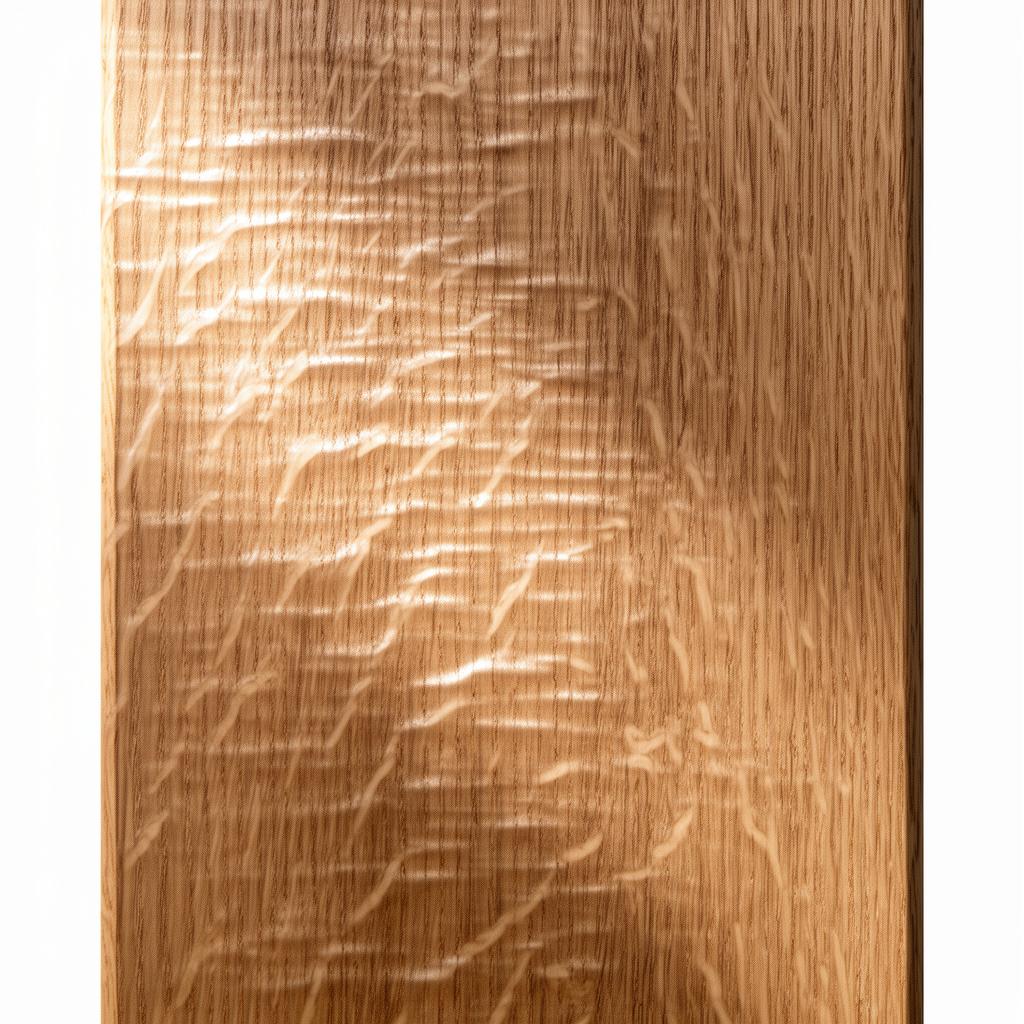
Straight grain face with prominent medullary ray fleck
About Quartersawn Oak
Quartersawn oak is produced by cutting the log into quarters and then sawing each quarter into boards perpendicular to the growth rings. The cut exposes the wood's medullary rays — radial structures that move nutrients horizontally through the trunk — as iridescent silver-gold or copper ribbons that shimmer when light hits the surface. This 'ray fleck' is the visual signature of Mission furniture, Stickley pieces, Greene & Greene millwork, and the entire American Arts & Crafts movement of 1900-1920.
Both white oak and red oak can be quartersawn, but white oak produces dramatically more visible ray fleck because its medullary rays are larger and more numerous. When designers say 'quartersawn oak' without qualification, they almost always mean quartersawn white oak. Red oak quartersawn shows subtler fleck and reads more like rift-cut — less collectible, but more affordable.
Quartersawn lumber is the most dimensionally stable cut available from any species. Because the growth rings run perpendicular to the board face, the wood expands and contracts much less across its width with humidity changes. For NYC kitchens that swing from 25% relative humidity in February to 75% in July, this stability is genuinely useful — quartersawn doors and panels stay flatter, and joints stay tighter, than the same species cut plain or rift.
The cost is significant. Quartersawn yield from a log is the lowest of any cut — typically 15-20% versus 60% plain-sawn. Expect quartersawn white oak in the NYC market to run $18-$24/board foot, roughly double plain-sawn and 30-40% above rift-cut. For a 30-linear-foot kitchen, that's a $5,000-$8,000 lumber premium over plain-sawn.
Finish quartersawn oak to celebrate the ray fleck, not hide it. Traditional Mission finishes used fuming with ammonia (a chemical reaction with white oak's tannins that produced the deep brown of original Stickley pieces) followed by a thin shellac or oil topcoat. Modern equivalents include hardwax oils, conversion varnishes in clear or amber, and reactive iron-acetate finishes. Avoid heavy pigment stains that obscure the fleck.
Best uses in cabinetry: feature islands, libraries and built-ins, range hoods, statement pantries, and bathroom vanities where the fleck becomes a design moment. For a full kitchen of cabinets, the cost can become prohibitive — many of our Brooklyn and Manhattan clients specify quartersawn for the island and a few key pieces, and rift-cut or plain-sawn for the perimeter cabinets, blending cuts of the same species.
Close-up of quartersawn oak grain — straight grain face with prominent medullary ray fleck.
The Honest Tradeoffs
What we love
- Most dimensionally stable cut available — minimal seasonal movement
- Iridescent ray fleck is impossible to replicate any other way
- Defining wood of American Arts & Crafts and Mission style
- Holds tight joinery in NYC's humidity swings
What to watch for
- Most expensive cut of oak — roughly 2× plain-sawn cost
- Lowest yield per log = longest lead times (10-14 weeks)
- Strong visual character can overwhelm minimalist designs
- Ray fleck makes inconsistent panel matching harder to manage
Common Uses
- •Mission/Craftsman cabinetry
- •Feature islands
- •Library millwork
- •Custom range hoods
- •Statement vanities
Best Finishes
- •Fumed (ammonia)
- •Hardwax oil natural
- •Amber shellac
- •Reactive iron-acetate
Door Styles That Suit It
- •Mission/Craftsman flat panel
- •Inset shaker
- •Slab (for modern fleck-forward)
- •Raised panel
Quartersawn Oak Cabinet FAQs — Ray Fleck, Mission Style & Finishes
6 questions
- What is the difference between quartersawn, rift-cut, and plain-sawn oak?
- It's all about how the log is sliced. Plain-sawn cuts parallel to one face (cathedral grain, cheapest, ~60% yield). Rift-cut slices at a 30-60° angle to the rings (straight vertical grain, no fleck, ~25% yield). Quartersawn cuts perpendicular to the rings (straight grain plus shimmering ray fleck, ~15-20% yield, most expensive).
- Why is quartersawn oak associated with Mission furniture?
- Gustav Stickley and the early-1900s Arts & Crafts movement chose quartersawn white oak specifically for its ray fleck — they viewed it as honest expression of the wood's structure, in contrast to ornate Victorian veneers. The fumed finish on original Stickley pieces is what produces that signature dark brown.
- How much more does quartersawn cost than plain-sawn?
- In the NYC market, quartersawn white oak runs $18-$24/board foot versus $10-$12 for plain-sawn — roughly double. On a typical 30-linear-foot kitchen, expect a $5,000-$8,000 lumber premium. Many clients specify quartersawn only for the island and feature pieces to manage cost.
- Is quartersawn red oak the same thing?
- Both species can be quartersawn, but red oak shows much subtler ray fleck because its medullary rays are smaller. When designers say 'quartersawn oak' without qualifying, they nearly always mean white oak. Quartersawn red oak is roughly 25% cheaper and reads more like rift-cut.
- Can quartersawn oak be used in modern kitchens?
- Yes, but selectively. The ray fleck reads as strong character — beautiful in transitional and maximalist designs, potentially overwhelming in pure minimalist kitchens. A common solution is quartersawn on a single feature element (island, range hood, or pantry wall) with rift-cut elsewhere.
Quartersawn Oak Comparisons
Choosing between species or cuts? These head-to-head guides break down grain, cost, durability, and best use.
Quartersawn vs Rift-Cut Oak
Ray-fleck Mission/Stickley character vs ultra-clean linear grain at a similar price tier.
Read the comparisonQuartersawn vs Plain-Sawn White Oak
When the ~2× cost of quartersawn earns its place — feature islands, libraries, heirloom builds.
Read the comparisonQuartersawn White vs Red Oak
Both quarter beautifully, but tone, hardness, and moisture resistance set them apart.
Read the comparison
Start a project
Let’s measure your room.
Tell us about the space and we’ll book a free in-home consultation. We bring the samples.
By appointment only in Brooklyn, Manhattan, Queens and Staten Island.