How to Choose Quartz Countertops With Custom Cabinets
Choosing quartz countertops with custom cabinets requires coordinating undertones, edge profiles, and installation sequencing. Here is the step-by-step process for getting it right in a Brooklyn kitchen renovation.
By Green Cabinets NY Team
Key Takeaways
- Match quartz undertones and edge profiles to your custom cabinet finish and door style during design, not in the showroom, to prevent the most common Brooklyn renovation budget overruns.
- Budget a median $55,000 for major kitchen remodels by planning quartz fabrication alongside custom millwork to eliminate gaps, overhangs, and alignment issues.
- Specify non-porous, stain-resistant, and heat-resistant quartz when pairing with inset shaker cabinets and unlacquered brass pulls for seamless integration.
- Align quartz installation sequencing with the U.S. millwork market's growth to $38.5 billion in 2026 to keep projects on time and every joint intentional.
The samples are spread across the kitchen floor. Six quartz slabs leaning against freshly installed custom cabinet bases in a Carroll Gardens brownstone. The millwork is a warm, white-painted shaker style with inset doors and unlacquered brass pulls. Some slabs look immediately wrong: too cold, too veiny, too busy. Two are in serious contention. The designer crouches down, holds a cabinet door sample against each one, and asks the homeowner a single question that will settle the debate. Moments like this happen in every custom kitchen project, and knowing what drives that final call makes all the difference.
The right quartz countertop selection depends on your cabinet finish, undertone, and door style, not on what looks best in a showroom. The 2026 Houzz Kitchen Trends Study places median major kitchen remodel spend at $55,000, and the U.S. millwork market sits at approximately $37.5 billion in 2025, projected to reach $38.5 billion in 2026. Quartz remains the dominant engineered surface because it is non-porous, stain-resistant, and heat-resistant, according to Curava's material comparison. But pairing it with custom cabinets without coordinating undertones, edge profiles, and installation sequencing is the most common reason Brooklyn renovations go over budget and timeline.
Why Quartz and Custom Cabinets Are a Natural Pair
Quartz and custom millwork share a fundamental design principle: both are built to exact specifications, and both fail when treated as afterthoughts. A quartz slab fabricated to fit stock cabinets will always reveal gaps, overhangs, or alignment issues that a skilled cabinetmaker would have caught during the design phase. When the cabinet and the countertop are planned together, the result is a kitchen where every joint, every reveal, and every edge profile feels intentional.
The mechanics are straightforward. Custom cabinets are built to the millimeter for a specific NYC kitchen, accounting for out-of-plumb walls, radiator pipes, and floor slopes that plague pre-war Brooklyn brownstones. A quartz countertop fabricated to sit on those cabinets needs the same precision. If the cabinet frames are even a quarter-inch out of level, the quartz will telegraph that error through visible lippage at seams or an uneven reveal at the cabinet face. The countertop does not hide cabinet problems. It amplifies them.
Green Cabinets NY approaches this pairing by finalizing cabinet door styles, finishes, and hardware before any quartz selection is locked in. The reason is simple: the cabinet is the larger visual surface, and the countertop should complement it, not compete with it. A warm white shaker door with a subtle cream undertone will clash with a cool gray quartz that has blue veining. But that same quartz might pair beautifully with a natural white oak cabinet that has its own cool undertones. The pairing has to be tested with actual samples under actual kitchen lighting, not judged from a website photo.
The sustainability angle matters here too. Ronbow's analysis of sustainable cabinetry makes the point that most cabinetry brands talk about sustainability without showing proof. CARB2 compliance and low-VOC finishes are measurable standards that matter when you are pairing an engineered stone product with wood cabinetry in a space where indoor air quality is a real concern. Quartz itself is non-porous and does not off-gas, but the adhesives and sealants used during installation can. Coordinating material choices across both surfaces lets you control the full environmental picture.
How to Match Quartz Tones to Cabinet Finish
This is where most homeowners lose their way. They fall in love with a quartz slab at the stone yard, bring home a small sample, and discover weeks later that it looks completely different under their kitchen's LED lighting next to their finished cabinets. The fix is to read undertones systematically before committing to either material.
Every quartz slab has a base color (what you see from ten feet away) and an undertone (what you see when you hold a true-white reference card next to it). The undertone is what creates harmony or dissonance with your cabinet finish. White quartz slabs can skew warm (cream, butter, peach) or cool (gray, blue, green). Painted cabinet finishes have the same hidden bias. A "plain white" painted door might be a warm white (Benjamin Moore White Dove) or a cool white (Benjamin Moore Chantilly Lace). Pairing a warm white cabinet with a cool gray quartz creates a visible tension that most people cannot name but everyone can sense.
The process for getting this right has three steps. First, identify the undertone of your cabinet finish before you visit a single stone yard. Hold a pure white sheet of paper next to your cabinet door sample in natural daylight. If the cabinet looks yellow or cream next to the paper, it has a warm undertone. If it looks gray or blue, it has a cool undertone. Second, narrow your quartz search to slabs with the same undertone family. Third, bring your actual cabinet door sample (not a photo) to the stone yard and test it against full slabs, not remnants. Full slabs show the range of variation across the surface. Remnants can mislead.
For stained or natural wood cabinets, the undertone comes from the wood species itself. Walnut has a naturally cool, chocolate-brown undertone that pairs well with quartz slabs featuring gray or charcoal veining. White oak leans warm and golden, which harmonizes with cream-based quartz patterns. Ash is lighter and more neutral, giving you more flexibility across the quartz spectrum. If you are working with a walnut cabinet species, the quartz should pick up the depth of the wood without trying to match it exactly. Contrast is fine. Conflict is not.
Brooklyn-specific design trends in 2026 lean toward two dominant pairings. The first is warm white painted shaker cabinets with a soft, low-variation quartz in a cream or cashmere base. This combination reads as clean and timeless, which suits pre-war apartments where the architecture already carries visual weight. The second is natural white oak cabinets with a bolder quartz featuring movement and veining. Here the wood provides warmth and texture while the quartz provides the visual drama. Both pairings work because the undertones are coordinated, not because the materials are expensive.
For homeowners exploring white oak cabinet options, the quartz selection process should happen after the wood finish is approved. The finish application can shift the wood's undertone by a half step, and that shift is enough to change which quartz slabs work.
How to Evaluate Quartz Quality Before You Commit
Quartz is not a commodity. Two slabs with the same name from the same brand can differ in resin consistency, color saturation, and surface finish. The differences are not always visible in a showroom under fluorescent lights. They become obvious in a Brooklyn kitchen with south-facing windows and recessed LED fixtures.
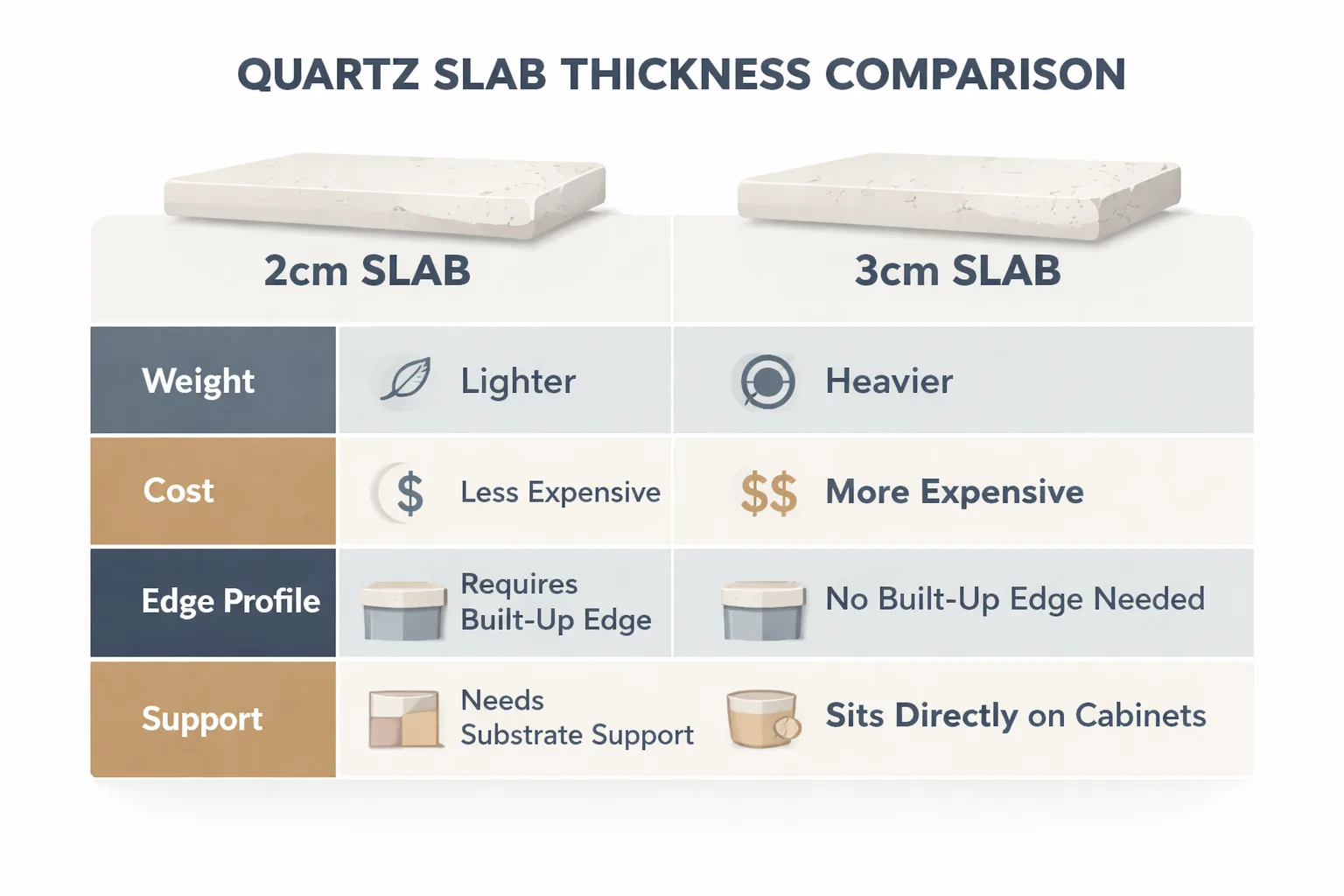
Thickness is the first spec to verify. Standard quartz slabs come in 2cm and 3cm thicknesses. A 2cm slab is lighter and less expensive, but it requires a built-up edge profile to achieve the visual heft that most custom cabinetry is designed to complement. A 3cm slab sits directly on the cabinet frames without substrate support and provides a more substantial look at the cabinet face. For inset cabinet doors, where the door sits flush within the cabinet frame, the countertop overhang and thickness determine whether the door clears the counter edge when opened. This is a detail that stock cabinet suppliers cannot account for because they do not know your door style or hinge configuration.
Edge profiles interact with cabinet door styles in ways that are easy to miss. A sharp 90-degree square edge profile looks clean and modern, but it can visually clash with a traditional shaker door that has a beveled inside profile. A eased edge (a slight round at the top and bottom) is more forgiving across door styles. A full bullnose edge reads as traditional and can look dated against flat-slab cabinet doors. The edge profile should echo the cabinet's design language, not fight it.
Surface consistency is harder to evaluate but just as important. Lower-priced quartz lines sometimes show a visible resin pooling or color mottling under direct light, particularly in solid-color slabs. Hold a flashlight at a low angle across the slab surface in a darkened room. If you see uneven gloss or texture variation, that inconsistency will be visible under kitchen task lighting every evening. Premium quartz brands like Caesarstone, whose 2026 ICON collection features crystalline silica-free surfaces, invest more in quality control during the pressing and curing process. The result is a more uniform surface that maintains its appearance over time.
When evaluating quality, ask the fabricator three direct questions. What is the resin-to-quartz ratio? (Industry standard is roughly 7-10% resin by weight.) Where was the slab manufactured? (Different factories have different quality control standards.) What is the warranty coverage for staining, chipping, and color fastness? If the fabricator cannot answer these questions clearly, find a different fabricator. The quality of the installation matters as much as the quality of the slab. A premium quartz slab installed by a careless fabricator will chip at seams, show visible adhesive lines, and fail to sit flush with your custom cabinet frames.
For those considering semi-custom kitchen cabinets as a middle ground, the same quality evaluation applies. The difference is that semi-custom cabinets have less flexibility in door style and dimensions, which can limit your edge profile and overhang options.
How to Plan the Installation Sequence
The installation sequence for cabinets and countertops is not a suggestion. It is a requirement that, when violated, costs real money. The correct order is: cabinet installation, then templating, then quartz fabrication, then countertop installation. Every step depends on the one before it.
Cabinets go in first. This is non-negotiable. The cabinets define the actual footprint of the kitchen, including any deviations from the plan that occurred during installation. Walls are not perfectly flat in Brooklyn brownstones. Floors are not perfectly level. Cabinet installers make micro-adjustments on site to account for these realities, and those adjustments change the dimensions that the quartz template must capture.
Templating happens after cabinets are installed and leveled. A templater visits the site with digital measuring tools or physical template material and records the exact dimensions of every cabinet run, including corner radii, cutout locations for sinks and cooktops, and overhang specifications. This is not a step where approximations are acceptable. A template that is off by an eighth of an inch means a quartz slab that does not fit, and a quartz slab that does not fit means a re-fabrication charge and a two-to-three-week delay.
Quartz fabrication takes place off-site based on the template. The slab is cut, edge-profiled, and polished in a fabrication shop with specialized equipment. This process typically takes 7-14 business days depending on the complexity of the cuts and the fabricator's schedule. In a dense urban market like NYC, fabricators are often booked weeks in advance, so the templating appointment should be scheduled before the cabinets are even installed to hold your place in the queue.
Countertop installation is the final step. The fabricated quartz is delivered, maneuvered into the kitchen (which in NYC often means navigating narrow hallways, tight stairwells, and small elevators), and set on the cabinet frames with adhesive. The installer checks for level, makes final adjustments, and seals any seams. The entire installation takes a few hours, but those hours depend on weeks of prior planning.
For a deeper look at how cabinetry installation fits into the broader renovation timeline, the small kitchen renovation guide covers the sequencing challenges specific to compact NYC kitchens where space constraints affect every step.
The cost structure of this sequence is worth understanding because it directly affects how custom kitchen cabinets prices are calculated. Stock cabinets cost $100-$300 per linear foot with immediate availability, according to CabStone's cabinet comparison guide. Custom cabinets cost more but are built to fit your space exactly, which reduces the templating risk and the likelihood of re-fabrication charges. The cost for custom kitchen cabinets includes the precision that makes the countertop installation go smoothly. When homeowners try to save money on cabinets and then install a premium quartz slab, the installation errors that result can erase the savings.
Common Mistakes When Pairing Quartz and Cabinets
Three mistakes account for nearly every pairing failure in Brooklyn kitchen renovations. Each one is preventable, and each one costs more to fix than to avoid.
The first mistake is choosing the quartz before the cabinet doors are finalized. This happens because stone yards are inspiring places. A homeowner sees a dramatic slab with bold veining, commits on the spot, and then tries to find a cabinet finish that works with it. The problem is that cabinet finishes are more constrained than quartz options. There are hundreds of quartz patterns and maybe a dozen cabinet finishes that suit a given kitchen's lighting and architecture. Locking the quartz first narrows the cabinet options prematurely and often forces a compromise that satisfies neither surface. Always finalize the cabinet door style and finish first. Then select the quartz to complement it.
The second mistake is ignoring the visual relationship between quartz veining and cabinet frame proportions. A quartz slab with large, sweeping veins creates a pattern that continues across the countertop surface. If that pattern does not align with the cabinet frames below it, the eye registers the misalignment even if the conscious mind cannot identify the cause. This is particularly noticeable with shaker-style cabinets, where the rail and stile proportions create a grid that the countertop pattern should either echo or deliberately contrast. A busy quartz with random veining against a tight shaker grid creates visual noise. A quieter quartz with subtle movement lets the cabinet detailing breathe.
The third mistake is underestimating lead times in the NYC market. Custom cabinets typically require 8-12 weeks from design approval to delivery. Quartz slabs are often in stock at local stone yards, but fabrication scheduling depends on the templating timeline, which depends on the cabinet installation. If the cabinets are delayed, the templating appointment shifts, the fabrication slot is lost, and the countertop installation moves back by weeks. In a market where fabricators are booked 3-4 weeks out, a one-week cabinet delay can become a four-week project delay. The solution is to schedule the templating appointment the moment the cabinet delivery date is confirmed, not after the cabinets are installed.
Are your cabinet finishes finalized before your quartz selection?
When This Process Breaks Down
This pairing process assumes you have control over both the cabinet and the quartz selections. That is not always the case in NYC renovations. Three scenarios routinely derail the sequence.
When a co-op board requires specific countertop materials or thicknesses for plumbing or structural reasons, the quartz selection may be constrained before the cabinet design begins. This reverses the normal workflow and can force cabinet adjustments to accommodate a pre-selected slab thickness or edge profile. The fix is to verify building requirements before starting either selection.
When a general contractor separates the cabinet and countertop trades into different subcontractors with no shared project manager, coordination breaks down. The cabinet installer levels the frames to their standard. The templater measures. The fabricator cuts. But nobody checks whether the cabinet installer's standard matches the fabricator's tolerance assumptions. Seams that should be invisible become visible. Overhangs that should be uniform vary by a quarter-inch across the run. Green Cabinets NY manages both sides of this equation, but when the countertop is sourced independently, the homeowner becomes the project manager whether they want to or not.
When the renovation is in a rental property where the owner plans to sell or refinance within 3-5 years, the calculus changes. The cost of custom kitchen cabinets may not be recoverable in a short holding period, and a premium quartz slab adds to that investment without a proportional return. In these cases, semi-custom cabinets with a mid-range quartz can deliver 80% of the aesthetic impact at 50% of the cost. The pairing process still matters, but the material budget should reflect the exit strategy.
How Does Quartz Compare to Recycled Glass for Eco-Friendly Kitchens?
Quartz is an engineered stone made from mined quartz crystals combined with plastic resin binders under heat and pressure, as Curava's material analysis explains. Recycled glass countertops are marketed as a more eco-friendly alternative because they divert glass from landfills and use a similar resin-binder system. Both materials are non-porous, stain-resistant, and heat-resistant.
The sustainability comparison is not as straightforward as the marketing suggests. Neither material has widely available lifecycle analysis data comparing manufacturing emissions, resin binder sourcing, or end-of-life recyclability. A Brooklyn homeowner pairing recycled glass with FSC-certified custom cabinets might assume the combination is fully sustainable, but without data on the resin systems used in both products, the claim remains unverified. The honest answer is that both quartz and recycled glass are reasonable choices for a kitchen that prioritizes durability and low maintenance. If measurable sustainability is the priority, focus on what you can verify: CARB2 compliance for the cabinets, low-VOC finishes, and FSC-certified wood species. These standards are documented and auditable. Countertop sustainability claims are largely marketing without the data to back them up.
What Edge Profile Works Best With Inset Cabinet Doors?
Inset cabinet doors sit flush within the cabinet frame, which creates a precise, furniture-grade look. The edge profile of the quartz countertop directly affects whether inset doors function properly and whether the overall design feels cohesive.
A square edge profile (also called a straight edge) is the most common pairing with inset doors because it provides a clean, architectural line that mirrors the precision of the inset construction. The risk is that a sharp square edge can chip more easily at the front corners, particularly in a high-traffic kitchen. A slight ease (a 1-2mm round at the very top edge) maintains the square look while reducing chipping risk.
A demi-bullnose edge (rounded on the top, flat on the bottom) softens the transition between the countertop and the cabinet face. This works well with inset shaker doors because it echoes the slight rounding on the inside edge of the shaker profile. A full bullnose is generally too traditional for inset cabinetry, which tends toward a more contemporary or transitional aesthetic.
The overhang dimension matters as much as the edge profile. With inset doors, the standard 1-inch overhang can block the door from opening fully if the hinge configuration is tight. Test the door swing with a sample overhang block before the quartz is fabricated. This is exactly the kind of detail that custom cabinetmakers catch and stock cabinet suppliers cannot.
For kitchens with integrated appliance panels, the edge profile should also be consistent across the countertop and any visible stone surfaces on the appliance panels. A mismatch between the countertop edge and the panel edge is a small detail that reads as a big mistake.
How Do You Budget for Cabinets and Quartz Together?
The 2026 Houzz Kitchen Trends Study reports a median major kitchen remodel spend of $55,000. Cabinets and countertops together typically account for 30-40% of that total. Understanding how the two budgets interact helps avoid the common trap of overspending on one and compromising on the other.
Custom kitchen cabinets cost more than semi-custom or stock options because they are built to order, typically from premium materials, with joinery and finishes that require skilled labor. The investment is justified when the kitchen has irregular dimensions, when storage optimization is critical (as it is in most NYC apartments), or when the homeowner wants a specific design that stock lines cannot deliver. The cost of custom kitchen cabinets includes the design consultation, material selection, fabrication, and installation. It does not include the countertop.
Quartz countertop pricing is driven by the slab cost (which varies by brand, color, and pattern complexity), fabrication complexity (cutouts, seams, edge profiles), and installation logistics. In NYC, installation logistics can add 15-25% to the fabrication cost because of elevator restrictions, parking limitations, and labor rates.
The budgeting principle is simple: allocate the cabinet budget first, because the cabinets define the kitchen's function and longevity. Then allocate the quartz budget based on what remains. A common mistake is to spend heavily on a premium quartz slab and then compromise on cabinet construction quality. The cabinets will outlast the countertop in most cases, and poor cabinet construction will cause problems that no premium quartz can mask.
For developers managing multiple units, the commercial millwork approach offers economies of scale that can make custom cabinets viable across an entire project. The same coordination principles apply: finalize the cabinet design, then select a quartz that works across all units to simplify fabrication and reduce per-unit cost.
What This Actually Means for Your Renovation
The process of choosing a quartz countertop with custom cabinets is not about finding the most beautiful slab or the most impressive cabinet door. It is about creating a coordinated system where every material, dimension, and installation step is planned to work together. The homeowners who get this right are not the ones who spend the most money. They are the ones who follow the sequence, test the undertones with real samples, and refuse to lock in one material before the other is resolved.
Green Cabinets NY has built its process around this coordination because the alternative is expensive. When cabinets and countertops are selected independently, the gaps show up in the installation. Seams land in the wrong places. Overhangs are inconsistent. Undertones clash under task lighting. And the homeowner is left trying to fix problems that should have been caught during the design phase. The solution is to treat the cabinet and the countertop as a single decision, made in the right order, with the right samples, under the right lighting. That is how a $55,000 renovation delivers a kitchen that looks like it cost $80,000, and how a Brooklyn brownstone kitchen becomes the room that everyone wants to gather in.
FAQ
Can I install quartz countertops myself?
No. Quartz slab installation requires specialized equipment for lifting, cutting, and polishing, along with professional-grade adhesives and seam-setting tools. A standard 3cm quartz slab can weigh 20-25 pounds per square foot, meaning a typical kitchen island slab weighs 400+ pounds. DIY installation risks slab breakage, seam visibility, and voided manufacturer warranties. Always use a licensed fabricator.
How long does quartz countertop fabrication take after templating?
Fabrication typically takes 7-14 business days after templating, depending on cutout complexity and the fabricator's current workload. In the NYC market, fabricators are often booked 3-4 weeks out, so schedule the templating appointment as soon as the cabinet delivery date is confirmed. The total timeline from cabinet installation to countertop installation is usually 3-5 weeks.
Does quartz stain or require sealing?
Quartz does not require sealing because it is non-porous. The resin binder fills the spaces between quartz crystals, preventing liquids from penetrating the surface. However, prolonged exposure to strong chemicals, high-pH cleaners, or direct heat can damage the resin. Use trivets for hot pans and avoid abrasive cleaners. Quartz is stain-resistant, not stain-proof.
What is the price difference between 2cm and 3cm quartz?
3cm quartz typically costs 20-30% more than 2cm quartz for the same slab, but the overall installed cost difference is often smaller because 2cm slabs require a substrate support layer and built-up edge profile that adds labor and material cost. For custom cabinets designed to receive a 3cm slab, the thicker option is usually the better value.
Can I use quartz in a bathroom vanity?
Yes. Quartz is an excellent choice for bathroom vanities because it is non-porous and moisture-resistant. When paired with a custom bathroom vanity, the same coordination principles apply: finalize the vanity design first, then select the quartz. The vanity's wood species and finish should complement the quartz undertone, and the edge profile should work with the vanity door style.
Get the cabinet and quartz pairing right the first time with a design consultation that coordinates every material, dimension, and installation step.